
Planking math

It depends on what you’re trying to do.

If you intend to paint the model then with the hull strip planked on bulkheads you can hide your planking by sanding, using filler, and finally paint. With the planking hidden, the result will resemble an actual ship at small scale viewing distances.

On the other hand, with the current fad to show off one’s workmanship with a “natural” or more correctly bright finish the planking is there for all to see. Why worry about details like what kind of knot to tie the whoosit to the whatsit when the kit supplied strip, edge bent planking sticks out like the proverbial sore thumb? These bright finished models should be planked with correctly spiled planking.

Roger
 
There certainly were good practices; staggering of butts, use of stealers, etc. Depending upon where a particular vessel was built some were written down and some were not. It is a fact, however, that ships were not planked with uniform narrow strips. There are enough planking expansion drawings surviving in various archives to verify this. A ship at sea is constantly subjected to alternate hogging and sagging loads. These caused shear stresses between adjacent rows of planking that eventually led to failure of the caulking. Great care was therefore taken to attempt to “lock” these neighboring strakes together.

So If you want to build a bright finished model to demonstrate your skill, why not plank it correctly. Otherwise paint it.

Roger
 
There certainly were good practices; staggering of butts, use of stealers, etc. Depending upon where a particular vessel was built some were written down and some were not. It is a fact, however, that ships were not planked with uniform narrow strips. There are enough planking expansion drawings surviving in various archives to verify this. A ship at sea is constantly subjected to alternate hogging and sagging loads. These caused shear stresses between adjacent rows of planking that eventually led to failure of the caulking. Great care was therefore taken to attempt to “lock” these neighboring strakes together.

So If you want to build a bright finished model to demonstrate your skill, why not plank it correctly. Otherwise paint it.

Roger
You give examples from real practice... nice, but people create a model and you can impose as many rules on yourself as you want, but they only exist in your head. That is great if that is what you want, but I think it is good if everyone decides that for themselves. For example, I don't do that myself and I am quite happy with the result. On top of that... if something that can be reasonably complex becomes quite a bit easier... I think that is also an important consideration.

Personally, by the way, I prefer looking at a contemporary model from the museum, and that planking looks super uniform too... I think that gives it a nice look. That's fine, right? To each their own.
 
. It is a fact, however, that ships were not planked with uniform narrow strips.
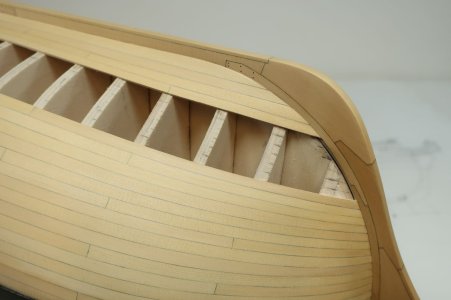
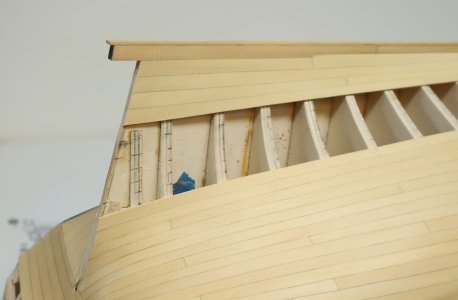
The two examples shown are not uniform narrow strips.
1780774765442.jpeg
Here is another example of not uniform narrow strips. The method used would be hard to differentiate from spiling.
A ship at sea is constantly subjected to alternate hogging and sagging loads.
Fortunately, our models will not be subject to that.
 
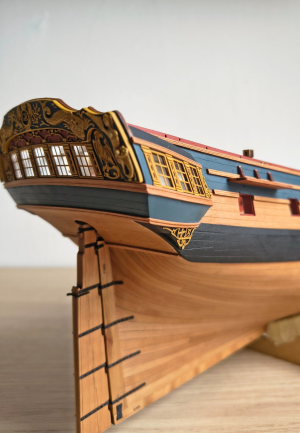
Ronald's model was, if I remember correctly, made by edge-bending Pear (much harder than Alaskan Yellow Cedar). The results look excellent and the planks don't look out-of-scale or inaccurate to my eye. Granted, I'm not an expert on 18th-century warships, but nothing about it screams "wrong!" to me.

Although I personally spile planks, as I buy my wood in sheets rather than strips, there are clearly a lot of people out there who have made edge-bending work well. Obviously a poor job of edge-bending won't look good, just as a poor job of spiling won't look good either. As long as people are getting good results, I see no reason to dismiss one method or the other out of hand. As with other aspects of modeling, people should figure out what methods work for them.
 
Let's say the longest rib is 102mm and each plank is 5mm that would give me 20 planks with 2mm left over, do i do the rest of the math with that 20 plank number and put the 2mm strip next to the keel or do I say 21mm and have to slightly adjust the height of all the planks
Tongue in cheek pedantry: :pmeasuring a rib gives the length of the inside surface of the plank To avoid gaps along the seams of the outer surface caused by the curve of the bilge it is common practice to chamfer the edges of the planks slightly towards the inner surface. 21 such planks will then fit the measured rib length; the outer surface (the full plank width) will cover the slightly greater distance round a rib with virtual beam 1.5 or 2mm greater than the actual rib.
 
But one is building a model...not a real ship? People also use 3d printed items on their models now...is that also "false"? I found the method in the videos to be literally one of the easiest methods to plank a hull... why make it harder than it is? Not sure why God would be against bending a piece of wood sideways :)
It depends on the builder. :) Some people want their model to be as accurate as possible to the real thing. Others are not as concerned by accuracy and just want a nice looking model. :)
 
It's true that the degree of accuracy in a model is up to each builder. But the question here is whether edge bending produces a visibly less accurate result than spiling. As far as I can tell, on a finished model, the only way to tell if the planking was edge-bent or spiled is to look at the grain--which should be basically unnoticeable anyway if we're using good-quality wood with an eye to scale appearance. Does it really make a model "less accurate" is a plank was edge bent into shape instead of being cut out in the same shape? Surely, if we're concerned about accuracy to this degree, the use of glue instead of physical fasteners is a much bigger problem....

My other, humorously sarcastic response to all this is that this conversation is hopelessly focused on large, ocean-going European ships of the 1700s-1800s (more or less), and local planking practices could vary tremendously. Such as in the small vessel below in Northeastern Brazil. It would be inaccurate to model a Napoleonic-era British frigate that way, but it would also be inaccurate to model this Bahian workboat like it was a Napoleonic frigate.
954288_40ef8466c14341d18e0acdb059644866~mv2.jpg
Source
 
I found the method in the videos to be literally one of the easiest methods to plank a hull... why make it harder than it is? Not sure why God would be against bending a piece of wood sideways :)

If radical edge-setting works well for you, by all means, go for it. My point was simply that bending planking stock "across the flat" means fighting the stock to keep it flat, rather than turning up (or down, seemingly the wood's choice at any given moment) on the bend. Planking requires bending the plank, the amount of bend being a function of the hull shape. Heat-bending the curve of the plank across its wider dimension and across its narrower dimension requires bending the plank is two dimensions at once. Cutting the spiled plank shape from a piece of wider planking stock only requires that the plank be bent in one dimension and that dimension is the one in which the stock is most amenable to being bent. It's just a basic engineering principle. Edge-setting quarter inch strips such as are provided in most all kits these days isn't particularly difficult and that's especially so if one is building a large vessel at 1:96 scale, for example, where there are lots of "wide open spaces" amidships without much shape to them. However, when you are building a model of a smaller vessel to 1:24 or 1:48 scale, the planks will be proportionately larger in scale and quarter inch stripwood is no longer scale planking. The width of scale planking in those scales will be greater if you are depicting the planking to scale and will in most instances become much more difficult to edge-set than the quarter inch stock.

It's not harder to spile and cut a plank to shape but do what you find works best for you.
 
But one is building a model...not a real ship? People also use 3d printed items on their models now...is that also "false"? I found the method in the videos to be literally one of the easiest methods to plank a hull... why make it harder than it is? Not sure why God would be against bending a piece of wood sideways

There are two entirely separate activities being confused here.

One is kits - which I see as being mostly about assembly. With 3D printing, laser cutting, 4D milling - the direction seems to be for a wooden kit to be no different from a plastic kit as far as ease of assembly. It would be the same except that much of it is wood instead of polystyrene. The process is mostly about the result.

One is scratch - hardcore scratch - start with just plans scratch. You sorta haveta figure out which camp the author of a post is from. The rules/goals/ideals are very different. The process is about the journey. It is about the importance of each step. The extreme is to be a shipyard - with their materials limitations - but using AC power instead of human power. Suggestions, rules, and methods that apply here are not intended to apply to kits. They are intended to also serve as chum and bait to lure those who seek a worthy challenge to switch camps.

Monograph or modeler plans as an origin for a build is in the no man's land but much closer to hardcore scratch. It is still not the same thing though.

Physics is against edge bending. There is more resistance to bending in the thick dimension. A jump to the thin dimension will relieve the force if that option is available. That is, the board will twist given any opportunity.

Here is another example
The more I see AYC the more I hate the look of it. It may as well be plastic for all of the character it has.
 
It's not harder to spile and cut a plank to shape but do what you find works best for you.
What works best is sometimes limited by what one has to work with.

It's been mentioned more than once that a great many, if not most of the modelers here and elsewhere are building kits. Beginners in particular feel restricted for the most part to what comes in the kit, all he other resources that are available notwithstanding.
Spiling requires stock that is not provided in virtually all kits. It would be nice to change that, but for now it is the way it is.

The expertise found here could do well to help beginners do their bet work with what they have, and maybe help them move on to what some feel are higher aspirations.
 
There are two entirely separate activities being confused here.
I really don't think that's the case, though. Nothing in this question is about the merits of kit-building vs scratch-building. There are multiple methods of getting a curved plank, and which method someone goes with to get that curved plank will depend on what they're comfortable with, what tools they have, and what wood supplies they have--which may be shaped by whether you're working from a kit, but not wholly determined by that. From what I can tell, it's not even a matter of whether or not you mill your own wood, as whether you can make thin sheets or thin strips still depends on the tools and wood you have available. With the tools available in my neighborhood carpentry class, for instance, I can mill strips from 1/4 or so boards, but can't really mill a 1/32-inch sheet, unless I want to plane down a much thicker board and waste a lot of wood.

All of which is to say, I see no reason to tell people that there's only one way to go about things. Much more useful, I think, to lay out the different options available.
 
All of which is to say, I see no reason to tell people that there's only one way to go about things. Much more useful, I think, to lay out the different options available.
I totally agree.

But if the choice is to use a technique that is different from actual practice and it is on display ---

thinking- thinking - it is disingenuous to be offended when the scratch camp points out the incongruity as it applies to being historical.

Choices can be made - there are often compromises that come with the choice - do not expect standards to be changed. it is an informed consent situation.
 
Do you feel it detracts from the workmanship?
This is a choice for each builder to make. My intent is to point out that the hype behind AYC ain't necessarily the whole story.
Take a minute - look closely - look at the master works - past and present - then determine how it fits.

White Oak is way over the edge at the other extreme, but there should be some character there.
 
Sometimes it is difficult to craft a response that works. Like
Jacques Cousteau I am a scratch builder and I am interested in locally built smaller craft. I certainly agree that local builders of regional workboats developed their own ways of
building these boats; ways that would not meet the approval of established shipwrights. When building a model of one of these local it is correct to show these local practices. My post above mentioned one of these; strip built boats built by Northern Minnesota fishermen.

As has been often said however, the majority of forum members are kit builders building Nelson Era Warships so the elephant in the room becomes how to realistically plank POB kit models using the kit supplied planking strips. The simple answer is that “It’s not possible.”

Regarding Gatzby’s comment about helping beginners, SOS does offer a School for Ship model building moderated by Dave Steven and aimed at novice scratch builders. If you feel something similar is needed for kit builders your welcome to do so.

Roger
 
If you feel something similar is needed for kit builders your welcome to do so.
What I feel, is that we do our best to help those who ask for help, and our help be more than sending them out shopping for tools and materials, when what they have invested in a kit may be the best they can do right now.

No doubt, those who are interested in scratch building, and acquiring the tools and materials to do so are in the right place.
Gregory
 
But if the choice is to use a technique that is different from actual practice and it is on display ---

The practice of model building or ship building ?

If you can show that a technique is without merit, that is a different argument.

I show you a planking job that is indistinguishable from spiling, and you complain about the wood being used.
It's a no-win situation.
 
Back
Top