


- Joined
- May 3, 2026
- Messages
- 169
- Points
- 78

I found the method in the videos to be literally one of the easiest methods to plank a hull... why make it harder than it is?
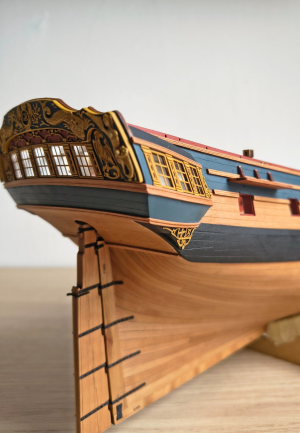
Especially when it provides results like this.

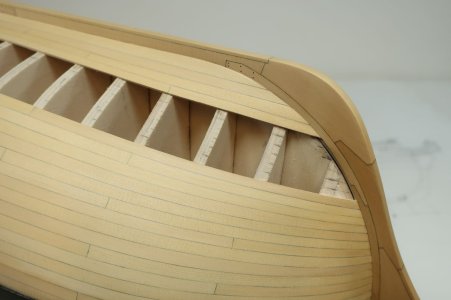
Or this.

 |
The beloved Ships in Scale Magazine is back and charting a new course for 2026! Discover new skills, new techniques, and new inspirations in every issue. NOTE THAT OUR NEXT ISSUE WILL BE July/August 2026 |
|
 |
As a way to introduce our brass coins to the community, we will raffle off a free coin during the month of August. Follow link ABOVE for instructions for entering. |
|
I found the method in the videos to be literally one of the easiest methods to plank a hull... why make it harder than it is?


Should? Why? There are no rules...These bright finished models should be planked with correctly spiled planking.
Roger
You give examples from real practice... nice, but people create a model and you can impose as many rules on yourself as you want, but they only exist in your head. That is great if that is what you want, but I think it is good if everyone decides that for themselves. For example, I don't do that myself and I am quite happy with the result. On top of that... if something that can be reasonably complex becomes quite a bit easier... I think that is also an important consideration.There certainly were good practices; staggering of butts, use of stealers, etc. Depending upon where a particular vessel was built some were written down and some were not. It is a fact, however, that ships were not planked with uniform narrow strips. There are enough planking expansion drawings surviving in various archives to verify this. A ship at sea is constantly subjected to alternate hogging and sagging loads. These caused shear stresses between adjacent rows of planking that eventually led to failure of the caulking. Great care was therefore taken to attempt to “lock” these neighboring strakes together.
So If you want to build a bright finished model to demonstrate your skill, why not plank it correctly. Otherwise paint it.
Roger
The two examples shown are not uniform narrow strips.. It is a fact, however, that ships were not planked with uniform narrow strips.
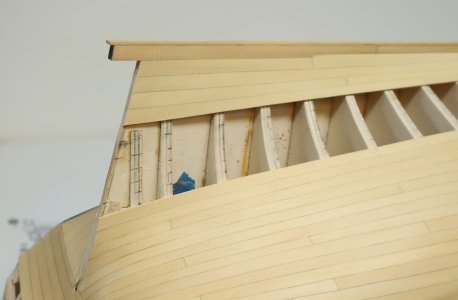
Fortunately, our models will not be subject to that.A ship at sea is constantly subjected to alternate hogging and sagging loads.


Tongue in cheek pedantry:Let's say the longest rib is 102mm and each plank is 5mm that would give me 20 planks with 2mm left over, do i do the rest of the math with that 20 plank number and put the 2mm strip next to the keel or do I say 21mm and have to slightly adjust the height of all the planks
 measuring a rib gives the length of the inside surface of the plank To avoid gaps along the seams of the outer surface caused by the curve of the bilge it is common practice to chamfer the edges of the planks slightly towards the inner surface. 21 such planks will then fit the measured rib length; the outer surface (the full plank width) will cover the slightly greater distance round a rib with virtual beam 1.5 or 2mm greater than the actual rib.
It depends on the builder.But one is building a model...not a real ship? People also use 3d printed items on their models now...is that also "false"? I found the method in the videos to be literally one of the easiest methods to plank a hull... why make it harder than it is? Not sure why God would be against bending a piece of wood sideways
Some people want their model to be as accurate as possible to the real thing. Others are not as concerned by accuracy and just want a nice looking model.

I found the method in the videos to be literally one of the easiest methods to plank a hull... why make it harder than it is? Not sure why God would be against bending a piece of wood sideways

There are two entirely separate activities being confused here.But one is building a model...not a real ship? People also use 3d printed items on their models now...is that also "false"? I found the method in the videos to be literally one of the easiest methods to plank a hull... why make it harder than it is? Not sure why God would be against bending a piece of wood sideways
Or this.
The more I see AYC the more I hate the look of it. It may as well be plastic for all of the character it has.Here is another example
What works best is sometimes limited by what one has to work with.It's not harder to spile and cut a plank to shape but do what you find works best for you.
I really don't care for it either. Do you feel it detracts from the workmanship?...
The more I see AYC the more I hate the look of it. It may as well be plastic for all of the character it has.
I really don't think that's the case, though. Nothing in this question is about the merits of kit-building vs scratch-building. There are multiple methods of getting a curved plank, and which method someone goes with to get that curved plank will depend on what they're comfortable with, what tools they have, and what wood supplies they have--which may be shaped by whether you're working from a kit, but not wholly determined by that. From what I can tell, it's not even a matter of whether or not you mill your own wood, as whether you can make thin sheets or thin strips still depends on the tools and wood you have available. With the tools available in my neighborhood carpentry class, for instance, I can mill strips from 1/4 or so boards, but can't really mill a 1/32-inch sheet, unless I want to plane down a much thicker board and waste a lot of wood.There are two entirely separate activities being confused here.
I totally agree.All of which is to say, I see no reason to tell people that there's only one way to go about things. Much more useful, I think, to lay out the different options available.
This is a choice for each builder to make. My intent is to point out that the hype behind AYC ain't necessarily the whole story.Do you feel it detracts from the workmanship?
What I feel, is that we do our best to help those who ask for help, and our help be more than sending them out shopping for tools and materials, when what they have invested in a kit may be the best they can do right now.If you feel something similar is needed for kit builders your welcome to do so.
The practice of model building or ship building ?But if the choice is to use a technique that is different from actual practice and it is on display ---