• SUBSCRIBE TO SHIPS IN SCALE TODAY!

    The beloved Ships in Scale Magazine is back and charting a new course for 2026!
    Discover new skills, new techniques, and new inspirations in every issue.

    NOTE THAT OUR NEXT ISSUE WILL BE MARCH/APRIL 2026
  • Win a Free Custom Engraved Brass Coin!!!
    As a way to introduce our brass coins to the community, we will raffle off a free coin during the month of August. Follow link ABOVE for instructions for entering.

HMS Victory - Limited Edition by Occre, 1:87

Regarding the deck beams, are they precut in the kit? None of them has any round up from what can be seen in the photos. This is one of the most basic things for a deck and is missing, thus my question. The lower decks will be pretty much out of sight, but this will be really noticeable on the higher decks.

First rate circa 1800
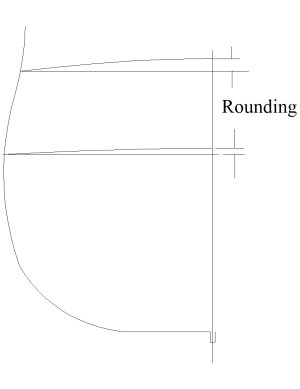
Deck Rounding (at Midships where appropriate)
Orlop 2 inches
Lower gundeck 6 inches
Middle gundeck 7 inches
Upper gundeck 8 inches

Quarter deck 9 inches
Forecastle 8 inches
Roundhouse or poop 10 inches

1781259287214.jpeg
 
Last edited:
They are not precut. IF, the ribs are 90 degrees to the keel, then the length of the 2x2 oak carlings are 15 mm between the 5x5 oak beams. A few of my beam spacings were off .5-1 mm, so I really couldn't cut a whole batch of them at once. If I tried to force a 15 mm piece into a 14 mm space, it skews the 5x5 beam & the next row will be off, creating a domino effect.
 
If I tried to force a 15 mm piece into a 14 mm space, it skews the 5x5 beam & the next row will be off, creating a domino effect.
My post was probably confusing so I am not sure what you are describing. The kit has the wrong number of tiers of carlings on the lower gun deck for a first rate at the time of the Victory rebuild in 1803. In any case I am not sure how the round up has any effect on the carlings. Every beam is a different length but the arc is the same on each for a given deck. Every beam is sawn to shape. The Fully Framed Model has great photos and explanations on doing this.

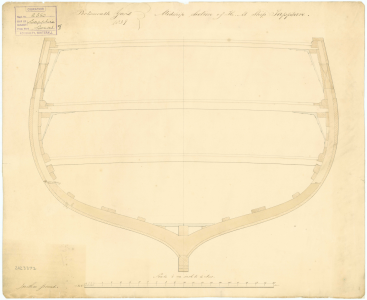
The rounding is clearly shown on the below plan from RMG.
1781351029255.png

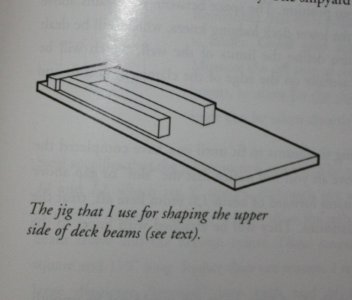
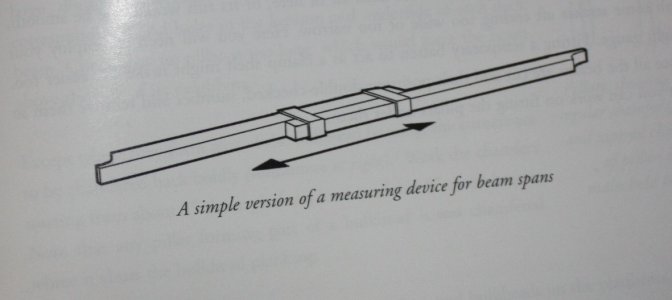
The following drawings are from page 221 of volume I of The Fully Framed Model by David Antscherl

Jig for checking and finishing the round up of a sawn beam. A different jig is used for each deck as the round up is different but can be found from the contemporary scantlings or drawings, at least for British warships.
1781351703345.jpeg

Measuring device to get the exact length of each beam.

1781351743091.jpeg
 
Last edited:
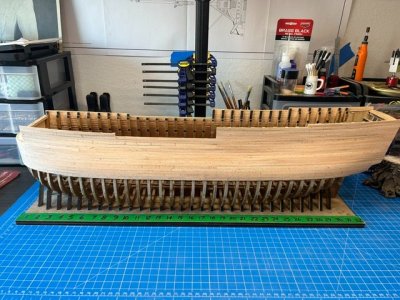
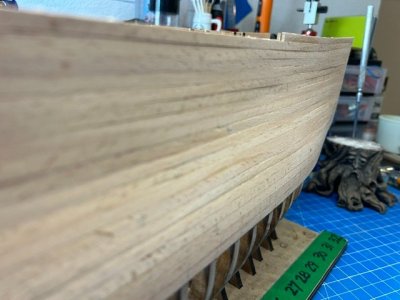
OK Guys, I need some advice on the hull. As I mentioned earlier, I am going for a rugged/weathered look on this build. With that in mind, at what point am I done sanding? Is the hull supposed to have a few voids as would a weathered ship? Or... is it up to me?

I had 5 prominent proud edges & several small ones throughout the hull. After 2 hours of careful scraping, the blades were not affective anymore & switched to a small wooden sanding block with #120. I'm good for about 45 minute sessions until my hand starts cramping. I also have about 2 hrs into the sanding. I still have several sanding sessions to go, but at some point, I will be doing more harm than good.

My plan was #120, #220 & #320 or #400 wet sand with oil in the end.
 
Is the hull supposed to have a few voids as would a weathered ship?
When you say voids are you speaking about gaps between strakes of adjacent planks? If there are gaps below the water line the ship will sink.
Aged/weathered wood does change color but the ship's carpenter was supposed to be sure there were no voids/leaks in the planking. :) A sanding mouse saves a lot of time and is easy to control.
1781518607462.png
For even more control you can add just a small piece of sand paper when appropriate.
Allan

1781518481151.jpeg
 
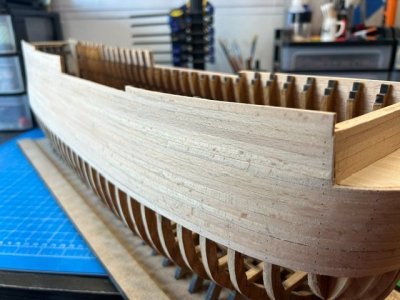
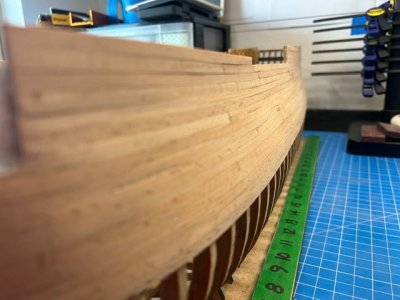
Thanks Allan. I have a similar one, but I was apprehensive about using it on the hull. I was a little vague on my last post. After several hours of sanding with #120, I rubbed the hull with mineral spirits to clean it up. A few planks are still slightly raised, 3 low spots at planking butt joints & few slight gaps.

This build is single planked, 5x2 mm beech.

There is still a massive amount of parts to install on the hull. Some of the high & low spots hopefully will be covered or possibly be removed from cutting the gun ports.

My questions are:
-Keep chasing the high spots or call it good?
- Since I am going for a slightly weathered look, (not beat to shreds), should I stop sanding @ #220 or 320? I want the Danish oil to soak in really well.

IMG_1432.jpegIMG_1436.jpeg

IMG_1434.jpeg
IMG_1433.jpeg
 
In general your hull looks good. See you have some normal hollows in the corner at the butt joints.

I see where you want to go.

Try wood files. Sanding that long means sanding isn’t working. Much material is yet to be removed. Rasp and files are best for that.

Need half round file to smooth the corners.

Position the file at a 45 degree angle when working along the plank edge.

Start slow with files, gain confidence, and you are on your way.

Good luck with it.

-Rich
 
I have never haed luck with rasps as the ones I have used dig tiny grooves that then need to be sanded or scraped. Can you give some information on the rasps that you use?
Thanks
Allan
Just normal full size cabinet maker rasp. Very light passes. Files are better for beginners. Files are next in the woodworking process, then sandpaper last, if needed. Files will take care of the plank humps.
 
Two comments:

#1 If you wish to use a tool that is a bit more aggressive than a file but leaves a surface that is as smooth these small razor files are just the ticket:
https://www.stewmac.com/luthier-too...iles?queryid=9e4e7d05da68b5aced802760b82fd104

Yeah, I know that they are a bit expensive - but they do the job - well.
StewMac sells an AC mini grinder - benchtop that is about the same as TEMU $132 vs $20
so perhaps these files may be found at an Asian site for much less - but they are so sharp and well made that I suspect that they are Japanese.

The ironic aspect is that the grinder is the wrong tool for the wrong job. It is sold as the way to keep an edge on the their Ultimate Scraper and no kidding the mini scraper is really the ultimate. But an aggressive grinding wheel is not the way to do it. It will just eat a lot of steel - quickly. A flat fine grit sharpening stone and a small carbide burnishing rod to turn the edge burr is quicker and probably more effective. https://www.stewmac.com/luthier-too...aper?queryid=18b27fb6a6fab45f316f458d288d7d17

#2 Victory - when its level of tech was cutting edge - was a flagship - The fleet admiral called it home. Unless the captain was anxious to retire and retire right soon - nothing on the ship would ever look rugged or weathered. Showroom fresh and shipshape and Bristol fashion - all the time.

drift:

Now when Centurion limped into Portsmouth in 1744 - I imagine rugged and weathered would have been a distant dream.
But the loot diverted any attention from how she looked.
(I think that whole mission was really some Suit's attempt to get rid of George Anson by sending him on a hopeless suicide mission. It backfired about as spectacularly as anything possibly could. But it would take a Suit with an off the scale level of psychopathy to initiate and authorize sending 80 years old marines from the Greenwich retirement home and walking wounded from the hospital to fill out the crews just to get them off the books and get Anson out to sea. I can't begin to imagine the feelings of anguish and helplessness that washed over Anson at having to watch so many die. He was the epitome of loyalty coming from the top down. )

 
Last edited:
Back
Top