• SUBSCRIBE TO SHIPS IN SCALE TODAY!

    The beloved Ships in Scale Magazine is back and charting a new course for 2026!
    Discover new skills, new techniques, and new inspirations in every issue.

    NOTE THAT OUR NEXT ISSUE WILL BE July/August 2026
  • Win a Free Custom Engraved Brass Coin!!!
    As a way to introduce our brass coins to the community, we will raffle off a free coin during the month of August. Follow link ABOVE for instructions for entering.

Vlieboot »De Zwane« 1592 — Barents discovers the Arctic

.​

@Heinrich

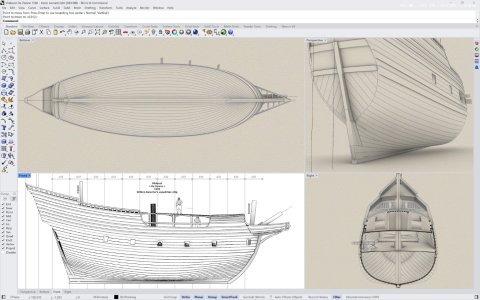
At this stage, even before I start drawing up the 2D plans, all that remains for me to do is to design the longitudinal and transverse bulkheads of the model framework.

It would be helpful to know the target size or scale of the model in order to select the correct thickness of material for these elements and the density of their spacing. The idea is to choose one of the standard thicknesses of commercially available plywood or MDF (for example, 3, 4, 5 or 6 mm). In fact, there’s nothing to stop you from choosing the thickness of the bulkheads yourself, according to your own preferences in this regard.

You may also have other suggestions regarding this stage; now is a good time to share them. For example, at the moment I’m assuming you’ll close off all openings in the hull, such as doors or gun ports, which also affects the placement and shape of the bulkheads. Otherwise, if you leave it up to me, you’ll simply get whatever I come up with, not necessarily in line with your needs or ideas...

As for my suggestions, laser-cutting the bulkheads is fine by me, but for visible parts it’s probably better to opt for traditional cutting methods because of the unsightly and troublesome to remove scorch marks left by the laser. But that will, of course, depend on your toolkit and other similar circumstances.

.​
 
If you could do a very traditionnal (computer generated) set of lines and offsets on a 1/48-scale, imperial measures to the 64th, to the outside of planking, frames spaced at 1", longitudinals and waterlines at 1/2", diagonals to suit you, with rabbet, deck lines and camber, I think anyone with a good will can build a hull in whatever way he/she sees fit.
 
Last edited:
.
If you could do a very traditionnal (computer generated) set of lines and offsets on a 1/48-scale, imperial measures to the 64th, to the outside of planking, frames spaced at 1", longitudinals and waterlines at 1/2", diagonals to suit you, with rabbet, deck lines and camber, I think anyone with a good will can build a hull in whatever way he/she sees fit.

Thanks, Pepite :). Actually, these days it sounds more like data tailored for a maritime institute capable of carrying out hydrodynamic research, but that’s perfectly fine by me (to be honest, I personally doubt that such a dataset would be very useful to today’s model-makers, especially given that it’s for outside of planking).

And, to save myself the trouble of extracting the coordinates of hundreds of points and formatting them in a table, I’d even be willing to provide the original virtual model of this reconstruction for such research. After all, I’m curious myself to see how it would behave under near-real conditions.

However, such a study would make even more sense if it were carried out in parallel with studies of similar reconstructions, in particular the Duyfken, the Halve Maen or the replica of Barents’ expedition ship from Harlingen, in order to compare the results and interpret them more effectively.

.​
 
„Loos bovenet” (continued from post #85)
This is most interesting to see the the loos bovennet was actually something universal and not an exclusive design element to the Dutch. It seems that even in the 16th century, the world was a small place. ;)
 
It would be helpful to know ...
Dear Waldemar. I do apologise for my late replies - the irony is that even though I am supposed to be on holiday, I am busier than during the regular academic year. ROTF

I will compile all my requirements and suggestions in as much detail as I can and send that to you in a PM during the course of tomorrow. I will also include photographs which explain certain things better, but that takes some time to put together.
 
Agreed, for most modellers, these kind of information is totally redundant. My idea was to give someone the means to build his model in another way than just POB. Solid hull from vertical or horizontal layers for an instance. A table of offsets as given by the designer is used by boatbuilders to previsualize and build the keel, frames or molds in real size on which the actual hull is then build. They are quite easy to use really, but, yes, it does take some time and fiddling to get 'there'.
 
Last edited:
Solid hull from vertical or horizontal layers for an instance
I have always been an admirer of this building method as per the "old-school" Russian masters, but I have to choose a method that I am familiar with and that I believe will give me the greatest chance of achieving a successful build.
 
I have always been an admirer of this building method as per the "old-school" Russian masters, but I have to choose a method that I am familiar with and that I believe will give me the greatest chance of achieving a successful build.
An I like trying out something differend every now and then. After half a dozen POB-kits (and some other 20 or so of them waiting in my actual kit stack:)), I 'd like to at least start thinking about something 'new'.
 
.​
An I like trying out something differend every now and then. After half a dozen POB-kits (and some other 20 or so of them waiting in my actual kit stack:)), I 'd like to at least start thinking about something 'new'.

In any case, apart from the drawing of the set of bulkheads to be cut out, the intention is, of course, also to draw up a proper lines plan of the ship, with all the standard lines, particularly the contours of the bends and the waterlines. So there will be an alternative... :)

.​
 
It would be wonderful if you were to build this model following a different building method!
Yes. But we have to wait and see how I can go about it. I have no dedicated modelling or woodworking shop at my disposition. If I had, I'd probably build real boats rather than model ships ... Ian Oughtred or Paul Gartside have some very beautiful ones in their catalogue:p.
 
Back
Top