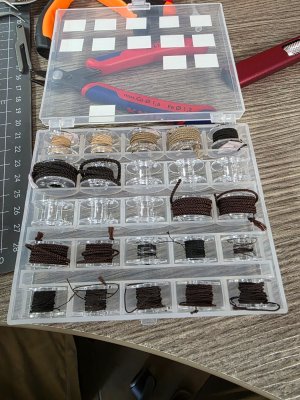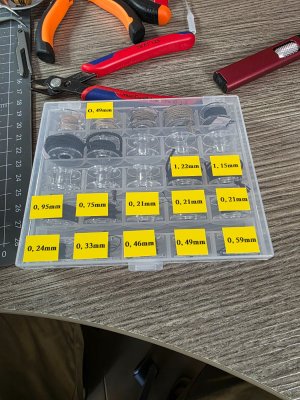
Your rope walk and the rope you have produced with it both look fantastic!The Tan is done with Serafil 120/2 (180) 3x16 (1.30mm) 576 gr. 13% Tension.
Rob

 |
The beloved Ships in Scale Magazine is back and charting a new course for 2026! Discover new skills, new techniques, and new inspirations in every issue. NOTE THAT OUR NEXT ISSUE WILL BE July/August 2026 |
|
 |
As a way to introduce our brass coins to the community, we will raffle off a free coin during the month of August. Follow link ABOVE for instructions for entering. |
|
Your rope walk and the rope you have produced with it both look fantastic!The Tan is done with Serafil 120/2 (180) 3x16 (1.30mm) 576 gr. 13% Tension.
 30 times.....
That rope walk is very well designed; I tried to do business with the person who invented it, but it didn't work out, people are very wary about shipping to the USA and don't want to do business. In any case, the quality of your ropes looks excellent! Congratulations. I'm still trying to set mine up; I have all the components, but now I just need the time to put them together! Best regards, and kudos on the results.Hi guys,
I want to share my setup with you and the result of endless trial & error, i am satisfied with results.
View attachment 626841
View attachment 626842
View attachment 626843
View attachment 626844
View attachment 626845
View attachment 626846
View attachment 626847
View attachment 626848
Thx, import and export to and from usa is not funny at the moment, shipping costs and import/export regulations makes it a big hassle, products becomes almost twice as expensive. For us in the Netherlands it costs somewhere around €150 to send a package of 10kg to the USA and there is the possibility of customs. The risk is just to high. So i understand Stephan completely.That rope walk is very well designed; I tried to do business with the person who invented it, but it didn't work out, people are very wary about shipping to the USA and don't want to do business. In any case, the quality of your ropes looks excellent! Congratulations. I'm still trying to set mine up; I have all the components, but now I just need the time to put them together! Best regards, and kudos on the results.
I totally understand where you're coming from and I don't get why shipping has to be so complicated, though that’s down to government policy and has nothing to do with ship modeling or rope making, haha. But believe me, I bought a machine that cost around $300 just for the unit itself, and I’d honestly rather pay that €150 shipping fee than go through the frustration I’m dealing with now. Even returning the machine to the seller turned into a disaster because UPS completely wrecked the package; the seller apparently can't or won't handle the claim with UPS, so now I’m left with neither the machine nor a refund. Don't you think it's sometimes better to pay a few dollars more for something you know works, rather than experimenting with obscure machines that end up gathering dust because they're too complex to use? To wrap things up, I’ve heard from more than one modeler who bought that type of rope maker machine and ended up throwing it in the trash, or just letting it collect dust for that very reason. Still, I’m glad you guys are getting good use out of those machines and achieving such excellent results. I actually spoke with Stefan, too, and I really appreciate him being brutally honest with me, haha.Thx, import and export to and from usa is not funny at the moment, shipping costs and import/export regulations makes it a big hassle, products becomes almost twice as expensive. For us in the Netherlands it costs somewhere around €150 to send a package of 10kg to the USA and there is the possibility of customs. The risk is just to high. So i understand Stephan completely.
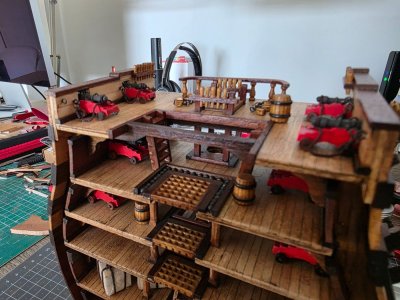
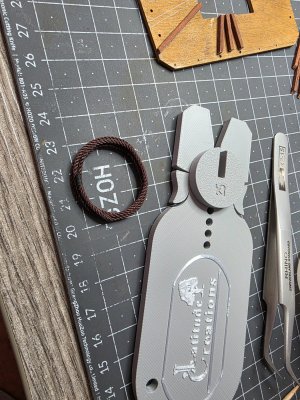
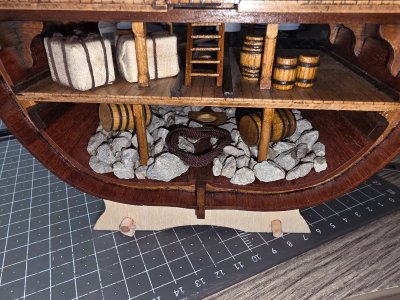
Hi ChrisHowdy crew!
Allow me to "briefly" introduce myself and my experience in rope-making (I apologize in advance for my lengthy post). My name's Chris, from Italy, currently working on the master section of Santisima Trinidad, kit by Occre. I'm by no means a navigated modeler, but I've been active in this field for more than 10 years, on and off. For various reasons, I've yet to finish a model, although I've got a few WIPs. One thing I can say for myself is that, where I lack in constancy, I try hard to compensate by being as clean and precise as I can.
Anyhoo, the Santisima section will see the finish line, I'm sure. I'm currently at that magical step that is masts' building and rigging.... the most intriguing aspect of model making, that which defines the degree of success and realism of the build, in my personal view.
In anticipation of this step and wanting to come to it with a certain degree of knowledge, I began studying on the subject matter of rope making earlier this year. To cut things short, I came across some posts of esteemed members of this forum (namely, Phillipsart and Steef66) and ordered a ropewalk machine from Stephan.
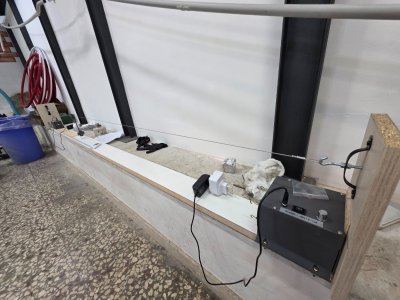
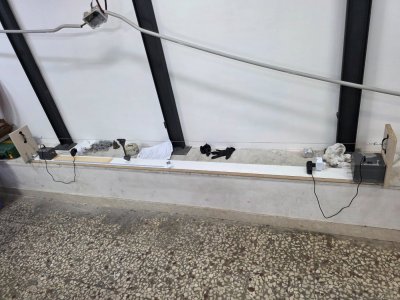
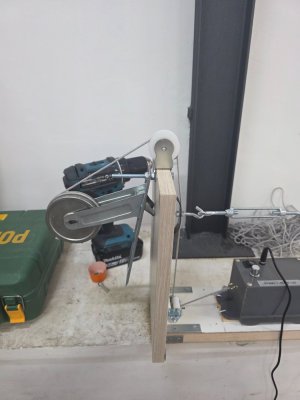
After designing the initial, maybe temporary, setup (pictures provided), I've been experimenting with it, sometimes successfully, sometime not. My setup is a 2.10m useful span on a plank from hook to hooks. The tensioning system I've devised with a mechanism used for roller shutters, that's spring-loaded. This design choice was to make the whole ropewalk a portable device. The only noticeable drawback is the fact that I can't determine the weight of the tensioning load applied, and even if I could measure it with a dynamometer, it does not remain entirely constant throught the process, given the spring-load nature. I've got in mind a way to improve it soon, still keeping it portable and at the same time making it measurable and, most importantly, repeatable.
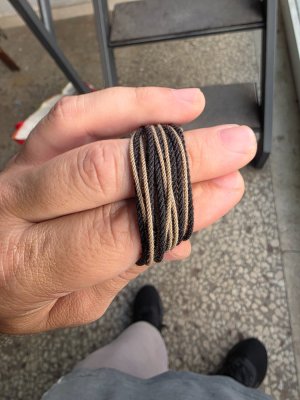
I'm using Gutermann E121 thread, but also Mara 120. I find the latter to be a better thread, but it's clearly more expensive than the E series and I'm limited to the minimum size rope I can make, as the 3x1 setup returns a rope diameter of 0.39, and for seizing-valid rope, I need to obtain a smaller diameter.
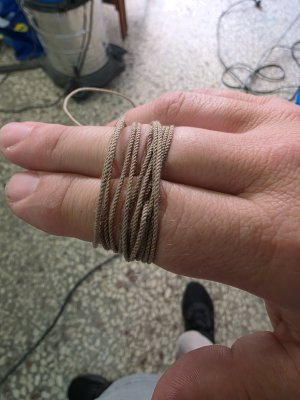
The issue I'm having with the E121 thread is that I find it to be very elastic and fragile, and when the rope is twisted, it tends to severely curl back and shrink. Especially when twisting low diameters. I've tried the following setup with E121: 3x1 with minimum tension applied by the spring-loaded mechanism, 5% reduction of original length during the first phase of the twisting, in order to make rope I can use for seizing, output of approximately 0.21. This is the lowest I can obtain, but the rope tends to severely shrivel once I cut it free from the ropewalk. I can save perhaps a meter, as both ends curl back irreparably.
But even with different other setups tried so far (3x2, 3x4, 3x6) with tension which gets increased as the number of threads (yarns?) increase, Gutermann E121 remains an unstable and elastic rope that tends to shrivel back to various degrees. I'm not sure where I'm going wrong. Other than the setup with the variable spring-loaded mechanism, which I can't really control, I don't see where else I could be improving the process.
I guess my questions are, has anyone come across this issue with E? Where does the solution lie?
Thanks for sharing your experiences and advices.
View attachment 627395
View attachment 627397
View attachment 627398
View attachment 627399
View attachment 627400
View attachment 627401
View attachment 627403
View attachment 627404
View attachment 627405
View attachment 627406
View attachment 627407
View attachment 627408
View attachment 627409


Hi Chris,Howdy crew!
Allow me to "briefly" introduce myself and my experience in rope-making (I apologize in advance for my lengthy post). My name's Chris, from Italy, currently working on the master section of Santisima Trinidad, kit by Occre. I'm by no means a navigated modeler, but I've been active in this field for more than 10 years, on and off. For various reasons, I've yet to finish a model, although I've got a few WIPs. One thing I can say for myself is that, where I lack in constancy, I try hard to compensate by being as clean and precise as I can.
Anyhoo, the Santisima section will see the finish line, I'm sure. I'm currently at that magical step that is masts' building and rigging.... the most intriguing aspect of model making, that which defines the degree of success and realism of the build, in my personal view.
In anticipation of this step and wanting to come to it with a certain degree of knowledge, I began studying on the subject matter of rope making earlier this year. To cut things short, I came across some posts of esteemed members of this forum (namely, Phillipsart and Steef66) and ordered a ropewalk machine from Stephan.
After designing the initial, maybe temporary, setup (pictures provided), I've been experimenting with it, sometimes successfully, sometime not. My setup is a 2.10m useful span on a plank from hook to hooks. The tensioning system I've devised with a mechanism used for roller shutters, that's spring-loaded. This design choice was to make the whole ropewalk a portable device. The only noticeable drawback is the fact that I can't determine the weight of the tensioning load applied, and even if I could measure it with a dynamometer, it does not remain entirely constant throught the process, given the spring-load nature. I've got in mind a way to improve it soon, still keeping it portable and at the same time making it measurable and, most importantly, repeatable.
I'm using Gutermann E121 thread, but also Mara 120. I find the latter to be a better thread, but it's clearly more expensive than the E series and I'm limited to the minimum size rope I can make, as the 3x1 setup returns a rope diameter of 0.39, and for seizing-valid rope, I need to obtain a smaller diameter.
The issue I'm having with the E121 thread is that I find it to be very elastic and fragile, and when the rope is twisted, it tends to severely curl back and shrink. Especially when twisting low diameters. I've tried the following setup with E121: 3x1 with minimum tension applied by the spring-loaded mechanism, 5% reduction of original length during the first phase of the twisting, in order to make rope I can use for seizing, output of approximately 0.21. This is the lowest I can obtain, but the rope tends to severely shrivel once I cut it free from the ropewalk. I can save perhaps a meter, as both ends curl back irreparably.
But even with different other setups tried so far (3x2, 3x4, 3x6) with tension which gets increased as the number of threads (yarns?) increase, Gutermann E121 remains an unstable and elastic rope that tends to shrivel back to various degrees. I'm not sure where I'm going wrong. Other than the setup with the variable spring-loaded mechanism, which I can't really control, I don't see where else I could be improving the process.
I guess my questions are, has anyone come across this issue with E? Where does the solution lie?
Thanks for sharing your experiences and advices.
View attachment 627395
View attachment 627397
View attachment 627398
View attachment 627399
View attachment 627400
View attachment 627401
View attachment 627403
View attachment 627404
View attachment 627405
View attachment 627406
View attachment 627407
View attachment 627408
View attachment 627409
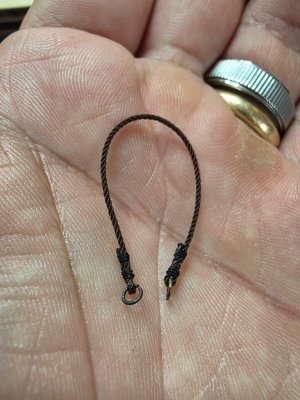
Grab a magnifying glass and take a close look at the E121 thread. If you see that it’s made up of several even thinner strands (twist it a little between your fingers), then it’s probably already twisted clockwise. I’ve discovered that Skala 360 (Guterman’s thinnest thread) is made up of two strands and that they’re twisted clockwise.E121 3x1? Have you ever tried that?
Oh, yeah, I'll try what you suggested Stephan, thanks. Although, if I had to guess, by what I can see the E121 series does not appear to be twisted at all. In fact, if you look at the thread you can actually see that the strands that make it are kinda loose and not twisted like in the Mara series (which I haven't had any issues with). Nonetheless, I'll give it one more try.
In any case, if anyone has tried twisting E121 in the 3x1 configuration successfully, I would appreciate some pointers.
Thanks all
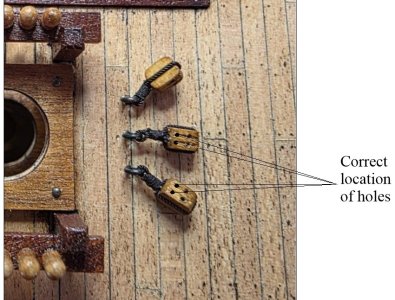
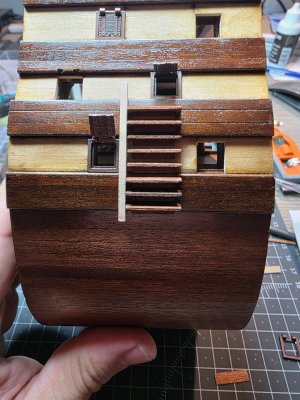
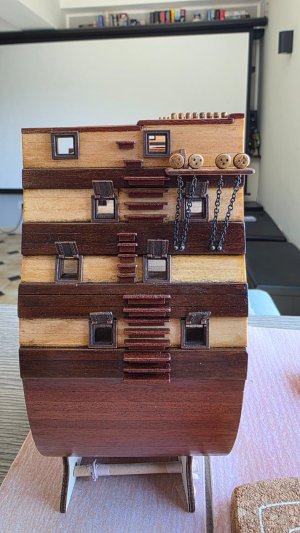
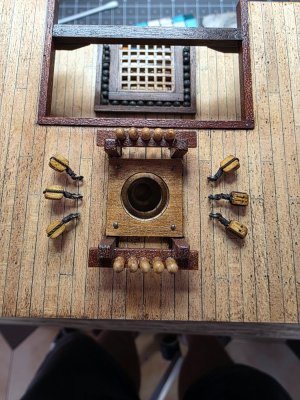
Thanks Allan. Indeed, they are. I followed the Occre instructions (pictures really) and only figured out that the blocks were depicted upside down after I had positioned them. I will do something about them, for sure, and I really like your idea of drilling new holes. As you pointed out, these kinds of thing matter a lot to me.The rope walk looks really good and the rope is super!
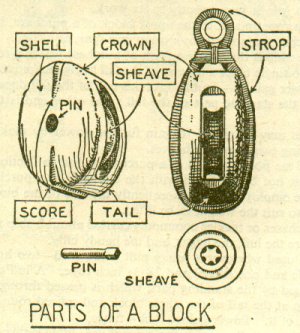
You may want to change the blocks, they are upside down so the rope will not go over where the sheave would be but rather over the tail piece. You can also just drill the holes in the proper location as an alternative if this kind of thing matters to you.
What ship is the model?
Thanks Allan
View attachment 627550
View attachment 627565
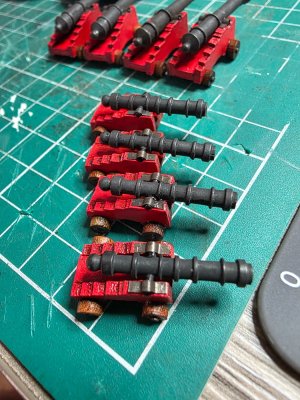
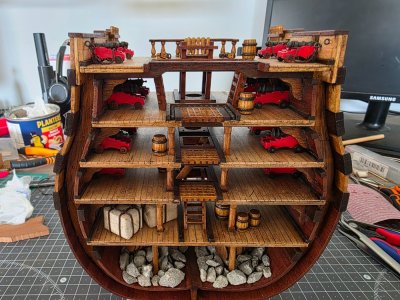
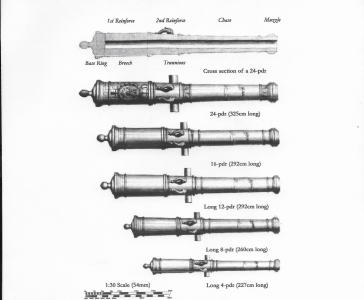
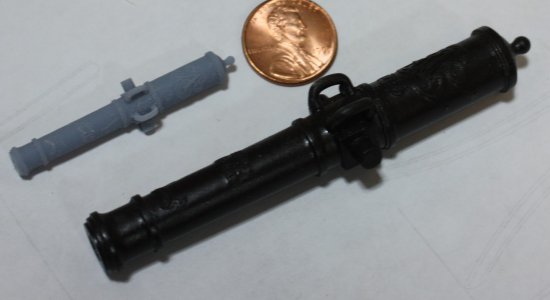
Certainly not your fault. OcCre does not seem to care how a ship was actually built. Other examples,,,,,,, there is no rounding of the deck beams, giant belaying pins, and considering the era, huge rocks instead of kentledge and shingle for ballast and cannon that are from another century. Those wooden barrels lying on the rock pile would have been destroyed in the first rough weather they faced.I followed the Occre instructions

Hi Chris,Oh, yeah, I'll try what you suggested Stephan, thanks. Although, if I had to guess, by what I can see the E121 series does not appear to be twisted at all. In fact, if you look at the thread you can actually see that the strands that make it are kinda loose and not twisted like in the Mara series (which I haven't had any issues with). Nonetheless, I'll give it one more try.
In any case, if anyone has tried twisting E121 in the 3x1 configuration successfully, I would appreciate some pointers.
Thanks all
Hi Robert,Hi Chris,
I am waiting on my shipment with the E121, E151 and E283 as soon it is in i can provide you with my test results. But the main thing is and always will be is weight. I blew a lot of yarn before i had the setup that was satisfying for me. Also the tension is important, i start off on 10% to 12% depending of the length of the ropewalk. Also the tension on the separator is important.
I am currently working on a ropewalk database where i try to collect as many information regarding the settings of the ropewalk, the type of yarn, weight, tension etc.
Maybe somebody else could help you out, i believe @Phillipsart is also using E121 and uses the same ropewalk from @Steef66 as we do. Maybe he has some tips for you. I agree with @Steef66 that you should try with "normal" weight.