• Ships of Scale has incorportated an extra level of security when you log In. Please follow on-screen prompts to acknowledge that you are not a robot via a "Check Box" or a "Pictorial Check Box Puzzle". This is needed due to higher level of AI Activity Security.
  • SUBSCRIBE TO SHIPS IN SCALE TODAY!

    The beloved Ships in Scale Magazine is back and charting a new course for 2026!
    Discover new skills, new techniques, and new inspirations in every issue.

    NOTE THAT OUR NEXT ISSUE WILL BE July/August 2026
  • Win a Free Custom Engraved Brass Coin!!!
    As a way to introduce our brass coins to the community, we will raffle off a free coin during the month of August. Follow link ABOVE for instructions for entering.

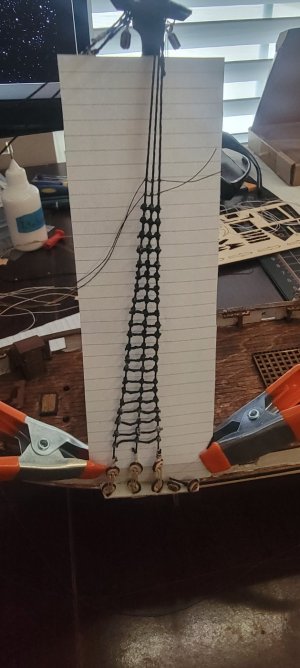
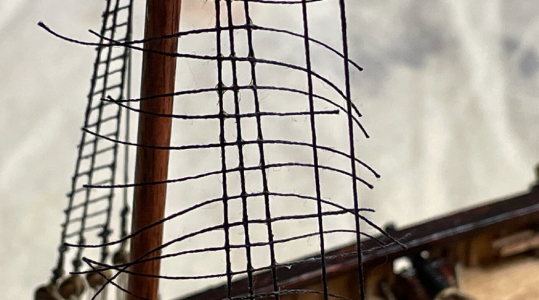
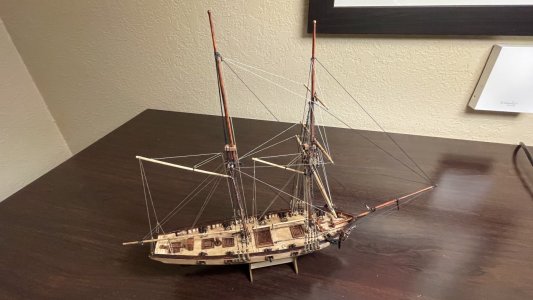
Rat lines first time

As to the clove hitches being too large
I'd agree that MINE are too large XD so hoping with the thinner lines it looks better! Picked some up to try for the next pieces.

I use a technique similar to that proposed by Graham
Both of ya'lls suggestions are somethign I'm going to look into! I I'm curious how it'll feel to ahve something similar although these ones are just 3 lines so not sure it'll be practical here. but worth looking into for sure.
 
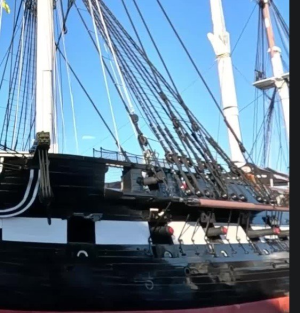
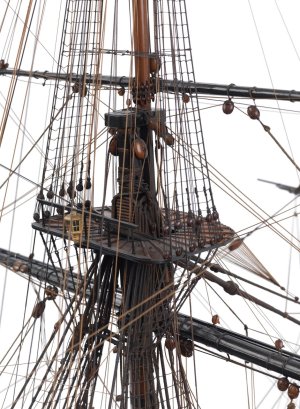
Use thinner line for ratlines or the knots look as large as bowling balls and the ratlines are far out of scale. Look at the ratline on USS Consitution below. You can barely see them at this distance. The clove hitch knots are completely undetectable. The ratlines are a small percentage of the diameter of the shroud lines. At a smaller scale of 1:100, you can't find thread fine enough to properly simulate ratlines, and they are still too thick.

1788392457502.png
 
I see 1:96 scale as being right at the edge of being a miniature scale.
Wood and fiber are cell based. Cells cannot scale. They set the lower margin for how small.
With miniature its becomes more illusion than exact replication.

Before 1859 in PA tar was plant based. That material is not asphalt 000 000 000 black.
As for foot ropes - I have been thinking - the stays would have a case-like tar coating- but
I would not want my bare feet standing on that thick a layer of tar in tropical heat. I would think that tar just soaked in would do. So a shade or two less dark for ratlines.

How about this for 1:96 - use a dull fine sowing needle to work a path thru the shroud lay - and pull the ratline thru- instead of a knot. If a clove knot "has to be there" -use a over rap of fine silk or something similar - soaked with shellac.

Quick update: tinkering with a smaller line and i already like this much better. Even with continuing the clove hitch. Also went with a dark brown color.
Perhaps a long visit at the RMG/NMM websitel3241_012.jpg

Compare what you are doing to a benchmark for what you should be aiming to do.
 
At a smaller scale of 1:100, you can't find thread fine enough to properly simulate ratlines, and they are still too thick.
Kurt, Not sure I agree. :(
Ratlines at 1:100 are about 0,005" diameter. Per the post above, I found Guterman U-121 Skala 240 Polyester is available which is 0,0048, Silk fly fishing line comes in diameters as small as 0.005" as well. Guterman Skala 360 has a diameter of 0.003", the equivalent of about 3/8" at 1:100
Allan
 
The plastic model warship guys use some very fine rigging lines. They work to scales an order of magnitude smaller than we do. Look at. Some of their posts. 1”:96 is close to 1:00 scale. At 1:100 scale, 1” is equivalent to .01”. 1/2” diameter ratlines would have a diameter at scale of .005”

Roger
 
I built 1/48 scale plastic aircraft and in detailing them for radio antenna I used 3/4# monofil. which was just about to scale. This would not work for ratlines as mono would be too stiff and is not limp enough but this made me think of the line I use for bass fishing which is a Dacron, it is very flexible (so you can feel the slightest bite) does not stretch, and in 16# test extremely fine (obviously so the fish can't see it). I haven't checked but I would assume that lighter pound test line may be even finer. After reading these post and checking my reels I appear to have an unlimited supply of fine line. I would encourage anyone to check out your local sporting goods store ( Cabela's Bass Pro) for this type of line. The line I have happens to be Khaki but could colored to your choice.
 
Use thinner line for ratlines or the knots look
100%, When looking up info on HOW to do them nobody really talked about line size so I didn't even think about it until I posted here and everyone was mentioning it lol. I've switched to a thinner line and am liking it a lot better so far
Compare what you are doing to a benchmark for what you should be aiming to do.
For sure, this seems to be the gist of what I'm getting so I went with a dark brown thread for now, also picked up a black and might go back for a couple lighter color options as well. I hadn't thought about running the threads through the lines, I'll put that on my list of techniques to try, especially for these smaller scales! See how it looks. The clove hitch wasn't important, just thought I'd get some practice in ha.
 
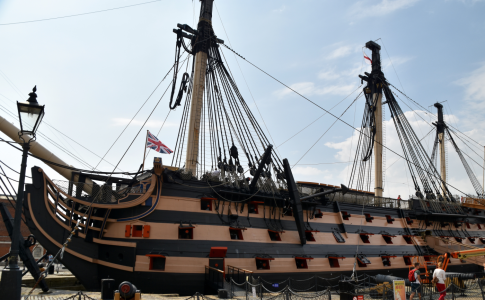
This is true for the USS Constitution ...

View attachment 631508

... but perhaps someone should tell the HMS Victory:

View attachment 631509
The deadeye lanyards in the above photo of Victory appear to be temporary lanyards lashed up during her reconstruction. I believe all of her top hamper above the base masts (which are iron faux reproductions) has been sent down and the lanyards are probably set up merely to keep the lower shrouds out of the way, rather than to support much of anything.
1788483236185.png
 
Ratlines were primary to crew and ship safety. They also didn’t require adjustment. There is, therefore a reason why care would have been taken to preserve them with pine tar and no reason not to. In no case would either they or lanyards be bright white. Hemp rope in its natural state is grey/tan.

Yes, a rotten ratline would certainly make a believer out of you in short order. I believe the practice was to soak line for uses like ratlines in diluted pine tar before use. In fact, all natural fiber cordage is so treated, with the degree of dilution varying according to the specifications of the cordage. The stickiness of the tar promotes the twist staying put when it is laid up. This is why new manila and hemp rope is golden brown while sisal and hemp fibers are naturally near white. In any event, the visual effect of viewing distance will cause ratlines to appear "black" at most scales.
 
The knots aren’t working. Was just rereading Brian King’s ship modeling solutions, he never uses clove hitches, just a half hitch at any scale - it looks good enough. With a dab of glue on the knot both appear the same. Found on rigging the Armed Virginia Sloop, with clove hitches, the shrouds were pulled in like yours. Found it difficult to get the clove hitches tight equally spaced. Shroud tension has a lot to do with it, tight thread today, is not tight tomorrow.

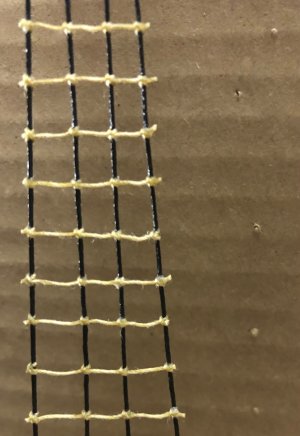
Here is an example of strips of thread laid across the shrouds. The work goes fast. Tieing shroud knots can be a tremendous time suck. Any opportunity to save time is worth a look.

There are many common suggestions in instructions and elsewhere about how to do things. And many of them are not practical - they can’t be executed at scale.

Good luck.

View attachment 631506

I agree that tying all the knots is admirable, but beyond my skill and patience. I coat the threads for ratlines with cyano glue to stiffen them, hang the thread vertically until the glue dries, cut the thread into appropriate lengths, lay them across the shrouds, glue them in place with cyano, then cut off the ends that protrude past the shroud lines. Looks fine for 1/64 scale or smaller. At least looks fine to me.
 
I agree that tying all the knots is admirable, but beyond my skill and patience. I coat the threads for ratlines with cyano glue to stiffen them, hang the thread vertically until the glue dries, cut the thread into appropriate lengths, lay them across the shrouds, glue them in place with cyano, then cut off the ends that protrude past the shroud lines. Looks fine for 1/64 scale or smaller. At least looks fine to me.
Gluing ratlines to the shrouds is the desired method on smaller models, as in this small model of the Baltimore clipper Halcon below. The scale appearance of the features is preserved. I used PVA glue in this case. Getting a consistent amount of glue a each joint proved to be a challenge ans shown by the different sized globs of wet glue below. The thin sewing thread used also was a bit fuzzy. When dry, the glue shrank without discoloration that CA glue often creates. After that, the trick is cutting the ends of the ratlines as close to the shroud lines as possible without cutting the shroud or pulling a glue joint apart.
1788538538977.png

Tiny models are more difficult to make details on.
IMG_4044.jpg
 
at 1:96 when looking at your ship from 3' away... does it make any difference which knot was used? i just make an overhand knot and a tiny dab of diluted glue. are you building a replica or model for a museum that demands exacting details?

i had a detail delema and asked my 11 yr old grand daughter if she had a fix we can come up with. her responce was, "people looking at your ships have no idea what they are looking at, so whats the difference?" smart kid! i left the problem alone and so far no one has commented yet. i still get the same oooooz n aaaahhhhhz like i do for all my ships. i think of these shortcuts as a finger print or signature.
 
at 1:96 when looking at your ship from 3' away... does it make any difference which knot was used? i just make an overhand knot and a tiny dab of diluted glue. are you building a replica or model for a museum that demands exacting details?

i had a detail delema and asked my 11 yr old grand daughter if she had a fix we can come up with. her responce was, "people looking at your ships have no idea what they are looking at, so whats the difference?" smart kid! i left the problem alone and so far no one has commented yet. i still get the same oooooz n aaaahhhhhz like i do for all my ships. i think of these shortcuts as a finger print or signature.
at 1:96, ratline knots are HUGELY out of scale. This is because the thread is overly large in diameter to start with, hence one typically just glues on ratlines to make things simple. You'd need to make ratlines out of human hair to really keep them in scale. If you build your model with the idea that no one will know or care what it looks like, then you might as well but one of those souvenir shelf models for a ridiculous amount of money and call it a day. If you are a modeler who wants a true model, not an ornament, you'll strive to make the details as good as your talents allow.
 
the object of the hobby is please yourself to the best of your ability, not please an audiance. do your best and try to improve. over the years skills improve, and so will the quality of your work, as you noticed by experimenting with these rat lines. polish the diamond a little at a time.

because you chose to take a shortcut or omit something, doesnt mean you don't care, its a limitation. its true most people looking at models have no idea what they are looking at. a frigate, bark, clipper, schooner, yawl yacht... its just a ship. no one will notice you didnt use clove hitches, or omitted bunts n leeches. they will be more amazed you were even able to tie anything that small. no one will know you didnt use hearts or rosewood blocks to proper scale or have ropes left or right twist or eye bolts that would be for giants in reality... thats your secret... its also not a reason to buy a souvenir and call it a day. its YOUR hobby.

the model is a representation of what you can do and that is what people notice first. more important is your feeling of satisfaction when its done and how youll make it better next time. do your best, improve as you learn. whats next?

its a hobby. enjoy the fruits of your labor.
 
For the scale you are working on you should use the thinnest thread you can find preferably in a light brown to beige colour.
Also, forget about the clove hitch, it's way too big even for larger scales. Instead use a simple single overhand knot with a touch of glue. Don't pull too tight as you work your way across as it will deform the shrouds.
Right . On very good models rope look often out of scale. And don't menstion knots and splices.
I wonder if it is not a problem of scale in volume rather than linear. In case of doubt, always smaller. Colour ? Stays, shroulds and ratlines, netting, were tarred on board and many times over. They were black. Black and white do not look right on a model. Off white, Off black.
New tarred rope was medium brown with a red tint.
 
I’m a little confused: I’ve read in several sources that ratlines and most running rigging weren’t tarred because crewmen would get their hands and feet full of tar and track it all over the deck and it would not come off their hands easily (I know that from experience lol). I would imagine that leaving rigging bare without tar or a concoction of fat and pitch etc would subject the lines to more rapid deterioration. I guess that most times it would depend on what was available and cost effective. What’s the real story?
 
I use a technique similar to that proposed by Graham but have made the spacer strips into single units that can be slipped on and off easily and generally don't need the addition of a retaining clip. Two strips of robust hull planking sandwich a short piece of thin planking that acts as a spacer. Different lengths have been made to accommodate varying numbers of shrouds. The starting end of the ratline is secured with a belaying pin. I find it easier to add ratlines from the top down.
I usually leave a spacer in place and use another for the next ratline to avoid disturbing the previous one.
View attachment 631521 View attachment 631522
I like that.. not just a spacer, but a light weight clamp to hold the shrouds in place, keeping spacing while allowing some tension to tie knots…

Thanks!
Not ready for those yet (next model), but will remember!
 
Back
Top