• Ships of Scale has incorportated an extra level of security when you log In. Please follow on-screen prompts to acknowledge that you are not a robot via a "Check Box" or a "Pictorial Check Box Puzzle". This is needed due to higher level of AI Activity Security.
  • SUBSCRIBE TO SHIPS IN SCALE TODAY!

    The beloved Ships in Scale Magazine is back and charting a new course for 2026!
    Discover new skills, new techniques, and new inspirations in every issue.

    NOTE THAT OUR NEXT ISSUE WILL BE July/August 2026
  • Win a Free Custom Engraved Brass Coin!!!
    As a way to introduce our brass coins to the community, we will raffle off a free coin during the month of August. Follow link ABOVE for instructions for entering.

Question RE Making your own rigging rope

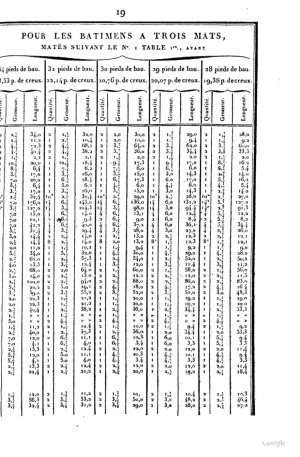
Hi Allan, my question is the actual measurements with period tables how come they are not mentioned? Frank
I am not at all sure what you mean (I know it is a translation issue :( ) Can you post an example of what kind of table you are describing?
Thanks
Allan
 
I am not at all sure what you mean (I know it is a translation issue :( ) Can you post an example of what kind of table you are describing?
Thanks
Allan
I think Frank wants to know how you get those thicknesses of your individual ropes. There are a lot to find about ropes thicknesses on ships. Like Steel, Yk, Witsen, Mondfeldt, etc. They all explain it different, but in the end they got the "same" thickness on each rope. And then recalculate that to your scale.
 
When you make rope from yarn for your model ship there are a lot of differences in the outcome.
When I make rope from example lock yarn Amann Serafil 120/2 and I make a 3 stranded rope of 2 yarns a strand. I get a thickness of 0,4 mm. in diameter.
But when make more turns in the rope with more weight on my rope and slowing down the splitter of the strands, I get thinner rope. So it all depends on your way of rope making and your machine you use. So you start to make rope on your machine and you adjust your speed and weight, that will bring out a result that will not be the same like I do. But my table that I made is just an indication for you. You have to make your own table of rope constructions.
You need:
The speed of turning the strands
The speed of turning the rope (these 2 are likely the same for the best result)
The speed you let turn the rope together (the speed the splitter is moving to the other side)
The weight or force on your strands
The length of your ropewalk
The kind of yarn you use.
 
I think Frank wants to know how you get those thicknesses of your individual ropes. There are a lot to find about ropes thicknesses on ships. Like Steel, Yk, Witsen, Mondfeldt, etc. They all explain it different, but in the end they got the "same" thickness on each rope. And then recalculate that to your scale.
Hello, these types of dimensional tebelles of the various monovre that I meant. Frank

cime.jpg
 
I am making my own ropes and cables for USF Constitution. The final diameter of the model rope varies with thread size, thread batch even in the same brand, total number of threads in the rope, and the number of strands in the rope. 4 threads per strand with 3 strands does not yield the same diameter as 3 threads per strand with 4 strands. And the final model rope diameter also varies with the weight which you hang off the end, and if you harden the rope with a vigorous stretch (recommended), a strong stretch will reduce the final diameter compared with a lighter stretch.
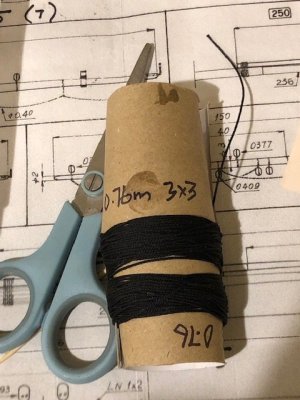
So, the final answer is to experiment with all variables, keeping a record of the variables, so you have a reasonable chance of reproducing a previous diameter by repeating the previous numbers. I wind my model ropes onto used lavatory paper cardboard rolls and write the variables onto the roll.
The published charts give a ball park figure for model rope diameters, and are useful, but your own results are the best predictors.toilet roll rope.JPG
 
Last edited:
I bought the Syren Rope Rocket a few months back. They have some information in the assembly instructions regarding sizes:(https://syrenshipmodelcompany.com/resources/ropewalkinsversion2.pdf)
What worked for me was buying a lot of thread and just making lots of rope. I buy Gutterman poly and over time have found I can produce pretty much whatever I want if I keep a supply of mara 120, 100, 70, 50 and 30. Five mara sizes gets me 10 rope sizes (1 strand or 3 strand runs. I have not tried the 4 strand option on the Rope Rocket yet) So now I have my own chart just complied by experience.
There are a number of videos on using the Rope Rocket on Youtube as well as a lot of info on the Model Ship World forum about fabricating ropes.
 
I have not tried the 4 strand option on the Rope Rocket yet
Just a heads up when you get there... Four-strand rope must be spun around a smaller core. While the Rope Rocket planetary rope machine has four "planets," I don't believe it has any provision for laying up four-strand rope around a core. The reason a core is required is because when the four strands are spun up against each other, one of the strands ends up collapsing into the middle of the twist.

As far as I know, the only commercially available rope making machines that are presently available that provide a mechanism for making cored rope are the models from Aleksei Domanov (now https://www.shipworkshop.com/) Three- and four-strand line can be produced with a fine wire or thread core. According to Domanov's instructions, the wire core permits shaping the wire, as in footrope catenaries where desired with three-strand line, but the core is not optional, but essential for preventing the "collapse" of one of the three strands of four-strand line into the center of the four-strand layup. (Full disclosure: I've never used the core feature on my PL4.) One the PL4, the core is fed through the center axle of the planetary wheel from a separate bobbin.

According to the Domanoff instructions (https://www.shipworkshop.com/_files/ugd/261ffb_78bd683d2cf649b88c671c133ebcbfbe.pdf), the size of the central core is important:


1756085150391.png


Per anecdotal reports, polyester thread does not seem to mind four-strand layups without a core strand and reportedly doesn't tend to collapse one strand into the center of the four-strand layup as seems to be the case with natural fiber thread. This may be attributable to the long fibers of the extruded polyester fibers or the tightness of the layups.
 
I have seen a formula that goes like this: take the number of strands and their diameters, add them together, then divide by 0.7 to get a close estimate of the rope's diameter. Has anyone heard that one? I am not set up yet to make ropes, but I wonder if someone will give that a go?
 
This is what I know about measuring rope size:
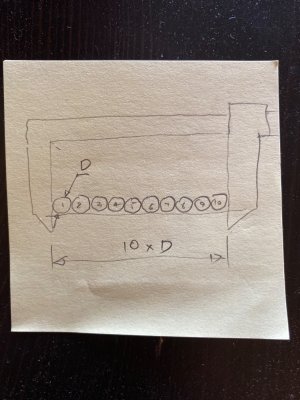
  • Choose a smooth dowel Any round dowel works — its diameter doesn’t matter because you’re measuring the rope, not the dowel.
  • Wrap the rope around the dowel 10 times
  • Measure the total width of the 10 wraps Use a ruler or calipers to measure the combined width of the wrapped section.

  • Divide by 10 This gives the rope’s circumference
  • Convert circumference → diameter Apply the formula:
D=C/π​
​
​
Then there is the following, which I don't know how it relates to your formula:

​

3‑strand rope (most common)​

The three strands sit around a center like three circles touching each other.

If each strand has diameter d:

Drope≈2d
So:

Crope≈2πd

4‑strand rope​

Four strands pack like a square of circles:

Drope≈dsqrt(2)
So:

Crope≈πdsqrt(2)
​
​
​
​
 
Last edited:
  • Measure the total width of the 10 wraps Use a ruler or calipers to measure the combined width of the wrapped section.

  • Divide by 10 This gives the rope’s circumference
It does not give us a rope circumference. This straight away gives a rope diameter. You can figure out a circumference from diameter as C=π*D. This exercise works well however with perfect geometric circles but does not work well with flexible rope and its strands made of fibers. I cannot even measure a yarn diameter I make all my ropes from. Yarn is not even round.
 
It does not give us a rope circumference. This straight away gives a rope diameter. You can figure out a circumference from diameter as C=π*D. This exercise works well however with perfect geometric circles but does not work well with flexible rope and its strands made of fibers. I cannot even measure a yarn diameter I make all my ropes from. Yarn is not even round.
I beg to differ on your analysis. It is in fact the circumference.
 
you are wrapping the rope around 10 times, so 10 times the circumference. I don't know how else to explain it.
 
you are wrapping the rope around 10 times, so 10 times the circumference. I don't know how else to explain it.
Nope. Diameter.
10 winds effectively lays 10 DIAMETERS of the thread side by side, just like Y.T's drawing shows.
The thread is wound around the CIRCUMFERENCE of the dowel.
 
Nope. Diameter.
10 winds effectively lays 10 DIAMETERS of the thread side by side, just like Y.T's drawing shows.
The thread is wound around the CIRCUMFERENCE of the dowel.
I just had a whole discussion about that yesterday. I don't think I want to get into it anymore. You can see all that in my log if you like.
Cheers
 
I just had a whole discussion about that yesterday. I don't think I want to get into it anymore. You can see all that in my log if you like.
Cheers
As I understand Jack's theory, by wrapping the rope around a piece of dowel 10 times, you will get an average size of the rope diameter, and then the formula to work out the circumference of the rope is the average size of the rope diameter, so C = 3.142 × the diameter.
Now, to me that means you would have to wrap the rope at an even load onto the dowel. So, to overcome that problem, I would use a weight, but there is still a problem because the weight will flatten the rope over the dowel no matter how heavy the weight is.
Which, to me, is not a real problem, because a fun fact: back in the real days of Sailing ships, there were many ropes made by many different companies and people. It has been quoted on many occasions that a rope from one company differed in size from another company's rope of the same diameter. There was not much difference, but it was a known fact. So, if your ropes, on measuring with a vernier caliper, measured 0.10mm (0.003") different, who would notice?
I have now got it stuck in my head: when viewing a model of a sailing ship, 1 Metre (1/4 scale) away is equivalent to 48 metres away, or roughly 150 feet away with the full-scale ship. Would you be able to make out the difference in the diameter or size of a rope? Maybe only 1 rope, and that would be the anchor rope.
So just aim for .10 of a mm difference.

 
Last edited:
I wouldn't call it jack's theory. Jack doesn't know what he's doing. lol
Now having said that, I did find a formula to convert tex number to diameter. That's in a previous post. For a specific material you need it's density, which I looked up as well.
 
I wouldn't call it jack's theory. Jack doesn't know what he's doing. lol
Now having said that, I did find a formula to convert tex number to diameter. That's in a previous post. For a specific material you need it's density, which I looked up as well.
Yeah, you know what you are doing; it just came across as quite strange, as everyone thought you were measuring the diameter, which you were at first with the wraps, but that was only to find the diameter of the rope, and you used pi x the diameter to find the distance around.
So how did you overcome the rope flattening out on the dowel? This would cause significant flattening of the rope. Whereabouts is the information found for the density of the material? In this post or another post, as I have not seen it, or just missed it.
 
Yeah, you know what you are doing; it just came across as quite strange, as everyone thought you were measuring the diameter, which you were at first with the wraps, but that was only to find the diameter of the rope, and you used pi x the diameter to find the distance around.
So how did you overcome the rope flattening out on the dowel? This would cause significant flattening of the rope.
I know. It's not a perfect method. All I did was make sure the loops were touching each other, but I can't control the flattening effect.
That's why I turned to starting with a known thread diameter using say the TEX number, and then using the approximation that for a 3 strand rope that the diameter of the final thread is twice the diameter of the individual strands. I don't really know what the error is associated with the former method although I suppose you could measure it with a microscope, but I don't have one. Apparently from what I read, this approximation is really good.
I suppose the ideal method would be to use a microscope with a ruler then you could measure the true diameter without compressing the thread. But I have never done that before so my observation is purely from a theoretical perspective. Since I don't have a microscope I am just going to leae that one alone.
 
Back
Top