I am not at all sure what you mean (I know it is a translation issueHi Allan, my question is the actual measurements with period tables how come they are not mentioned? Frank
Thanks
Allan
![]() |
The beloved Ships in Scale Magazine is back and charting a new course for 2026! Discover new skills, new techniques, and new inspirations in every issue. NOTE THAT OUR NEXT ISSUE WILL BE July/August 2026 |
![]() |
![]() |
As a way to introduce our brass coins to the community, we will raffle off a free coin during the month of August. Follow link ABOVE for instructions for entering. |
![]() |
I am not at all sure what you mean (I know it is a translation issueHi Allan, my question is the actual measurements with period tables how come they are not mentioned? Frank

I think Frank wants to know how you get those thicknesses of your individual ropes. There are a lot to find about ropes thicknesses on ships. Like Steel, Yk, Witsen, Mondfeldt, etc. They all explain it different, but in the end they got the "same" thickness on each rope. And then recalculate that to your scale.I am not at all sure what you mean (I know it is a translation issue) Can you post an example of what kind of table you are describing?
Thanks
Allan


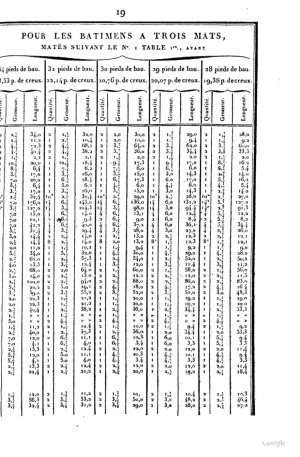
Hello, these types of dimensional tebelles of the various monovre that I meant. FrankI think Frank wants to know how you get those thicknesses of your individual ropes. There are a lot to find about ropes thicknesses on ships. Like Steel, Yk, Witsen, Mondfeldt, etc. They all explain it different, but in the end they got the "same" thickness on each rope. And then recalculate that to your scale.


There are a number of videos on using the Rope Rocket on Youtube as well as a lot of info on the Model Ship World forum about fabricating ropes.I bought the Syren Rope Rocket a few months back. They have some information in the assembly instructions regarding sizeshttps://syrenshipmodelcompany.com/resources/ropewalkinsversion2.pdf)
What worked for me was buying a lot of thread and just making lots of rope. I buy Gutterman poly and over time have found I can produce pretty much whatever I want if I keep a supply of mara 120, 100, 70, 50 and 30. Five mara sizes gets me 10 rope sizes (1 strand or 3 strand runs. I have not tried the 4 strand option on the Rope Rocket yet) So now I have my own chart just complied by experience.
Just a heads up when you get there... Four-strand rope must be spun around a smaller core. While the Rope Rocket planetary rope machine has four "planets," I don't believe it has any provision for laying up four-strand rope around a core. The reason a core is required is because when the four strands are spun up against each other, one of the strands ends up collapsing into the middle of the twist.I have not tried the 4 strand option on the Rope Rocket yet


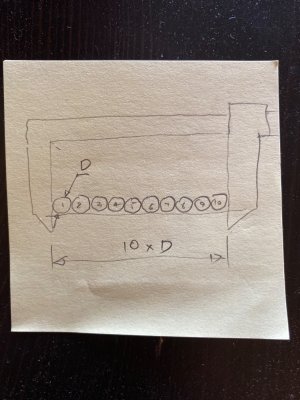
It does not give us a rope circumference. This straight away gives a rope diameter. You can figure out a circumference from diameter as C=π*D. This exercise works well however with perfect geometric circles but does not work well with flexible rope and its strands made of fibers. I cannot even measure a yarn diameter I make all my ropes from. Yarn is not even round.
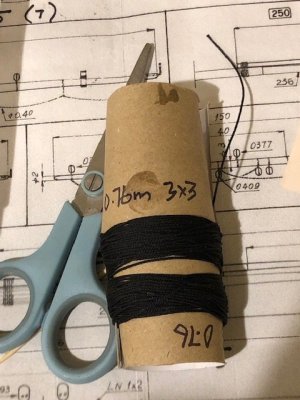
- Measure the total width of the 10 wraps Use a ruler or calipers to measure the combined width of the wrapped section.
- Divide by 10 This gives the rope’s circumference

I beg to differ on your analysis. It is in fact the circumference.It does not give us a rope circumference. This straight away gives a rope diameter. You can figure out a circumference from diameter as C=π*D. This exercise works well however with perfect geometric circles but does not work well with flexible rope and its strands made of fibers. I cannot even measure a yarn diameter I make all my ropes from. Yarn is not even round.


Nope. Diameter.you are wrapping the rope around 10 times, so 10 times the circumference. I don't know how else to explain it.

I just had a whole discussion about that yesterday. I don't think I want to get into it anymore. You can see all that in my log if you like.Nope. Diameter.
10 winds effectively lays 10 DIAMETERS of the thread side by side, just like Y.T's drawing shows.
The thread is wound around the CIRCUMFERENCE of the dowel.

As I understand Jack's theory, by wrapping the rope around a piece of dowel 10 times, you will get an average size of the rope diameter, and then the formula to work out the circumference of the rope is the average size of the rope diameter, so C = 3.142 × the diameter.I just had a whole discussion about that yesterday. I don't think I want to get into it anymore. You can see all that in my log if you like.
Cheers


Yeah, you know what you are doing; it just came across as quite strange, as everyone thought you were measuring the diameter, which you were at first with the wraps, but that was only to find the diameter of the rope, and you used pi x the diameter to find the distance around.I wouldn't call it jack's theory. Jack doesn't know what he's doing. lol
Now having said that, I did find a formula to convert tex number to diameter. That's in a previous post. For a specific material you need it's density, which I looked up as well.

I know. It's not a perfect method. All I did was make sure the loops were touching each other, but I can't control the flattening effect.Yeah, you know what you are doing; it just came across as quite strange, as everyone thought you were measuring the diameter, which you were at first with the wraps, but that was only to find the diameter of the rope, and you used pi x the diameter to find the distance around.
So how did you overcome the rope flattening out on the dowel? This would cause significant flattening of the rope.