


• Ships of Scale has incorportated an extra level of security when you log In. Please follow on-screen prompts to acknowledge that you are not a robot via a "Check Box" or a "Pictorial Check Box Puzzle". This is needed due to higher level of AI Activity Security.
  • SUBSCRIBE TO SHIPS IN SCALE TODAY!

    The beloved Ships in Scale Magazine is back and charting a new course for 2026!
    Discover new skills, new techniques, and new inspirations in every issue.

    NOTE THAT OUR NEXT ISSUE WILL BE July/August 2026
  • Win a Free Custom Engraved Brass Coin!!!
    As a way to introduce our brass coins to the community, we will raffle off a free coin during the month of August. Follow link ABOVE for instructions for entering.

Scratch Build of the St. Brendan

  • Thread starter Thread starter DMDay
  • Start date Start date
  • Watchers Watchers 5
Joined
Jun 15, 2023
Messages
57
Points
88

My son is named Brendan and I have always had an interest in the Navigatio Brendani, a 9th century text that chronicles the voyage of St. Brendan, a 6th century Saint, from Ireland on a peregrinatio, a voyage in which the Saint entrusted his destiny to God. Many scholars use this text to suggest that St. Brendan actually sailed to North America. There is ancient evidence that the boat he would have built, a curragh, existed from very early times in Ireland and can still be found being built today by Irish fisherman. (A curragh is not a coracle--the difference is that the latter is used on lakes and river, whereas the former is intended for sea fishing.)

I hope to build a replica of St. Brendan's boat and log it here.

Some of you may be aware of Tim Severin's book in which he built a full-size replica of St. Brendan's boat and then sailed it from Ireland to Newfoundland--and thus proved that the voyage described in the Navigatio actually could have happened. In preparing the plans for this build, I have examined his history of that voyage closely. I also am relying heavily on a series of articles that appeared in the journal The Mariner's Mirror in 1938 written by James Hornell in which he discusses that wide variety of curraghs used in Ireland with notes on their construction and differences.

The design I have chosen to use is from the Arran Islands and I enclose a schematic from Hornell's article here. First I will need to research the materials used in the 6th century and how this boat would have been built, determine a scale, and begin building a "mold." Curraghs are built "by eye," as the Irish say, and so there is a great deal of variation between boats of the same sort. Since I cannot lay out the shape of my model on the seashore, I will need to build a mold over which I can actually build the boat. (This is very similar to how many lifeboats are built in large models such as the Beagle and the Bounty.)
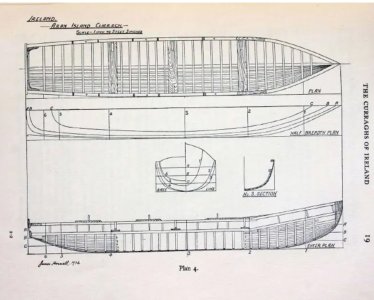
Plans 1 1-18.jpg
 
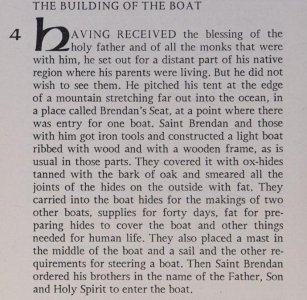
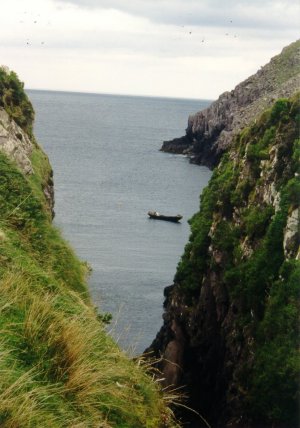
Some pics: 1) from the Navigatio describing St. Brendan building his boat (his home traditionally has been attributed to have been on the Dingle Peninsula), 2) Brendan's Bay on the Dingle Peninsula with a modern-day curragh floating in the Bay, and 3) my son Brendan some years ago in front of the ruined church near Brendan's Bay. This building, Kilmalkedar Church, was built about 1134 AD--notice the outline of a boat built into the wall).

Brendan Building Ship.jpg

irish16.jpg

20260831_083448[1].jpg
 
DMDAy,

I have built two currach models. The first was a model of Brendan’s currach, and was the subject of three articles published in the Model Ship Builder Journal in March, April, and May of 2013. The second was a model of Columba’s currach, from the same century, and this one was the subject of a NRJ article (Vol 66, No. 2, 2021). Each of these models was built the way these boats were actually constructed - double gunwale first, curved ribs added, longitudinal stringers tied to the ribs, and leather covering added over the completed frame. If you build your model this way, there is really no need for a mold. Manipulating the curved ribs, which were inserted into the lower gunwale, provided the native currach builders with a way of “fairing” the currach frame by eye, along with the stringers that serve a purpose similar to the battens commonly used to fair the stations in a plank-on-bulkhead model. I learned a lot from my Brendan model, and think that my subsequent Columba currach model described in the NRJ is the better one. I was able to get a copy of the Brendan plans from the estate of Colin Mudie, who drew them for Tim Severin’s reconstruction. If I can find them after all these years, I could send them to you by PM or by email. I purchased plans for the Columba currach from the Causeway Coast Maritime Heritage Group, and could send these to you as well, if you like. Best wishes for success, currachs are fascinating, time-tested boats that are a testament to the skills of early boatbuilders.

Seamus
 
Last edited:
I also used Hornell’s book as one of my references, very helpful in the details of construction. The Brendan and Columba currach replicas constructed by Severin and the CCMHG were 36’ in length, considerably larger than the ones pictured in Hornell’s book. If you use the plan you posted earlier in this blog, you might want to scale it up a bit. Let me know if/when you have questions during your build, I will be glad to share my experience in modeling curraghs.

Seamus
 
After some research, I see that large sea-going curraghs up to 35 feet long were possible in the 6th century. That's good because St. Brendan had a crew of 18--some rowing and some manning the sails.

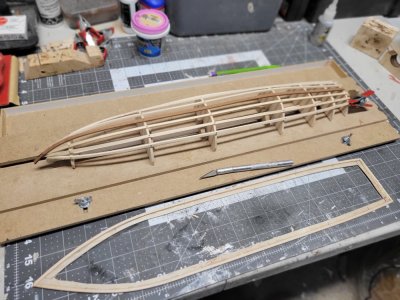
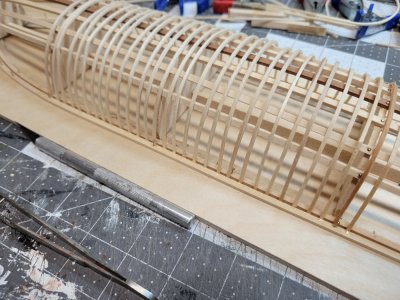
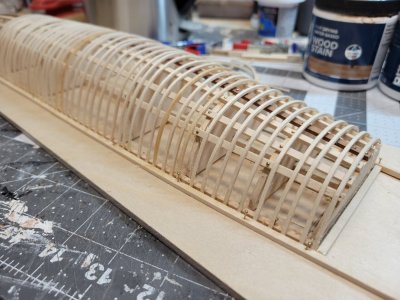
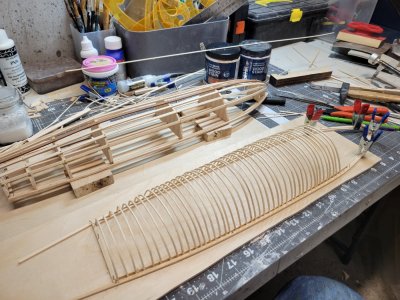
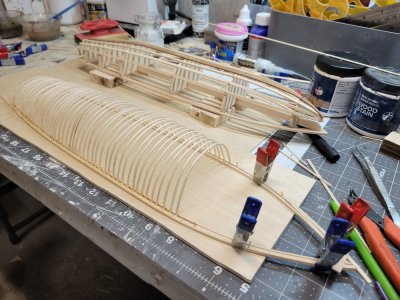
I decided on a scale of 1/24 which would result in a model about 18" long. First chore was to build the mold. Then I attached it to a base and added the 1/8" x 1/8" square dowel gunwales. I spaced the gunwale away from the mold with a 1/16" strip and then started adding the 1/16" x 1/16" square dowel frames. At this scale, lots of the frames break when placing them. I use both boiling water and a heated iron to bend them, but many times they break anyway. (Not really break, more like collapse. Any suggestions how to avoid this?)

Form and gunwall.jpg

20260903_113727.jpg

20260906_070542[1].jpg
 
Last edited:
After some research, I see that large sea-going curraghs up to 35 feet long were possible in the 6th century. That's good because St. Brendan had a crew of 18--some rowing and some manning the sails.

I decided on a scale of 1/24 which would result in a model about 18" long. First chore was to build the mold. Then I attached it to a base and added the 1/8" x 1/8" square dowel gunwales. I spaced the gunwale away from the mold with a 1/16" strip and then started adding the 1/16" x 1/16" square dowel frames. At this scale, lots of the frames break when placing them. I use both boiling water and a heated iron to bend them, but many times they break anyway. (Not really break, more like collapse. Any suggestions how to avoid this?)

View attachment 632443

View attachment 632447

View attachment 632449
Figured a way to bend the frames without breaking them. First soak in hot water 1-2 minutes. Next bend carefully over a can or bottle of suitable size and hold 1-2 minutes letting the wood fibers stretch. Next shape the frame to its proper length and then glue outside edges while still wet. Once I got the length correct for each frame, it went along quickly.
 
Very interesting project and nice work! I was going to recommend bending the frames around some sort of cylinder (bottle, mug, etc) first to limit breakage, but looks like you figured that out already.
 
I also used Hornell’s book as one of my references, very helpful in the details of construction. The Brendan and Columba currach replicas constructed by Severin and the CCMHG were 36’ in length, considerably larger than the ones pictured in Hornell’s book. If you use the plan you posted earlier in this blog, you might want to scale it up a bit. Let me know if/when you have questions during your build, I will be glad to share my experience in modeling curraghs.

I figured the length and breadth and multiplied the frames (and the size of the frames) to get to scale. Actual size is about 35' long, scale size is 18" long, frames are 1/16" x 1/16" dowels, and spacing between frames is about 1/4 inch.
 
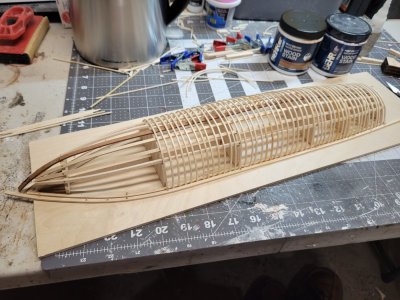
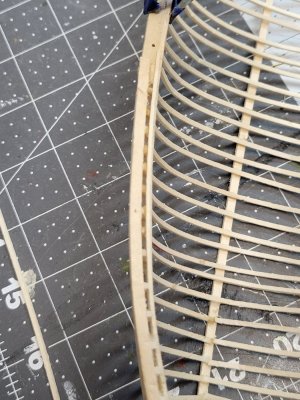
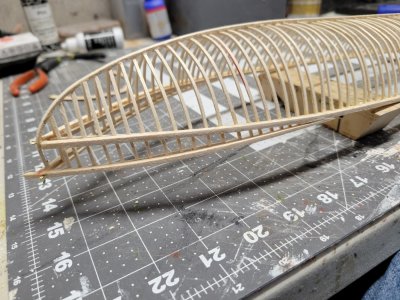
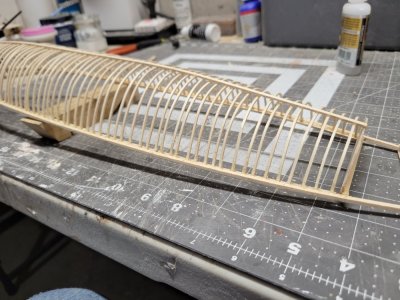
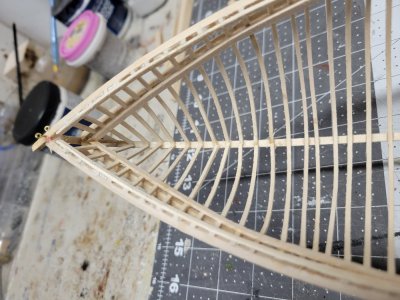
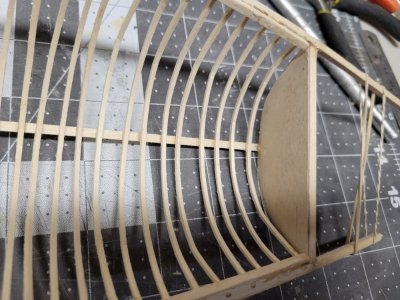
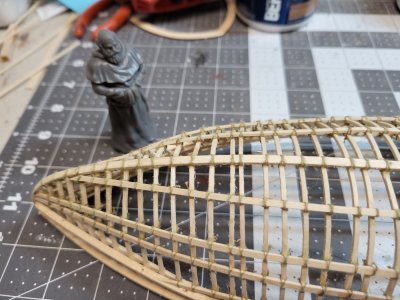
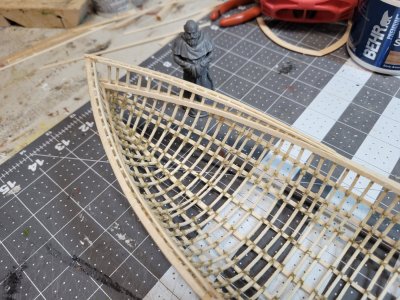
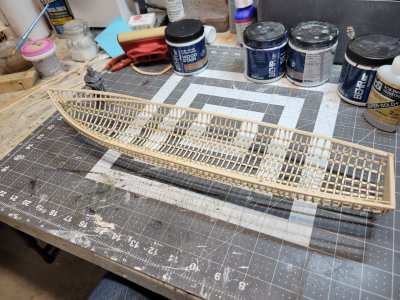
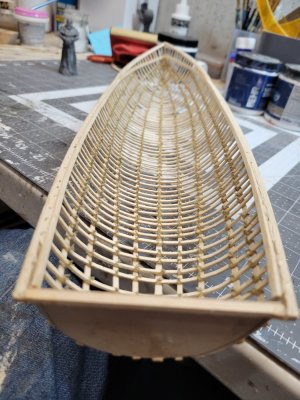
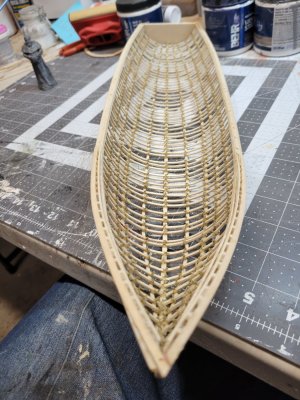
Finished up most of the framing today except for some sanding. The first photo shows the raised prow, the second the rear framing, the third an overview and the last two the prow and stern from inside. Many of the frames are not equally spaced, something I thought about correcting, but then decided to leave it as is. The Irish curragh builders worked "by eye" and at this scale I was forced to do the same. The imperfections help make it perfect for me.

20260908_174743.jpg

20260908_174754.jpg

20260908_174801.jpg

20260908_174818.jpg

20260908_174825.jpg
 
I continue to research ancient curraghs in Ireland. The earliest reference I can find is to the Navagatio Brendani above in which the constructions is described thus: "Saint Brendan and his companions took their tools and built a small, very light boat—ribbed and framed with timber, as is the custom in those parts—and covered it with ox-hides tanned red with bark. They smeared all the seams of the hides on the outside with butter, and stowed inside the vessel two additional sets of hides for the boat, provisions for forty days, butter for dressing the covering hides, and other necessities of life. They also set up a mast in the middle of the boat, along with a sail and other steering gear." Although this says that Brendan framed his boat with timber, a literal translation says he built it with "wood from the forest," not timber. From the following quotation, I think the "wood" he used would have been saplings of ash or birch. Likewise, "butter" was probable grease or lard.

The second reference (see attached) was written in 1621 by Philip O'Sullivan Beare in which he describes how his father used curraghs to bring about a victory during the Nine Year's War against the English Crown. This the the relevant part: "The ship planned by Dermot was made in this way: Two rows of osiers were planted opposite each other, the thickest end being stuck in the ground, and the other ends bent in to meet each other's vis-a-vis, to which they were fastened with cords, and so formed the frame of the ship turned upside down. To this frame the solid planks were fixed, and seats and cross beams were fitted inside. Outside it was covered with the skins of eleven horses, and oars and dowels were fitted on. The keel was flat, both on account of the material used and in order to avoid rocks and stones. It was twenty-six feet long, six feet broad, and five feet deep, but the prow was a little higher in order to stem the tide." The technique I'm using on this model isn't exact, but too late to change now.

I made the assumption in the beginning that both Brendan's and Sullivan's boat would have been tarred to make them watertight. I was surprised to learn that tar probably wouldn't have been available by Sullivan and certainly could not have been used by Brendan. From Google: tar-making in "Ireland never developed into a major domestic industry because Ireland lacked the vast, resinous pine forests required for traditional wood-tar production. Instead, the historical timeline of tar utilization and manufacturing in Ireland is divided into two distinct eras: imported wood tar for maritime use [17th century], and domestically refined industrial coal tar for road construction."

Since Brendan did not have tar to waterproof his boat, he would have had to rely on grease and lard. Note that the Navigatio says he used "butter." I need to research this more. Meanwhile I will continue with this build despite inaccuracies. Who knows, maybe I'll build a second model that is historically correct in the future. However, I will use what I learn as I go along with this one. Any ideas how to represent on a model ox or cow hides sewn together and waterproofed with grease and lard?
 

Attachments

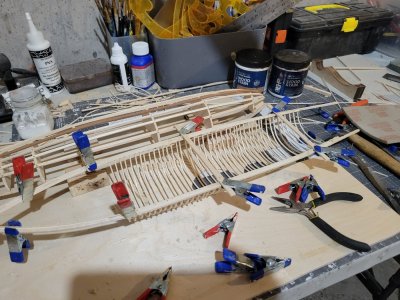
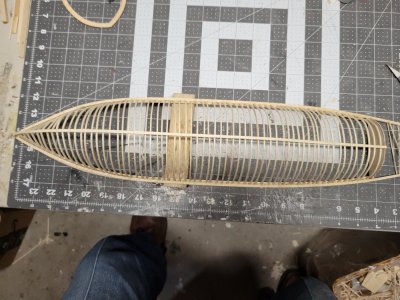
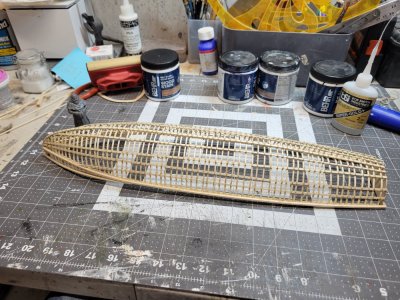
Finished tying the frames to the stringers. (Glad that's over!) Next some weathering and then will need to confront the "skins" issue. While the boat seems strong, it is very fragile. I worry that anything I might use to replicate cow hides will dry, contract and crush the model.

20260916_105210.jpg

20260916_105218.jpg

20260916_105243.jpg

20260916_105247.jpg

20260916_105256.jpg

20260916_105306.jpg
 
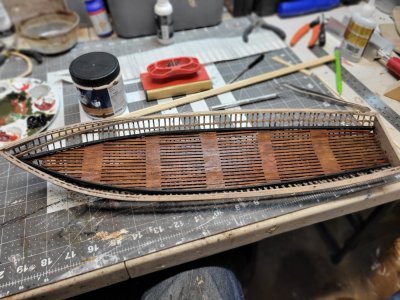
Weathered the frames and stringers a dark grey. For the most part, they won't be seen except inside the boat. Hoping the "skin" will be somewhat transparent enough to see the shadows through it. Added the floorboards. Next comes the thwarts.

20260918_133414.jpg
 
Back
Top