• Ships of Scale has incorportated an extra level of security when you log In. Please follow on-screen prompts to acknowledge that you are not a robot via a "Check Box" or a "Pictorial Check Box Puzzle". This is needed due to higher level of AI Activity Security.
  • SUBSCRIBE TO SHIPS IN SCALE TODAY!

    The beloved Ships in Scale Magazine is back and charting a new course for 2026!
    Discover new skills, new techniques, and new inspirations in every issue.

    NOTE THAT OUR NEXT ISSUE WILL BE July/August 2026
  • Win a Free Custom Engraved Brass Coin!!!
    As a way to introduce our brass coins to the community, we will raffle off a free coin during the month of August. Follow link ABOVE for instructions for entering.

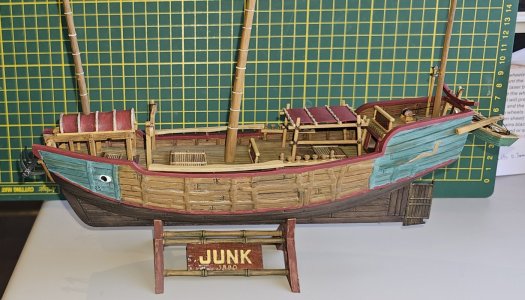
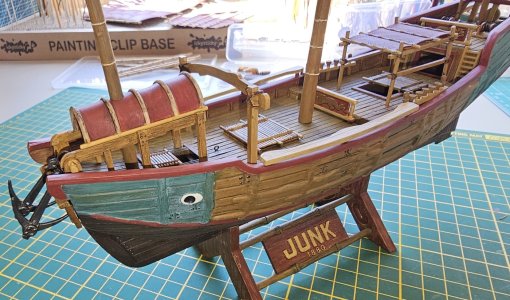
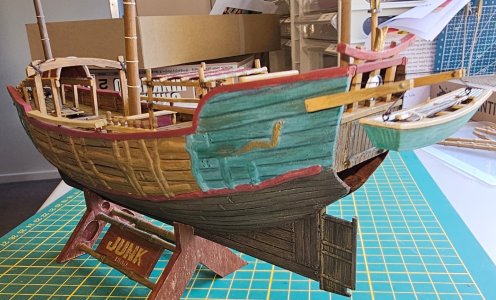
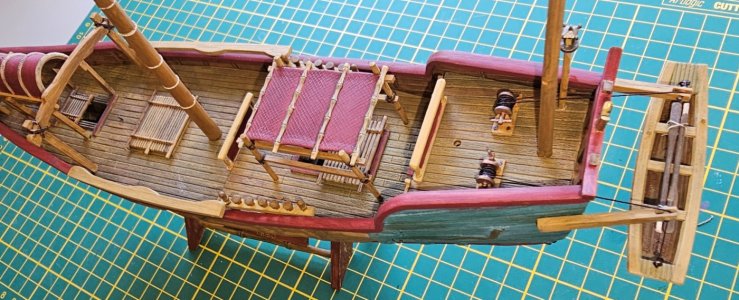
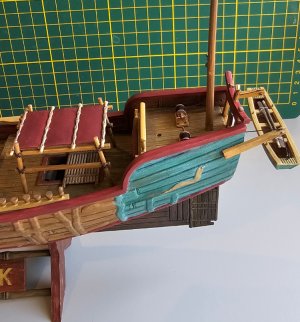
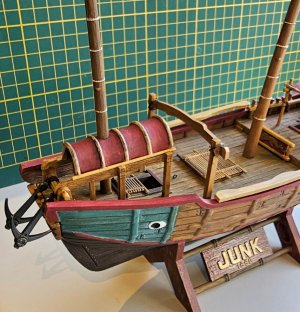
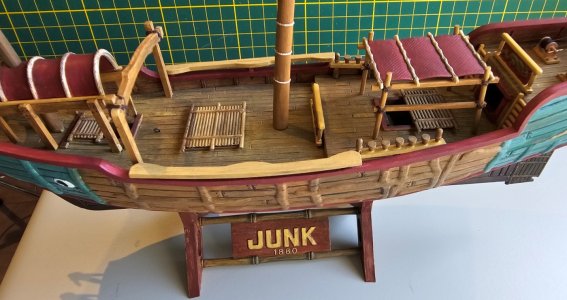
Chinese Junk - Imai/Aoshima 1:60

Good day John!
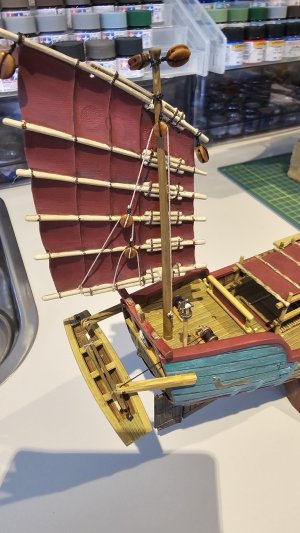
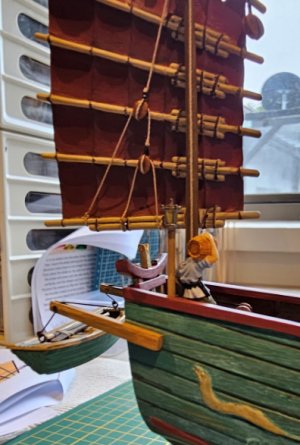
Blocks looks like a little bit out of scale, too big :) ? No?
Compare sizes of deck details, size of the sail and refering to the pictures posted early, they easily could be 50% smaller...?
 
Last edited:
Good day John!
Blocks looks like a little bit out of scale, too big :) ? No?
Compare sizes of deck details, size of the sail and refering to the pictures posted early, they easily could be 50% smaller...?
I think there are two problems here.

1) The persepctive of the photo makes it look worse.
2) The halyard blocks are too large for that sail but probably not for the others.

I am looking into this and will post more info and pics soon :-)
 
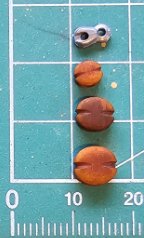
So my logic was to vary the sizes of the blocks for some visual interest, as well as likely accuracy. The blocks provided in the kit are 6mm long so I used that as the basis. It is a 1:60 kit so 6mm means 36 cm or 14" which seemed about right. I planned the following sizes:
Halyards: 7mm
Braces: 6mm
Lifts and Sheets: 5mm

Here they are with the kit block also.
Pic-0005.jpg

The kit block is weird - not really anywhere to put a pulley in that thing.

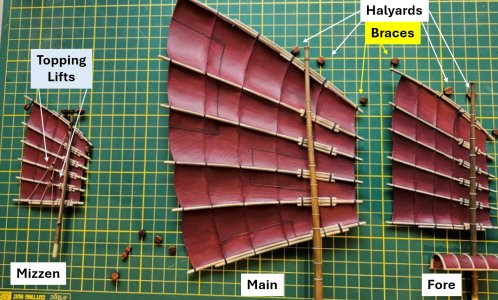
I think my logic is not a total failure but I did forget to take into account the variation in the size of the sails! I started with the mizzen first and it is by far the smallest. Here are the three sails, with my proposed blocks in the positions for the halyards and braces.

Pic-0010.jpg

I think the halyard and braces blocks are OK for the fore and main mast. But they are too large for the mizzen...

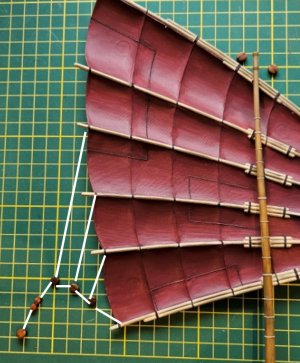
And here is how I propose to add the sheets for the main. Again, the blocks look OK to me. But I will need smaller ones for the mizzen.

Pic-0011.jpg

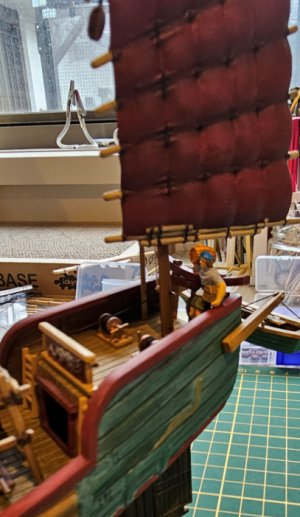
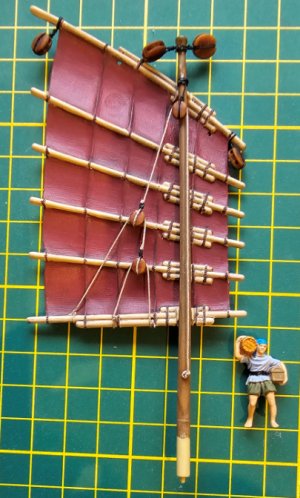
I have also tried to get a better picture of the mizzen, without the distortion in the pic I posted earlier. I have placed a figure in the pics to try to show some scale also. It is not as bad as the earlier picture made it look. But I do agree that the mizzen really needs smaller blocks - although the main and fore mast are probably OK.
Pic-0006.jpgPic-0007.jpgPic-0008.jpg

As always, comments sought.

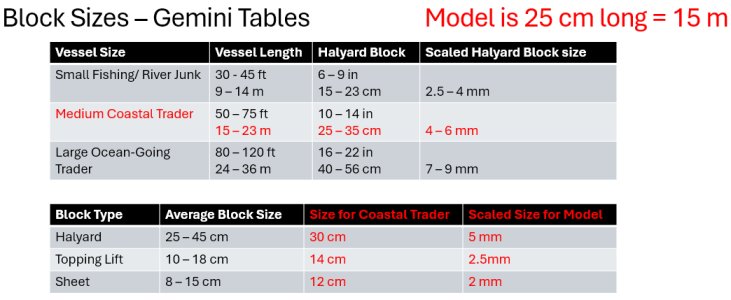
Gemini has prepared a table of block sizes according to the size of the junk. (But it did not vary according to the size of the sail!)The model is a scaled 15m long vessel which makes it a coastal trader size.

Pic-0001.jpg

Gemini also pointed me to this book which I am now looking through! (It is on the Internet Archive.)
cover.jpg

More soon...
 
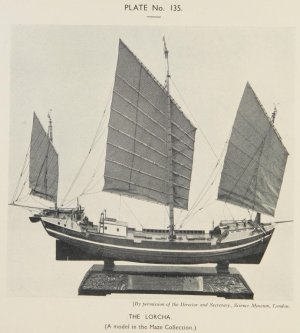
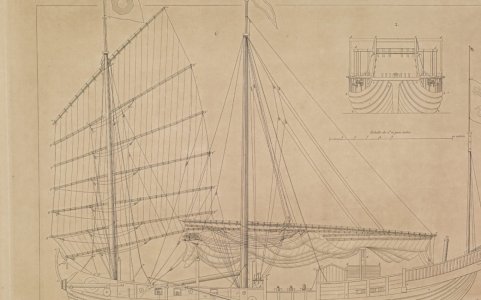
Well...in vol 2 of the book above I found a few pages on The Lorcha...which looks remarkably like the model kit!

Pic-0210.jpg

Pic-0205.jpg

It even has a sprit - I believe it is called an outrigger or stern bumpkin?

Ever since I decided to add sheets to the sails, I was a concerned about the mizzen. The sheets are secured behind the sail and in the model kit the sail extends over the stern. So how was I going to rig this? Now I see - I will add an outrigger and use this Lorcha as a guide...

Still working on the sizes of the blocks...more later :-)
 
Good day,
Agree , blocks on the mizzen asks to be reduced in size...
more over , compare to the man figure, if it is in scale, I could suggest / without digging in question deeply/ just visually , non of the blocks on this boat could be bigger than diam.of the barrel which he carry on his sholder, which is not more than 350- 400 mm in diam I guess, and even than it is hige size for the block, block of such size supposed to be used for heavy lifting and big ropes...
Boats on these two nice pictures You posted , have blocks looking proportionally to the boat rigging... imagine man figure there on these drawings and size of the blocks in proportion to man figure...
To add outrigger for mizzen - nice idea! It asks to be here...
There is common rules which could be roughly used to determine size of the blocks for the sail ship model depend on rope size... but You need to be shure that your rope sizes calculated correctly :))))!

Screenshot_20260927_082331_Samsung Browser.jpg
 
Yes... I compare that two tables given by AI, which You and I have after google search...they are giving same data actually
Biggest block, as supposed - for the hallyard 4 - 5 mm long and rope diam 0.6 - 0.7 mm - size diam of the barrel 's bottom on the man figure sholder
All others light weight ropes and blocks/ topping lifts, sheets, etc much smaller 2.0 to max 3.0 mm long and rope 0.25- 0.3 mm - size roughly of the man figure head ...
But of couse it is just " talking" about ... final decision what really need to be done or not need to be made by You...
 
Thanks to Kirill for keeping me honest!

Also on he Lorcha - the Worcester book says they were often used against pirate actions, and their heydey was about 1850-1900. The model is labelled as a junk from 1880. I am thinking the kit maker based it on the Lorcha.

Also - there is apparently an excellent 1:14 scale model of a Lorcha in the Science museum in London. Seems likely that this was the basis of the kit. But only they know why they changed the hull to make it look way too rustic...and they altered the deck fittings. And the rigging is a fantasy :-)

I started this junk because I thought Harry Houdini's model looked nice, it would be something different, and it would be a break from the demands of the Golden Hind. So it was just a bit of fun. I was going to follow the rigging in the kit - which includes stays and braces. I thought this was curious because junks are famous for not having stays on the masts. But I was not too fussed. It was just a fun side project. However, the "sheets" in the kit instructions were probably the result of an acid trip and I was not going to follow that. I decided to add topping lifts and an approximation to the actual sheets.

Having now looked more closley at the rigging, and having found what I think is a reliable example, I think I will do the rigging much more closer to reality. I will spend today trying to sort it all out but my plan is probably:
1) include halyards - possibly with a tackle if the required blocks are not too fiddly!
2) topping lifts
3) sheets
4) some form of parral - might be interesting

NO stays. NO braces.

I will also consult the model in the Science Museum inLondon - there are likely to be pictures online.

More soon!

And thanks to those who inspired me to do a better job than I originally intended (especially Kirill and Jake)

JL
 
Good day John
I didnt think before You start your " junk " project that it could be interesting , but later reading some articles about chineese shipbuilding history I realized that " chineese junk" is a kind of technology perfection fo ancient time and they used to built perfect vessels already in that time while in Europe shipbuilding was in the begining of its later glory...and china style rigging it is something spec8fic and very functional system / no analogy in europe rigging tradition!
there are a few intersting fact

«The most significant innovation in Chinese shipbuilding was the watertight bulkhead... This feature, known to the Chinese by the Han dynasty and universally employed by the Sung, was not adopted in Europe until the eighteenth century. It rendered the ship virtually unsinkable in the event of localized hull damage — a concept utterly foreign to medieval European shipwrights.»
— Needham, J. (1971). Science and Civilisation in China, Vol. 4, Part 3: Civil Engineering and Nautics. Cambridge University Press, p. 517.

«The Chinese junk’s rigid lugsail, supported by bamboo spars and adjustable in segments, permitted efficient sailing against the monsoon winds with minimal crew. Unlike European square sails, which required large crews to haul and reef, the junk’s sail could be trimmed by one or two men even in heavy weather.»
— Ibid., p. 532.

«The hull construction of the junk was based on the principle of ‘segmented integrity’: each watertight compartment acted not only as a buoyancy chamber but also as a structural rib, stiffening the entire frame without the need for internal keelsons or heavy framing. This made the junk lighter, more flexible, and far more resilient to torsional stress than contemporary European vessels.»
— Lin, J. (1986). The Chinese Junk: A Study in Maritime Technology. Hong Kong University Press, p. 94.

«The sternpost rudder, fixed vertically and operated by winches and ropes, was the first true rudder in human history. Unlike the steering oars of Mediterranean ships, it was centrally mounted, fully submerged, and capable of precise directional control even at low speeds — a decisive advantage in narrow river channels and crowded harbors.»
— Ibid., p. 112.

«The use of wooden dowels and hemp ropes instead of iron nails was not a sign of technological backwardness, but of sophisticated material adaptation. The flexibility of the joints allowed the hull to flex with the waves, absorbing shock rather than transmitting it — a design feature that minimized fatigue cracking and extended service life.»
— Francis, P. (2004). The Chinese Junk: Design, Construction and Evolution. Seaforth Publishing, p. 78.
«The convex hull form — often mislabeled as ‘flat-bottomed’ — was in fact a carefully calculated hybrid: a shallow draft forward for river navigation, transitioning to a deep, rounded aft section for oceanic stability. This was an early example of hydrodynamic optimization, predating similar principles in Western naval architecture by centuries.»
— Ibid., p. 103.


57ef74c3371c4c26c3b79830c2bc9128_ce_800x534x0x54_cropped_1332x888.webp

ec018aeac1_jonka_voile.webp
 
Thanks Kirill.

This is very interesting too: https://www.icm.gov.mo/rc/viewer/20027/1169

The usual belief that "junks are flat bottomed vessels without a keel" is not correct once you move to the South of China. A discovery in 1973 of a boat from about 1000AD showed a keel :-) So Worcester's study (from1940s and 50s) predated this discovery. But the link above says that he is absolutely correct for river vessels and northern chinese sea going vessels. The southern ones sometimes had keels.

The inclusion of a keel was the very definition of a "lorcha" - which is what is shown in the model kit.
 
Last edited:
Here is my current plan for the rigging of the sails on the Lorcha/Junk.

Firstly - no stays and no braces.

What I plan to include is:
  • Halyard (one per mast)
  • Topping lifts (on each side of sail)
  • Sheets (on the leech edge of course)
  • Luff hauling parrels

So here is my thinking, for each kind.

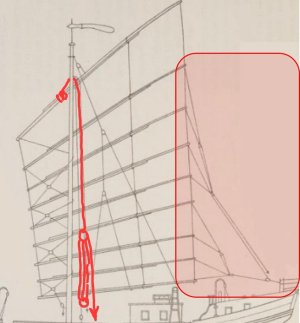
Halyards:
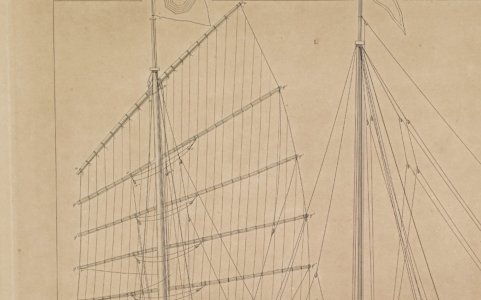
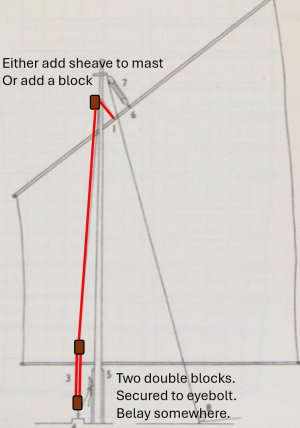
Worcester Vol 1 p72 shows this figure and says there may be up to 4 halyards. I will go with just one. The one I marked in red in the figure. I will either add a block at the top of the mast or, if it is wide enough, put a (fake) sheave through the mast.

Pic-0225.jpg

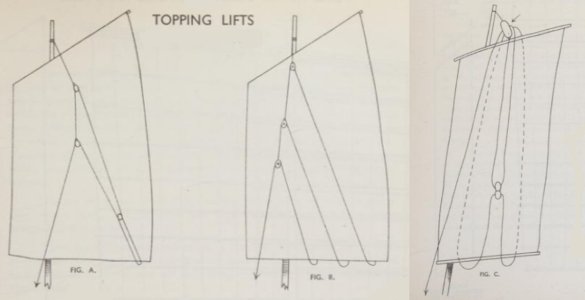
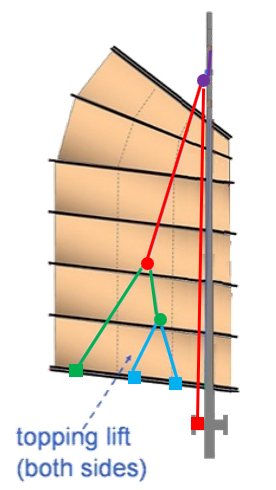
Topping Lifts:
These can be complicated. Worcester gives three examples and I am going with basically a simplified version of the middle one.
Pic-0226.jpg

Pic-0227.jpg

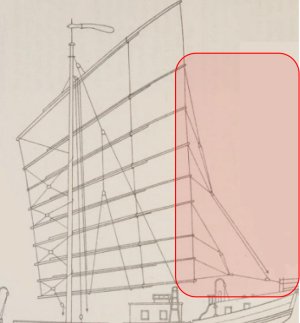
Sheets:
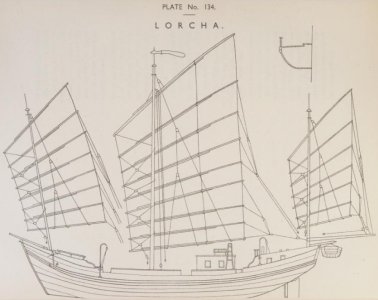
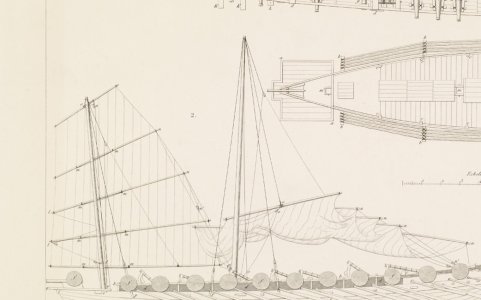
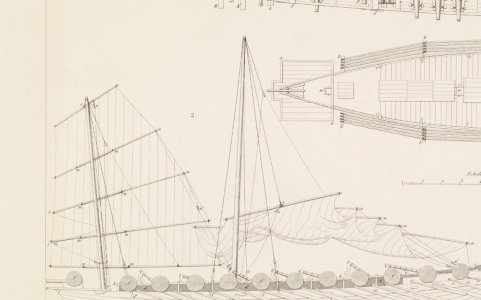
These can get well out of hand! For my simple skills, at least. This is from Worcester Vol 2 Plate 134. It is his schematic for the Lorcha.
Pic-0228.jpg

A problem with the kit is that each sail has 6 battens (well, technically, 4 plus a boom plus a yard, which I am all battens for now; 6 in total).
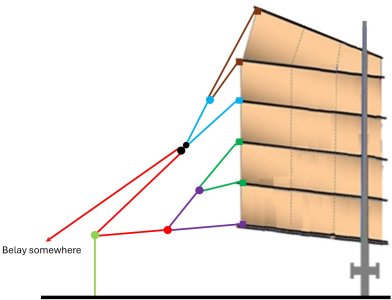
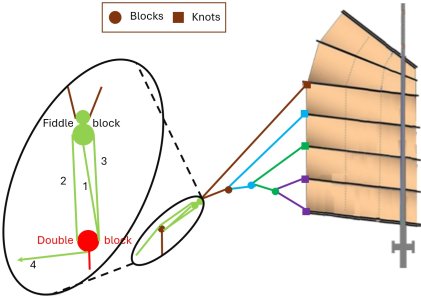
So copying the figure above is not possible. I propose to do the sheets in two groups of three battens. It is still complicated (for my mind) and on the mizzen sail it will be very difficult. But here is my tentative proposal. Requires 4 blocks and a fiddle block for each sail.


Pic-0229.jpg

As an alternative, this arrangement is slightly simpler...

Pic-0230.jpg


Luff Hauling Parrels
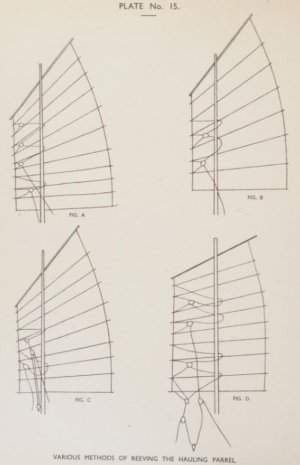
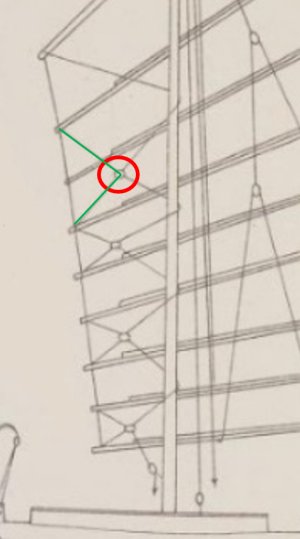
Again, these can be arbitrarily complex (at least to my eye). This is again from Worcester:
Pic-0231.jpg

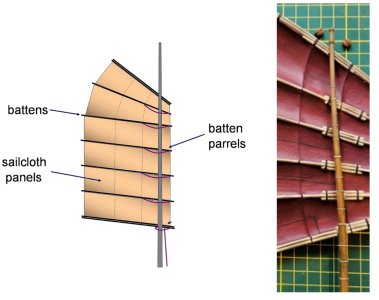
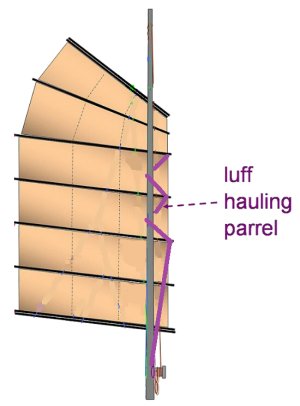
I think I prefer the diagrams on the Wikipedia page. They show separate diagrams for the batten parrels and luff-hauling parrels.

Pic-0232.jpgPic-0239.jpg

I propose to ignore the batten parrels (far left). The centre figure shows the kit part and there is some extra bamboo on the batten next to the mast. I assume this is the kit-maker's idea of something like the batten parrels. In any event, they make it hard to do anything and it might be too crowded. So I will ignore.

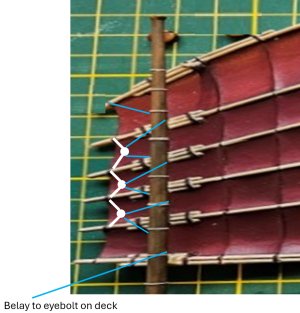
But I will try to add the luff hauling parrels. The simplest way is the spiral shown in the right diagram above. Or if we get more sophisticated we can return to Worcester:
Pic-0234.jpg

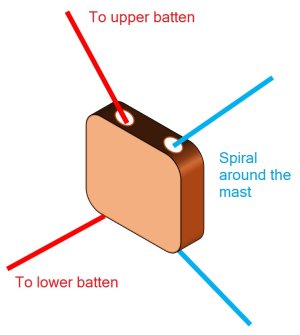
Each of the blocks here is stropped to the batten above AND the batten below That requires making a 2-legged strop/bridle for 2mm blocks. No thanks. So I propose to cheat...Kirill, do not read the next part :)

I will use a single block but use all four holes ... which usually simulates the pulley disc in the middle.

Pic-0235.jpg


Pic-0240.jpg

So now I will sort out the sizes of the blocks and lines for the three masts...and then the belaying points.


Comments sought, as always.

Cheers!
 
Hello!
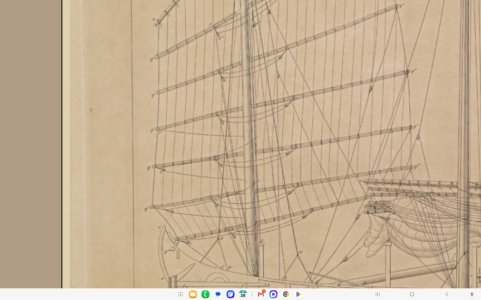
I dont see picture with tie haliyard in attached drawings ... the fall secured at the upper yard in the middle than through the lead block on the mast top and down to deck to the upper haliard block - as I can see on this drawing

Screenshot_20260927_073357_Gallery.jpg
 
Oh! Now I can see them ... looks right for me, or you can use arrangement directly which is shown in poz.7 on the drawing You posted above , on one of the picture tie halliyard blocks position shown wrong for fully hoisted up yard

Pic-0228.jpg
 
On the drawings You posted batten parrels ommited at all... only luff hauling parrels shown, You can add them in a simple form such as on the drawing in # 75, like a fixed parrels ?
but of couse adjustable parrels look much more interesting with all these ropes but much more complicated in reproducing and would requered set of small blocks of 1.5 mm or at least 2 mm size ...

Screenshot_20260928_072852_Samsung Browser.jpg
 
Last edited:
Back
Top