


• Ships of Scale has incorportated an extra level of security when you log In. Please follow on-screen prompts to acknowledge that you are not a robot via a "Check Box" or a "Pictorial Check Box Puzzle". This is needed due to higher level of AI Activity Security.
  • SUBSCRIBE TO SHIPS IN SCALE TODAY!

    The beloved Ships in Scale Magazine is back and charting a new course for 2026!
    Discover new skills, new techniques, and new inspirations in every issue.

    NOTE THAT OUR NEXT ISSUE WILL BE July/August 2026
  • Win a Free Custom Engraved Brass Coin!!!
    As a way to introduce our brass coins to the community, we will raffle off a free coin during the month of August. Follow link ABOVE for instructions for entering.

Metal mounts for blocks and dead eyes

Joined
May 23, 2026
Messages
38
Points
48

Location
Chicago IL
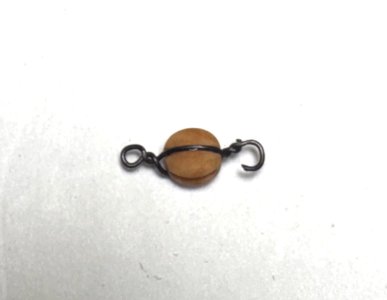
I want a metal look for securing blocks and deadeyes to the hull or other rigging parts. I have purchased some manufactured straps and rings but found them fiddly and often not the correct size, fit or look I wanted. I tried bending them myself using wire but still found it difficult to get tight fits and sharp corners around small blocks and dead eyes. I wanted something more malleable to hand form with no tools.
I tried solder and found it works perfectly. It can easily be bent tightly around any shape and be pulled and formed into any end shape or configuration needed.
It is strong enough for holding rigging tight and it can be secured with a drop of C/A.

Especially easy for small parts I have used this on 4mm blocks and 3mm deadeyes
using .015" solder. No heat just C/A.20260919_120343.jpg
 
I have purchased some manufactured straps and rings but found them fiddly and often not the correct size, fit or look I wanted.
I am curious to know if anyone has any long term experience using soldering wire.

What kind of wire did you try before the solder John? I can see brass being a pain in the neck to work with at times unless it has been annealed with something as small as a butane cigar torch. Copper is another metal many have found to be a great material with which to work. Uncoated copper wire comes in dozens of diameters and can be blackened in situ with liver of sulfur and is easy to bend and twist by hand or with a simple tweezer.
Allan
 
Allan

I did try copper and brass and they do work but for me not as well.
Even using a butane lighter and tweezers is difficult for me. I have very limited use of my right hand and need to do things a little different some times.
 
Totally understood. I would still give copper a try as it is proven and is really easy to bend and kink and even tight in knots.
Thanks John
 
On some occasions I have drilled a hole lengthways through a block (avoiding the sheaves) and inserted a shortened eyebolt. This can be opened to form a hook.
The block can be stropped with cord, with or without a loop at the other end. It worked for some 7mm double blocks at the foot of the lower yard halliards.
 
I guess I'm an 'odd duck'. I like the look.

I did go back and retry copper wire and it is about as workable
for me as solder, but again I just like the look of flat gray metal.
 
Try using annealed wire. I’ve been using it for years. Easy to work with. And unlike brass wire it already is black and doesn’t need blacking like brass wire does.
It can be purchased from Bluejacket Shipcrafters or Model Expo. In various gauges .
kli

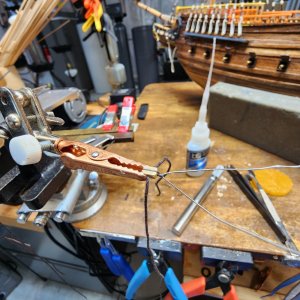
1790445597282.jpeg
A 4mm block with 28 gauge annealed wire

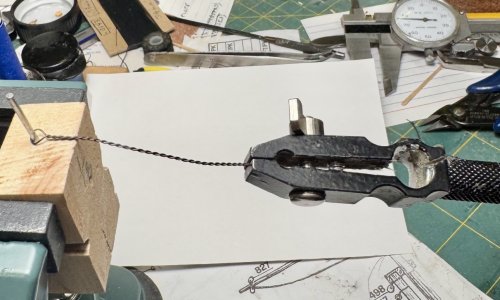
1790446215852.jpeg
A quick and fast method to twist the wire
 
I want a metal look for securing blocks and deadeyes to the hull or other rigging parts. I have purchased some manufactured straps and rings but found them fiddly and often not the correct size, fit or look I wanted. I tried bending them myself using wire but still found it difficult to get tight fits and sharp corners around small blocks and dead eyes. I wanted something more malleable to hand form with no tools.
I tried solder and found it works perfectly. It can easily be bent tightly around any shape and be pulled and formed into any end shape or configuration needed.
It is strong enough for holding rigging tight and it can be secured with a drop of C/A.

Especially easy for small parts I have used this on 4mm blocks and 3mm deadeyes
using .015" solder. No heat just C/A.View attachment 638219
Hi John, brilliant alternative, never thought of solder wire.
I have used orignary copper bell 18 awg stranded wire, which has copper coloured wire and silver copper coloured wire. Depending on desired finish diamenter, I strip the insulation off, select "x" number of strands and twist them together, then wrap around deadeye, pully, whatever.
But my favourite is Guitar Strings wire. Phosphor Bronze (0.010 - 0.047) diameter. The inner core wire I sometimes strip off the wrapped guitar wire to use the inner core wire, althought it is much harder to bend, it offers a strong tip to push into the wood planking without drilling a pilot hole first.
I appreciate this discussion, as other contributers have offered other good alternatives, cheers Richard.
 
In Bonsai copper wire is used to shape branches. This can be an issue when the gauge gets large. Regardless, much copper bonsai wire is annealed. The annealment process "softens" the wire making it much, much easier to wrap around the branches. Bending the wire supposedly brings the molecules back it to alignment and it stiffens. I used to put stripped household wire in the oven on a cookie sheet at 350 degrees. The time would depend on the gauge of the wire. I do the same to my 18, 20, and 22 gauge copper and steel wire (although annealed steel wire is available at ACE hardware) It works very well. The added advantage is that paint sticks way better to the annealed stuff than the slick glossy new stuff.
 
350 degree Fahrenheit ist way too low for annealing copper or steel. Copper and it's alloys are typically annealed at about 1000 degrees Fahrenheit (550 centigrade), steel at about 1300 degrees (700 centigrade). Copper and alloys can be quenched (better for creating a fine grained crystalline structure), steel has to cool down very slowly to keep it malleable.
 
350 degree Fahrenheit ist way too low for annealing copper or steel. Copper and it's alloys are typically annealed at about 1000 degrees Fahrenheit (550 centigrade), steel at about 1300 degrees (700 centigrade). Copper and alloys can be quenched (better for creating a fine grained crystalline structure), steel has to cool down very slowly to keep it malleable.
All I can tell you is I have done this numerous times. The hour or more on 14 gauge wire did what I needed it to. On the 18, 20, and 22 it worked even better. Gauges larger than 14 I put in my Weber grill directly on the coals until the copper turns red. I fish it out and lay it on the gravel that is my yard, (no grass in Vail, Arizona household landscaping) to cool on it's own.
 
Back
Top