• Ships of Scale has incorportated an extra level of security when you log In. Please follow on-screen prompts to acknowledge that you are not a robot via a "Check Box" or a "Pictorial Check Box Puzzle". This is needed due to higher level of AI Activity Security.
  • SUBSCRIBE TO SHIPS IN SCALE TODAY!

    The beloved Ships in Scale Magazine is back and charting a new course for 2026!
    Discover new skills, new techniques, and new inspirations in every issue.

    NOTE THAT OUR NEXT ISSUE WILL BE July/August 2026
  • Win a Free Custom Engraved Brass Coin!!!
    As a way to introduce our brass coins to the community, we will raffle off a free coin during the month of August. Follow link ABOVE for instructions for entering.

Rudder Construction

Joined
May 9, 2024
Messages
5,895
Points
738

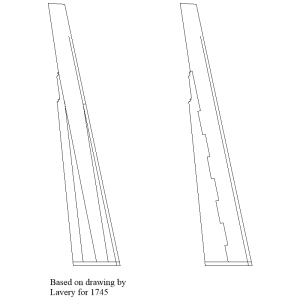
I am looking for contemporary based information on the construction of rudders for 5th rates in 1744. I read that the bottom protective piece came about in 1745 so may not have been used. Brian Lavery provides a couple drawings, one being from 1745 but as the new Establishment came out that year I am not sure it is appropriate for 1744. I do not recall where I read about the construction as shown in the rudder on the right below but would like to know which of these would be appropriate for 1744 or if there was another standard construction method used. TIA
Rudder design.PNG
 
Intresting topic Allan.
For a Royal Navy 44gun 5rate actually being built in 1744, i would not use the 1745 establishment as the governing standard. Appropriate baseline is the 1741 revision of the 1719 establishment, and there are surviving contemporary admiralty plans dated 1744 for exactly these ships.
So if is a ship buil in 1744, i would regard 1745 Establishment as a later development, not as default construction specification.
Lavery describes normal rudder as being constructed from four principal pieces, joined by tables plys coaks. Central main piece was normally hard oak, forward piece was frequently elm, and after pieces could be fir.
Guessing as always...
He says that narrow strips were often applied to lower and after edges, called sole and back, to protect the main structure.
You would need to find someone with access to more direct information on a books. Most of yopics it is likely just speculation, as I’ve often seen ships built hastily and not according to the proper plans, in reason, due to war, a lack of proper wood, or even the death of one of the constructors.
One advantage is that access to British plans and data is more widespread than, say, French or Spanish ones. There is no single standard.
All it takes is for a ship to sail to the Pacific and stop for a quick repair, and the regional standard is no longer maintained.
So...
 
Allan,

Changes in the Establishments did not appear fully developed from nowhere. They were were codifying changes that the more progressive navy yards had already been practicing. Neither the Admiralty Board or the Navy Board were populated by forward thinkers. It would take a fairly thick plank to wack them upside the head to get them to change.
I would pretend that Fowey was build by a progressive yard or that being on the North American station it may have had its rudder replaced in Charleston with the colonials being favorable to the new. I would pick the 1745 design.
 
Hmm.
Standard or establishments is adopted in old world, and how long would it take for full standardization to reach ships built in colonies?A voyage between them takes 6–8 weeks. Factor in standardization and the retraining of craftsmen, and you are looking at a matter of years. I am also firmly convinced that ships were redesigned during construction...
 
Thanks Kuba and Dean!
1741 revision of the 1719 establishment, and there are surviving contemporary admiralty plans dated 1744 for exactly these ships.
Kuba,
Sadly, none of the plans I have researched for any rates between 1719 and 1745 show rudder construction. This includes the contemporary plans of the group that included Fowey. 1719, 1741 and 1745 Establishments give details on the rudder scantlings but nothing on construction that I could find so far. The sole piece is mentioned in the 1745 Establishment, The Shipbuilder's Repository and The Elements and Practice of Naval Architecture but no mention in the 1719 Establishment. Do you have any contemporary based sources showing this? Where can I find a copy of the 1741 Establishment? I checked ADM/170 at RMG but it only had the 1719 Estbablishment. The NA in Kew may have it but it is my understanding that you have to go there to photograph the documents. Any help you can lend is greatly appreciated.

Dean, from what I could find and discussing this with the team at Key Biscayne, it is believed she sank with her original rudder even though she frequented Charleston and other ports as far north as Boston in her short career. At only four years old and never having had a grounding or battle damage, there would have been no need for a new rudder.

Lacking better information I will likely go with the Lavery version, but I have months before hanging it so if anyone finds better information that would be phenomenal. I did go through Olivier's notes in his observations in English shipyards in 1737 and he gives descriptions and scantlings but as to construction, wrote that it was similar to the method used on French vessels.

Allan
 
Last edited:
I am also firmly convinced that ships were redesigned during construction...
I agree, in that establishments may not have always been followed that closely..

Who was enforcing the "establishments"..

My guess is that " establishments = We would like for you to do it this way. "


As far as the rudder, on my models, I like to go with what I think looks good.
 
Thanks Kuba and Dean!

Kuba,
Sadly, none of the plans I have researched for any rates between 1719 and 1745 show rudder construction. This includes the contemporary plans of the group that included Fowey. 1719, 1741 and 1745 Establishments give details on the rudder scantlings but nothing on construction that I could find so far. The sole piece is mentioned in the 1745 Establishment, The Shipbuilder's Repository and The Elements and Practice of Naval Architecture but no mention in the 1719 Establishment. Do you have any contemporary based sources showing this? Where can I find a copy of the 1741 Establishment? I checked ADM/170 at RMG but it only had the 1719 Estbablishment. The NA in Kew may have it but it is my understanding that you have to go there to photograph the documents. Any help you can lend is greatly appreciated.

Dean, from what I could find and discussing this with the team at Key Biscayne, it is believed she sank with her original rudder even though she frequented Charleston and other ports as far north as Boston in her short career. At only four years old and never having had a grounding or battle damage, there would have been no need for a new rudder.

Lacking better information I will likely go with the Lavery version, but I have months before hanging it so if anyone finds better information that would be phenomenal.

Allan
Primarily, i take British knowlege from book "The Elements and Practice of Naval Architecture", chapter IV, published in 1805, though it is somewhat difficult to decipher. The information is presented in a rather crude manner, often requiring one to make inferences or piece together various threads.
You will find there all construction techniques, link to the archive is below.

 
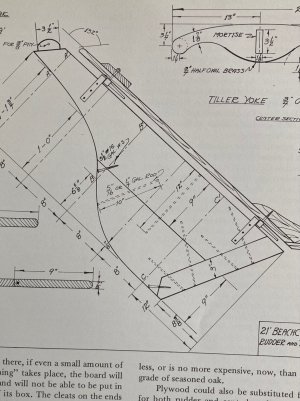
I don't understand the benefit of the staggered joint on the right-hand rudder in the 1st post. Rudders made up of multiple boards have the pieces edge bolted as shown on the figure below (from Building Classic Small Craft by John Gardner). This shows a rudder for a small boat but the construction method is basically the same. There is no need for the notched joint since the bolts (in the example below galvanized rod) prevent longitudinal movement between the boards. I think that the left-hand representation is more likely accurate.
Fair winds!

rudder.jpeg
 
Where can I find a copy of the 1741 Establishment?
Allan,
I am fairly certain that you probably already have a copy of the 1741 Establishment - if you have a copy of Rif Winfield - British Warships in the Age of Sail 1714-1792 .
It is spread over the entries for every rate. It was only an adjustment to the dimensions of each class from the 1733 Establishment. I cannot find the exact statement that confirms this.
The reference librarian at Kew might be able to provide a yea or nay for this.
 
he Elements and Practice of Naval Architecture"
I would use Steel's work for most builds after about 1790 as well as scantlings for boats as it is a great source for the appropriate period. Unfortunately it is not reliable for my 1744 project. Looking at scantlings from 1719, 1745, 1750, 1788 and Steel, they are all quite different so not much help for a ship built 50 years earlier.
British Warships in the Age of Sail 1714-1792
Thanks, now I have another item for the Christmas list!!!! Dimensions are not the problem as I have the contemporary drawings of the rudder and keel as well as scantlings from the 1719 and 1745 Establishment so I know the taper of the thickness goes from about 18" at the hance to match the siding of the keel at the aft end which tapers from 14" in the dead flat to 9 1/4" at the aft end.

This shows a rudder for a small boat but the construction method is basically the same.

Andy, Many thanks for your reply. Unfortunately, modern rudder designs are not contemporary to the 1744 rudder and the archeological team (and me too :)) wants the model to be built to duplicate the actual ship as closely as possible using the wreck and contemporary information. The actual rudder would be the best source but it has not been found at the wreck site and will likely not be found unless another hurricane uncovers it. The tabled construction was actually more complex than can be seen in the drawing I posted. I just cannot find any information to confirm if this style of construction was used on HMS Fowey or other ships in the group.
Allan

 
I would use Steel's work for most builds after about 1790 as well as scantlings for boats as it is a great source for the appropriate period. Unfortunately it is not reliable for my 1744 project. Looking at scantlings from 1719, 1745, 1750, 1788 and Steel, they are all quite different so not much help for a ship built 50 years earlier.

Thanks, now I have another item for the Christmas list!!!! Dimensions are not the problem as I have the contemporary drawings of the rudder and keel as well as scantlings from the 1719 and 1745 Establishment so I know the taper of the thickness goes from about 18" at the hance to match the siding of the keel at the aft end which tapers from 14" in the dead flat to 9 1/4" at the aft end.


Andy, Many thanks for your reply. Unfortunately, modern rudder designs are not contemporary to the 1744 rudder and the archeological team (and me too :)) wants the model to be built to duplicate the actual ship as closely as possible using the wreck and contemporary information. The actual rudder would be the best source but it has not been found at the wreck site and will likely not be found unless another hurricane uncovers it. The tabled construction was actually more complex than can be seen in the drawing I posted. I just cannot find any information to confirm if this style of construction was used on HMS Fowey or other ships in the group.
Allan

Allan,
I don't know if it will help you, but there is a pretty decent pic of the construction of the rudder for the 1742 Granado in the Anatomy of the Ship series. If you don't have it, I can take a pic of that part and post it for you if you think it would help. :)
 
Unfortunately, modern rudder designs are not contemporary to the 1744 rudder
Agreed. But the properties of wood have not changed. And the construction of the rudder that I presented (from a 19th century Beachcomber-Alpha dory) is basically the same as your Lavery rudder: boards edge-bolted together with a cleat at the bottom. I was simply questioning the benefit of tabling for construction of a rudder. If your continuing research remains inconclusive, I would choose to use a construction that has proven its worth over centuries. Fair winds!
 
Back
Top