

• Ships of Scale has incorportated an extra level of security when you log In. Please follow on-screen prompts to acknowledge that you are not a robot via a "Check Box" or a "Pictorial Check Box Puzzle". This is needed due to higher level of AI Activity Security.
  • SUBSCRIBE TO SHIPS IN SCALE TODAY!

    The beloved Ships in Scale Magazine is back and charting a new course for 2026!
    Discover new skills, new techniques, and new inspirations in every issue.

    NOTE THAT OUR NEXT ISSUE WILL BE July/August 2026
  • Win a Free Custom Engraved Brass Coin!!!
    As a way to introduce our brass coins to the community, we will raffle off a free coin during the month of August. Follow link ABOVE for instructions for entering.

Scratch Build of the St. Brendan

  • Thread starter Thread starter DMDay
  • Start date Start date
  • Watchers Watchers 8
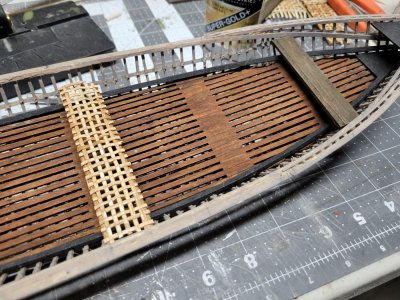
Have been exploring what the seating thwarts might have looked like on a 6th century curragh. The picture here shows a solid wood seat in a one-man modern coracle--note the "woven" floorboards laid over the frames. As I work on this project, it seems that curraghs may have been little more than very large "baskets" woven together with hides stretched over the frames. The question is whether the seating thwarts were solid wood as in this picture or would they have been more like wicker? Here is a picture of two possibilities--one solid wood, one from an old piece of wicker I found. I suspect the wicker thwarts would not have been strong enough to provide structural strength.
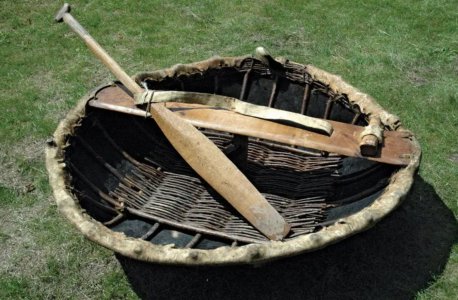
Coracle.jpg

thwarts2.jpg
 
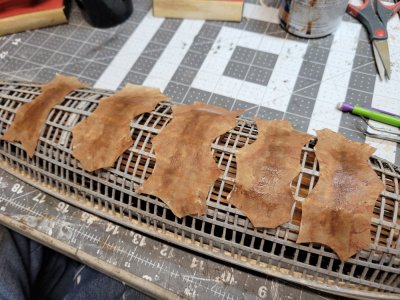
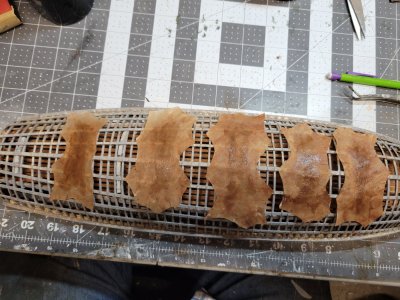
These samples were cut from sail span and then stained. For the model, I'll be cutting the sail span and applying it to the hull with a glue wash before starting the staining process. These samples are what I want the hides to look like after completion. Also will be adding dope to stretch and smooth the hides hopefully providing some translucence.
 
Thanks for the link. Since I'd never built a boat like this one before, it has turned into a real learning project. There are many thing I would do differently...and for that reason, I am considering giving it another try once this one is completed. The .7/1 mm leather you linked looks promising and is something I might consider next time.

on curragh.jpeg
 
The .7/1 mm leather you linked looks promising and is something I might consider next time.
Was the leather shrunk/tightened on these boats? If they were, silk span may be worth a try as it will shrink tight on the framing just like on a model plane.
Allan
 
August Crabtree was a very talented and obsessive American ship model builder. His dozen or so models from various historical eras now reside in a purpose built room at the Mariners Museum at Newport News, Virginia.

The first model in the series features the well known caveman crossing the river on his log. According to the museum, for the caveman’s primitive clothing, Crabtree trapped a mouse, skinned it, and tanned the skin.

Roger
 
Was the leather shrunk/tightened on these boats? If they were, silk span may be worth a try as it will shrink tight on the framing just like on a model plane.
Allan
Naturally so, I think. Most modern curraghs have a tightly stretched skin. Given 6th century materials, I imagine the covering wasn't skin-tight, but it had to be somewhat tight to sail/row and to prevent leakage.
 
Rawhide will shrink itself tight when streched and sewn (soaking) wet over a framework. For watertightness it must then be liberally greased inside and out when all is dry again. See Severin.
 
August Crabtree was a very talented and obsessive American ship model builder. His dozen or so models from various historical eras now reside in a purpose built room at the Mariners Museum at Newport News, Virginia.

The first model in the series features the well known caveman crossing the river on his log. According to the museum, for the caveman’s primitive clothing, Crabtree trapped a mouse, skinned it, and tanned the skin.

Roger
Living in the country, we catch an occasional mouse. However, I can't imagine skinning one...I'd rather feed them to the fox that lives in our woods.

20260904_085821[1].jpg
 
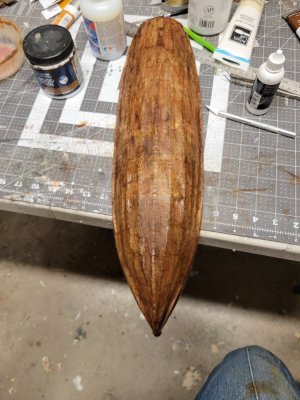
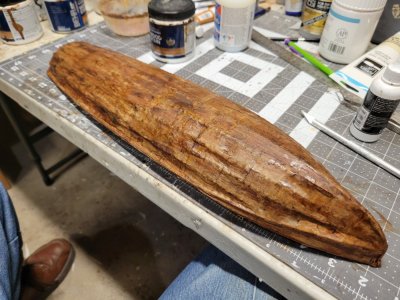
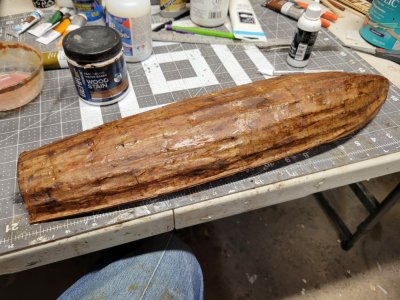
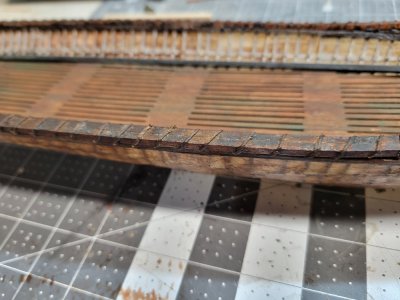
Thanks for the suggestions. I will keep them in mind if I decide to repeat this project with all I've leaned and all the great suggestions. Meanwhile, here is where I am now.

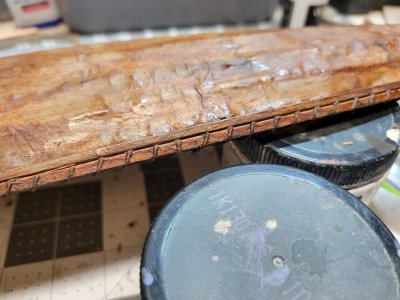
I added the sail span in about 45 sections cut to form to the shape of the frames and stringers. Then I added a thin wash of light stain and sealed it all with dope. The sail span shrunk nicely revealing the stringers and underlying frames. Then I continued with more stain washes to darken the "hides". I added dark stain along several of the seams to bring them out. Then sealed with a mat varnish. Finally, added some highlights using enamel varnish mixed with walnut stain to create highlights where there would be excess grease from sealing the seams.

20261002_084248[1].jpg

20261002_084222[1].jpg

20261002_084213[1].jpg
 
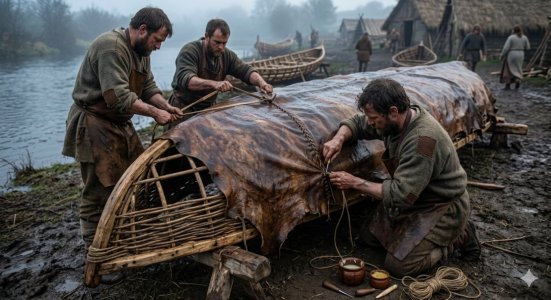
There are some differences of opinion about how the ox hides would be attached to a 6th century curragh. Many sites think that the pieces were cut to fit the frame, then sewn together and the seams liberally greased inside and out to prevent leakage. Another possibility, one that eliminates any external seams (and thus any need for waterproofing) was called a tunnel stitch or a blind butt seam. This instruction is from the Leathersmith site:

This specialized leatherworking technique protects the boat from leaking:
  • The Technique: Rather than pushing a needle straight through the leather from one side to the other, harness makers used a highly curved awl to punch holes that entered from the flesh side (the interior facing side) of the thick hide, curved halfway through the cross-section of the leather, and exited out of the butt edge (the side rim).
  • The Seam: When two hides were placed edge-to-edge, the curved holes aligned perfectly. The flax thread was then threaded through this hidden internal channel.
  • The Result: Because the awl and thread never penetrated the "grain side" (the smooth, outer waterproof layer facing the water), there were no visible stitch holes on the outside of the boat, creating a naturally waterproof joint.
While there are no early examples of curraghs from the 6th century, there is much evidence from Irish crannogs (lake dwellings) and monastic sites dating from the 6th century onward consistently showing advanced leather craft, utilizing animal sinew or waxed linen threads pulled through awl-pierced channels to construct highly durable, hidden seams.

My model shows no seams joining the hides from outside the boat. (Note, I didn't think of this until recently and so have no way to suggest or show those seams on the internal hull. Maybe next time....)
 
Last edited:
Back
Top