


• Ships of Scale has incorportated an extra level of security when you log In. Please follow on-screen prompts to acknowledge that you are not a robot via a "Check Box" or a "Pictorial Check Box Puzzle". This is needed due to higher level of AI Activity Security.
  • SUBSCRIBE TO SHIPS IN SCALE TODAY!

    The beloved Ships in Scale Magazine is back and charting a new course for 2026!
    Discover new skills, new techniques, and new inspirations in every issue.

    NOTE THAT OUR NEXT ISSUE WILL BE July/August 2026
  • Win a Free Custom Engraved Brass Coin!!!
    As a way to introduce our brass coins to the community, we will raffle off a free coin during the month of August. Follow link ABOVE for instructions for entering.

What Brands Make Higher End Limited Edition/"Museum Quality" Model Kits and How Different Are They from a Standard Kit?

The Hudson River Maritime Museum in Kingston, NY, displays numerous ship and boat models done by both professionals and hobbyists, some models appear to be straightforward kit based. If they will have it, I hope to donate my 1846 Danube River Paddle Steamer to the Museum some day if they will have it. For those who have never visited the Museum or at least it’s website, you will be in for a treat if you do.
 
Since design is under discussion, let me tell you a little anecdote from the trenches of kit development.

Ben Lankford was a naval architect who designed many of our kits, especially the conversions of solid-hull kits to planked hulls. And when I say naval architect, I don’t just mean his degree. He designed battleships for the US Navy.

When he created his first kit, Marc Mosko (aka The Boss) asked him:
“Ben, what about the model? You have to deliver a finished model so we know the kit works.”
“Marc, I designed battleships. Do you think I built them before handing them over to the Navy?”

Case closed.
 
My thoughts. “Museum Quality” resides in the attention to detail in the pieces/parts and their assembly. You can assemble a quality model from an average kit by paying attention to the details. One of the most important issues in quality is the attention to scale. So many kits just toss in blocks, for example, that are not to scale. I am a kit modeler. I go to mid-priced kits ($500 range) and then pay attention to the fine details of the assembly. Above all, make sure every part is to scale. For example, a kit will toss in two sizes of rigging blocks when fine details needs six. Thus, in my opinion, a more expensive kit is one that emphasizes scale with enough pieces/parts to achieve it.
 
Hi all,

New to the forum and ship modeling (but not woodworking and modeling more broadly).

I was wondering if anyone had any insights or experience with some of the higher end model kits, the difference in quality, and who makes them. Specifically, I am thinking of Occre's Limited Editions (Victory/Soleil Royal) and Agora (Constitution/Cutty Sark).

For those of you who have completed these models, is there a significant difference in quality and difficulty for these kits in the roughly $2,000 price point? Are there any other brands that offer these so-called "Museum Quality" model kits?

Thanks!
Sam
At the end of the day, what makes a high quality model is how many hours you are willing to put into it. To make a top model requires a lot of research into the construction and fine detail and then making sure that is then reproduced at the scale of the model as accurately as possible. Looking through some of the finely made models on SOS, you can appreciate how much skill and effort has gone into making them, often 1000's of hours of work over many years.

Many of the so called "high-end" kits may have better instructions, higher quality wood, lost wax castings, etched pieces and good rope, but from what I see in them, it is not 2, 3 or 4x the price premium over a good kit that you can upgrade yourself at a fraction of the price. Out of an over-priced box is no guarantee of building a high end model.
 
Since design is under discussion, let me tell you a little anecdote from the trenches of kit development.

Ben Lankford was a naval architect who designed many of our kits, especially the conversions of solid-hull kits to planked hulls. And when I say naval architect, I don’t just mean his degree. He designed battleships for the US Navy.

When he created his first kit, Marc Mosko (aka The Boss) asked him:
“Ben, what about the model? You have to deliver a finished model so we know the kit works.”
“Marc, I designed battleships. Do you think I built them before handing them over to the Navy?”

Case closed.
I think maybe it's more feasible to build a model based on a preliminary design, and iterate that, than it is to do the same with a real battleship. It's economics that dictate the decision, which is understandable. Kits could presumably be iterated after first release, based on feedback though. I know sometimes they are, but not as a rule. I think Watton iterates his kits and instructions with agility.

It's not a big deal as long as the kit is buildable with a reasonable amount of allowance for kit error by the builder. I know such things are considered "part of the hobby". But I'm probably not the only one curious why parts in kits that have been released for years are still substantially wrong. Recent example I've worked through is the beak on the lobster smack. This same issue is reported in build logs, so it's not just me. I didn't realize it was wrong until after painting.

Probably more than half of the "drawn to actual size" diagrams are not drawn to actual size.

An instructions errata insert seems easily feasible for established, well-reported kit errors.

All that said, I love Model Expo! The customer service is top notch, the products and prices are good, and the ads I get in email (every day) are actually usually pretty entertaining.
 
While talking about high end kits, one manufacturer offers their kits in both pearwood and boxwood, with the boxwood version more costly. Might there be a good reason for this?
 
The cost of boxwood is higher than the cost of pear.
Allan

it also depends on the source if you are a kit maker in Europe or China and using imported boxwood wood from South America the kit is going to cost more. As an example Cherry grows everywhere where i live and it is used for firewood. On the west coast it commands a high price. so a kit maker using Cherry on the west coast has higher costs as opposed to a kit maker on the east coast using local wood.
 
Most kits are walnut
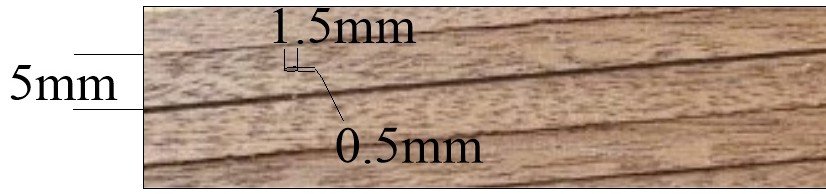
Sadly that is true, and therein lies a problem. I THINK most of them are sapele (or similar species) which is a porous, brittle, West and Central African wood that is not suited for planking but it is cheap, so popular with many kit manufacturers. At our scales, seeing the thousands and thousands of these small holes in the wood would be like huge holes in full size planks. The elongated pores average about 1.5mm X 0.5mm. Assuming 1:48 this would be a hole or large dent about 72mmX 24mm (3" X 1") . At 1:96 it would be 6"X3" The ship would probably sink as soon as it hit the water.
Allan

The photo below is from a build log of a kit from a popular manufacturer.
1791657930142.jpeg
 
Sadly that is true, and therein lies a problem. I THINK most of them are sapele (or similar species) which is a porous, brittle, West and Central African wood that is not suited for planking but it is cheap, so popular with many kit manufacturers. At our scales, seeing the thousands and thousands of these small holes in the wood would be like huge holes in full size planks. The elongated pores average about 1.5mm X 0.5mm. Assuming 1:48 this would be a hole or large dent about 72mmX 24mm (3" X 1") . At 1:96 it would be 6"X3" The ship would probably sink as soon as it hit the water.
Allan

The photo below is from a build log of a kit from a popular manufacturer.
View attachment 642664
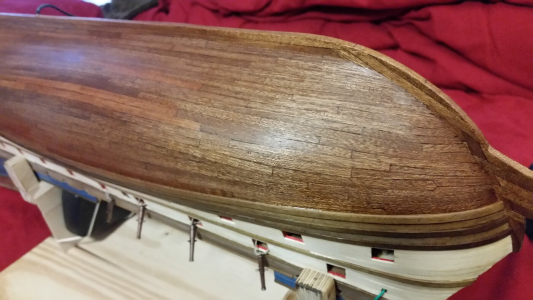
Walnut is great for railings, wales, planking, and fittings because of it's strength but it does not like to bend and the grain can sometimes be a bit too large. Sapele and it's close cousin mahogany have great color but coarse grain, and the grain coloration has bands and speckles that mask plank lines. It looks goo from a distance but has complex contrasts in shade up close.

Mahogany planked hull:
1791658761924.png

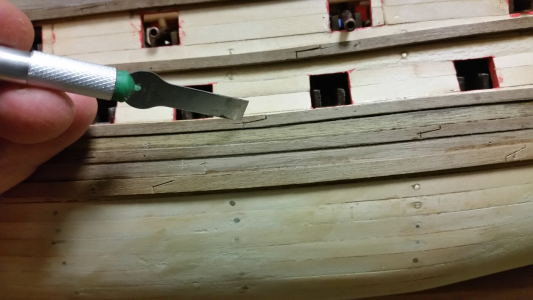
Walnut (bare wood) wales. Dark walnut, although more plain than mahogany or sapele, appears more realistic on a hull. Mahogany or sapele (which often appear identical) looks prettier, but not realistic in terms of grain color and coarseness, being too large in scale for a the model. If you want the artistic look, mahogany is great. If looking for realism, such as a movie film model, walnut is more appropriate. Most kits offer sapele these days. I prefer to replace it with cherry to keep the red-brown color, but tone down the grain so you can see the plank lines better.
1791659166761.png
 
:)
I think “museum quality” is a rather elastic definition. There are lots of museums, and they are all different. I’ve seen fairly primitive models exhibited simply to give visitors an idea of the general appearance of a historical ship. And I’ve seen genuine works of art exhibited at the Rijksmuseum.

By the way! You can compare the quality of a kit with a Rijksmuseum model, at least here:

https://www.rijksmuseum.nl/en/colle...-Waterschip--3113682fa96c74947e4922a39d892e79

and

https://kolderstok.com/en/collections/wijdschip/products/wijdschip-smalschip

These are certainly different vessels, but they are broadly similar in type. And you can see that, in principle, the differences are not that great. If you want to, you can absolutely build a model from an inexpensive kit in the style of the Rijksmuseum model. Just add a little effort and some extra details. :)
 
My house is a museum. It contains ancient relics such as myself. I still have the Dan Dare pocket watch I was bought at age 7, the treadle scroll saw I was bought aged 10 and other ridiculous "treasures". Some of the ornaments and crockery date back to grandparents. I am satisfied with (most) of the kits I have built.
Ergo they are museum quality.
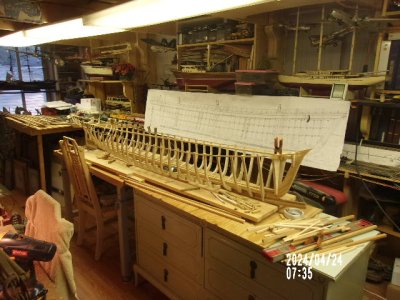
Dear Ancient Relic: I would have saved a lot of relics from my younger years too but my parents had other ideas. Seems that I was destined to become one of the unfortunate souls that were sent off to military school while my parents moved from Massachusetts to Florida. All my "stuff' was never seen again. However my collection resumed upon returning home years later so now I have all kinds of ships,cars,airplanes, unbuilt kits and half finished scratch models along with a room full of the stuff you have to have to do all those builds. My question for you is Just how old does a house have to be to be considered a museum? And how old must an "ancient relic" be to qualify as museum quality. My museum attached.

100_0008 - Copy.JPG
 
I think maybe it's more feasible to build a model based on a preliminary design, and iterate that, than it is to do the same with a real battleship. It's economics that dictate the decision, which is understandable. Kits could presumably be iterated after first release, based on feedback though. I know sometimes they are, but not as a rule. I think Watton iterates his kits and instructions with agility.

It's not a big deal as long as the kit is buildable with a reasonable amount of allowance for kit error by the builder. I know such things are considered "part of the hobby". But I'm probably not the only one curious why parts in kits that have been released for years are still substantially wrong. Recent example I've worked through is the beak on the lobster smack. This same issue is reported in build logs, so it's not just me. I didn't realize it was wrong until after painting.

Probably more than half of the "drawn to actual size" diagrams are not drawn to actual size.

An instructions errata insert seems easily feasible for established, well-reported kit errors.

All that said, I love Model Expo! The customer service is top notch, the products and prices are good, and the ads I get in email (every day) are actually usually pretty entertaining.
Thank you for all comments -and the compliments!
About the emails... I'm guilty as charged ;)
 
Back
Top