



Those guys are ripped! Better not let the gals with the boobs get sight of them. Won’t be able to keep anyone in place.

 |
The beloved Ships in Scale Magazine is back and charting a new course for 2026! Discover new skills, new techniques, and new inspirations in every issue. NOTE THAT OUR NEXT ISSUE WILL BE July/August 2026 |
|
 |
As a way to introduce our brass coins to the community, we will raffle off a free coin during the month of August. Follow link ABOVE for instructions for entering. |
|

And one would need to build yet another ship to have enough space for all their offspring!Those guys are ripped! Better not let the gals with the boobs get sight of them. Won’t be able to keep anyone in place.

Blender 5.2.2. LTS. I'm still waiting for the Blender Devs to make the boolean functions work better.Very nice... Is Blender 4.4 ?


Is this something you know them to be working on?Blender 5.2.2. LTS. I'm still waiting for the Blender Devs to make the boolean functions work better.
I’m a beginner too, and most of my models rely on hard surface modeling techniques which are slow. The Boolean functions, unify, and difference, are the ones I use most, but they are very prone to making a mess out of your polygon mesh, leaving unfused polygons, overlapped, polygons, and internal geometry that has to be cleaned up manually. The functions themselves need to be improved upon. Most of the modeling work I do is clean up because of these messy functions. I have no idea if the developers are improving on the boolean functions, but they really need an overhaul. They often do more damage than good.Is this something you know them to be working on?
I'm really a beginner, but I have had no trouble adding and subtracting simple shapes.
Do your problems have to do with more complex objects like you are showing here?
Lees news, more stability... First time i used Blender 3,2, next i had breake... Now 4.4... ...Relearning the interfaceI’m a beginner too, and most of my models rely on hard surface modeling techniques which are slow. The Boolean functions, unify, and difference, are the ones I use most, but they are very prone to making a mess out of your polygon mesh, leaving unfused polygons, overlapped, polygons, and internal geometry that has to be cleaned up manually. The functions themselves need to be improved upon. Most of the modeling work I do is clean up because of these messy functions. I have no idea if the developers are improving on the boolean functions, but they really need an overhaul. They often do more damage than good.



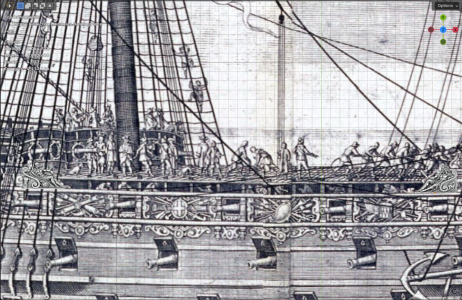
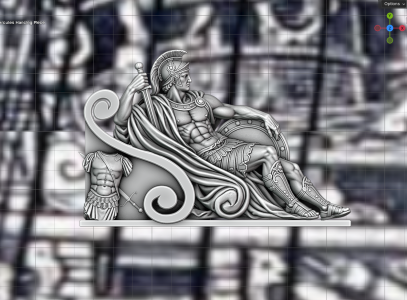
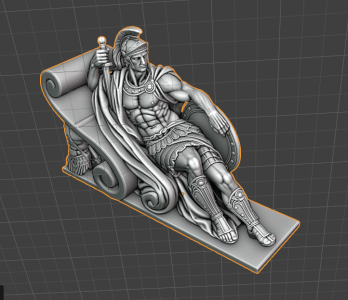
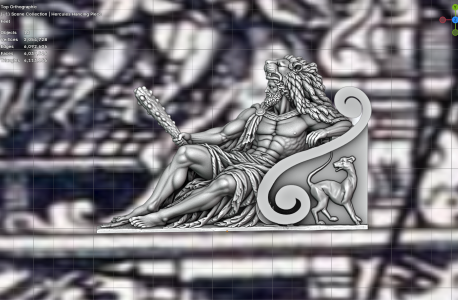
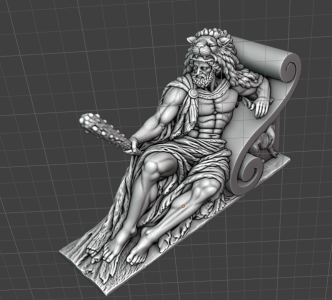
You copied my abs! Were you in my gym during my work out? Actually, those are excellent looking pieces. By the way, what does hancing mean?The port side hancing pieces for the waist were done, Aolus and Neptune, incorporating the AI generated scupltures.
View attachment 644805
View attachment 644806
View attachment 644803
That was YOU? Daammmnn!You copied my abs! Were you in my gym during my work out? Actually, those are excellent looking pieces. By the way, what does hancing mean?

The issue of round tuck versus square tuck was pretty much solved with the research of many other persons before myself. HMS Sovereign of the Seas had a round tuck just like many other large vessels of English construction at the time. The controversy hinged on the painting of Peter Pett and HMS Sovereign of the Seas. The painting itself shows planks with curves and directions of a round tuck, but also featured what appeared to be a hard line close to where the edge of a square tuck would be. Maybe believe this was an artists distortion. Square tuck was considered obsolete by the English by this time, although continental ships carried it a bit further into 1630s. Willem van de Velde’s drawings of HMS Royal Sovereign (Sovereign of the Seas renamed) and other English ships show a round tuck. If you read some of the early pages in my Bill, log, you’ll see more information on the square versus round, talk controversy.I am more interested about the issue of round-tuck versus square-tuck in the Sovereign of the Seas. Can you direct me to how you dealt with this issue? Thanks!
Thank you for responding ! I appreciate it very much. I was aware that the issue was largely seen favoring the round tuck but that virtually every producer of the Sovereign depicted the ship with a square tuck. I will gladly go back to find your solutions!The issue of round tuck versus square tuck was pretty much solved with the research of many other persons before myself. HMS Sovereign of the Seas had a round tuck just like many other large vessels of English construction at the time. The controversy hinged on the painting of Peter Pett and HMS Sovereign of the Seas. The painting itself shows planks with curves and directions of a round tuck, but also featured what appeared to be a hard line close to where the edge of a square tuck would be. Maybe believe this was an artists distortion. Square tuck was considered obsolete by the English by this time, although continental ships carried it a bit further into 1630s. Willem van de Velde’s drawings of HMS Royal Sovereign (Sovereign of the Seas renamed) and other English ships show a round tuck. If you read some of the early pages in my Bill, log, you’ll see more information on the square versus round, talk controversy.
I tore apart and restructured the stern on my model to form a round tuck. See my build log for detail details.
Lesson #1: never trust the research of kit makers. Do your own homework and discover the details and let the kit be just the starting point.Thank you for responding ! I appreciate it very much. I was aware that the issue was largely seen favoring the round tuck but that virtually every producer of the Sovereign depicted the ship with a square tuck. I will gladly go back to find your solutions!
It's a lesson I learned long ago. Consider the cannons . . . they are usually a uniform size not respecting usual practice of placing larger guns lower in the hull while lighter guns are higher. Blocks are frequently of incorrect scale, while deck furniture is often from a stash used for ships of differing scales. Yes, check details and adjust. I hadn't been aware that the issue of round versus square tucks in 17th century English warships had been largely resolved. I am pleasantly surprised.Lesson #1: never trust the research of kit makers. Do your own homework and discover the details and let the kit be just the starting point.
The hancing figures of Mars and Hercules on the starboard side of the waist were rebuilt using the AI generated sculptures.
View attachment 645112
View attachment 645113
View attachment 645116
View attachment 645114
View attachment 645115
For each hancing figure, the AI took 30 seconds to generate a 2-D computer image, which was fed into Meshy, which took 1 minute to render into a 3-D STL file, then I reshaped the figure slightly, and added the icon objects and railing that each figure rests upon and merged them into the AI figure, which took about 1-2 hour (I work slow). The result merges elements I modeled with the AI figure, and then you do about half and hour's worth of polygon cleanup to remove mesh flaws and reduce the high polygon count to a workable level without sacrificing details.Just for my curiosity... approx. how much time do you need to create those figures shown in your last post?
János