• Win a Free Custom Engraved Brass Coin!!!
    As a way to introduce our brass coins to the community, we will raffle off a free coin during the month of August. Follow link ABOVE for instructions for entering.
  • SUBSCRIBE TO SHIPS IN SCALE TODAY!

    The beloved Ships in Scale Magazine is back and charting a new course for 2026!
    Discover new skills, new techniques, and new inspirations in every issue.

    NOTE THAT OUR NEXT ISSUE WILL BE MARCH/APRIL 2026

Help with warping hull second strips

Joined
Jul 28, 2023
Messages
6
Points
13

Location
Salt Lake City, Utah, US
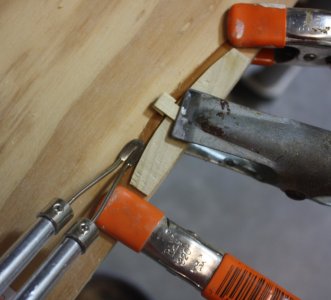
Could anyone suggest a good technique to prevent second planking strips (.6mm thickness) from warping laterally after applying Titebond II wood glue? I've tried slightly extra and slightly less glue but inevitably as I apply the strips to the hull the edges curl and refuse to stay flush to the hull. Given the curves of the hull, I haven't been able to consistently use clamps but am still hoping there's a workaround. Thanks a million for any tips and thoughts!
 
You can use the Titebond II as a contact cement. Apply a total coverage, but just wet layer of the PVA to both meeting surfaces. Let the PVA polymerize - i.e. wait 24 hrs. Place the veneer and iron it. The heat activates the PVA to bond.
Be careful with the heat.

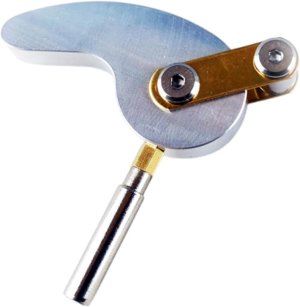
An excellent bender is the now extinct aeropiccola benderaeropiccola bender.jpg

On Amazon is a - from the convoluted description: Chinese substituteChinese aeropiccola bender.jpg
"Wood Board Bending Pliers Boat Models Making Tool Wooden Strips Bender Part for 936 Series Soldering Irons"
Same school as AYBABTU ?

You are on your own for what a 936 series soldering iron is or where to get one.
Something in-line like a dimmer switch for to control the temp is probably prudent.

Now for the unpleasant part: the veneer that you have been provided.
The economical way to produce veneer is to rotary cut it. Turn the log against a blade and peal off one continuous sheet.
Like a roll of paper towels. The veneer is cupped. It is always going to "want" to be cupped. That is its equilibrium state.
If your planking was plane cut - tablesaw/bandsaw - it is likely to "want" to lay flat forever.
My bet is the species of wood for your show layer is a Walnut color African species that is brittle and open pore. It was probably chosen because it is a popular color ( in no way the color of any species of wood used to plank an actual ship ) and does not cost much.

 
Last edited:
as I apply the strips to the hull the edges curl and refuse to stay flush to the hull.
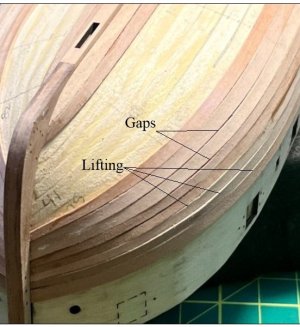
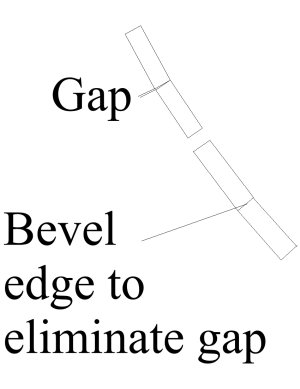
This sounds like you are trying to edge bend which will cause lifting. Are the planks lifting like in the photo below? Planks cannot be applied without lifting if they are not pre-shaped across the breadth. Assuming the wood supplied are strips, not sheets, once the plank's breadth has been shaped/tapered, they can be bent around a jig. Some of us like to soak the planks first then shape them. Once bent to the shape you need, hot air or hot iron keep the bend. Alternatively you can spile each strake, but most kits do not give sheets of wood that you would need. In either case the edge will also need to be beveled slightly for a tight fit to the adjacent plank. There are photos and videos posted here at SoS that will help you get rid of the lift IF that is the problem you are referring to. Hope this helps.
Allan
1773919856213.jpeg

Gap if the edges are not beveled
1773920365092.jpeg
 
Last edited:
Thank you, everyone, for the tips and the shared experience!

Allan, the photos shows EXACTLY the lifting that I’m coming up with. I’ll work the solutions you suggest and try the bender Jaager describes.

Thanks again!!
 
The bender is great for the broad bend but it is the edge bending that creates problems more often than not.


The photo is old, back when I used a soldering iron to heat the wood. Any decent hot air gun works better and can be set for a temperature that will not scorch the wood. I do not recommend using her hair dryer unless you do it when she is out of the house, but it does work in a pinch. :)

1773929205588.jpeg
More information from lining off to the planking can be seen in a four part video. Part three shows his bending station, but the entire four segments are extremely helpful.
 
A possible method you might try. Spile your plank then slightly bevel both edges (top to be fitted under previous plank and bottom beveled to receive the next plank under it),fit it in, glue and clamp.
 
I had the same problem when using regular pva glue. it was driving me nuts. I switched to a product called "weld bond" which has a much higher tack and this solved the problem. I also used some painters tape to help hold them in place for the few minutes it takes to set. Problem solved.
 
I also used some painters tape to help hold them in place for the few minutes it takes to set.
Whatever works for anyone of us is the way to go. I am one of those that happens to hate forcing a piece of wood into a shape on the model. My bad to be sure. :( If the plank is spiled or pre-edge bent I find regular PVA (carpenter's glue) and finger pressure for a minute is sufficient to hold it properly. Then there is always CA, but the fumes are killer for many so needs to be used sparingly, if at all.

Allan
 
Last edited:
I like Gorilla Wod glue. Dries reasonably quick but still gives you time to reposition things,
 
All that warping and curling is from the water that is in a lot of glue. The dry plank absorbs the glue and the water like a sponge and then the wood curls as it dries. You could try a glue that has no water in it's makeup and see if that's any better. I usually sand the second layer smooth and use dry wall putty to smooth out the joints and then prime and paint or stain. If you want to keep the wood color and show the grain as with mahogany you still have to sand it smooth but you'll probably need to get thicker planks so you don't run through the wood with sanding. I don't use drywall mud if I want to clear coat the planks. They have to fit tightly on each edge. This is a big problem for all of us. The one thing to remember is to use the thinnest width that is practical for the second layer. The thinner width is much easier to bend and keep the edges tight than wider planks are.
 
And that, children, is the reason why "double planking" is about the worst way to plank a ship model known to man. ;)

Just one additional thought to consider:

"Edge setting" (bending across the wide dimension of a plank) can be done and some expert modelers have taken it to high art, such as the guy in those planking videos above. However, as they say, "There's many a slip betwixt the cup and the lip." A lot of times, it's a lot easier said than done, especially if you are dealing with peeled veneer wood, coarse grained hardwood species, or planks milled on the flat rather than vertical grained.

Spiling is definitely the only way to fly. That doesn't mean one always has to plank, of course. Hulls can be stacked "bread and butter" fashion or even carved out of solid wood, and so on. However, as noted, spiling the correct plank shapes which will fit when the plank is bent in one direction only can be rather wasteful of expensive wide sheet wood. This is how many manuals show it being done. I think this is because many people don't think "in scale." In real life, wood isn't available in planks much more than a foot wide and not much longer than 24 feet. It takes very large trees to yield much more width than that out of the heartwood after they're barked. Even were larger trees might exist, in the case of period models, they just didn't have the technology to readily get trees that big moved around to the mills nor to handle planking longer than 24 feet long.

The solution though is to "think in scale" and like a real ship builder. Getting the spiled shapes out of a scale 24' plank reduces material waste tremendously and you don't need expensive sheet stock, either. At 1:48 scale, a 24' plank will be only six inches long. At 1:96 scale, a 24' plank will be only three inches long. The trick is to spile the shape of your plank full length but cut out your planks in scale lengths. They get a lot easier to handle that way. When a modeler struggles to hang a 24-inch-long piece of quarter inch wide strip wood on a 1:48 scale model, it's like a real-life shipwright trying to hang a plank a foot wide and 96 feet long, or at 1:96 scale, two feet wide and 192 feet long! It's no surprise that things go haywire when we try to fit wood that isn't to scale in terms of its mechanical properties into scale applications. With shorter planks, there's a lot less wasted wood, too!
 
Back
Top