• Win a Free Custom Engraved Brass Coin!!!
    As a way to introduce our brass coins to the community, we will raffle off a free coin during the month of August. Follow link ABOVE for instructions for entering.
  • SUBSCRIBE TO SHIPS IN SCALE TODAY!

    The beloved Ships in Scale Magazine is back and charting a new course for 2026!
    Discover new skills, new techniques, and new inspirations in every issue.

    NOTE THAT OUR NEXT ISSUE WILL BE MARCH/APRIL 2026

L'Orenoque Mamoli 1:100 scale

Last thought on the outrigging mechanism for the bateaux tambour (maybe not last :p). How did they raise the inboard side enough so that the boat's weight would start to fall outboard and then engage the fixed davits? Yellow arrow. Perhaps yard tackle? I can't see a bunch of sailors with crowbars and bulging thigh muscles getting 3 tons of metal off the top of the sponson without a mechanical aid to do the heavy lifting. Blue arrow.
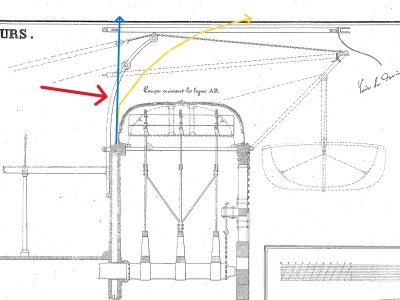
lo bt outrigging 5.jpg
 
Last thought on the outrigging mechanism for the bateaux tambour (maybe not last :p). How did they raise the inboard side enough so that the boat's weight would start to fall outboard and then engage the fixed davits? Yellow arrow. Perhaps yard tackle? I can't see a bunch of sailors with crowbars and bulging thigh muscles getting 3 tons of metal off the top of the sponson without a mechanical aid to do the heavy lifting. Blue arrow.

View attachment 588141
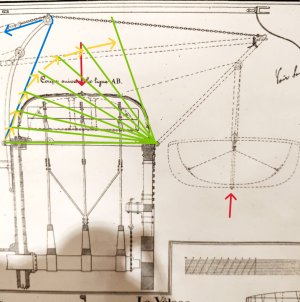
i had long ago understood that the hinged spars were used to flip the boat. The chain at the top remains attached to the end of the hinged spar so that it is used to raise the inner edge of the boat. It runs around the top davit sheave to the purchase that is shown, top left. Once the boat is practically vertical , the mobile spar is fitted into the upper end of the hinged spar and the lower davit sheave is used to push it over and outwards while the chain now becomes a brake. As i said previously , the curve of the davit guides the hinged spar to stop sideways flexion forces from breaking the hinges at full opening. I still believe there must be some mechanism fixing the boat solidly to the hinged spars. see next post.
 
Martin!

I have been thinking about both parts of your post. This first part - how did they manage to flip the boats? I finally figured it out.

I could always see these bars - yellow arrows, but I couldn't understand them from the Panama plans.

View attachment 588127
View attachment 588131

It seemed to me that they would interfere with the wheel. I was wrong. This from my Paddle Wheel Warships reference book:

View attachment 588133View attachment 588134

Here finally is an original French plan from 1850 showing the same mechanism

View attachment 588135

Now I see that on the working bateaux tambours on my model (the port side) I have some detainling work to do:p

Thank you for your curious questions, spirit guide!

Blessings.
Chuck
here on the second from last illustration , you can see that the design is slightly different and that the wales of the boat fit snugly into recesses on the hinged spars. This would stop the boat from sliding around on the spar and that is the mechanism that i find necessary , but cannot see. note that the last illustration shows straight davits but the hinged spar tips still engage at full closure , with the same locking pin as seen on the Panama. The hinged spars are what the french denominate "Arcs Boutantes"
 
Martin! @Martin By Eye I forgot to add to my last post - So, given that the picture shows the mechanics of lifting the bateaux - no need for yard tackle - there would be no need to unrig the chain?

Thoughts please.

Blessings.
Chuck
 
Martin! @Martin By Eye I forgot to add to my last post - So, given that the picture shows the mechanics of lifting the bateaux - no need for yard tackle - there would be no need to unrig the chain?

Thoughts please.

Blessings.
Chuck
you've got it. i don't know how you add all those coloured arrows, makes it much easier to explain.. The chain can stay where it is, looks pretty heavy .Just the purchase to be stowed away, (it may well run through a pulley somewhere on the opposite side of the bridge, then down to the capstan when working). and , the loose pusher spars, which would probably have a storage rack somewhere close by. The system is self contained, needs no yard involvement. That gauge chain will be easy enough to find, stowage chain for the crossed fixations would be much finer and may be more difficult. Cost me a fortune for the Cutty. Are you going for chain stays for the funnel ? The stays for the davits look to be wire rope, it was beginning to commonly take over.
 
What ho, shipmates!

The story of epic failure :eek:

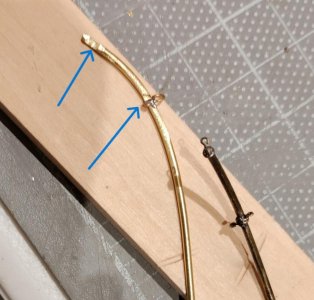
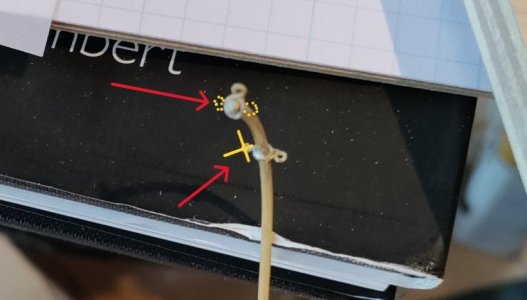
Making the bateaux tambours davits has been very challenging. I don't have a shipyard with a precision metal drill press or a lathe to turn square brass stock into a round profile. Those would be the right tools for the job of making these davits. So, when you don't have the right tools, improvise.

Pic 1: On the left V 1.0 - I thought to grind out the paths for the chain and rope and cover theground out part with a small sheet of brass. If my soldering skills were well developed, I might be able to do it. You see the result. Part of the trouble was making good contact between the brass so that the parts did noot move when the iron hit the solder. On the right V 2.0. Even though V 2.0 is wrong, I tried the blackening brew on it. Only one bath in and I think after a second she might do.

Pic 2: V 2.0. I could see that I would have to suggest the methods shown in the plans rather than making a miniature of the actual method. The chain is meant to pass through the top loop. Oops. I put double loops too low. Those loops are meant to hold the davit guy lines and belong at the top with the chain loop.

I spent two hours last night on V 3.0. We'll see.

Blessings. Peace. Gratitude.
Chuck

lo epic fail 2.jpg
lo epic fail 1.jpg
 
i think you will probably need about fifteen attempts to get a compromise up to your own high standards ROTF. I do the same sometimes(often) !
I suggest perhaps trying soldering short flat plates either side of where your sheaves will be then drilling through between them with a dremel rather like a block would be made.
I have some chunks of cork that i use as a pin mat when holding things in place for soldering with pins . if the pins get stuck in the solder i cut them out afterwards
 
Last edited:
i think you will probably need about fifteen attempts to get a compromise up to your own high standards ROTF. I do the same sometimes(often) !
I suggest perhaps trying soldering short flat plates either side of where your sheaves will be then drilling through between them with a dremel rather like a block would be made.
I have some chunks of cork that i use as a pin mat when holding things in place for soldering with pins . if the pins get stuck in the solder i cut them out afterwards
Martin! Too right!

I will keep trying. Part of my problem has been failing to care properly for my preferred soldering iron tip. :eek: I have retinned it - I think ;) .

The other problem is finding bits that are small enough AND sturdy enough to drill through the brass. The scaled diameter of the davits is 1/16inch. Anyone out there with ideas on the right drill bits - preferably available on Amazon?

There is an alternative - look at the RN method - no sheeves through the davits. I would not like to go this route, but it would save me from getting to V 30.0ROTF

Blessings.
Chuck
 
Brass work hardens. When you stretch it, compress it or bend it it gets harder. It’s therefore, important that your drill takes a bite from the surface being drilled as soon as it starts turning. If it just “massages” it just makes the surface being drilled harder.

HSS wire sized drills are available in sizes as small as approximately .0125” Some modelers buy a selection from industrial supply houses like McMaster Carr. I buy mine on Amazon. Beware of imported ones from you know where. Mine came from Amazon, are US made, Chicago Latrope brand. The Gyros brand recommend by Amazon are junk.

The work hardening property of brass requires sharp drills and pressure. Drilling by hand in a pin vise is hit or (mostly miss). I put these small drills in a pin vise chucked in my drill press. They go through the brass like butter.

The smallest hole that I have drilled is .025.”
Roger
 
Last edited:
HSS is best. can you not get proxxon bits on amazon U.S. ?
Some modelers buy a selection from industrial supply houses like McMaster Carr. I buy mine on Amazon.
Martin! Roger!

Thank you both! I just ordered some Proxxon bits on Amazon HHS for about $15 per set (got 3 sets). Roger, I'll check your brand - can one ever have too many tiny drill bits? Also thank you for dropping the knowledge about needing an immediate bite.

Seems like a drill press is necessary :eek: :eek: :eek:. Oh well. I guess I don't need that new pair of wingtips after all.ROTF

Blessings. Peace. Gratitude.
Chuck
 
Back
Top