

• Win a Free Custom Engraved Brass Coin!!!
    As a way to introduce our brass coins to the community, we will raffle off a free coin during the month of August. Follow link ABOVE for instructions for entering.
  • SUBSCRIBE TO SHIPS IN SCALE TODAY!

    The beloved Ships in Scale Magazine is back and charting a new course for 2026!
    Discover new skills, new techniques, and new inspirations in every issue.

    NOTE THAT OUR NEXT ISSUE WILL BE MARCH/APRIL 2026

L'Orenoque Mamoli 1:100 scale

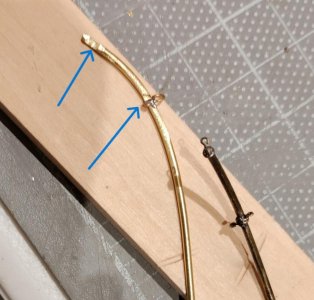
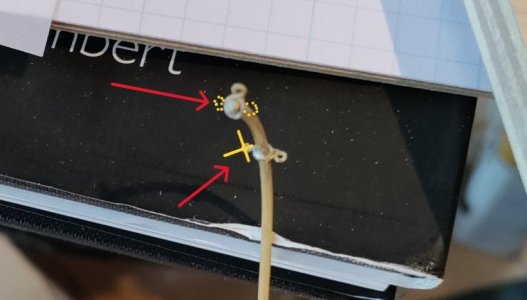
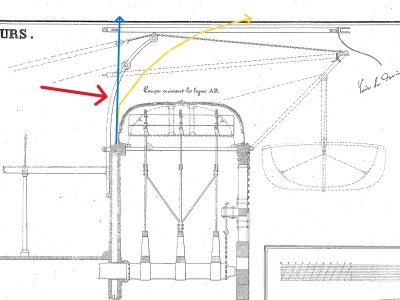
Last thought on the outrigging mechanism for the bateaux tambour (maybe not last :p). How did they raise the inboard side enough so that the boat's weight would start to fall outboard and then engage the fixed davits? Yellow arrow. Perhaps yard tackle? I can't see a bunch of sailors with crowbars and bulging thigh muscles getting 3 tons of metal off the top of the sponson without a mechanical aid to do the heavy lifting. Blue arrow.
lo bt outrigging 5.jpg
 
Last thought on the outrigging mechanism for the bateaux tambour (maybe not last :p). How did they raise the inboard side enough so that the boat's weight would start to fall outboard and then engage the fixed davits? Yellow arrow. Perhaps yard tackle? I can't see a bunch of sailors with crowbars and bulging thigh muscles getting 3 tons of metal off the top of the sponson without a mechanical aid to do the heavy lifting. Blue arrow.
View attachment 588141
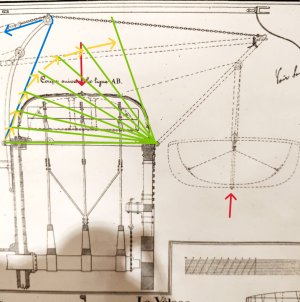
i had long ago understood that the hinged spars were used to flip the boat. The chain at the top remains attached to the end of the hinged spar so that it is used to raise the inner edge of the boat. It runs around the top davit sheave to the purchase that is shown, top left. Once the boat is practically vertical , the mobile spar is fitted into the upper end of the hinged spar and the lower davit sheave is used to push it over and outwards while the chain now becomes a brake. As i said previously , the curve of the davit guides the hinged spar to stop sideways flexion forces from breaking the hinges at full opening. I still believe there must be some mechanism fixing the boat solidly to the hinged spars. see next post.
 
Martin!

I have been thinking about both parts of your post. This first part - how did they manage to flip the boats? I finally figured it out.

I could always see these bars - yellow arrows, but I couldn't understand them from the Panama plans.

View attachment 588127
View attachment 588131

It seemed to me that they would interfere with the wheel. I was wrong. This from my Paddle Wheel Warships reference book:

View attachment 588133View attachment 588134

Here finally is an original French plan from 1850 showing the same mechanism

View attachment 588135

Now I see that on the working bateaux tambours on my model (the port side) I have some detainling work to do:p

Thank you for your curious questions, spirit guide!

Blessings.
Chuck
here on the second from last illustration , you can see that the design is slightly different and that the wales of the boat fit snugly into recesses on the hinged spars. This would stop the boat from sliding around on the spar and that is the mechanism that i find necessary , but cannot see. note that the last illustration shows straight davits but the hinged spar tips still engage at full closure , with the same locking pin as seen on the Panama. The hinged spars are what the french denominate "Arcs Boutantes"
 
Back
Top