

• Win a Free Custom Engraved Brass Coin!!!
    As a way to introduce our brass coins to the community, we will raffle off a free coin during the month of August. Follow link ABOVE for instructions for entering.
  • PRE-ORDER SHIPS IN SCALE TODAY!

    The beloved Ships in Scale Magazine is back and charting a new course for 2026!
    Discover new skills, new techniques, and new inspirations in every issue.

    NOTE THAT OUR FIRST ISSUE WILL BE JAN/FEB 2026

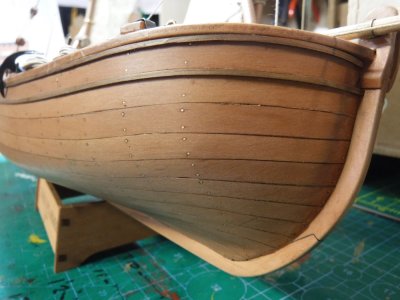
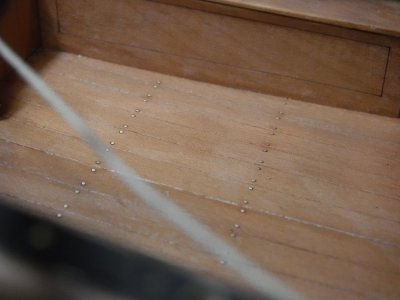
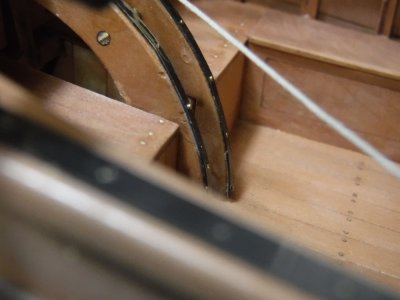
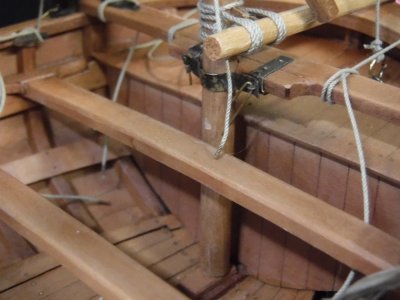
1:24 Pearwood French Longboat from Unicorn Model

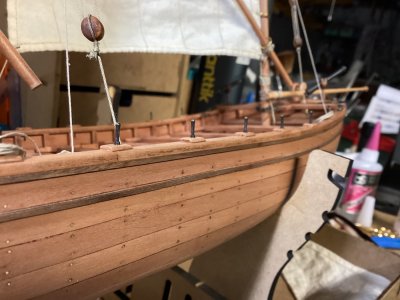
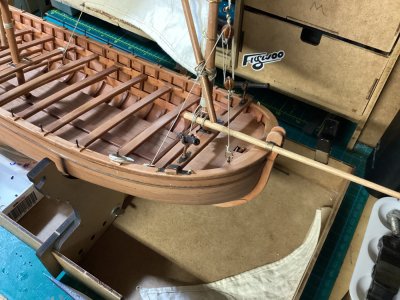
Today, working on the rudder pintles and gudgeons. This model puts one pintle on the rudder, and the other pintle on the hull. This works. Just not seen it done before. But what do i know?

I used the included plywood bending jigs. These jigs make wide bends. And these are tightened using needle nose pliers and fingers. One jig required some CA, to keep it from splintering.

The instructions ...
IMG_5876.png
IMG_5882.jpeg

And the results, well at least the first 2 out of 4. Showing T10 and T11 ready ...
IMG_5880.jpeg

The included wooden bending jigs get it started. But the metal requires more work, to get a proper fit. Even getting the metal centered in the jig while closing it, so it didn't pull one way or the other, took some effort. I used a vise to close the jigs.
 
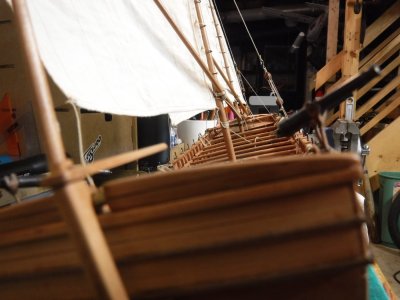
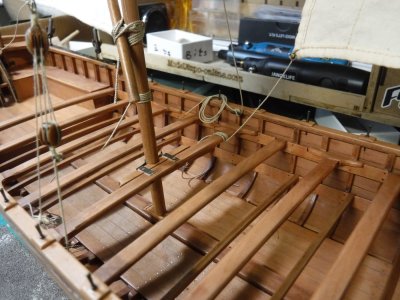
Just realized, yesterday, as I was sorting through my ToDo list - and - one of the items on that ToDo list was to rig the masts to the hull - when I realized that this model has no shrouds or stays supporting the masts - to rig them to the hull with.

I did some research - and this is done sometimes, especially on a very fwd masted ship without a lot of hull up there to stay the mast too. And it simplifies moving the sails about.

But back in the day - did they do that - not put any shrouds or stays on the masts of longboats? Dunno. I'm tempted to put a couple of shrouds on each side of both masts. Anyone know?

Masts, booms and bowsprit all tapered. The bowsprit is a lighter color, as it is made out of my own 4mm stock, as the kit was short one 4mm dowel rod.
1765214680601.png

And the tools I used to taper em all ...
1765215051485.png
 
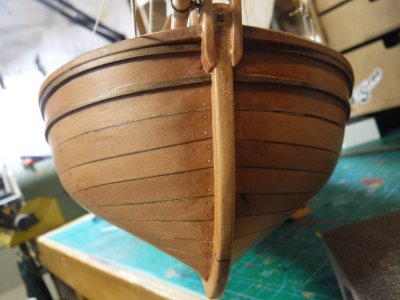
i was thinking to paint my longboat hull out side leave the inside stain. my eye are not what they use to be the paint would make it better looking and hide a lot of my mistake. they must have painted there longboat the color available them was black and white from what i gathered on the web has any one have more info on the color available during those time. many tks .
 
What I learned today, about freestanding vs stayed masts, and Longboats, and why I'll build to the instructions, and not add any shrouds or stays to these masts ...

My query to copilot ...

Did 18th century longboats always have stays and shrouds supporting the mast?

Short Answer: No — 18th‑century longboats did not always have stays and shrouds supporting their masts. While larger vessels consistently used standing rigging (stays and shrouds) to stabilize tall masts, smaller boats like longboats often carried simpler rigs. Some longboats had fully stayed masts, but others used short, unstayed “plug‑in” masts that could be stepped quickly without elaborate rigging.

âš“ Rigging Practices in the 18th Century​

  • Standing Rigging Defined: Stays and shrouds are part of the standing rigging — fixed ropes that hold the mast upright. Stays run fore‑and‑aft, while shrouds brace the mast laterally.
  • Large Ships: On frigates, ships of the line, and other tall‑masted vessels, shrouds and stays were essential. Without them, the mast could not withstand wind pressure.
  • Longboats: These were ship’s boats, typically 30–40 feet long, used for transport, towing, and landing troops. Their rigs varied:
    • With stays and shrouds: When carrying larger sails (like lug or square sails), longboats often used shrouds and stays for stability.
    • Without stays: For smaller sails or temporary use, a mast could simply be stepped into a socket in the keel. This “free‑standing” mast was quicker to rig and suited short trips.
Longboats were versatile craft. Some were rigged with proper shrouds and stays when used for extended sailing, but many relied on simpler, unstayed masts for short, utilitarian trips. Unlike larger ships, there was no universal requirement — rigging depended on the boat’s size, sail plan, and intended use
 
i was thinking to paint my longboat hull out side leave the inside stain. my eye are not what they use to be the paint would make it better looking and hide a lot of my mistake. they must have painted there longboat the color available them was black and white from what i gathered on the web has any one have more info on the color available during those time. many tks .
No idea - no plans to paint mine. For instance, I'm deciding today, whether to use clear matt or semi-gloss acrylic for covering the stained wood (otherwise, stained wood readily shows any and all water marks).

Anyway, here's 2 links to sites that provide historic color advice for ships:
Generally, my understanding is that for English ships ... the captain decided - and based his decision on personal preference, what was available at the time and his finances. So, color schemes tended to vary quite a bit. That's all I know - and I haven't read either of those links yet.
 
Last edited:
Tks for your time, from research there was not much color to choose from, there was black , white, some reddish, and yellow, maybe more , black for below the water line white or reddish for the side still in the research mode.
 
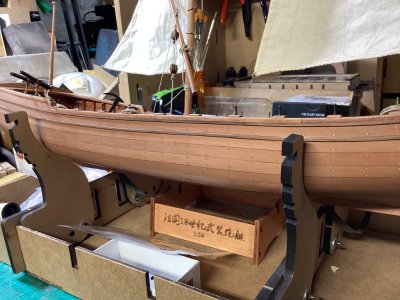
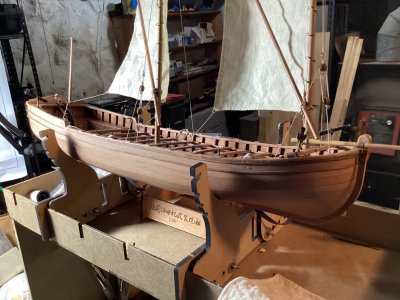
So, been experimenting with clear coats. Tried rubonpoly, semigloss and matte. And found that I prefer the semigloss, as the matte mutes the wood too much for my taste. Anyway, I have the starboard hull in matte and the port hull in semigloss. Plan to finish the interior with semigloss. (The rubonpoly was nice, but no way to do the interior rubbing on the clearcoat.)

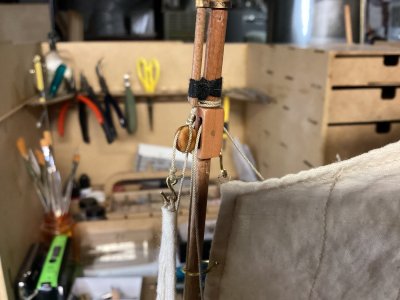
The instructions called for these metal bits to be used to attach top minimasts to the masts. Where you are suppose to drill a hole in the mast and insert the pointed bit into it.
IMG_5961.jpeg

And i started down that path, as shown below ...
IMG_5933.jpeg

But instead I used a single S shaped strap as shown here ...
IMG_5958.jpeg

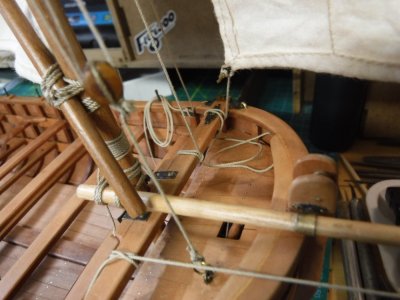
And then I rigged em with the kits fuzzy black thread (gonna use my own thread from now on).

Working on the sails, wondering how to get the outer rope attached. I experimented with this technique, of gluing the rope and then sewing it, on a hanky ... but I find the gluing stiffens the rope too much to my liking. That's my rope threaded through the needle. And that is kit rope glued to the hanky.
IMG_6007.jpeg

I have never used a sewing machine, and being unsure how to hem stitch the roping to the sails without gluing it first, I realized I could snake a rope through the hem already sewn into these sails. And I did just that ...
IMG_5975.jpeg
IMG_5977.jpeg
IMG_5994.jpeg
One corner to tie off. Then apply just enough CA- to the exposed rings at each corner to secure them, without stiffening up the works.

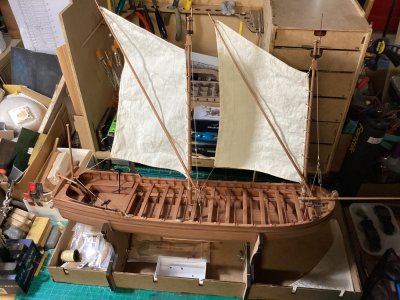
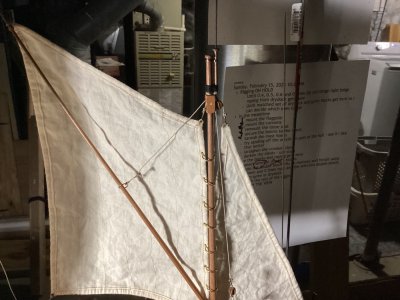
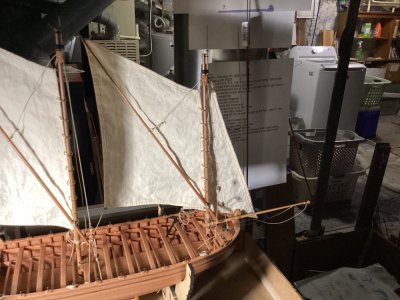
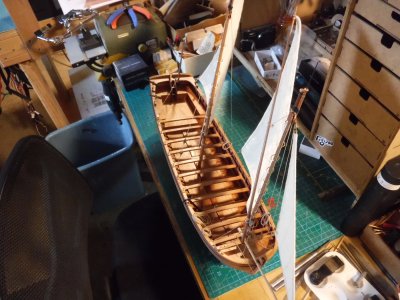
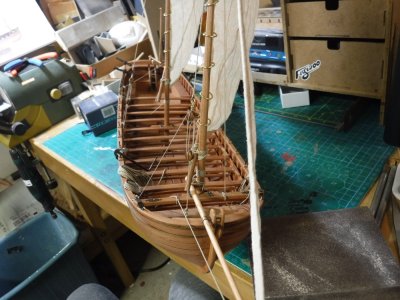
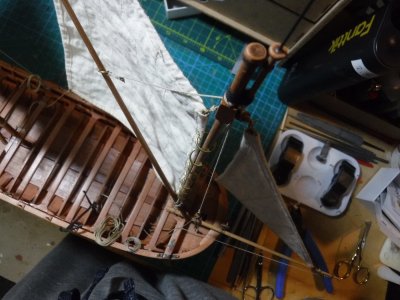
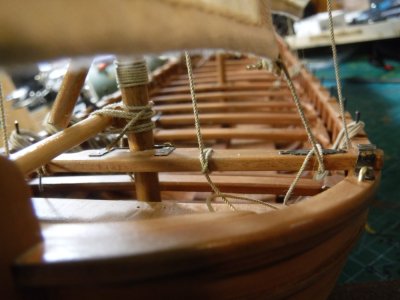
And a couple pics showing what i got so far ...
IMG_5998.jpegIMG_5987.jpegIMG_5983.jpeg

And, now Im looking for a way to make neat holes in the sails for the metal mast rings.

Thx, Merry Xmas and Happy New Year.
 
Last edited:
Beautiful work on the longboat Tim!

Enquiring minds (mine, at least) want to know what the white model with the big bubble canopy is that is in the background of your last photo.
 
Beautiful work on the longboat Tim!

Enquiring minds (mine, at least) want to know what the white model with the big bubble canopy is that is in the background of your last photo.
Thx.

The white model is a Finwing Penguin. Got it in 2012. Was going go fly it this summer, after putting a 3 axis FPV gimbal on it - but I never got around to that. I fly drones mainly these days - easier, and arguably way more fun. Easier because I just pick up a drone and walk into my backyard - where with planes, I have to prep em for travel, put em in the car, drive to the field, assemble the plane - fly - take plane apart for travel, drive back home, disassemble for storage. And being over 70, all of this matters - so, the Penguin was staged for flight this summer - and that's all that happened. I still fly drones in my backyard, almost every day. Even in the winter - I fly from inside the house, looking out over the back yard. And all this reminds me - I need to put that Penguin back into storage.
 
Finished adding the attachment loops to the sails. Using the rope I had threaded through the factory hem in the sails. First, I drilled a 2mm hole in my work bench. Then I inserted a short 2mm brass rod, and used this to shape the loops. I also used it to splice the open ends into a loop. The glue was CA-.

Setting it up for gluing the splice ...
IMG_6012.jpeg

After applying CA- to the splice, and trimming the excess rope off ...
IMG_6015.jpeg

Sails ready ...
IMG_6019.jpeg
 
Very nice work on the sails Tim. The loop at the bottom corner is called a "clew".

View attachment 568247
Thx. Clews. I didn't have a clue. (Sorry, almost! Oh geeze!!!) It's a problem with some kits, like this one - you don't learn anything nautical - no details, no history, no terminology. Looking at your pic, there sure are a lot of scale details in a sail, that one could attend to, if one was so inclined.
 
Thx. Clews. It's a problem with some kits, like this one - you don't learn anything nautical - no details, no history, no terminology. Looking at your pic, there are a lot of scale details in a sail, that one could attend to, if one was so inclined.

Indeed. It's all about how far you want to take it (and the limitations of the scale you're working in as well).

While many kits can help with terminology, you can't rely on them to educate you on everything nautical. Books are great for us old timers, but the internet can be your friend. To find the illustration above, I simply searched for "parts of a square sail". Easy-peasy.
 
Back
Top