

• Ships of Scale has incorportated an extra level of security when you log In. Please follow on-screen prompts to acknowledge that you are not a robot via a "Check Box" or a "Pictorial Check Box Puzzle". This is needed due to higher level of AI Activity Security.
  • SUBSCRIBE TO SHIPS IN SCALE TODAY!

    The beloved Ships in Scale Magazine is back and charting a new course for 2026!
    Discover new skills, new techniques, and new inspirations in every issue.

    NOTE THAT OUR NEXT ISSUE WILL BE July/August 2026
  • Win a Free Custom Engraved Brass Coin!!!
    As a way to introduce our brass coins to the community, we will raffle off a free coin during the month of August. Follow link ABOVE for instructions for entering.

BALDER, Vlaardingen Herring Lugger from 1912, scratch build scale 1:50 Plate-On-Frame

.......Speechless

No words—just a lot of admiration.
What a joy and pleasure it was to see this wonderful model together with you in Hamburg!

And of course a night - or better evening - to remember ;-)

All the best, DAniel
I agree with every word that dear Daniel wrote above;
I had the privilege of seeing the model with my own eyes, and it is simply amazing.
What an outstanding result on this furled sail, Peter! Just wonderful!
You also thanks for the nice words and compliments, Stephan, Daniel, Shota and Paul.
Ps to Daniel&Shota: It was great to meet you in Hamburg in the IMM but also in special the evening with the group in the Blockhouse!

And a special thanks to all the visitors with or without a hit on the ‘like-button’. It keeps me motivated to work towards a final result.
Regards, Peter
 
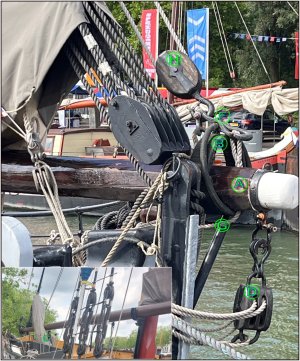
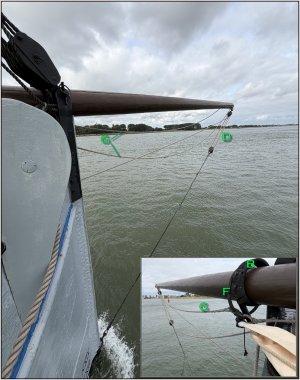
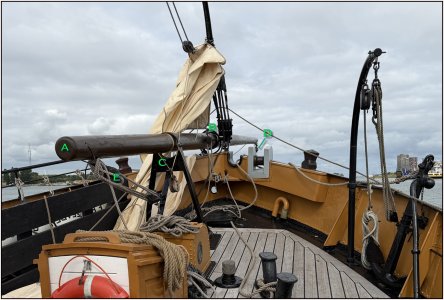
Thanks to the preparatory work, installing the jib boom went quite quickly. Because it is retracted while in port and must be extended for sailing, several operations are required involving lines that serve dual purposes. I will try to clarify this with a few photos of the full-scale Balder.

Retracted:
1251 Kluiverboom.jpg
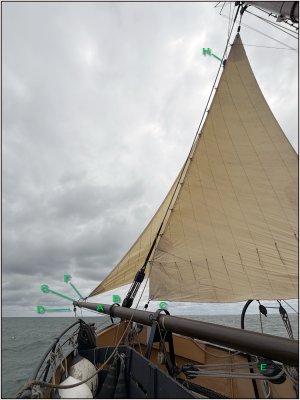
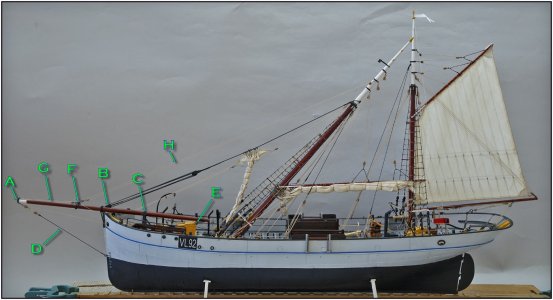
I have marked the components related to extending and retracting the outer jib boom (kluiverboom) in the photos. While not every component is visible in every shot, I have used consistent labels for each part throughout.
A: Outer Jib boom
B: Ring bracket on the bow
C: Boom saddle (or support)
D: Bob of waterstay
E: Boom outhaul
F: Traveler
G: Traveler outhaul
H: Outer Jib halyard
When retracted, the boom 'A' sits with its forward end inside the ring 'B'. Approximately one-third of the way from the aft end, it rests on a support located next to the mast. (See insert)
1250 Kluiverboom.jpg
The boom is pulled outward using the outhaul line 'E'. As it extends further, the forward section is supported by the outer jib halyard 'H', which is hooked into the traveler 'F'. (In the photo above, please disregard the outer jib sail itself.) As the boom slides outward, the traveler also moves along with it, pulled by the traveler outhaul 'G'.
Once the aft end of the boom has moved past the support next to the mast, it is held up by one of the topsail halyards. Throughout this process, the forward section remains supported by the traveler 'F' and the outer jib halyard 'H'. The traveler 'F' also moves forward, assisted by the outhaul 'G'. Initially, most of the weight is at the aft end, but it shifts toward the bow. As it is pulled forward, the aft end of the boom is guided into the boom saddle 'C'. Once in position, it is secured under tension using the bobstay 'D' and the outhaul line 'E'.

Setting the outer jib:
1252 Kluiverboom.jpg
The traveler 'F' is pulled back using the other end of the outhaul 'G', a continuous line that is also attached to the aft side of the traveler. The outer jib halyard 'H' is detached, and the tack of the outer jib is secured to the hook on the traveler. The traveler 'F' can then be pulled outward again using the outhaul 'G'.

A quick overview:
1253 Kluiverboom.jpg
The boom is positioned within ring 'B' and saddle 'C', and secured in place with the bobstay 'D' and the outhaul 'E'.

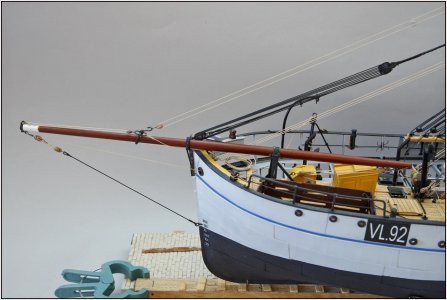
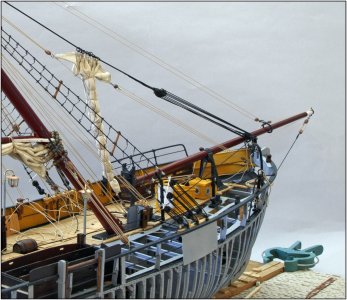
The model with the jib boom:
1254 Kluiverboom.jpg
While fishing the boom 'A' is retracted somewhat. The outhaul line 'E' is attached to an eye further aft, pulling the boom back. Once in position, it is secured again, along with the bobstay 'D'.
I have positioned the traveler 'F' slightly further outboard. As soon as the skipper decides to sail to a different location, the mast is set upright, and the traveler is immediately ready to assist in extending the boom.

An image free of distracting letters and arrows:
1255 Kluiverboom.jpg
We no longer lower the mast, but we do have to extend and retract the boom in order to sail. On the 1:1, this is quite a significant task, requiring various lines to be constantly tensioned or eased. It demands good coordination among the crew members.
1256 Kluiverboom.jpg
It gets rather crowded on the foredeck.

Now I can go ahead and pull all the lines taut and secure them.
Regards, Peter
 
Last edited:
Incredible system for extending the jib boom, which you have managed to duplicate beautifully and more importantly, it functions!!

Wow, your work leaves many of us speechless!!

Thanks for sharing both the model pictures and the great reference photos of the 1:1.

 
Incredible system for extending the jib boom, which you have managed to duplicate beautifully and more importantly, it functions!!

Wow, your work leaves many of us speechless!!

Thanks for sharing both the model pictures and the great reference photos of the 1:1.
Thanks again for the compliments, Brad. It’s the advantages of the 1:50 scale to make the most parts functional and of course the presence of the 1:1 and old specifications to replicate it in scale.
Regards, Peter
 
Back
Top