


- Joined
- Nov 13, 2025
- Messages
- 228
- Points
- 113

I'm partway through this build, so I figured I may as well start a build log, giving a quick run-down of the journey so far. I'm building it pretty slowly--I started in February and am still fairing the hull--so don't expect a quick stream of posts! I have a full build log on another forum, so this first post will just be a summary.
As a modeler, I'm most interested in small workboats. The varieties of local designs are fascinating, and researching and modeling them is a fun way to think about how people around the world adapted to big picture changes like globalization and economic development. I'm especially interested in Latin American vessels, but not exclusively. I've also always been drawn toward the fully framed modeling style, as I like the idea of working out every part of how a boat works.
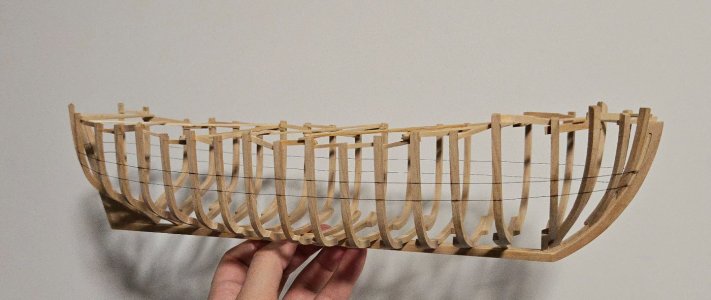
I've been modeling for a couple years, and for my first full-hull POF model, I decided to build from an Ancre monograph, as I didn't want to have to loft my own frames. I initially considered the Gozzo Santa Caterina, but decided against it because of a few issues others noted with the planset, and because it would be miniscule and very challenging in my preferred 1:32 scale. So, I decided to go with Jean Boudriot's reconstruction of the Bateau de Lanvéoc. It's a very simple, single-masted open vessel, and rescaled to 1:32, it's a manageable size--the hull is about 15 in / 38 cm long. It has very full hull lines, and I find it an intriguing if very unglamorous vessel.
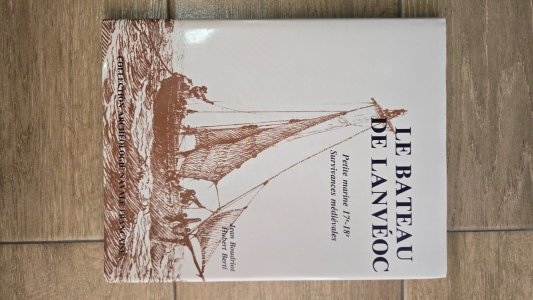
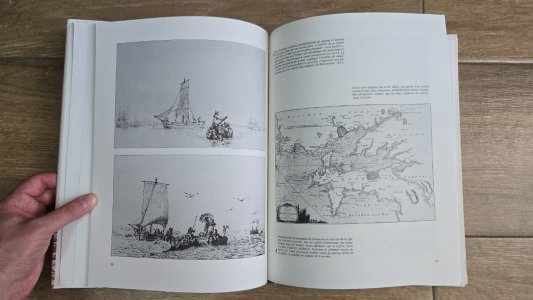
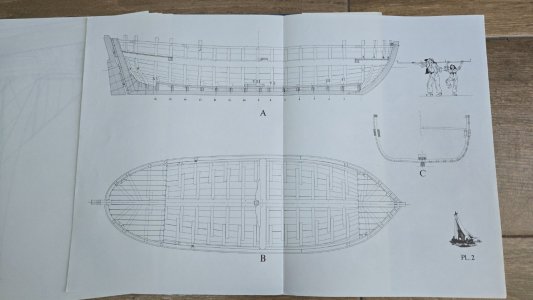
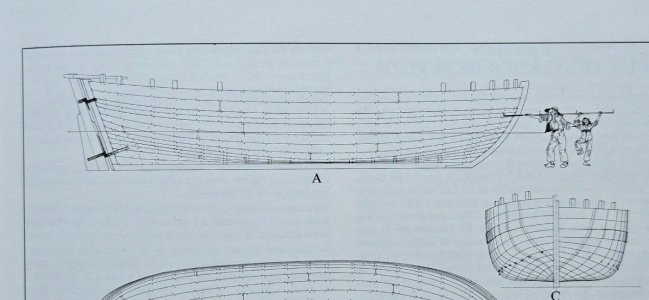
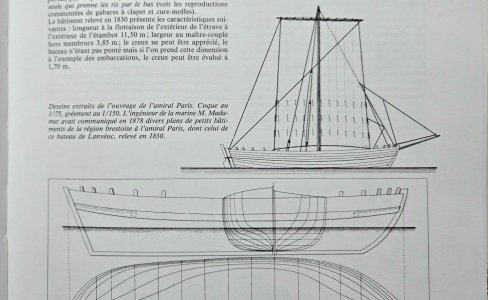
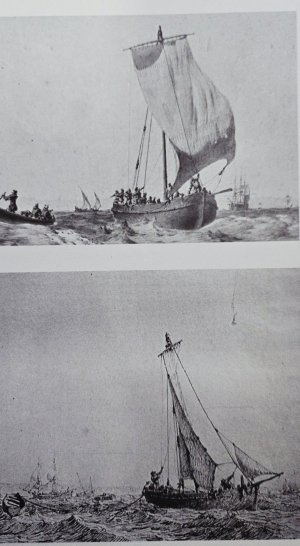
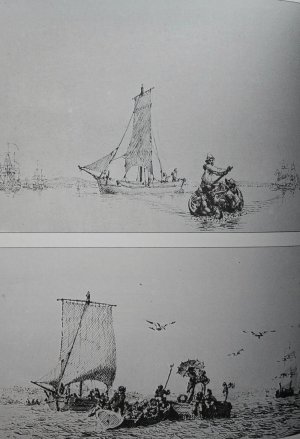
To briefly summarize, as the monograph shows, by the 1600s, the French Atlantic coast developed a number of similar vessel types characterized by one or two square-rigged masts. The Bateau de Lanvéoc was a distinct type used in the 18th century into the early 1800s as a ferry and coastal cargo hauler in the area around the important military port of Brest. Pierre Ozanne made a number of drawings of the vessel, and François-Edmond Pâris recorded a hull plan from 1830. The Bateau differed from other vessels in the region, such as the sharper-lined, lug-rigged Plougastel Boat used for fishing, in having a single square sail and a small jib, a seemingly outdated rig by the period that nevertheless persisted in use. After 1830, the vessel appears to have fallen out of use, increasingly replaced by gaff-rigged and eventually powered vessels. I found that several paintings of Brest harbor from the late 1700s and early 1800s seem to show Bateaus like those in the monograph.
I decided to make the model in alder. So far, I've found it to be a very nice wood to work. It's not as hard as cherry, but sands much smoother than basswood, and I like the color. I ordered sheets of alder in the required thicknesses from Ocooch Hardwoods, and I was pleased with the quality.
There are plenty of build logs that give a step-by-step look at POF construction. Here, I'll limit myself to a few general comments and notes about the monograph. With a few exceptions I'll discuss below, I've found this to be a fairly straightforward process, but the build definitely requires a lot of care and emphasis on detail. It's been a very rewarding experience, if a very slow one.
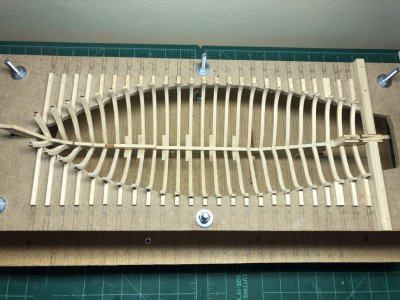
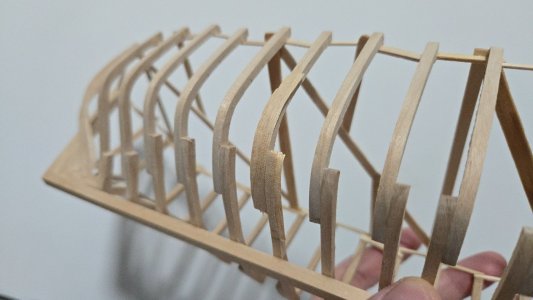
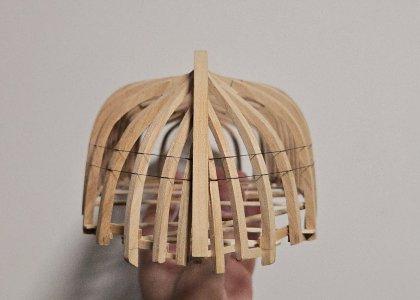
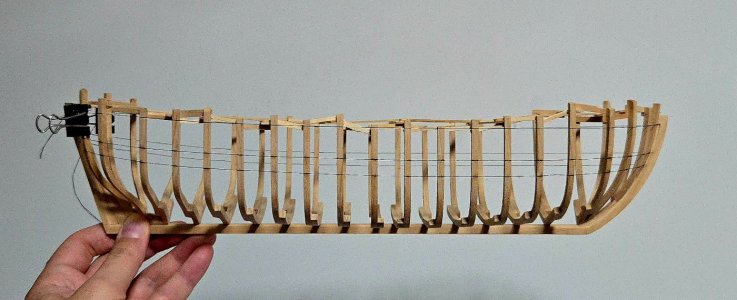
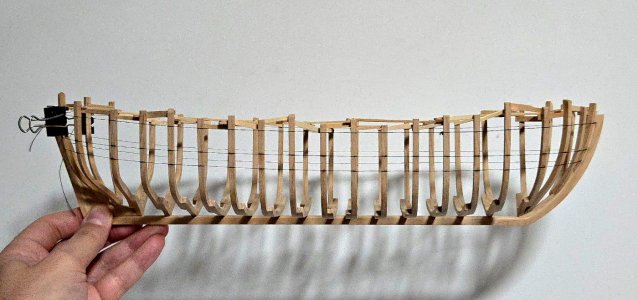
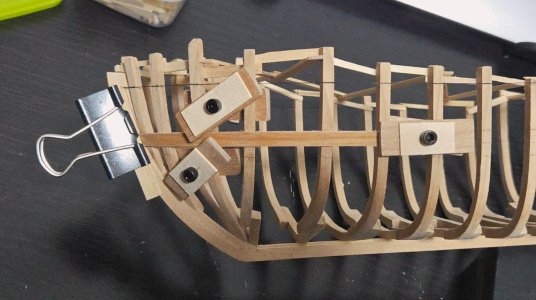
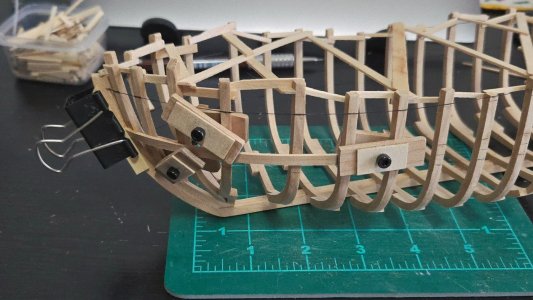
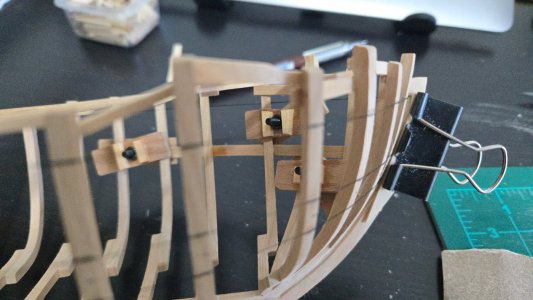
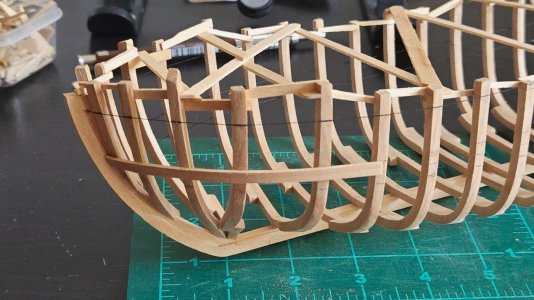
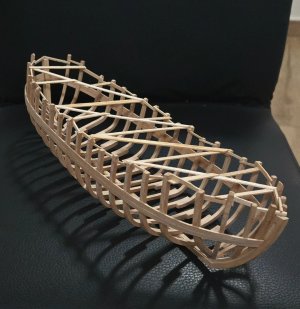
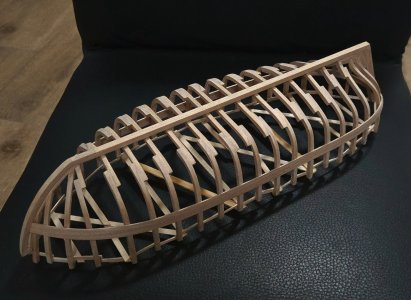
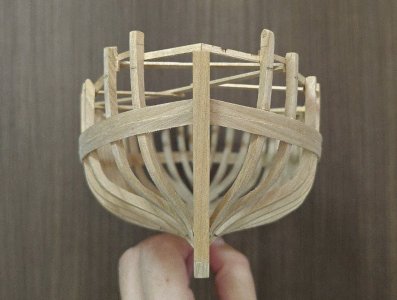
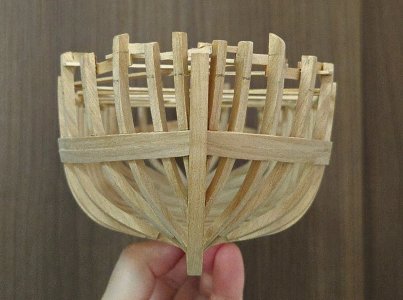
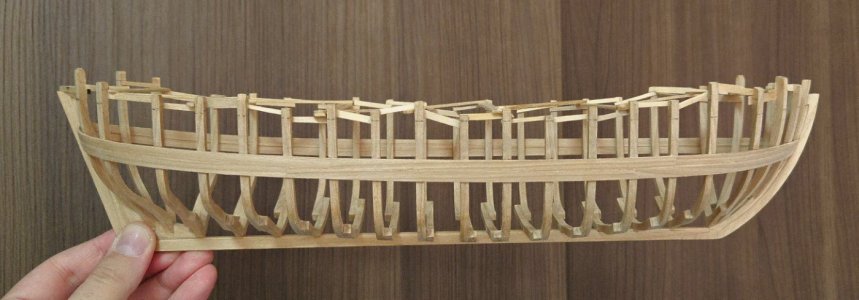
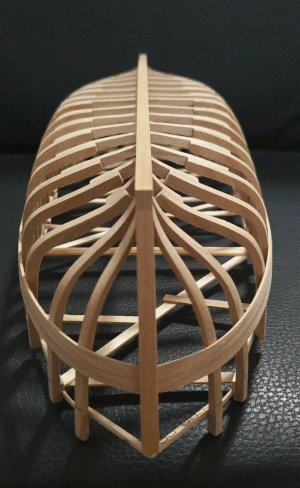
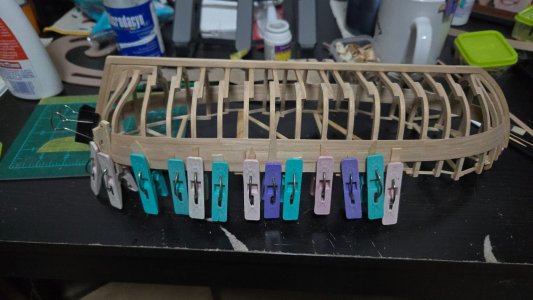
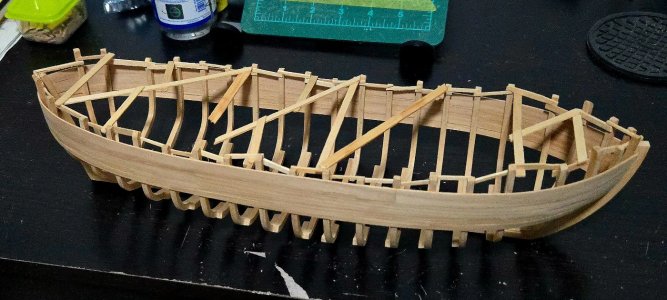
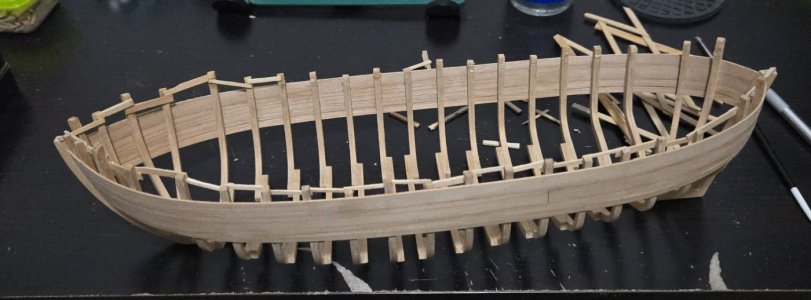
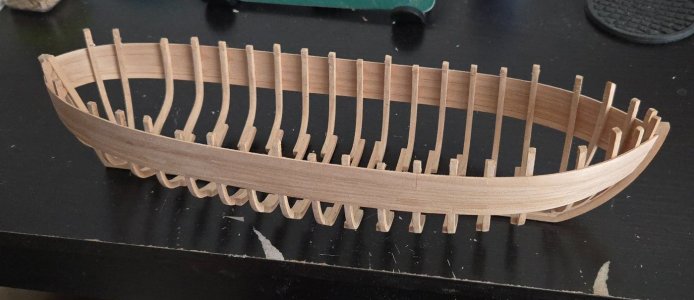
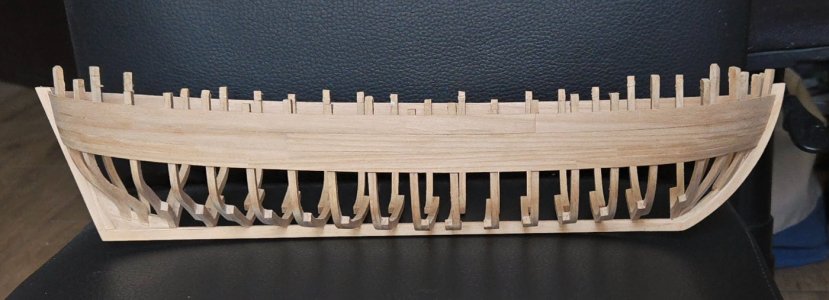
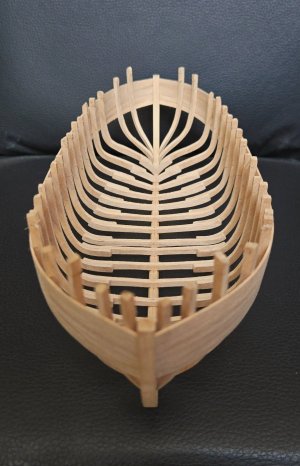
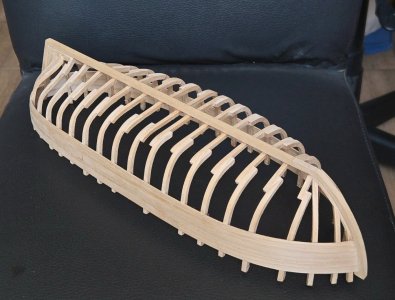
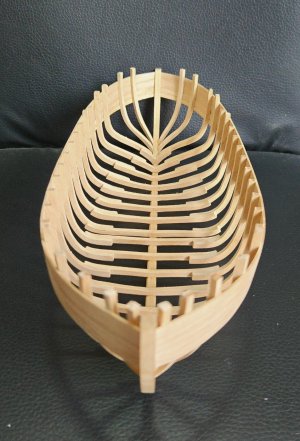
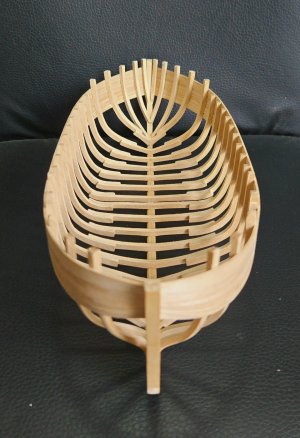
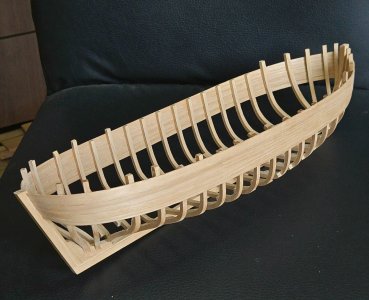
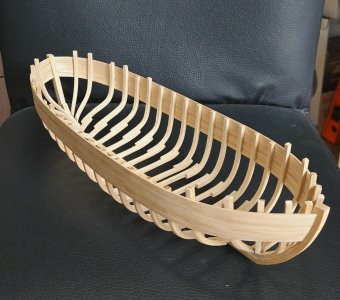
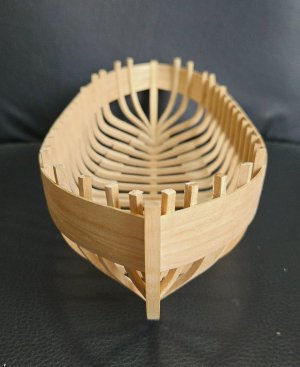
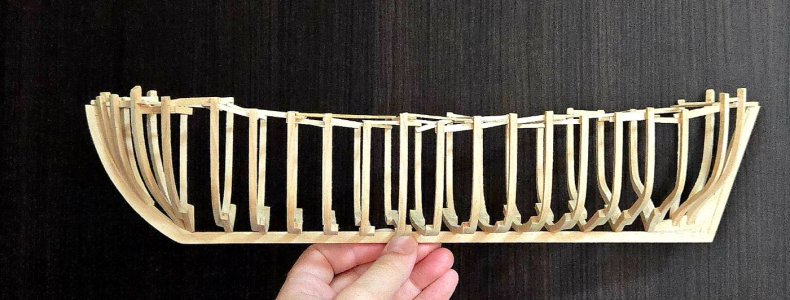
At the moment, the framing is complete. I added a lot of scrap support pieces, rather haphazardly, to secure the frames for fairing. I decided to fair the exterior first, and will add the internal parts after planking the hull. I'm still deciding whether to leave the model partly unplanked to expose the framing, or to just plank everything, as it's an open boat and the framing will be visible on the inside. I'm doing a little fairing here and there, rather than trying to fair everything at once.
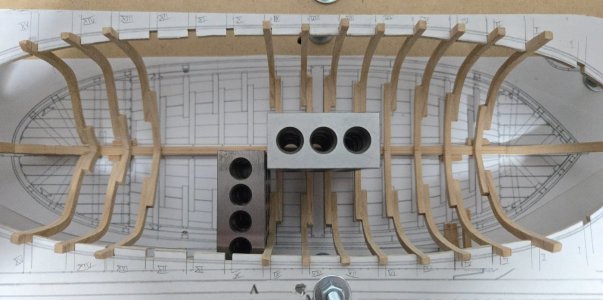
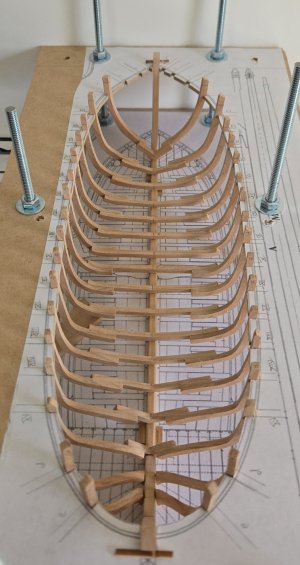
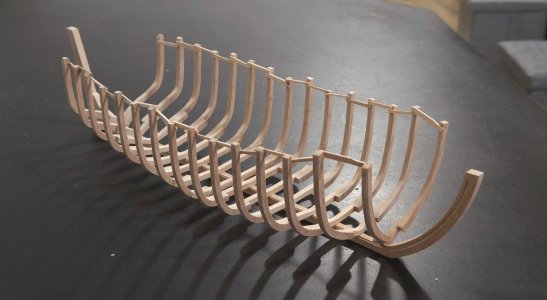
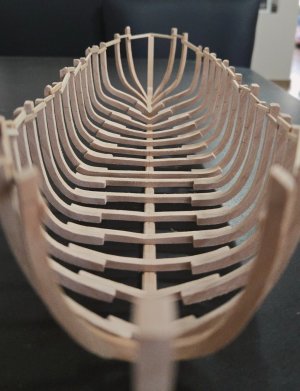
The round stern, especially, is extremely hard to fair, and I keep snapping battens trying to check. I will ultimately have to do some substantial pre-bending to fit the planks around it. That said, the plans seem to show a very rounded stern, so I think that's how it should be.
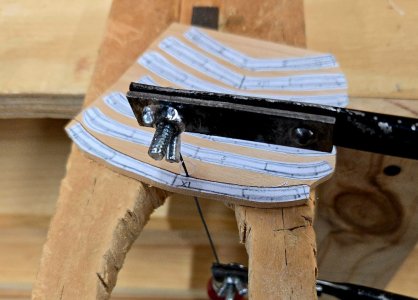
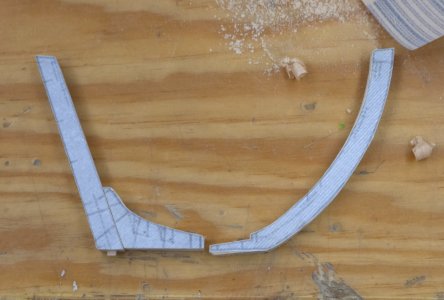
I used a fretsaw to cut out all the parts. In the future, it would be a lot faster to use a powered scrollsaw, although I need to practice first to avoid wasting good wood. I also probably cut the frame parts a little too wide of the lines. Sanding by hand to get close took absolutely forever, so I bought a cheap dremel-type tool. It was useful, but sanding still took a very long time.
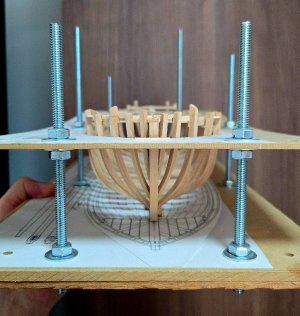
Another challenge that I had was simply setting up the building jig, which I made mostly of mdf. It was surprisingly hard to find bolts long enough to raise the top part of the jig high enough. After fruitlessly trying in several hardware stores, I had to just buy a long threaded rod, saw it to size, and file the sawn tips so I could fit the nuts onto it. This added a lot of time to the build.
Finally, I made things more difficult for myself by buying the monograph in French instead of a language I can speak. Dumb mistake, I know. It was substantially cheaper and faster via ebay rather than ordering in English or Spanish from Ancre directly, but google-translating the text a paragraph at a time has been complicated. Google Translate and Deepl are both not particularly good at dealing with maritime jargon. In the future, if at all possible I'll stick with languages I can read.
There are also a few issues I should bring up about the plan set. In general, I'm happy with it, and wouldn't have been able to reach the point I have without the plans. But, I want to bring up some things I noticed, to help any future builders.
First, a minor issue: the plan set does not include limber holes on the frames, or any sort of pump. Given that it's an open vessel, I suppose bailing would work (although it would be hard with a full cargo load or lots of passengers), but I feel like you would still want limber holes to better collect water.
Second, the top-down plan view is slightly narrower (about 2-3mm) than the tops of the frame drawings. At first I thought the top-down view might be at wale height rather than the cap rail, but it doesn't align that way at the bow and stern. Ultimately I resolved this by slightly widening the notches in the framing jig, but trying to figure it out added a few perplexing days to the build.
Third, some of the frames are supposed to extend beyond the rail to serve as tie-off points. Not all of the frame drawings include this extra length, though, and while I left my frames a little extra long, some won't be quite long enough. Further in the build I'll have to decide whether to live with shorter ones than shown in the plans, or to do repairs to properly extend them (the joints would be covered by planking).
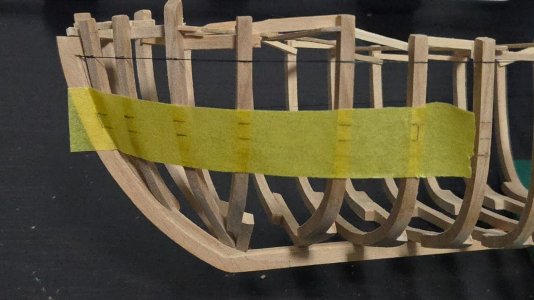
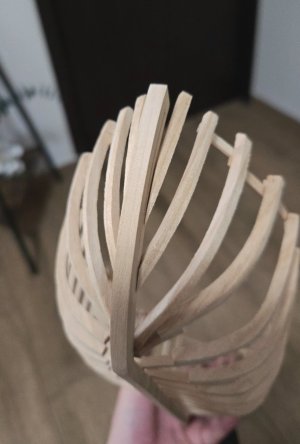
Fourth, and most important: the plan set makes some baffling choices about the cant frames at bow and stern. This has been the single biggest problem I've had with this monograph. At the bow, the frame drawings for cant frames A and B simply don't bother showing the bottom ends of the cant frames--they end in an undefined way. These frames need to join against the stempost, but the details of how they should join are completely left out of drawings.
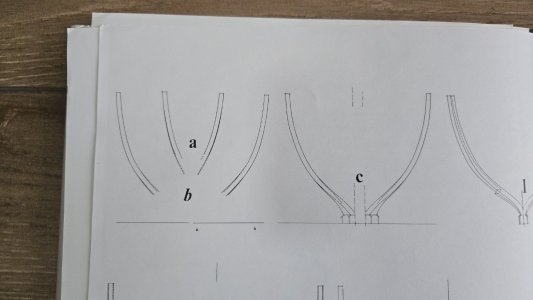
To resolve this, I did a lot of trial-and-error carving, needed to redo a frame, and ended up with rather mediocre joints that, thankfully, will be covered by the foredeck and hull planking.
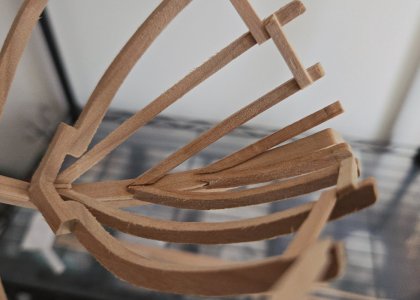
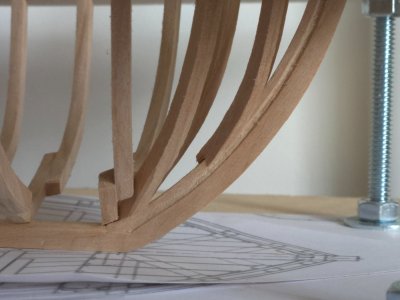
The aft cant frames, D and C, are equally confusing, but in a different way. The drawings show them as ending on the keel.
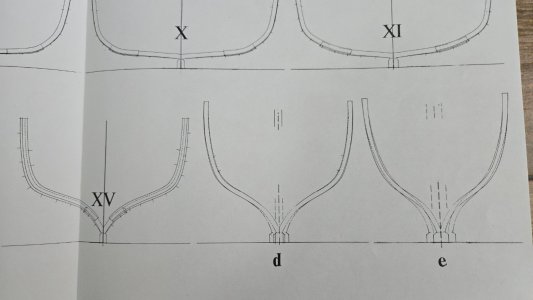
However, they actually join with the deadwood. Trying to fit them properly against the deadwood, at the proper angle and height, was also a long process of trial-and-error. I ended up having to cut shallow notches into the deadwood, as otherwise there was nothing to hold the cant frames in the right spot and, especially given the complex angles, they tended to skate all over the surface of the deadwood when I tried to position them. I also had to cut the bottoms back a good bit, as otherwise the frames stuck out way too far to get a fair curve. Due to this all being trial-and-error, the notches ended up being a bit oversized--thankfully they will be covered by planking.
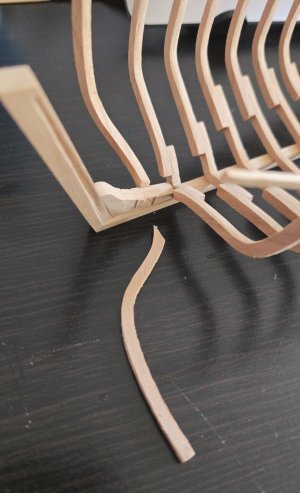
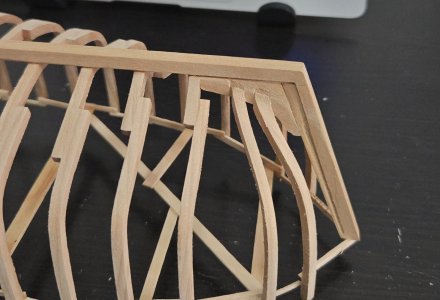
Even now, I'm not 100% sure that they're properly positioned. While I received some suggestions to place them with the aid of battens, the pronounced curve at the stern would require that the battens be pre-bent to the proper curve, which would add a lot of complexity to an already complex undertaking.
The issues with the cant frames are, so far, the biggest problem that I've had with this monograph. From what I can tell, cant frames are challenging to figure out in the best of circumstances, and I would expect a monograph to be a little clearer about them--I can see the aft cant frame drawings being a simple mistake, but the fore cant frame drawings simply seem unfinished.
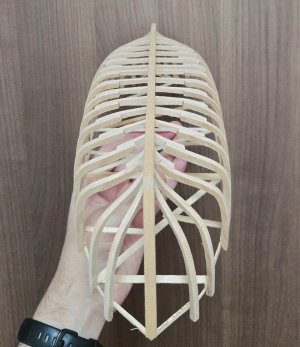
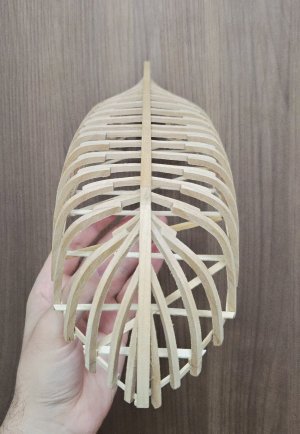
Despite these issues, I'm enjoying the build. I'm getting close to finishing fairing, and its a joy to see the curves of the hull really emerge. I'm looking forward to getting to planking, which is actually one of my favorite parts of modeling, and I'm curious to see how the alder is to bend. I'm learning a lot with this build, and it's been worth it to struggle through the challenges.
As a modeler, I'm most interested in small workboats. The varieties of local designs are fascinating, and researching and modeling them is a fun way to think about how people around the world adapted to big picture changes like globalization and economic development. I'm especially interested in Latin American vessels, but not exclusively. I've also always been drawn toward the fully framed modeling style, as I like the idea of working out every part of how a boat works.
I've been modeling for a couple years, and for my first full-hull POF model, I decided to build from an Ancre monograph, as I didn't want to have to loft my own frames. I initially considered the Gozzo Santa Caterina, but decided against it because of a few issues others noted with the planset, and because it would be miniscule and very challenging in my preferred 1:32 scale. So, I decided to go with Jean Boudriot's reconstruction of the Bateau de Lanvéoc. It's a very simple, single-masted open vessel, and rescaled to 1:32, it's a manageable size--the hull is about 15 in / 38 cm long. It has very full hull lines, and I find it an intriguing if very unglamorous vessel.
To briefly summarize, as the monograph shows, by the 1600s, the French Atlantic coast developed a number of similar vessel types characterized by one or two square-rigged masts. The Bateau de Lanvéoc was a distinct type used in the 18th century into the early 1800s as a ferry and coastal cargo hauler in the area around the important military port of Brest. Pierre Ozanne made a number of drawings of the vessel, and François-Edmond Pâris recorded a hull plan from 1830. The Bateau differed from other vessels in the region, such as the sharper-lined, lug-rigged Plougastel Boat used for fishing, in having a single square sail and a small jib, a seemingly outdated rig by the period that nevertheless persisted in use. After 1830, the vessel appears to have fallen out of use, increasingly replaced by gaff-rigged and eventually powered vessels. I found that several paintings of Brest harbor from the late 1700s and early 1800s seem to show Bateaus like those in the monograph.
I decided to make the model in alder. So far, I've found it to be a very nice wood to work. It's not as hard as cherry, but sands much smoother than basswood, and I like the color. I ordered sheets of alder in the required thicknesses from Ocooch Hardwoods, and I was pleased with the quality.
There are plenty of build logs that give a step-by-step look at POF construction. Here, I'll limit myself to a few general comments and notes about the monograph. With a few exceptions I'll discuss below, I've found this to be a fairly straightforward process, but the build definitely requires a lot of care and emphasis on detail. It's been a very rewarding experience, if a very slow one.
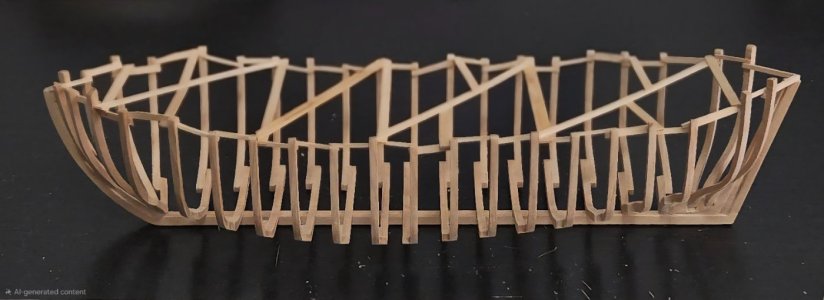
At the moment, the framing is complete. I added a lot of scrap support pieces, rather haphazardly, to secure the frames for fairing. I decided to fair the exterior first, and will add the internal parts after planking the hull. I'm still deciding whether to leave the model partly unplanked to expose the framing, or to just plank everything, as it's an open boat and the framing will be visible on the inside. I'm doing a little fairing here and there, rather than trying to fair everything at once.
The round stern, especially, is extremely hard to fair, and I keep snapping battens trying to check. I will ultimately have to do some substantial pre-bending to fit the planks around it. That said, the plans seem to show a very rounded stern, so I think that's how it should be.
I used a fretsaw to cut out all the parts. In the future, it would be a lot faster to use a powered scrollsaw, although I need to practice first to avoid wasting good wood. I also probably cut the frame parts a little too wide of the lines. Sanding by hand to get close took absolutely forever, so I bought a cheap dremel-type tool. It was useful, but sanding still took a very long time.
Another challenge that I had was simply setting up the building jig, which I made mostly of mdf. It was surprisingly hard to find bolts long enough to raise the top part of the jig high enough. After fruitlessly trying in several hardware stores, I had to just buy a long threaded rod, saw it to size, and file the sawn tips so I could fit the nuts onto it. This added a lot of time to the build.
Finally, I made things more difficult for myself by buying the monograph in French instead of a language I can speak. Dumb mistake, I know. It was substantially cheaper and faster via ebay rather than ordering in English or Spanish from Ancre directly, but google-translating the text a paragraph at a time has been complicated. Google Translate and Deepl are both not particularly good at dealing with maritime jargon. In the future, if at all possible I'll stick with languages I can read.
There are also a few issues I should bring up about the plan set. In general, I'm happy with it, and wouldn't have been able to reach the point I have without the plans. But, I want to bring up some things I noticed, to help any future builders.
First, a minor issue: the plan set does not include limber holes on the frames, or any sort of pump. Given that it's an open vessel, I suppose bailing would work (although it would be hard with a full cargo load or lots of passengers), but I feel like you would still want limber holes to better collect water.
Second, the top-down plan view is slightly narrower (about 2-3mm) than the tops of the frame drawings. At first I thought the top-down view might be at wale height rather than the cap rail, but it doesn't align that way at the bow and stern. Ultimately I resolved this by slightly widening the notches in the framing jig, but trying to figure it out added a few perplexing days to the build.
Third, some of the frames are supposed to extend beyond the rail to serve as tie-off points. Not all of the frame drawings include this extra length, though, and while I left my frames a little extra long, some won't be quite long enough. Further in the build I'll have to decide whether to live with shorter ones than shown in the plans, or to do repairs to properly extend them (the joints would be covered by planking).
Fourth, and most important: the plan set makes some baffling choices about the cant frames at bow and stern. This has been the single biggest problem I've had with this monograph. At the bow, the frame drawings for cant frames A and B simply don't bother showing the bottom ends of the cant frames--they end in an undefined way. These frames need to join against the stempost, but the details of how they should join are completely left out of drawings.
To resolve this, I did a lot of trial-and-error carving, needed to redo a frame, and ended up with rather mediocre joints that, thankfully, will be covered by the foredeck and hull planking.
The aft cant frames, D and C, are equally confusing, but in a different way. The drawings show them as ending on the keel.
However, they actually join with the deadwood. Trying to fit them properly against the deadwood, at the proper angle and height, was also a long process of trial-and-error. I ended up having to cut shallow notches into the deadwood, as otherwise there was nothing to hold the cant frames in the right spot and, especially given the complex angles, they tended to skate all over the surface of the deadwood when I tried to position them. I also had to cut the bottoms back a good bit, as otherwise the frames stuck out way too far to get a fair curve. Due to this all being trial-and-error, the notches ended up being a bit oversized--thankfully they will be covered by planking.
Even now, I'm not 100% sure that they're properly positioned. While I received some suggestions to place them with the aid of battens, the pronounced curve at the stern would require that the battens be pre-bent to the proper curve, which would add a lot of complexity to an already complex undertaking.
The issues with the cant frames are, so far, the biggest problem that I've had with this monograph. From what I can tell, cant frames are challenging to figure out in the best of circumstances, and I would expect a monograph to be a little clearer about them--I can see the aft cant frame drawings being a simple mistake, but the fore cant frame drawings simply seem unfinished.
Despite these issues, I'm enjoying the build. I'm getting close to finishing fairing, and its a joy to see the curves of the hull really emerge. I'm looking forward to getting to planking, which is actually one of my favorite parts of modeling, and I'm curious to see how the alder is to bend. I'm learning a lot with this build, and it's been worth it to struggle through the challenges.