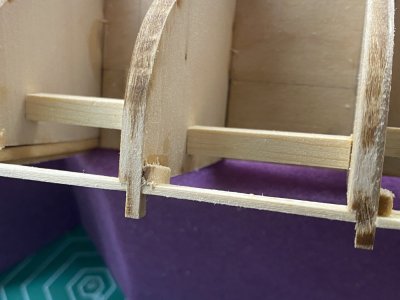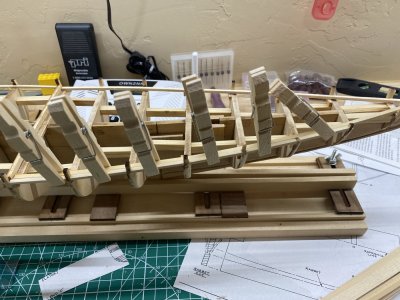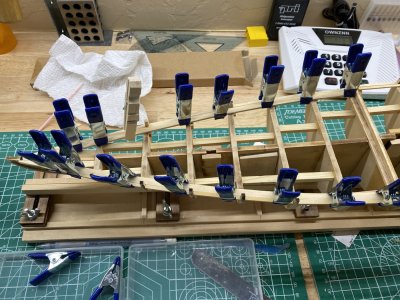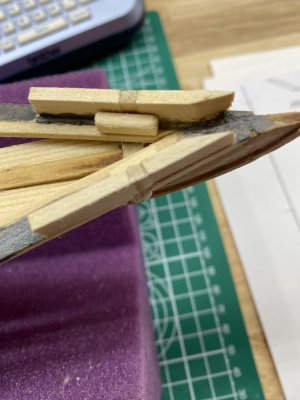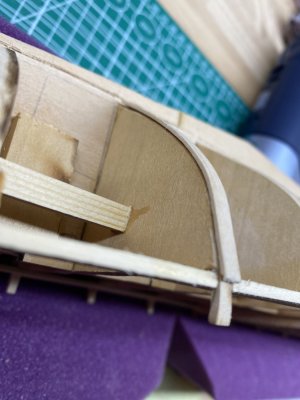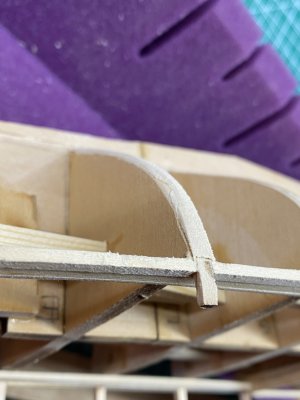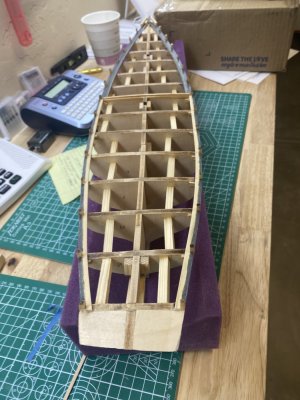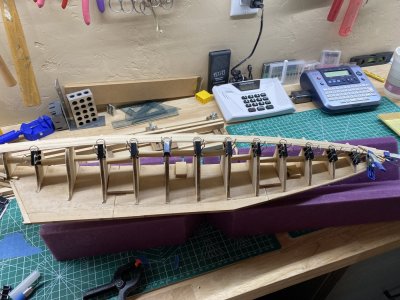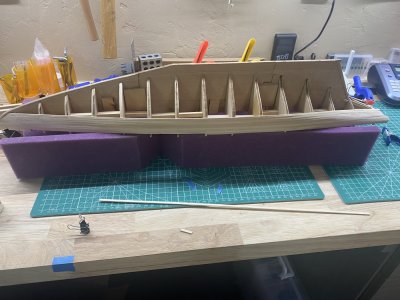




Being fairly new to shipbuilding I am slowly progressing to more and more complex builds. However i must say that even before I knew her name I always thought that the Bluenose was a simply beautiful ship. The flow of her hull is striking. I was able to get a secondhand kit of the model shipways build (MS2130). I have had it stored away for some time. We currently have 2 houses, one on the east coast and one in Arizona. I recently set up a small workshop in my Arizona house (with permission of the Admiral) and I decided to build the Bluenose here, when we are here on vacation.
That being so, this build log will progress in fits and starts depending if I am here. As of this time I have already been working on it for a while, but I have saved pictures of the build and I will "catch up" to my current state of where I am.
I am really using four sources of information to build. One is the instruction manual which appears to be fairly complete, but does a lot of things in a sequence I find not quite logical. The 3 other sources I am using is Jeff T's build.
The build from the suburban ship builders site.

 suburbanshipmodeler.com
And Gary Brinker's You tube series.
I have studied all of them and they are all excellent. I have learned that there are at least 4 different ways to do this build and they all come out looking great!
So Lets go.
Here is the kit
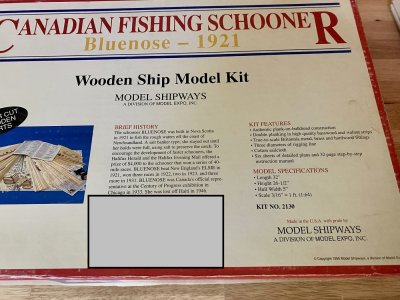
I am not sure how old my copy of this kit is but it appears pretty good. There are some pieces missing that I will have to scratch build, but all in all it is fairly complete.
The set of plans that come with it look fantastic. As did with my Constitution cross section, I hung the plans up on the wall using a magnetic holder used for posters, very convenient.
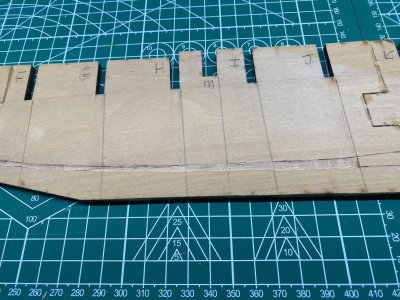
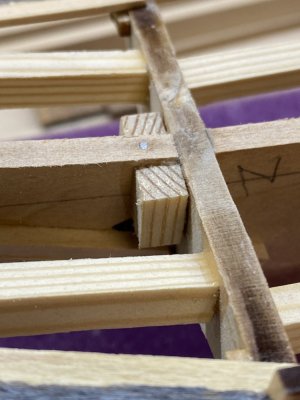
The 3 parts of the keel fit together quite well. I glued them with some epoxy on a sheet of wax paper and let them set. After that I drew in lines for the bulkheads and labeled them. Taking a copy from the plans I cut out the outline of the rabbet and copied them on both sides. You can notice on extremely weak area on the frame, where bulkhead N is located. With my usual luck this of course snapped and I had to repair it with some epoxy and a small nail. I then beefed up the joint with some pieces of wood glued to each side of the frame.
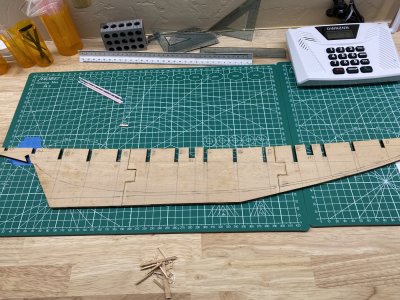
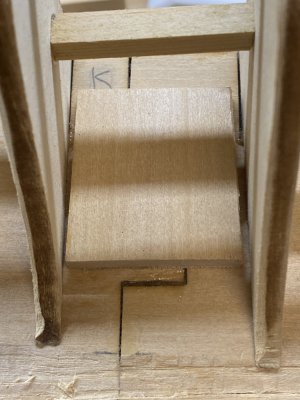
I cut the rabbet and bearding line, mostly using an x-acto chisel blade. The plywood used here did not allow for as smooth a cut as i would wish, but I smoothed it out later with sanding sticks.
That being so, this build log will progress in fits and starts depending if I am here. As of this time I have already been working on it for a while, but I have saved pictures of the build and I will "catch up" to my current state of where I am.
I am really using four sources of information to build. One is the instruction manual which appears to be fairly complete, but does a lot of things in a sequence I find not quite logical. The 3 other sources I am using is Jeff T's build.
Bluenose - Model Shipways MS2130 - 1/64 - By JeffT [COMPLETED BUILD]
I will be building the Model Shipways Bluenose (MS2130) in 1/64 (3/16"=1') scale. This is one of the ships I have wanted to build for some time. I got pretty lucky when purchasing the kit and got it at a super sale price when Mode Expo moved their warehouse last year. The Bluenose will be...
shipsofscale.com
The build from the suburban ship builders site.
Bluenose Canadian Schooner – The Suburban Ship Modeler
The Bluenose is a 1920’s Canadian fishing and racing schooner. This build was based on the Model Shipways kit. This was chosen as my second build because it is bigger, a little more involved, and …
suburbanshipmodeler.com
And Gary Brinker's You tube series.
I have studied all of them and they are all excellent. I have learned that there are at least 4 different ways to do this build and they all come out looking great!
So Lets go.
Here is the kit
I am not sure how old my copy of this kit is but it appears pretty good. There are some pieces missing that I will have to scratch build, but all in all it is fairly complete.
The set of plans that come with it look fantastic. As did with my Constitution cross section, I hung the plans up on the wall using a magnetic holder used for posters, very convenient.
The 3 parts of the keel fit together quite well. I glued them with some epoxy on a sheet of wax paper and let them set. After that I drew in lines for the bulkheads and labeled them. Taking a copy from the plans I cut out the outline of the rabbet and copied them on both sides. You can notice on extremely weak area on the frame, where bulkhead N is located. With my usual luck this of course snapped and I had to repair it with some epoxy and a small nail. I then beefed up the joint with some pieces of wood glued to each side of the frame.
I cut the rabbet and bearding line, mostly using an x-acto chisel blade. The plywood used here did not allow for as smooth a cut as i would wish, but I smoothed it out later with sanding sticks.
Last edited:




 .
.