
• SUBSCRIBE TO SHIPS IN SCALE TODAY!

    The beloved Ships in Scale Magazine is back and charting a new course for 2026!
    Discover new skills, new techniques, and new inspirations in every issue.

    NOTE THAT OUR NEXT ISSUE WILL BE July/August 2026
  • Win a Free Custom Engraved Brass Coin!!!
    As a way to introduce our brass coins to the community, we will raffle off a free coin during the month of August. Follow link ABOVE for instructions for entering.

Build Log: HMS Race Horse 1754 - Sergal/Mantua Kit

Joined
Jan 12, 2026
Messages
12
Points
48

Hello shipbuilders!

After completing the 18th Century Longboat a couple of months ago, I've decided to start my next build: the HMS Race Horse (or Racehorse). Originally designed as a French privateer, the British purchased it during the Seven Years' War (though I'm unsure why the French would sell it to their enemy). It was refitted as a frigate/sloop, then a fire ship, and then a bomb ketch. After the war, it had a second life as an Arctic explorer. I've always been fascinated by cold weather exploration, and I love the idea of a warship being converted to a vessel of exploration (ignoring the fact that it was re-converted to a warship later). I think it's also important to specify that this was an expedition of economic, rather than scientific, exploration.

Here's some interesting info I found on the ship and its crew:
  • The Wikipedia article - hopefully accurate? It gives a brief history of the vessel, including its eventual capture by the French off the coast of New Jersey. LINK
  • An article from the US Naval Institute all about the Arctic expedition of the Racehorse and its partner ship, the Carcass (on which Lord Nelson and Nicholas Biddle served as midshipmen). Side note, what a cursed name for a ship, Carcass is! LINK
  • A painting of the Racehorse returning from its Arctic expedition. LINK
  • A fascinating article about one of the men aboard the Racehorse, Olaudah Equiano. Its source is the man's autobiography - sounds like I'll have to track that down. LINK
  • More information on the expedition, including a drawing of the Racehorse's plans. LINK
  • A BBC article about the wreck of the HMS Racehorse - it was uncovered by divers back in the 80's and more recently catalogued. Includes underwater footage and interviews. I'm not actually sure if this is the same HMS Racehorse though, since the model they show is very different and appears to be missing the mortar pits and what I think is the poop deck. LINK
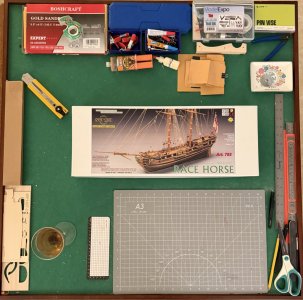
Onto the build! I started the kit last night after a most critical step: fixing a nightcap to go with it:

1776878516869.jpeg

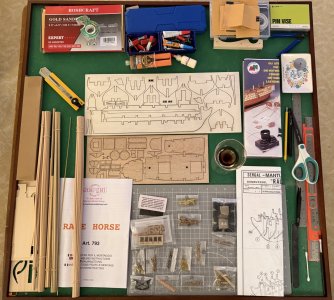
A few notes as I unboxed:
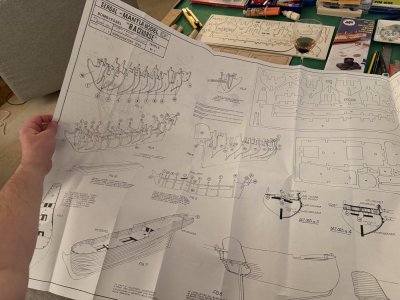
  • The instructions are scattered and international. I'll probably scan everything and reprint just what's relevant to me. I'll also have to translate what's on the scale drawings
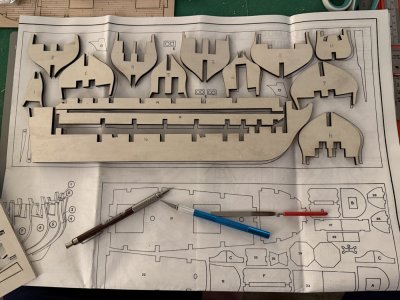
  • Coming from the Longboat, I was surprised at how thick the bulkheads are - almost 5mm! I spent a shameful amount of time trying to pry it into two/three pieces. It's laser-cut, but the plywood was warped. Hopefully the bend isn't bad enough to impact the individual pieces
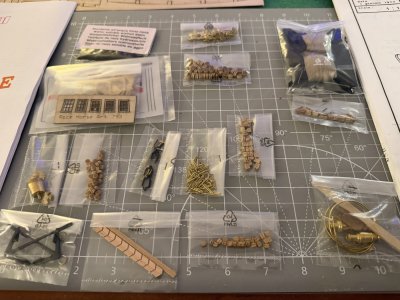
  • Most of the metal bits seem to be preformed - another big departure from my time with the longboat where I made nearly everything metal from wire
Here are a few pics of the kit and its components. I'm not experienced enough to judge quality, but it all seemed good to me (warped bulkhead sheet aside):

1776878613306.jpeg 1776878726300.jpeg1776878743865.jpeg1776878787542.jpeg

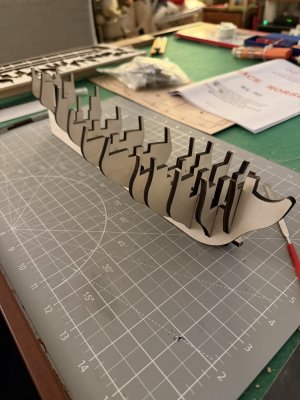
Getting organized was the goal of the evening. But I had some leftover time, so I cut out, cleaned up, and labeled the bulkheads. In a dry-fit, everything seems quite loose, so I'm nervous about squaring these bulkheads up. Starting that will be tonight's job.
1776878872039.jpeg

Until next time!

-Gus
 
Thank you very much, Allen! I'll need all the luck I can get.

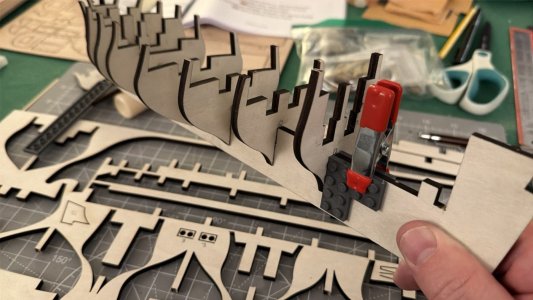
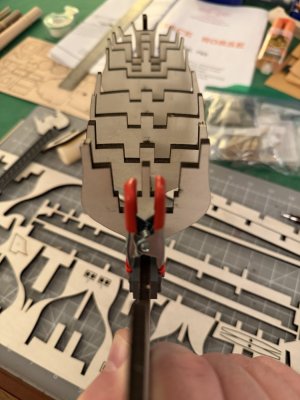
A small update, but I was able to glue the main bulkheads over the last couple of nights. I struggled at first to square them up, but then I found an 'L' shaped Lego, and it did yeoman's work. The final one, which is angled sternward, I had to eyeball. The frame isn't perfect, but it's better than I did on the Longboat.

IMG_7922.jpg IMG_7921.jpeg

IMG_7930.jpeg

I also found two additional frame pieces that should help with rigidity. That's good, because the keel is noticeably warped. If these two extra pieces don't straighten it out, I'll need to build a cradle of some kind. Until next time!

-Gus
 
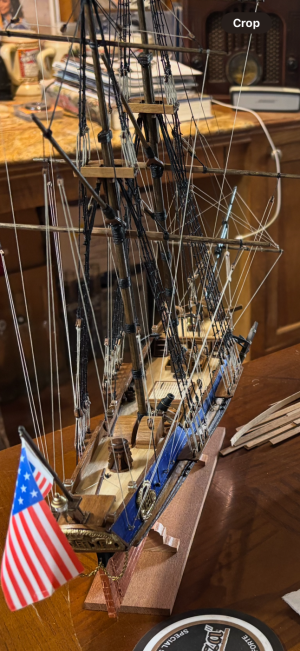
Wow, incredible work on your Racehorse, Seatoland! I can only hope to bring mine to a fraction of your finish, but that's what striving is for! Also very much appreciate more pictures to reference, since it doesn't seem like there are many Racehorses online. If you have the time, I'd love to know a little more about what you bashed/replaced.

I also find myself quite envious of that jig, Leno! While the Lego was helpful, I've since found that Bulkhead #5 must have slid up while I clamped it, because it sits +-2mm higher than it should. I'm now faced with a decision: try to denature the glue and reset it, or forge ahead? I'm unsure how my error will affect the hull's shape.

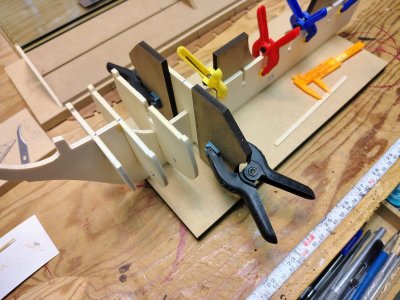
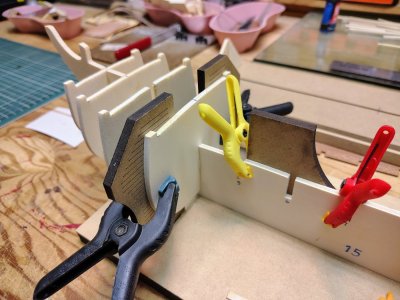
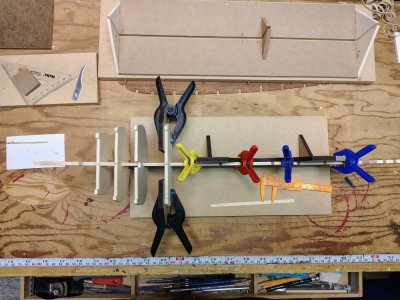
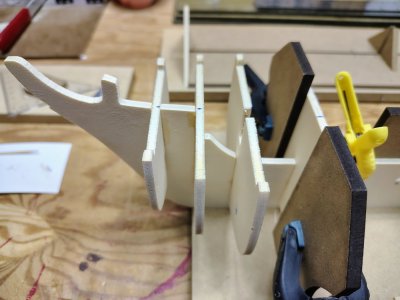
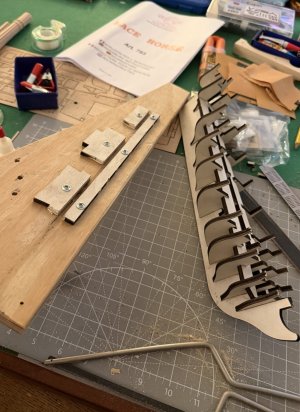
As far as progress it concerned, I completed two things over the weekend. One evening was spent cobbling together my own, ugly version of a work base. I know I could do much better with a trip to the store, but my time is so limited I'd never actually build if I waited for perfection. If you can't tell, I simply cut off parts of the bulkhead plywood, sandwiching the keel between factory edges. Hopefully it'll keep it straight as I plank. Please forgive it's ugliness!

IMG_7971.jpeg IMG_7973.jpeg

The other thing I did was fair the first four bulkheads. The instructions call to only fair the first two, but I thought the angle was enough to warrant some extra sanding. Now I'm just left with deciding whether to 1) address my error with Bulkhead #5 or 2) start planking. Until next time!

-Gus
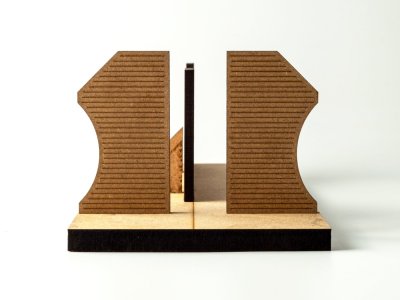
 
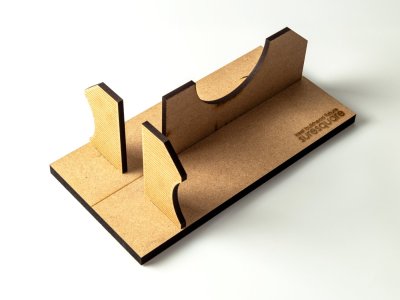
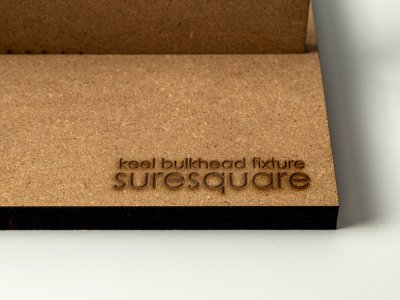
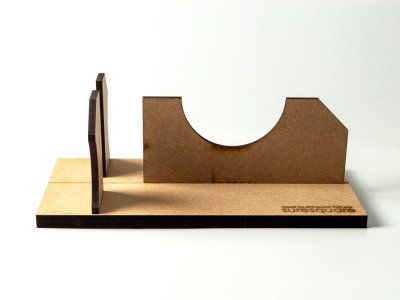
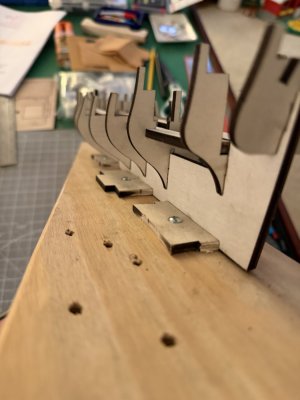
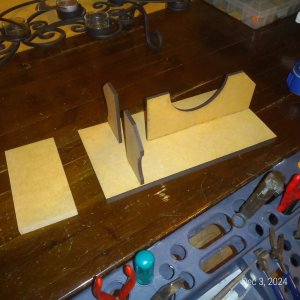
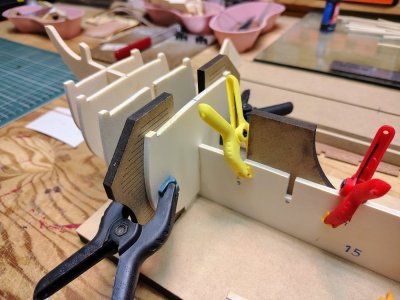
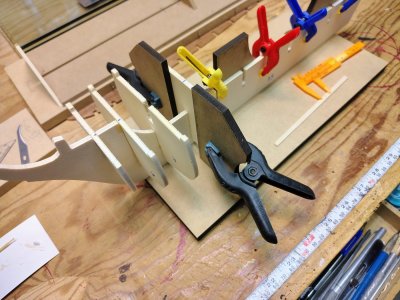
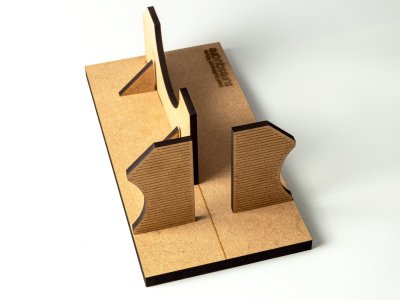
I'm a retired Red Seal Carpenter. I designed and fabricated a prototype myself. I've been trying to source a laser cutting manufacture for this jig but haven't had much luck. I designed the unit for flat pack shipping where the customer can assemble the unit using wood glue and a square. Its not complicated, easy to assemble and use. My initial price came in at 25.00 CDN (Retail) plus shipping. I used the prototype unit for two ship kits and it worked out great. I have more time on my hands now that I'm retired so I'll be trying source a laser cutting manufacture again. Attached is a photo of the prototype.

P_20241203_111145_p.jpg

IMG_20260215_140427214_HDR_AE.jpg

IMG_20260215_140416555_HDR_AE.jpg
 
Side note, what a cursed name for a ship, Carcass is
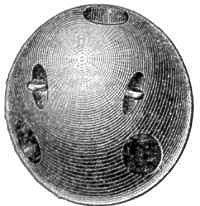
You might be interested to know that the "Carcass" is named not after an animal or human body part, but after the incendiary shell fired by bombardment ships.
Bombardier ships fired two types of projectiles from mortars: high-explosive bombs and incendiary shells. The incendiary shell was called a "carcass" because it consisted of iron rods resembling ribs. Inside was a fabric shell containing an incendiary mixture.


Wiki:


For the composition of the flammable material used in a carcass, 18th century philosopher Christian Wolff prescribed 10 parts of pounded gunpowder, 2 of nitre, 1 of sulfur, and 1 of colophony; or 6 of gunpowder, 4 of nitre, 4 of sulfur, 1 of beaten glass, 0.5 of antimony 0.5 of camphor, 1 of sal ammoniac, and 0.25 of common salt. For the shell, he started with two iron rings (others used plates), fitting one at one extreme, near the aperture at which the carcass was to be fired, and the other at the other. These he braced with cords drawn lengthwise; and across these, at right angles, laced other cords, making a knot at each intersection. Between the folds of the cords, he made holes, inserted copper tubes, and filled them half full of powder and lead bullets, packing it in with a tow. The internal shell's aperture was then plugged up, and it was immersed in a mixture of 4 parts of melted pitch, 20 of rosin, 1 of oil of turpentine, and as much ground gunpowder as was needed to reduce it to the consistency of a paste. After immersion, the shell was to be covered with tow, and immersed again, until it was the proper size for the mortar.

Carcass shells as used by the Royal Navy from the 18th to the 19th centuries were filled with a mixture of saltpeter, sulfur, rosin, sulfide of antimony, tallow and turpentine.
Wolff prescribed 10 parts of pounded gunpowder, 2 of nitre, 1 of sulfur, and 1 of colophony; or 6 of gunpowder, 4 of nitre, 4 of sulfur, 1 of beaten glass, 0.5 of antimony 0.5 of camphor, 1 of sal ammoniac, and 0.25 of common salt. For the shell, he started with two iron rings (others used plates), fitting one at one extreme, near the aperture at which the carcass was to be fired, and the other at the other. These he braced with cords drawn lengthwise; and across these, at right angles, laced other cords, making a knot at each intersection. Between the folds of the cords, he made holes, inserted copper tubes, and filled them half full of powder and lead bullets, packing it in with a tow. The internal shell's aperture was then plugged up, and it was immersed in a mixture of 4 parts of melted pitch, 20 of rosin, 1 of oil of turpentine, and as much ground gunpowder as was needed to reduce it to the consistency of a paste. After immersion, the shell was to be covered with tow, and immersed again, until it was the proper size for the mortar.

Carcass shells as used by the Royal Navy from the 18th to the 19th centuries were filled with a mixture of saltpeter, sulfur, rosin, sulfide of antimony, tallow and turpentine.

1711161518833.png
Carcass_shell.jpg
1711051366452.png
 
Phew, it's been a while since I either got to work on my ship or logged in! First and foremost, @iutar, that is absolutely fascinating! Thank you very much for sharing that info about carcasses. I'm a bit of a word-nerd too, so this intersection of naval history and etymology was right up my alley.

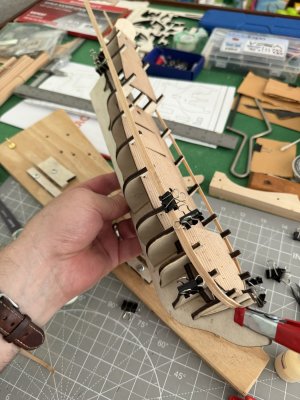
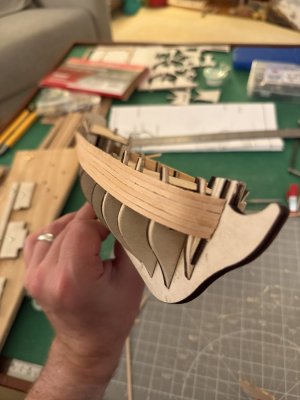
I haven't had a chance to make much process, but in dribs and drabs I've managed a few of the initial plank layers. I've found that the instructions continue to be...lacking. At least for someone with my skill level. On my last boat I could count the planks on the plans to figure out where I was and how I needed to shape. This kit essentially tells you to just go for it.

Start of the bow:
IMG_9365.jpeg

I've also found that the space between the bulkheads is quite wide, so the planks separate. I'm sure I could more precisely shape them so they lay in place, but I've simply added a bit of glue and clamped them with scrap to keep things flush. they're also slightly lapstraking. I'm could bevel them, but that seems like a lot of trouble when I can hopefully knock off the edges with sandpaper later.

Clamping solutions on the stern:
IMG_9382.jpeg

I'm currently running the planks parallel to the keel. I know a curve is going to come in somewhere, but the plans don't got into great detail - it simply describes adding the wedge-shaped slivers when the curve becomes too severe. Since this is just the first layer, I'm going by feel more than anything. My hope is that this will show the trouble zones, and I can come up with a plan of attack for the 2nd layer.

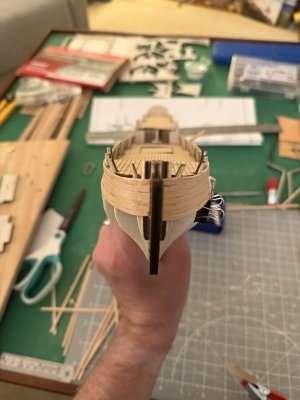
The bow:
IMG_9384.jpegIMG_9385.jpeg

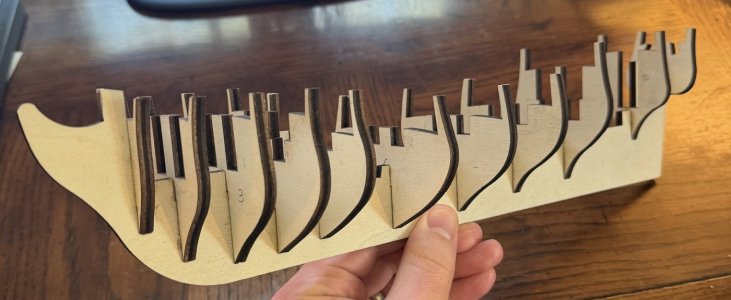
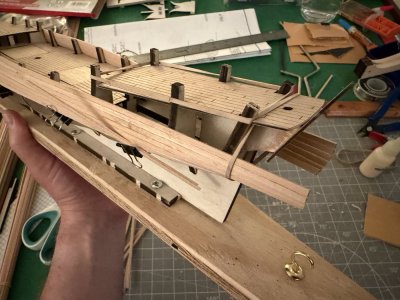
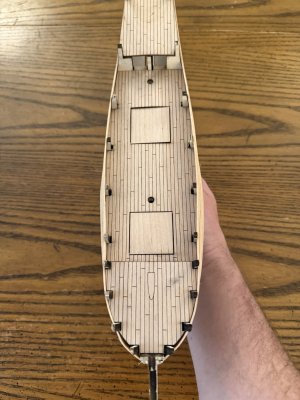
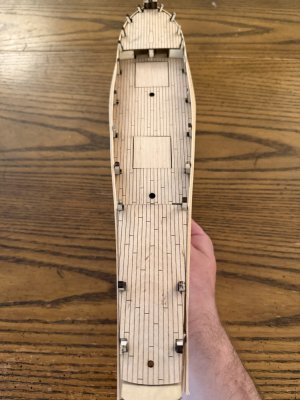
Finally, I've noticed what seems like a bit of an oddity. There's what I can only describe as a bulge or a hump around the 6th bulkhead. I don't know if this is part of the ship's design or if it's an error (the manufacturer's or, more certainly, mine). I've gone through with a set of calipers and measured each bulkhead against the plan's cutouts, and I'm fairly certain they're not out of order (wouldn't that be embarrassing?). However, one of the bulkheads in the affected area doesn't actually conform to what's on the plans - its width at the top is off by a couple of millimeters. Seems strange.

IMG_9387.jpegIMG_9388.jpeg

Regardless, it's a very interesting hull shape to me, and I'm looking forward to continuing! Hopefully any major errors can be addressed with a liberal application of wood filler and sandpaper.

Until next time!
 
Even for a French ship, the shape looks rather odd. I looked for contemporary drawings at RMG but could not find any which makes me wonder where Sergal came up with the design.
Allan
 
Back
Top