
• Win a Free Custom Engraved Brass Coin!!!
    As a way to introduce our brass coins to the community, we will raffle off a free coin during the month of August. Follow link ABOVE for instructions for entering.
  • SUBSCRIBE TO SHIPS IN SCALE TODAY!

    The beloved Ships in Scale Magazine is back and charting a new course for 2026!
    Discover new skills, new techniques, and new inspirations in every issue.

    NOTE THAT OUR NEXT ISSUE WILL BE MARCH/APRIL 2026

Chess trees

Joined
May 9, 2024
Messages
4,928
Points
588

I am researching a 44 gun British frigate of 1744 and the contemporary plan does not show chess trees on the hull. It does show two fenders, but no chess tree. I looked at several more plans of fifth rates prior to the 1745 Establishment and none of the ones I saw show chess trees. Those that I saw from 1745 and beyond do show them. My conclusion would be that they came into use with the 1745 Establishment, but, the 1719 Establishment gives scantlings for chess trees for ships of 70 guns and smaller. Does anyone have information based on contemporary sources regarding when chess trees would have been installed on British naval vessels?
TIA
Allan
 
I checked my plans list for 44 gun and found this for a 1741 Establishments Fifth rate Pearl j5475 ZAZ2278

j5475 ZAZ2278  Pearl.jpg

I think I see something that could be a ches-tree - had to look it up in Falconer I just thought of it as being a fixed sheave block.

Pearl has two full gun decks plus possible guns on the Q-deck and F-deck. I am imagining that these things sailed like a slug - being short and fat with too much hull for wind to hit for its length. I like to think of a frigate as being long, low, and sleek. A ship with one full gun deck and additional guns on the Q-deck and F-deck. Blame
FIRST FRIGATES ,THE GARDINER,ROBERT CONWAY MARITIME PRESS LONDON 1992

HEAVY FRIGATE ,THE VOL.1 GARDINER,ROBERT CONWAY MARITIME PRESS LONDON 1994
I am still waiting for vol. 2
 
A deeper search of my files:
positive for ches-tree =
Garland 20 1719
Argyle 50 1719
Centurion 60 1732
Namur 90 1723
Shark 8 1732
Victory 100 1737
Suffolk 70 1739
Yarmouth 70 1745 possible
Royal George 1756

At first I only looked at the ones I have prints - much higher resolution
So it was one example of every class for every Establishment.
The haphazard nature of ches-tree presence had me looking at KB size NMM icons.
When it came up with Namur 90 I stopped.

My opinion has it the the presence or absence of ches-tree on design plans is not a reliable indication of anything. I suspect the the presence on a particular design plan was an affectation of the draftsman and added on a whim.
The captain or shipsmaster? (the details guy for the ship's functioning) could add or remove a ches-tree with an afternoon's work?
I would vote that any ship from 1719 Establishment on could and probably did have at least one ches-tree.
 
I am imagining that these things sailed like a slug
Maybe that is why the one I am researching sunk in a protected bay while towing a capture. :) I would not have chosen this ship under normal circumstances.
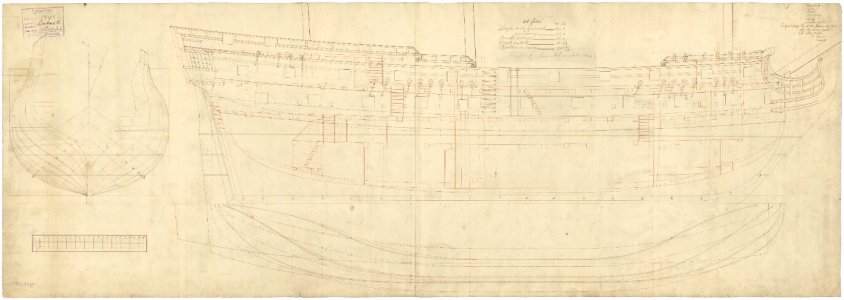
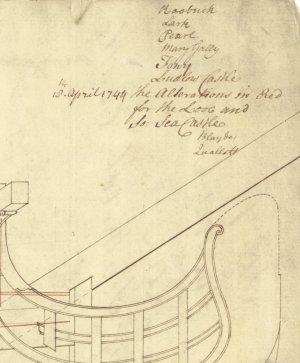
In any case, I wonder which Pearl drawing is correct? I have the one below in high res from RMG and she shows she was built similar to original Roebuck, Fowey, et al. The double tier of stern lights in the drawing above makes her look like Roebuck when they added the faked tier so she looked like a larger ship to the enemy. This drawing shows no evidence of a chess tree but the fenders are very clear.

J5587 High resolution plan.jpg
1775991108970.jpeg
 
Here is what Winfield has for Pearl:

Pearl 1708 40 1706 Establishment
Pearl 1726 40 1719 Establishment
Pearl 1744 44 1741 Establishment
Pearl 1762 32 Niger class
Pearl 1780 18 sloop ex-French prize

A ship may be a total loser as a design - but it did exist and should be modeled if only to show what was an example of a bad idea.

I have it in mind to eventually build an 80 - a rate that was the worst of all possible choices - yet the RN Suits persisted in building them even after every captain who commanded one informed them about how poorly an 80 performed. My perverse streak likes the idea.
 
Thanks Dean,
There are missing things on the drawing like the anchor lining, hawse holes, et al, so the chess trees may indeed be one of them. The project is for HMS Fowey, that was rebuilt as a 44 supposedly based on the plans above which list Pearl, Roebuck, Lark, Fowey and others in the upper right corner of the drawing. I am working with the National Parks Service on this and want to be as accurate as possible. There are some oddities, including the framing, according to the archeologist I am working with, based on the wreck in Biscayne Bay. Sorting these out is a bit of a challenge.
Thanks again for your input, it is always appreciated.
Allan
 
Allan,

Fowey is the name of two vessels that were almost contemporaries. The name was handed off with the same captain shifting from one to the other.
Fowey 40 1709 1706 Establishment design. Portsmouth built. In service until 1744. In 1744 there was an order for it to be reduced to 24 and renamed Queenborough. Instead, it was determined that the hull had deteriorated beyond saving and it was sold 1746.

Fowey 44 1744 1741 Establishment design. private yard built Hugh Blaydes - Hull. Fowey caused a 24 gun privateer to be run ashore at St. Malouine (France?) 1745. It was wrecked near Cape Florida 1748.

Where is Cape Florida? Looking - at the south tip of the sand bank island that is Key Biscayne hello Tricky Dick - a park.
I am going to do a riff based on this scant data:
Fowey being built at a private yard and that yard is listed as building four of the vessels in this class: Anglesea, Hector, Poole, and Fowey.
The same plan from the Navy Board(?) (there were two committees with less than efficient zones of responsibilities and more jealous competition than cooperation). The plan would probably have been bare bones on detail and not likely to have survived. I bet the written contract was anything but bare bones. You are probably well aware of my cynical opinion of the labor intensive inefficiencies of Navy shipyards. Wall of timber, top timbers chasing around Carter's barn to keep from cutting into one when framing a gun port. Looks like too much make-work to me. NOW - a private for profit yard working under a government contract that was probably far from generous could not afford to build that inefficiently. They would probably push the edge of acceptable and more if they could get by with it. The bones that you are working from probably reflect this.
A choice: do you want a recreation in wood - model size - to celebrate the work of a minimum required private yard? or the ideal hull framing as if it had been built in a government yard?
You know that if I built it - the framing would be stylized and the above the wale the (as attractive as 2x4 house) framing would be totally hidden behind planking - so as to not hurt my eyes. For a government museum that will probably want a half and half planked port and only framing stb. I would vote to go with ideal rather than what Hugh Blades probably built.
 
Back
Top