

• Ships of Scale has incorportated an extra level of security when you log In. Please follow on-screen prompts to acknowledge that you are not a robot via a "Check Box" or a "Pictorial Check Box Puzzle". This is needed due to higher level of AI Activity Security.
  • SUBSCRIBE TO SHIPS IN SCALE TODAY!

    The beloved Ships in Scale Magazine is back and charting a new course for 2026!
    Discover new skills, new techniques, and new inspirations in every issue.

    NOTE THAT OUR NEXT ISSUE WILL BE July/August 2026
  • Win a Free Custom Engraved Brass Coin!!!
    As a way to introduce our brass coins to the community, we will raffle off a free coin during the month of August. Follow link ABOVE for instructions for entering.

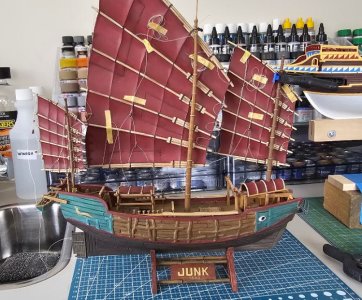
Chinese Junk - Imai/Aoshima 1:60

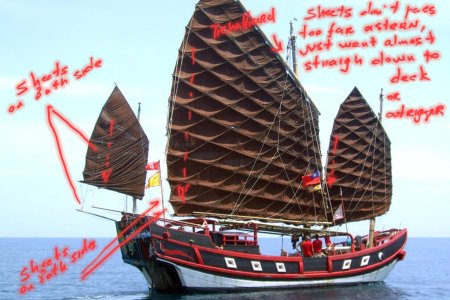
I think junk sail has two group of sheets , one for each side, at least it is clear visiable on the mizzen ... on the drawings one group of sheet probably ommited to simplify picture, or they are not v8siable from sertain point of observation...

 
I might remove the bumpkin if I can. And tryu to add to the ship. There is not clealry a way nbut I will see.

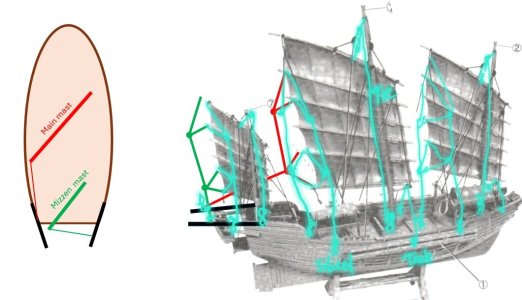
Indeed if I rig the mizzen sheets through the starboard side then a similar bumpkin onm the port can be used for the main sheets. That sail is large and the rigging willextend almost to the mizzen...so a bunpkin for that might make sense too.

I think the sheets are OK. Just at the end of the battens - I took the rigging from the book by Worcester. This shows the bumpkin attache to the mast...for added confusion!

Pic-0394.jpg

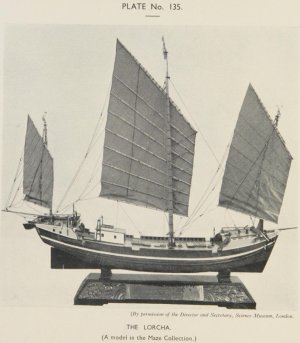
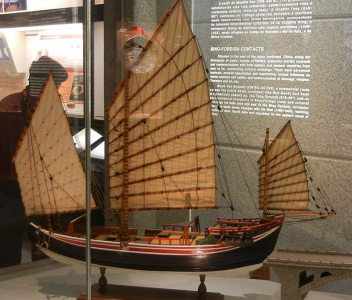
The photo of the model in the Science Museum is not clear enough for me to tell...is that bumpkin on the mast or the body of the ship?

Pic-0462.jpg
 
Last edited:
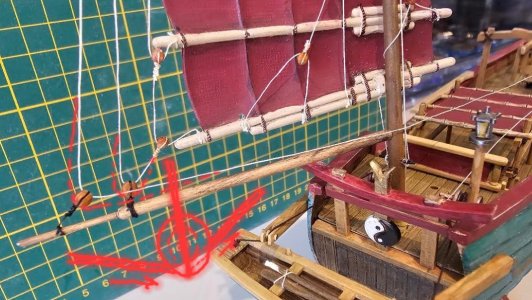
Oh I see one error - the sheet ropes (dashed red lines) go through the wrong holes in the blocks on the bumpkin. That is OK - they are just there for testing. I can fix that! But thanks for reminding me!

It is the solid red lines I do not follow...
 
Last edited:
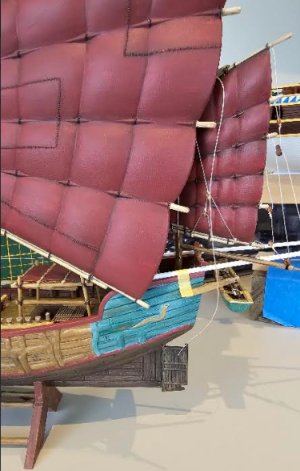
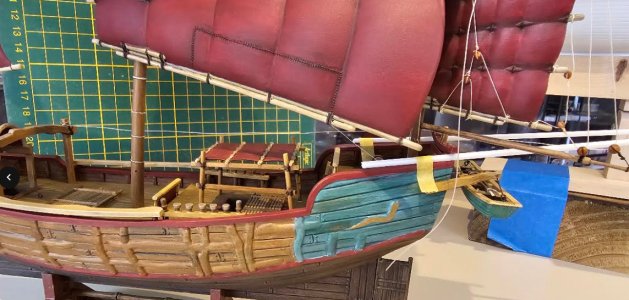
Before making a final decision about the mizzen bumpkin, I need to consider the rigging of the sheets on the main sail. If you just follow the kit then the boom (lowest batten) is well below the level of the deck and then the more realistic sheet rigging is (almost?) impossible.

Pic-0400.jpgPic-0402.jpg

So I think the sail need to be raised and tilted a bit to get the boom closer to horizontal to the deck and also above the deck. More like this:
Pic-0401.jpg


So given that this sail has sheets much the same as the mizzen, the rigging points are very close to the stern of the ship. Just as the mizzen sheets extend beyond the stern, so does the main, really, The sail is so much larger... I can rotate it a little but it needs the last couple of blocks have be beyond the stern, just like the mizzen.

This lorcha from the Wikipedia page shows a bumpkin attached to the mzzen mast (!) but the main sail sheets are indeed secured to the very rear of the ship!
1791260821828.png

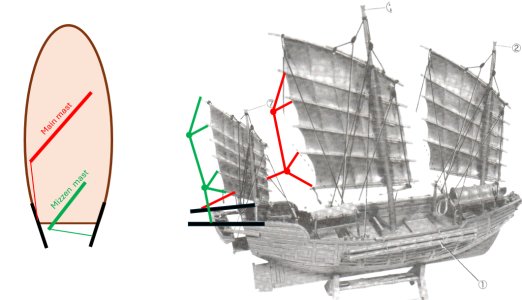
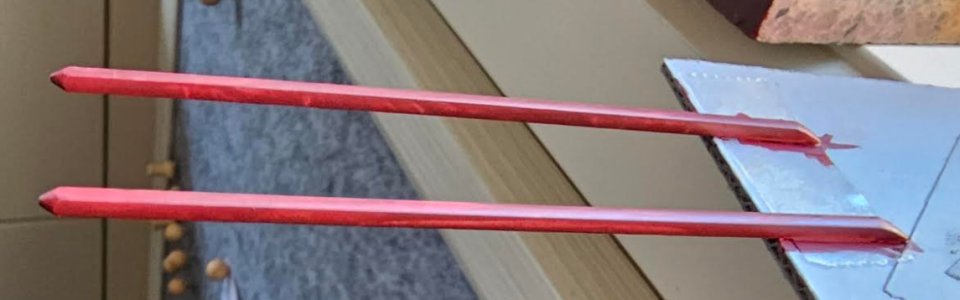
So I am thinking of removing the bumpkin on the mizzen mast (as suggested by Kirill) and adding a bumpkin to the structure on both the port and starboard side - as marked with the white styrene rods in the above picture. (I will shorten them!) Then I propose to use the starboard bumpkin for the mizzen sheets and the port bumpkin for the main sheets. Something like this:

Pic-0415.jpg
 
Hi John!
On that picture wich You posted , mizzen looks like mix of europian style rigging(moveable boom) and chinese...
It doesn't look genuene chinese in my eyes :)))
Look at this picture, real boat not model, it looks like they have sheets on both side of the sails, and they are lead not too far astern but mostly straight down to deck...? To be sure need to find more pictures with real , sailing junk boats not models...
As possible arrangements of tie halliard and sheets my suggestion

57ef74c3371c4c26c3b79830c2bc9128_ce_800x534x0x54_cropped_1332x888.jpg

Pic-0415.jpg
 
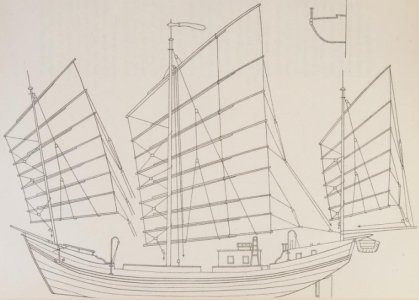
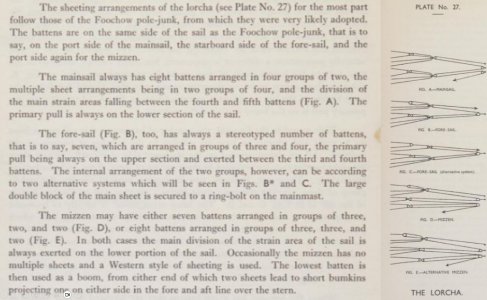
I have read some more about sheets in the book by Worcester (Internet Archive link here). Definitely only one set of sheets. But the rigging of them is interesting and quite varied. He also says that when "western style sheets" were used, the mizzen the sheet was secured to bumkins extending over the rear of the ship. I am not sure that this Imai model has western style sheets but I think I will remove the bumpkin on the mast and add one to the rear of the ship. This seems to be the most common.

Here is the relevant section in the book (p86):

Pic-0458.jpg

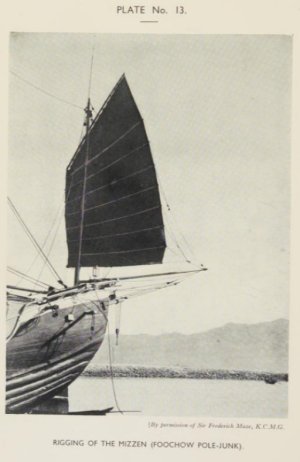
That said, here is a Foochow Pole Junk, thought to be the basis of the Lorcha variant (which is the kit model). And it has a bumpkin on the mizzen sail! Seems either may be used?

Pic-0461.jpg
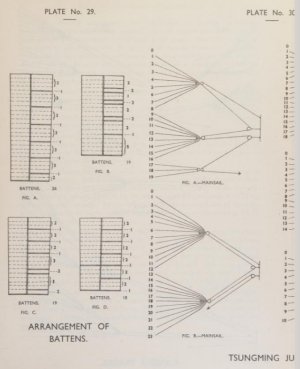
Again Worcester says (in Volume 2) that the best junk model they have is from a lorcha and it seems to be the basis of the kit. It shows a bumpkin for the mizzen, and the main sail sheets are tied to the mizzen sail. See post #83. But I think I will try to secure them on the port at the far rear. The mizzen is a bit busy in this kit! Not a lot of space... I also think the kit has errors in the dimensions of sails - certainly the main sail does not have enough battens. They have stuck with 6 on each sail, and made them larger, whereas in reality they were similar size to the other sails, but there were more battens. Well, I can live with these imprefections :)

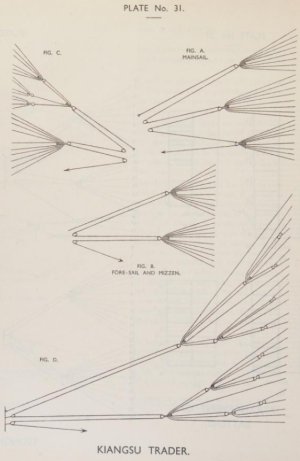
There is a very good section on sheets in Worcester's book - which show an enormous variation. Here are some relevant pictures.
Pic-0448.jpg

Pic-0447.jpg

Pic-0452.jpg

Pic-0453.jpg

Most pictures show the sheets going rearward but as Kirill says, there are many pictures which show them going straight down also. I guess either works!
Pic-0467.jpgPic-0466.jpgPic-0465.jpgPic-0463.jpg
 
Good day John,
If there used one set of sheets for one sail but not two, than probably
" tail" rope of this group need to be secured somewhere in the middle line of the vessel, but not on the one of the ship side as You suggested.
This is fore and aft sail arrangement, and when course need to be changed, sails need to be shifted from board to board to catch the wind, for that sheet as a rule secured in the middle line of the hull or should has opportunity to shift from board to board freely, or two sheets need to be used as used in case of west style fore and aft sails...?
 
You are probably right!! That could be why the sheets on the main sail are tied through the mizzen mast in many cases. Keeps it nice and centered as you say. Good thinking Kirill.

I'll have a look tomorrow to see how I could go with trying to keep the lines on the center. But I'm happy to approximate reality by going to one side or the other.

Certainly this is all been a great learning experience! And that is a major reason for building models, at least in my case.

Thanks Kirill!
 
I have started a gemini Notebook on Junks. It is quicker than reading through all of Worcester's books. ALso, the reference above has the 10 volume work onjunks by Audemarde. It is, however, in French. But Gemini does not care - it reads French and provides me with English answers. (Often dodgy or wrong...beware!)

Gemini disagrees with me about the model being a Lorcha - because it has no keel it is classed as a traditional coastal junk. It gives many reasons so I stand corrected (probably!)

I also gave it the Imai instructions and it is very critical of the rigging - as expected! Here is what it said:

The Rigging: A "Spider on an Acid Trip"
Your assessment of the kit’s rigging diagrams (especially Steps 9, 10, and 11) is completely justified. The kit designers essentially took Western square-rig concepts, panicked about structural stability, and invented a web of fantasy lines:
  • Impossible Shrouds and Forestays (Lines a and Masthead Stays):
    • The instructions have you rig heavy port and starboard shrouds (a) down to the deck, along with stays running between the mastheads and down to the bow.
    • In genuine Chinese junk seamanship, masts are unstayed pole masts. Because a Chinese balance-lug sail has up to a third of its area projecting forward of the mast, permanent shrouds and forestays would physically block the sail from rotating. If rigged per the instructions, the sails could never pivot or tack—they would be pinned flat against the standing rigging.
  • Fictional "Braces" (Lines c):
    • Step 9 depicts lines (c) running from the extremities of the top yards diagonally across to mastheads and deck rails.
    • Chinese lug sails do not have braces. The yard is hoisted on a halyard and held flush against the mast by a parrel; the horizontal trim of the sail is governed strictly by the sheet system on the trailing edge.
  • The Missing Sheets and the Bizarre Bulwark Line (d):
    • The kit completely omits the hallmark of junk rigging: the multiple batten sheets and euphroes (crowfoot blocks).
    • In their place, the instructions invent line d—a bizarre, continuous thread that snakes in a zig-zag pattern along the bulwark pin-rails from the stern all the way to the forward awning posts. This serves no functional purpose on a real vessel and was clearly conceived just to anchor the vacuum-formed plastic sails so they would not wobble on the display shelf.

How to Fix It for an Authentic Build
Since your hull represents a classic armed coastal junk, you can set the kit's rigging sheet aside:
  1. Discard the stays, shrouds, and yard-arm braces (a, c, and the inter-mast lines). Step the three pole masts cleanly and unstayed into the deck.
  2. Mount the sails with authentic parrels around the masts to hold the yards and battens snugly in place.
  3. Rig single halyard purchases from the yard slings to the deck/tabernacle cleats.
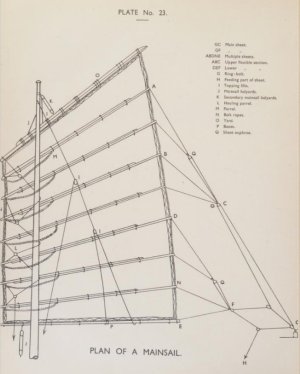
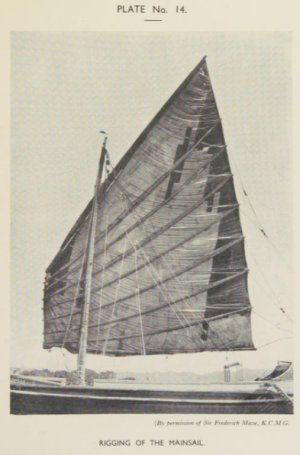
  4. Build a proper euphroe sheet network on the leech of each sail—using Worcester’s detailed sheet diagrams (Plates 27 & 28 in Volume 1)—leading the main and fore sheets aft to deck ringbolts, and the mizzen sheets to the stern transom.
 
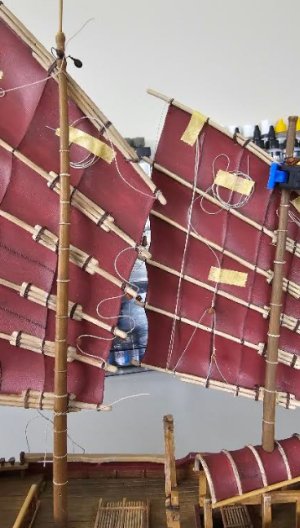
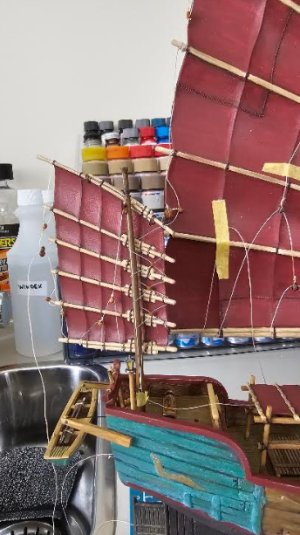
Having put the sails onto the junk has made me even less impressed with the model. The sails could not possibly rotate without hitting each other! This is a "schematic" model rather than a scale model!
Pic-0483.jpg
Pic-0482.jpg

Pic-0481.jpg

Today I finished the rigging! I have to add some rope coils and some barrels etc. Pics tomorrow.
 
Oh...and I questioned the AI about my model being a lorcha. It said it was not because it lacked a keel - however it does have a keel. I sent it pictues. It agreed but said that this is not the main distinguishing feature and it then explained in detail how the bow on the model is not what is expected for a lorcha. Then it explained what the model is, according to the huge number of classifications in Worcester's books:

Your kit is an authentic representation of a Southern Chinese sea-going armed junk (a Fukien or Kwangtung coastal trader / corsair).
Because it represents a deep-water Southern vessel rather than a northern river punt, having that prominent keel (lung-ku) and stern skeg is historically accurate. The mold-makers at Imai got the hull lines right, even if their instruction writer was confused about the terminology.
 
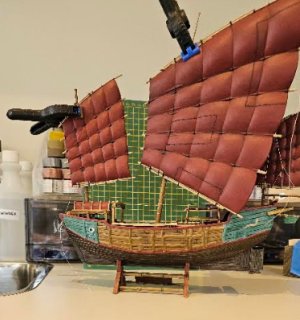
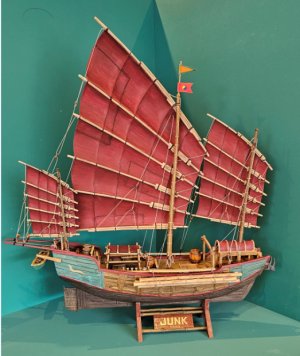
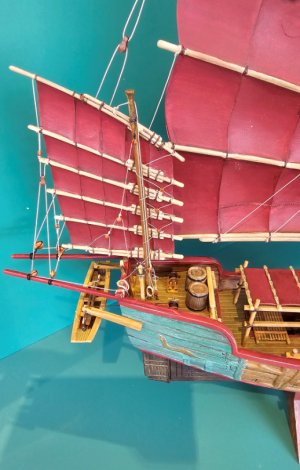
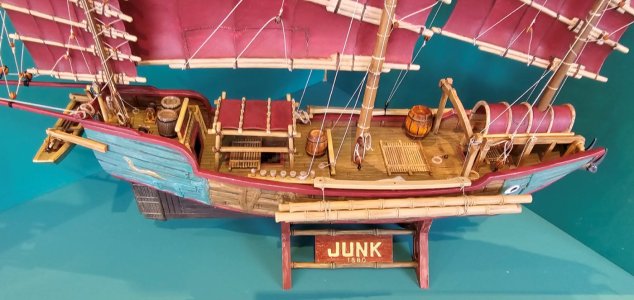
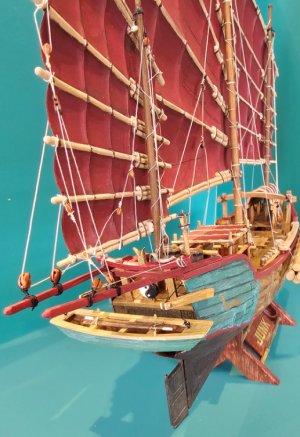
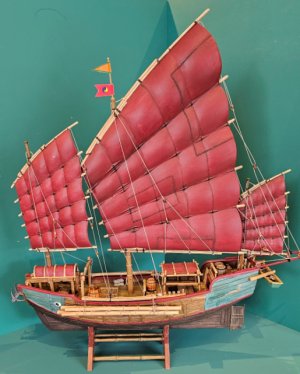
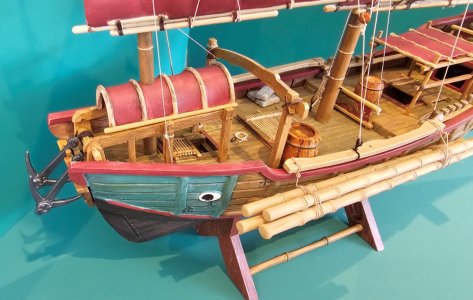
I finished the rigging today, added some cargo and the flags. I think it is done! I have some figures ordered so when they arrive I might add one or two for scale. But apart from that, I think, it is finished at last.

Junk Done 1.jpg

Junk Done 2.jpg

Junk Done 3.jpg

Junk Done 4.jpg

Junk Done 5.jpgJunk Done 6.jpg

Thanks to everyone who helped - especially Big Jake and Kirill.
 
Back
Top