• Win a Free Custom Engraved Brass Coin!!!
    As a way to introduce our brass coins to the community, we will raffle off a free coin during the month of August. Follow link ABOVE for instructions for entering.
  • PRE-ORDER SHIPS IN SCALE TODAY!

    The beloved Ships in Scale Magazine is back and charting a new course for 2026!
    Discover new skills, new techniques, and new inspirations in every issue.

    NOTE THAT OUR FIRST ISSUE WILL BE JAN/FEB 2026

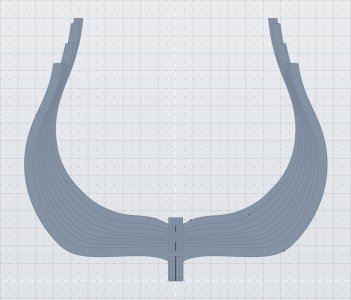
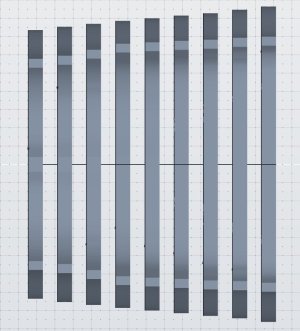
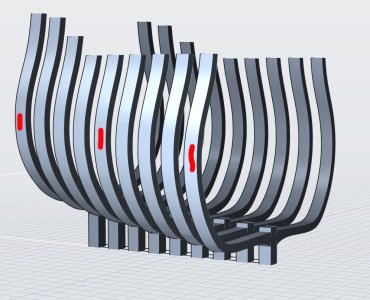
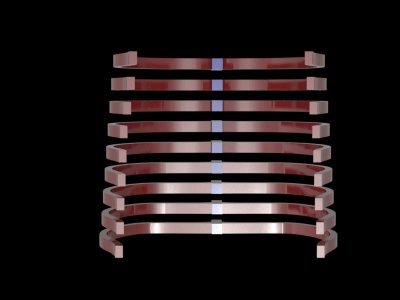
Drafting Frames Based on Old Plans

  • Thread starter Thread starter Jerzy
  • Start date Start date
  • Watchers Watchers 11
This is a very voluminous guide in terms of the number of pages, and it is no surprise that readers only get as far as page 9 and then prefer to seek advice on forums, as if in search of some magical, easy solution
There is no easy solution as you know. It is meant for those that enjoy this part of the process as much as the research and build itself or at least for showing how it can be done so an individual can decide if it is an endeavor they would like to try.
Allan
 
Your question is a good example of the disabilities understandably faced by those who wish to build ship models but lack essential knowledge and experience regarding how to go about doing that. For that reason, and not because I think you need a lecture, I'll share a bit of an "editorial" for the benefit of those who are situated similarly to yourself and wish to know where and how to learn the foundational skills about which you are presently asking.

Naval architecture and shipbuilding at any scale are very complex, multidimensional disciplines that take years of study and experience to master. Obviously, this is why so many people never progress beyond building ship model kits which ("allegedly") provide all that knowledge and information packaged in a box for sale at a (usually inflated) price. Be that as it may, what information anybody wishing to build a ship model requires has been published in books many times over. At the risk of spinning off onto a rant, I'll only mention in passing that one of the biggest problems with the internet is that it's come to be seen by many as a "convenient one stop shop" for getting quick answers without any of the foundational learning it used to take one to reach the same point. That may seem like an advantage in terms of efficiency, but, in fact, it simply leaves the student without any foundation to build upon in order to answer for themselves the next related question that inevitably arises. Instead, the student just ends up returning to the internet again to ask the next question and likely receive twenty-seven different answers. This is problematic because if the questioner doesn't know the answer, how are they ever going to pick the right one from the diverse collection generated by their query? Worse still, in the "Age of AI" we now are beginning to see wrong answers "chiseled in stone" as they are continually repeated online, "gain weight," and ultimately come to be republished as "intelligent" algorithmically generated query responses.

All of which is a long way around saying, "If you want to get good at this ship modeling stuff, don't just ask somebody to show you how to do it. Learn how to teach yourself do it." There's nothing wrong with not knowing something. Asking for help is exactly the right thing to do, but don't let the internet turn you into a lazy learner. The mind is a terrible thing to waste.

In specific response to your question:

If you aren't in command of basic mechanical drawing skills, as appears the case, find a basic textbook in what used to be called "mechanical drawing" or "drafting." There were millions printed because they used to teach drafting in every high school in America as a prerequisite for "manual arts" or "shop" classes. A basic drafting textbook will teach you the basics of "mechanical drawing." Drafting is a "language" and if you are not conversant in this language, you will always encounter ship modeling problems like the ones you are facing now. Read and learn the basics. (See, e.g., https://www.amazon.com/Basic-Drafti...phy=88716&hvtargid=pla-4583932699603256&psc=1)

There are two books which you will find to be valuable reference works to have in your ship modeling library.

1. Yacht Designing and Planning by Howard I. Chapelle (https://www.amazon.com/Yacht-Designing-Planning-Howard-Chapelle/dp/0393332594) Although focused on wooden yachts, its content is applicable to larger wooden vessels as well. It contains an excellent step-by-step overview of how ship's plans are drawn and used.

2. Lofting by Allan H. Vaitses (https://www.amazon.com/Lofting-Allan-H-Vaitses/dp/0937822558) Lofting is the process of drawing full-sized patterns of the various parts of a vessel from the "Table of Offsets" or drawn scale "lines." I know of no other book on the subject of lofting which is as comprehensive as this one. Knowing how to loft is as essential to the scale ship modeler as it is to the full-size shipyard. Anyone who wants to build a ship model from original plans should have this reference book on their drawing board. Even if you are old enough to have been taught to read mechanical drawings in school, this book will prove a lifesaver when you run into the more complex shapes of some vessels, such as curved elliptical transoms and the like. It will also provide you with valuable information on things like orthographic projection and foreshortening which drive unsuspecting ship modelers crazy. *

I believe if you stick with ship modeling for any length of time, these books will become "old friends" on your reference library shelves. You won't need them every day, but when you do have occasion to consult them, they will provide you with invaluable in-depth information that will serve you well as you continue on your modeling journey.

All of these books are available used. One nice thing about ship modeling is that it appeals to a lot of old guys who are croaking with remarkable regularity, thereby providing a steady stream of used copies of ship modeling titles at substantial savings over new retail prices.

____________________________________________________________
*
Foreshortening is the visual effect that causes an object to appear shorter than it actually is when viewed at an angle.

In the context of orthographic projection, which is a method of representing three-dimensional objects in two dimensions, foreshortening plays a crucial role.
Dear @Bob Cleek,

Thank you for taking the time out of your Sunday to draft this lengthy and thoughtful response.
I will look into your suggested reading materials and hopefully can gain some additional insight to the navel drafting process that was described earlier.

Just as a bit of information, I do have drafting skills that were honed many years ago and even had the opportunity to teach the lab for a drafting course while in college as well as being a draftsman for a company while working there as an engineer. Thus I am familiar with the drafting book you noted - as I still have a copy of it in my old library.

I asked for a referenced demo only because reading how lines are drawn is so much more difficult to comprehend than to simply see an abbreviated demo.
Navel architecture is a science onto itself. It takes years of training to understand the various nuisances of that profession - just like any of the other sciences.
I wouldn't expect you to know and understand the nuisances of powertrain design from small vehicles to armored tanks by simply showing you how a small car is laid out.

The same holds true as you noted for navel architecture. For us land lubbers who do not have that training we need to start somewhere and I greatly appreciate your thoughtful suggestions on where to start. I definitely will take a look at the suggested Chapelle and Vaitses texts as I believe they will be helpful.

Thanks again for your time, insights and suggestions as they are greatly appreciated by all who appreciate wisdom & experience that is being freely shared.
 
Dear @Bob Cleek,

Thank you for taking the time out of your Sunday to draft this lengthy and thoughtful response.
I will look into your suggested reading materials and hopefully can gain some additional insight to the navel drafting process that was described earlier.

Just as a bit of information, I do have drafting skills that were honed many years ago and even had the opportunity to teach the lab for a drafting course while in college as well as being a draftsman for a company while working there as an engineer. Thus I am familiar with the drafting book you noted - as I still have a copy of it in my old library.

I asked for a referenced demo only because reading how lines are drawn is so much more difficult to comprehend than to simply see an abbreviated demo.
Navel architecture is a science onto itself. It takes years of training to understand the various nuisances of that profession - just like any of the other sciences.
I wouldn't expect you to know and understand the nuisances of powertrain design from small vehicles to armored tanks by simply showing you how a small car is laid out.

The same holds true as you noted for navel architecture. For us land lubbers who do not have that training we need to start somewhere and I greatly appreciate your thoughtful suggestions on where to start. I definitely will take a look at the suggested Chapelle and Vaitses texts as I believe they will be helpful.

Thanks again for your time, insights and suggestions as they are greatly appreciated by all who appreciate wisdom & experience that is being freely shared.

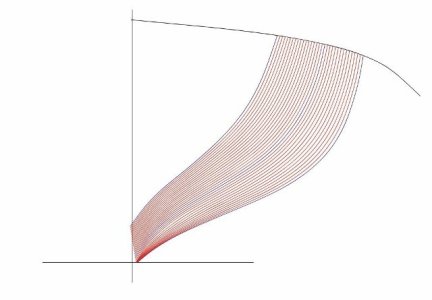
Say no more! Your drafting experience will serve you well. As soon as you take a look at either Vaites' or Chapelle's book, I expect you'll have an "ah-ha moment" and it will all fall into place. It's all about generating points on the plane of the particular plane view you are working with. There are three orthographically drawn planes that define the three dimensions of a ship's hull. With two of those planes, you can generate the missing one if need be by transferring the points of any curve on the two given planes onto the missing third plane and drawing a line through them with a spline or batten, an adjustable curve, or a set of "ship's curves" in the highly unlikely chance you have access to a set of these now highly collectable and scarce curves.

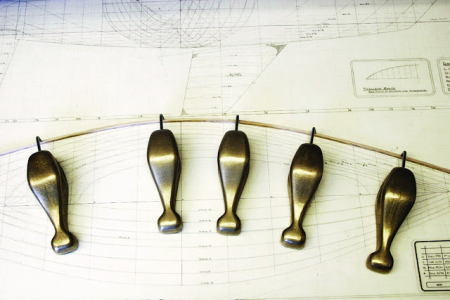
Spline and "ducks:" Anything that will hold the spline (bent batten, length of spring steel, section of bandsaw blade, etc.) in place will serve as a "duck" to hold the spline in place so a line can be drawn along its edge.

1771362933641.png

1771363042711.png

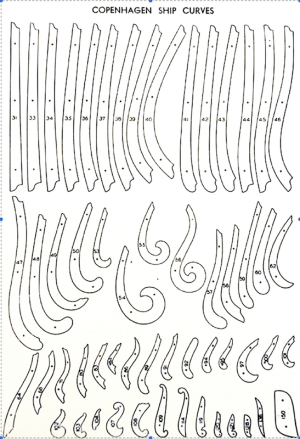
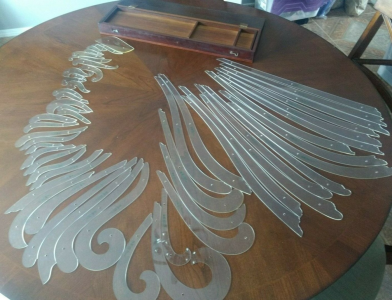
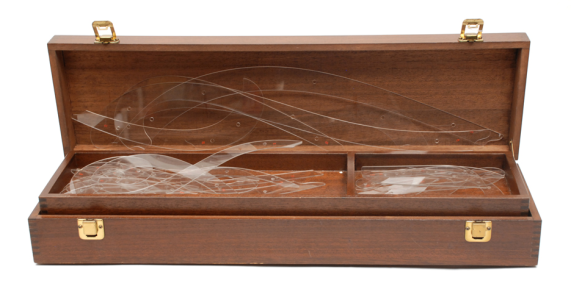
Copenhagen Ship's Curves: This set by Keuffel and Esser. Copenhagen Ship's Curves are not to be confused with "French curves," engineer's curves, or "highway" and "railroad" curves. Ship's curves are used for naval architectural drafting. Like other types of curves, they are designed to be used by overlapping at least 2 and preferably 3 points on a curved line drawn previously with the edge of another curve in the set. In this fashion fair curves are drawn notwithstanding their irregular shape. They very occasionally still show up on eBay and similar sites. There are stories of sets being found in thrift stores for legendary low prices, but the "going rate" of recent sales for complete sets (very hard to find) seems to start around $750 and up. Invaluable because they do accurately things that very few, if any, CAD programs can do yet. (Forget scanning the shapes from the old catalogs and "just" cutting them out on a laser cutter. Guys have tried and failed. The main reason given is the very high cost of the laser cutting.) If you find a set in your grandfather's garage, grab it! (If you come across the more common sets of highway and/or railroad curves, which are pure radius curves, grab them, too. They are very handy for generating deck camber curves on models. Highway and railroad curves are shaped the same, but are scaled differently. Highway curves define an arc of a circle, while railroad curves define the chord of a circle.)


1771362762207.png

1771362807979.png

1771363809097.png
 
Without having to invest in a set of drafting ducks ( I made mine, cast in lead from a home made wooden pattern 60+ years ago) you can use the loftsman’s system by using small brads to fix the spline in place. A piece of 1/2” MDF would make a drawing board. I rip splines on my table saw from a piece of spruce.

Roger
 
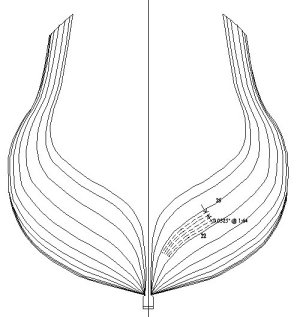
Is there any reason the frames cannot be drawn up by tracing the body plan station lines as a starting point? At our scales I believe they would be fine. For the frames between the station lines on the body plan, it is easy to tick where the frames would go, then connect the dots. The tracing of the original body plan below shows every three station lines and the dashed lines show the frames in between. Once done the scantlings for the moulded dimensions can be used to draw the inboard side of the frames, and the water lines and deck plans can be used to come up with the bevel. I realize the location of the station lines does not always line up with a frame, but for this ship, they did. This can all be done with pencil and curves or CAD.
Allan

Example of body plan with added frame lines

1771415414961.jpeg
 
Is there any reason the frames cannot be drawn up by tracing the body plan station lines as a starting point?

To be honest, I am not particularly fond of this supposedly fast or easy method. Let me explain:

— Firstly, it is inherently inaccurate, which must be taken into account by adding a large allowance for further processing, and as a result, it takes on more of a carpentry, as opposed to a design or drafting, character (while the latter was the original requirement, for example — for precise laser or CNC cutting).
— Secondly, it carries a real and high risk of so-called ‘cow ribs’ forming on the surface of the hull (characteristic of paper models and POBs with too few bulkheads).
— Thirdly, especially at the extremities of the hull, it is practically impossible for someone without experience in such work to achieve even reasonably approximate contours.
— Fourthly, in general, this rather chaotic method is likely to produce a rather chaotic result, if the whole process can be completed at all without applying orderly procedures.
— Fifthly, this method does not allow for verification of the correctness of the base plans (in particular fairness), which are almost invariably wanting in this respect.
— Sixthly, it may ultimately turn out that the entire effort required by this method will not be less or much less than that required by a methodologically proper method.

.​
 
Last edited:
Secondly, it carries a real and high risk of so-called ‘cow ribs’ forming on the surface of the hull (characteristic of paper models and POBs with too few bulkheads).
Overall your post makes a lot of sense, thank you very much.

I may have not been clear. I understand your other points, but for the most part I prefer to build fully framed models and using the body plan method allows this. I do take into account the reduced sidings on the higher futtocks and top timbers. I use arcs for all segments when drawing the frames and the lines are typically very smooth. Smoother than the saw cuts that follow anyway. :)

In the end I suppose I should learn to loft the frames. :)

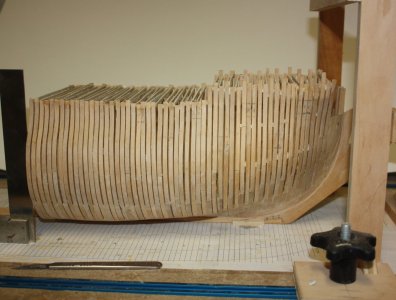
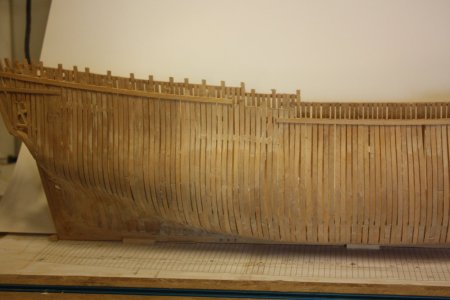
Example from several years ago. Litchfield (50) 1695 ---> before cant frames were used.

1771429968924.jpeg

1771430079618.jpeg
 
.
— Secondly, it carries a real and high risk of so-called ‘cow ribs’ forming on the surface of the hull (characteristic of paper models and POBs with too few bulkheads).

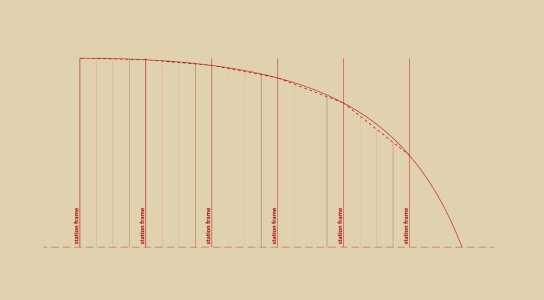
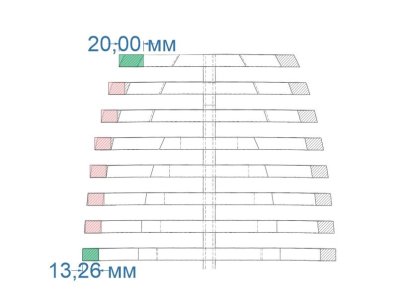
Allan, you already accumulated a lot of experience, and this kind of risk is proportionally much smaller in your case. But others, without your experience, both in drafting and in model construction itself, can easily loft ‘filling frames’ as shown below, that is, only up to the dotted line, instead of the solid line (if they do not add a processing allowance). In this case, the ‘station frames’ may become just such ‘cow ribs’, even if there are (incorrectly) lofted ‘filling frames’ between them. Admittedly, fairness can be, for better or worse, corrected by sanding, but at the cost of the model's hull shapes not matching the original shapes, i.e. those taken from the plan.

But again, these types of rescue operations are already in the category of woodworking, not drafting.

cow ribs effect.jpg
 
it is inherently inaccurate, which must be taken into account by adding a large allowance for further processing, and as a result, it takes on more of a carpentry, as opposed to a design or drafting, character (while the latter was the original requirement, for example — for precise laser or CNC cutting).

I absolutely disagree that only using the lofting of the stations is in anyway inaccurate. Prior to ~1860 my reading of what has come down to us suggests that only the station shapes were drawn out on the mold loft floor. They were used to produce the wooden timber patterns. The patterns had 'sirmarks' for the frame timbers between each station. The boss in the yard did the interpolation using eye and battens. The actual hulls were built using the method that you suggest is improper.

The appearance of several books around 1918 that demonstrate complete lofting of every edge of every frame - a method probably developed by designers educated in iron and steel hull construction. This sort of technique is required when metal is the framing material. The dominant technique used for POF is most likely an artifact and derivative of the WWI wooden hull building boom and the books that described their methods. This was the background of Charles Davis. Those methods were not a linear progression from the ancient master to apprentice line that existed up until iron and steel ended it - except in small one off yards mostly building small hulls.

The solid hull models dominant thru the 18th C. - solid hull carve and slice as the design method for an actual hull - carved solid hulls and carved laminate hulls do not require anything like the number lines that complete lofting of every possible line involves. Those hulls are as likely just as or even more accurate than a "a methodologically proper method". Now, I will take your "POBs with too few bulkheads" a step further and posit that ANY POB hull that also does not include a fill between every mold is unlikely to produce anything approaching an accurate hull. To be even more heretical, when there IS fill between every mold it has become a complicated way of producing a carved laminate hull.

Allan is suggesting a short cut on the drawing board that will not work the way that he would wish. None of the XZ lines are arcs. Equally spaced tics along the curve do not define the curve. All of the curves continuously increase in slope as they approach the ends. I doubt that it can be done accurately by eye.

for precise laser or CNC cutting
This is a different topic, but since you introduced it:
For a manufacturer of kits where multiple replicates of each component is a requirement, the utility and efficiency is obvious. For a one-off hull - it seems to be over-kill. Using a hydraulic press the squash an ant does the that job too. I can extrapolate this adapting of evolving high tech replacing hand craft skills to a point where a machine does the assembly and finish work too. The next SiFi step would be to request the finished model from a replicator. It turns what is a craft and skill challenge into something entirely different. (And if scratch is done to a complete degree an intellectual challenge, too. By that I mean starting with design or taken off plans and chasing the specters of information left to us yourself to do the total development.)
 
Last night I was reading an article about the history of the New York Shipbuilding Company; once the largest shipbuilder in the USA. The author claimed that New York Ship invented the “mould loft system” for building steel ships. Without getting into details, this system used mould loft developed templates for work that previously had to be marked out from the actual ship being built. Despite this author’s claim, this system had already been in use by the Chicago Shipbuilding Company, as documented in a SNAME technical paper published before New York Ship was founded.

In 1899 when New York Ship was established, the most active and dynamic shipbuilding area in the USA was not either its East or West Coast but the Great Lakes. Here the huge fleet of very large bulk carriers was built to deliver raw materials to the growing US steel industry. In 1899, the US Steel Corporation’s Pittsburgh Steamship Company fleet was larger than that of the US Navy.

My point is that only a small segment of the World’s shipbuilding technology has been studied and documented, although we are learning more every day. Waldemar’s posts about Portuguese shipbuilding texts are a good example. But, in many parts of the World seaworthy ships have been built using methods not documented or otherwise not studied or understood by historians. For example, was the well known British Dockyard system: lines drawing and mould loft used by the Americans in 1776 to produce nicely modeled row galleys to defend Lake Champlain, or did William Bates trace lines in the Snow at Manitowoc, Wisconsin to model his schooners in the 1850’s as claimed by one author. In both cases, the answer is almost surely no. Benedict Arnold did not have the time for the RN’s design process and Bates did nor record his detailed table of offsets from crude lines drawn in the snow. I have seen his offset book at the Maritime Museum. It is also interesting to note the large number of builder’s half models in the Smithsonian’s National Watercraft Collection used instead of lines drawings as the starting point
For the design process well into the mid Nineteenth century.

And finally, author William H. Thiesen writes in his Industrializing American Shipbuilding that wooden shipbuilders were artisans, adept at modifying hull structures as necessary during the construction process. The frame was finally faired by “dubbing.” Things changed with the change to iron and later steel. Now things had to fit exactly. This required preparation of 1000’s of design drawings not previously required for wooden construction.

Roger
 
I absolutely disagre [...]

It has been a long time since my explanations and intentions have been so badly misinterpreted, misunderstood, and distorted. There is so much of this in your statements that I simply don't want to waste my time correcting all these misperceptions. I don't like conversations in which one person completely misunderstands or refuses to understand the other, and I'm not going to get involved in this one either, sorry.

.​
 
Back
Top