

• Win a Free Custom Engraved Brass Coin!!!
    As a way to introduce our brass coins to the community, we will raffle off a free coin during the month of August. Follow link ABOVE for instructions for entering.
  • PRE-ORDER SHIPS IN SCALE TODAY!

    The beloved Ships in Scale Magazine is back and charting a new course for 2026!
    Discover new skills, new techniques, and new inspirations in every issue.

    NOTE THAT OUR FIRST ISSUE WILL BE JAN/FEB 2026

Dutch heavy frigate ca. 1700 – engineering or carpentry ‘snowman’ making?

I'm sure you are right Martes, but to the best of my knowledge Dutch frigates never had more guns than 40.

About the dating: all well, but the reasons Waldemar gives why the drawing has to be dated as early as 1700 do not seem very solid to me: square tuck sterns and double wales were still in use in all admiralties until after the first quarter of the 18th century.

Here a drawing by Gerbrand Slecht, active on the Amsterdam admiralty yard from 1723-26:
View attachment 452988

Here a Rotterdam drawing of probably the first man-of-war that was actually built after preliminary drawings, the Twikkelo, built in 1725 by Paulus van Zwijndregt:
View attachment 452989

Both show a flat tuck, be it that the flat part was mostly above the waterline, which makes it basically not different from ships with round tucks.

As to double or single wales: both were used, there is a drawing by Leendert van Zwijndregt from 1757 showing double wales (sorry for the bad picture, my copying machine has its limitations):
View attachment 452990
Clearly double wales.

I don't have the skills to comment on the other characteristics Waldemar mentions, but for me there are reasons to date the drawing a few decades later.
Just my 50 cents, i don't want to criticize Waldemar's brilliant work.

(Pictures taken from my book 'In Tekening Gebracht' (2000), of which I have an English translation for anyone who sends me a PM.)
Ab
The Dutch commonly built square-tucked ships because of their ease and speed of construction. Their naval needs were different from those of the English, The Dutch usually built merchant ships that could fight rather than warships that could also serve as merchants. More ships meant that these could be brought back as merchant ships after the war.

The English built both separately, preferring a standing navy. They experimented with 44-gun convoy escort ships but favored a smaller, faster, and more maneuverable ship in this role. Such smaller ships were called Frigates.

Bill
 
.​

Thank you for your contribution Bill, unfortunately it is sad to say that some of above are oversimplifications and generalisations that in principle should not be left like this. However, at the same time, these are too broad issues for which this thread is not intended, plus it would further delay me from returning to the discontinued threads on French and Swedish ships, and then deal with the next planned ones. Please all to not make any further posts, unless very closely related to the topic of the thread. Thank you.

.​
 
.​

Thank you for your contribution Bill, unfortunately it is sad to say that some of above are oversimplifications and generalisations that in principle should not be left like this. However, at the same time, these are too broad issues for which this thread is not intended, plus it would further delay me from returning to the discontinued threads on French and Swedish ships, and then deal with the next planned ones. Please all to not make any further posts, unless very closely related to the topic of the thread. Thank you.

.​
I meant it to be only generalizations. And, did you originate this thread? If not, let the readers make our comments. We can answer politely asked questions.

Bill
 
.​
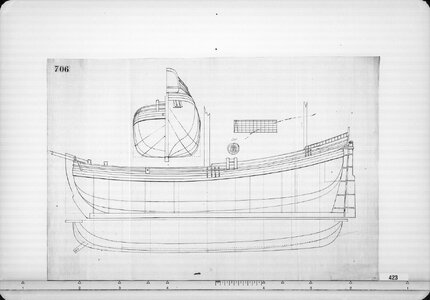
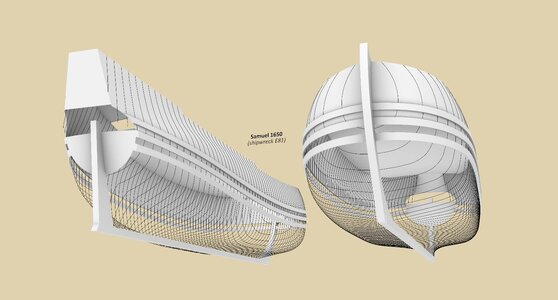
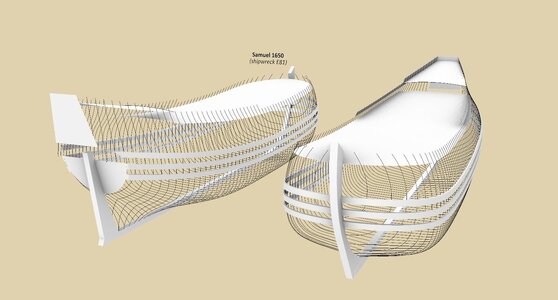
Thanks, Don. While we're still, nolens volens, in this thread, here's an opportunity to tell you that, as you requested, I've started developing the Samuel 1650, specifically just its hull lines, so that they're already directly suitable for eventual model building. I have of course still to reconstruct the whole upperworks from "nothing" in an archaeological sense. Right now I think it should be something simple, like the plan below. No beakhead, no foredeck (and naturally square tuck stern instead of round one), which has its obvious advantages for easier construction of the model, but you still have the chance to complain about it, as I am just starting the work.


Kof ca.1733 - NL-HaNA_4.MST_423 (2).jpg

.​
 
.​


I completely agree with that.


Yes, Bill, I did.


Thank you for your interest in this difficult and hitherto poorly recognised subject.

.​
I completely agree with you. This is a poorly recognized subject that deserves much better reviews. The three Anglo-Dutch Wars saw the evolution of Naval Warfare from the Medieval Era through the beginning of the Renaissance to the early Age of Reason and Enlightenment. It saw two different viewpoints of naval construction, and neither side really dominated the other. This subject seriously deserves significant study. I have grown to be seriously interested in these periods.

Bill
 
Last edited:
.​

Thank you. Perhaps it is even better that modern symposiasts, so to speak, have largely abandoned practical issues and are more concerned with such philosophical and culture-wide perspectives. At least something more concrete is left for others to investigate.

.​
 
.​

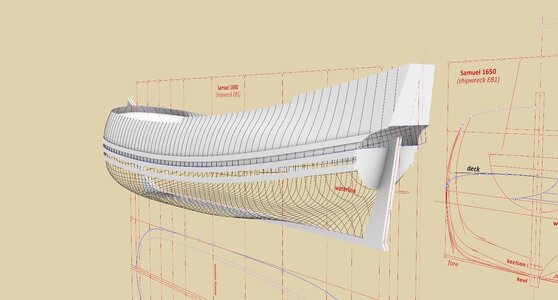
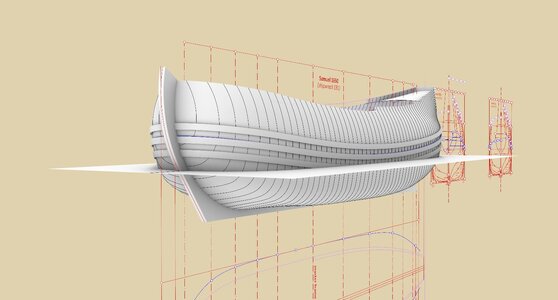
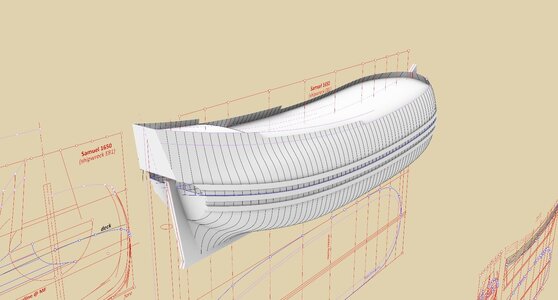
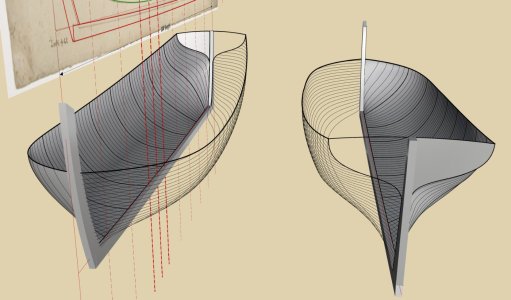
Don, the reconstruction of Samuel 1650 is almost ready. In a two-deck configuration, the ship is therefore quite tall, yet still within the permissible limit. I think I'll add the mast positions and what you can see will be included in the hull line drawings. All other 'details' will have to be taken from other works, preferably Ab's.


ViewCapture20240616_002955.jpg


ViewCapture20240616_003149.jpg


ViewCapture20240616_003240.jpg


ViewCapture20240616_003813.jpg

ViewCapture20240616_004035.jpg

.​
 
.​

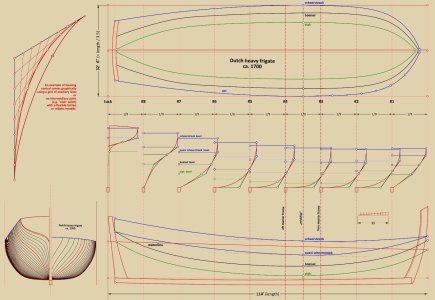
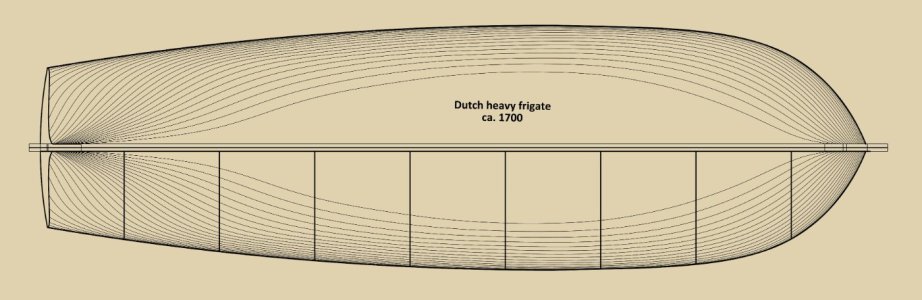
As it happens, this presentation also deserves to be updated, because the frigate design in question features yet another design structure arrangement within the the frame of Dutch parabolic design method, i.e., one that differs from the designs referred to in other threads on the Dutch approach to ship design.

Unlike the previous interpretation presented above in this thread, the contours of the frames have now been formed in a parabolic manner, as opposed to the simplified method using circular arcs. Therefore, the existing side projection of the hull (see posts #16 and 17) has been supplemented by an auxiliary “quasi scheerstrook” line, which plays a fairly important role in this particular variant of parabolic design, similar to the design of the frigate Wageningen 1723 (see https://shipsofscale.com/sosforums/threads/dutch-frigate-»wageningen«-1723-—-a-couple-of-decades-ahead-of-chapman….18387/#post-489033). On the side projection, this “quasi scheerstrook” line is parallel to the “scheerstrook” line in the aft section of the hull (at a distance of 5 feet, except for tuck, where it is closer by about half a foot), and in the fore section of the hull it gradually approaches the “scheerstrook” line (see diagram).

The set of design lines completed in this way already allows the formation of the contours of the frames consisting of two parabolic curves, lower and upper, and the process itself is essentially the same as already described for the frigate Wageningen, yet, interestingly, with the difference that here, for frames #2 to #6, the lower arm of the lower parabola is laid horizontally at the height of the keel (see diagram), making the hull lines noticeably fuller than in the frigate Wageningen.


Thank you,
Waldemar Gurgul


ViewCapture20260123_120030.jpg


ViewCapture20260123_111945.jpg


ViewCapture20260123_111355.jpg

.​
 
Back
Top