


• Ships of Scale has incorportated an extra level of security when you log In. Please follow on-screen prompts to acknowledge that you are not a robot via a "Check Box" or a "Pictorial Check Box Puzzle". This is needed due to higher level of AI Activity Security.
  • SUBSCRIBE TO SHIPS IN SCALE TODAY!

    The beloved Ships in Scale Magazine is back and charting a new course for 2026!
    Discover new skills, new techniques, and new inspirations in every issue.

    NOTE THAT OUR NEXT ISSUE WILL BE July/August 2026
  • Win a Free Custom Engraved Brass Coin!!!
    As a way to introduce our brass coins to the community, we will raffle off a free coin during the month of August. Follow link ABOVE for instructions for entering.

Glue Vs Nails

KRB

Joined
Jul 4, 2026
Messages
3
Points
3
Good morning everyone from Vancouver Island
I'm still quite new to ship modelling and I'm finding very relaxing and enjoyable. My first build was Latinas Mare Nostrum, my second one is Billings Mary Ann which is not quite finished. I would like to give a big shout out to pete_5 for his build log of the Mary Ann. Without it I don't think I would have gotten this far.
I'm going to try an Occre model next (any suggestions on which one will be greatly appreciated). On their tutorial videos I noticed they nail the first planking of the hull. Is there any advantage over gluing or does it boil down to personal preference?

Thx, Kevin
 
Not advantages. Only disadvantages as discussed in this forum previously. I wouldn't bother with any "double-planked" ship model kit whatsoever. It's well worth moving up at least into the mid-range of quality and price point at this stage. (If you aren't already moving beyond kits and into scratch building.) With your present experience, you should be able to recognize that Occre is not a brand rated highly for their accuracy. I expect you will find models from manufacturers like Model Shipways, Bluejacket Shipcrafters, and Vanguard will be much more appropriate to your present level of experience,
 
I'd stay away from Occre too. If you want to stick to fishing vessels, see this one:
or this one:
 
Good morning everyone from Vancouver Island
I'm still quite new to ship modelling and I'm finding very relaxing and enjoyable. My first build was Latinas Mare Nostrum, my second one is Billings Mary Ann which is not quite finished. I would like to give a big shout out to pete_5 for his build log of the Mary Ann. Without it I don't think I would have gotten this far.
I'm going to try an Occre model next (any suggestions on which one will be greatly appreciated). On their tutorial videos I noticed they nail the first planking of the hull. Is there any advantage over gluing or does it boil down to personal preference?

Thx, Kevin
Hello Kevin. I don't normally weigh in on these things but in the spirit of helping out a new guy: you must use glue - and not only on the frames/bulkheads - but between each plank. You will never get a smooth hull if you only glue/nail on bulkheads - there is too much flex in the plank between these attachment points to effectively sand or scrape.

I never found a use for nails. They either end up needing to be removed or sanded - and they make sanding unproductive because the metal is harder than the wood. If you need nails to hold a plank down to keep it in place then you need to go back and spend a bit more time shaping the plank.

Hope this helps.
 
I always use nails and glue for the first layer of the hull. I’m currently building Vanguard’s *Sherbourne*; it comes with nails, and the manual explicitly instructs you to use them. I push the nails in—about a third to halfway—and then remove them once the glue has dried for roughly 24 hours.
You should definitely glue the planks together along their entire length as well—not just glue them to the frames.
In some model kits, the spacing between the frames is too wide; in such cases, you should fill the gaps—for example, with balsa wood—to ensure a smooth hull planking.
Billing Boats kits often feature excessive spacing between the frames, combined with poor-quality wood for the hull.

I highly recommend Vanguard’s models; they offer several fishing boat kits. They use modern techniques for hull construction, and the materials included in the kits are excellent. You’ll notice a big difference compared to the models you’ve built in the past.
 
Last edited:
POB is not a method with any appeal for me - but there are some general techniques in play here.

For ship modeling at any level - nails of any sort are a bad, bad idea. In precision wood working - the principle by which a nail holds does not fit. From elementary school- two objects cannot occupy the same space at the same time. Nail goes in - wood has to go somewhere.
permanent - Nails can be used as a dowel - pre-drill the hole - scarify the nail surface to add tooth - dip in glue - even PVA will hold enough.
temp - drill a hole that is a tight fit - but not too tight -if you intend to extract it later.

POB molds - most are either plywood or MDF? Plywood - it is end grain - which makes for a weak bond at best. MDF - synthetic crap - but does bond. Neither is a place to drive a nail/

Plywood - first thing after the proper bevel is formed - give the edge a heavy soak in coat of PVA. Let polymerize.
If you do this, one thing to try = first layer of planking - dab a spot of PVA at each place where it will sit on the plywood. Let the PVA polymerize - 12 hrs.
Dry fit- add a spot of fresh PVA at 1/2 the meeting area. Place the plank. Iron the plank at each mold. Not too hot. Burn or even scorch - you don't want it.

Heat will activate a bond between two surfaces that a polymerized PVA on them. Sort of a heat activated contact cement.
The new wet PVA will form a stronger bond.
 
Last edited:
Welcome aboard from Connecticut!

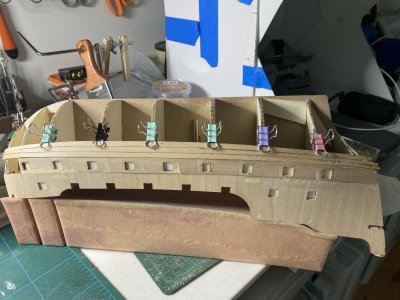
I would not use nails. I am building the Occre Black Swan and they supplied hundreds of nails. I and I believe most people use modified binder clips as clamps the hold the planking. You take the wire "wings" of one binder clip and put them in the ends of 2 other clamps..Here is an example.

IMG_2142.jpeg

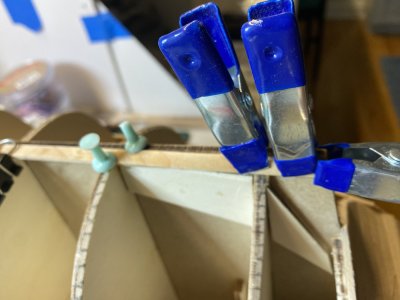
It can be a bit tricky to make the clamps. I find needle nose pliers help. Another important thing to do is to bevel the edge of the plank you are going to lay down to the previous plank. It will make them fit better and glue together better. It will also help a bit when the hull is shaped and sanded. There are some situations for example when there is not a lot of space to use the binder clamps that I will use broad head thumbtacks to help secure a plank. When I do that I place the tack adjacent to the plank so that the plank does not get a hole, but is held by the head of the tack.

IMG_2153.jpeg

I hope this helps.

Rob
 
Last edited:
There are many theorists on this forum.
I prefer to watch videos from people who are building something similar to what I’m planning to build.
 
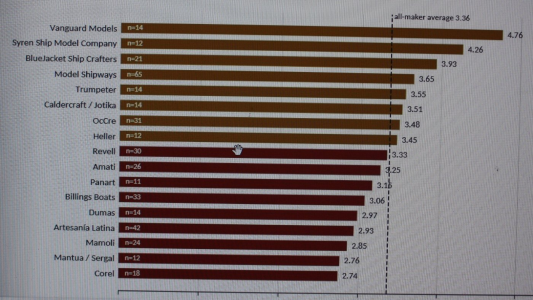
Welcome Kevin! Add me to the list of never using nails. If the parts are made and shaped correctly they do not need to be nailed. There are a couple high quality manufacturers from which to choose so you are not locked in to just one. This has been posted before, but it may be helpful. A poll was taken and published in Ships in Scale magazine. For some reason the number one manufacturer, Modelship Dockyard, was not included)- It appears to be pretty accurate based on the many build logs we see. Portland is coming on and should be one of the top two or three once established.

Allan

1792491686054.png
 
There are many theorists on this forum.
Hi UBJS A well designed model and using good planking techniques obviates the need for nails based on my experience, not some theory. With the exception of one model built in 1978, I have not used nails on any model in the nearly 50 years I have been building and selling my work. I am no theorist, just trying to explain from experience that nails may be an option, but they are not really needed and they create more problems than they solve.
Allan
 
Welcome Kevin! Add me to the list of never using nails. If the parts are made and shaped correctly they do not need to be nailed. There are a couple high quality manufacturers from which to choose so you are not locked in to just one. This has been posted before, but it may be helpful. A poll was taken and published in Ships in Scale magazine. For some reason the number one manufacturer, Modelship Dockyard, was not included)- It appears to be pretty accurate based on the many build logs we see. Portland is coming on and should be one of the top two or three once established.

Allan

View attachment 644829
That looks like a very nice list for kit assemblers. But if you want to be(-come) a ship modeller from kits, then turn it upside down.
 
First, a point that almost made me give up ship model building.
There is this notion that the planks should be shaped so perfectly that they can be glued in place using nothing but one’s fingers—holding them for a brief moment until the glue takes hold.

I tried and tried, but I could never manage to shape the wood that perfectly. I actually stopped building ships for about half a year, but then I came across some YouTube videos and saw that the builders were using both pins and various types of clamps.

I’ve realized that for me, pins—or rather, needles—work best. The pins from Vanguard are 0.5 mm, if I recall correctly.
I also use modeling pins, the kind typically used by people who build those large balsa-wood model planes from Guillow’s.

To those of you who completely dismiss the use of pins or needles: please consider that people are different. Not everyone is capable of such perfect craftsmanship. If it works for Olha, then I have no shame in using pins myself.
 
To those of you who completely dismiss the use of pins or needles: please consider that people are different. Not everyone is capable of such perfect craftsmanship. If it works for Olha, then I have no shame in using pins myself.
I have absolutely no objection to people using pins or nails. I just find using modified binder clips so much easier. Believe me few of my planks are shaped so perfectly that they can be set just using ones fingers.

Rob
 
There is this notion that the planks should be shaped so perfectly that they can be glued in place using nothing but one’s fingers—holding them for a brief moment until the glue takes hold.
With full respect to you, I disagree with this being some kind of fantasy or wish. I base my comments on actual practice not a wish.

From Meriam Webster dictionary defining "notion"
  • Idea or Opinion
  • Sudden Wish or Whim
Regarding "brief moment" that is a relative or ambiguous description so depends on your definition of the word brief. For those that have spiled or otherwise pre-shaped each plank correctly, it will hold after using finger pressure for a minute or less. Having done it many times by many people makes this a real working method, not a notion. Even so, for me, there are times when clamps are a savior but not to the extent that they are used to force a shape into a piece rather than just holding the pre-shaped piece in place for a minutes or two.

Further to show this is not just an opinion or notion, it is very clearly taught in the four-part video by Chuck Passaro starting with straight planks like those found in the majority of kits.

Allan
 
Last edited:
To those of you who completely dismiss the use of pins or needles: please consider that people are different. Not everyone is capable of such perfect craftsmanship. If it works for Olha, then I have no shame in using pins myself.

A lack of skill seems an inadequate excuse for an inadequate job. There are the easiest and best way to do things, the way to do things that will work, but not be as easy to do, and the way to do things that doesn't work worth a damn. People are different, to be sure. Many believe they know better than everybody about almost everything. Proof of that is the fact that only about one in ten ship model kits are ever finished.
 
Last edited:
I’m using Google Translate, so it might not be entirely accurate.
I’ve read—in books, on Swedish forums, and elsewhere—about shaping the planks with such precision that they can be glued in place without requiring significant pressure.

I have built about ten hulls.
Amati Swedish gunboat. Billing Boats *Norden*, *Bohuslän*, and *Vasa*.
Bluejacket *Spray* and *Bowdoin*. Occre *Polaris*. Master Korabel *Polotsk*.
Two or three others that were truly beginner-level builds—a Corel *Sloup* and something from Mamoli whose name I don’t recall. :)

Looking at the build logs here on the forum, I can see that even among those who have built several hulls, there is a wide variation in the results achieved.
I’ve come to terms with the fact that I’ll never build any truly spectacular hulls; I’m nearly 70 years old, and I’m happy if I can manage an hour of work here and there without my hands aching too much.
 
Back
Top