





- Joined
- Dec 7, 2022
- Messages
- 229
- Points
- 113

Here are two pictures associated with the Rattlesnake keel / plan / assembly jig. In the semi kit, the keel parts are laser cut as is the assembly jig. So here it is most important that the keel notches matches the jig than the plans. There seems to be creep when placing the laser cutting over the plans:

But there is no visible creep when keel is compared with the jig:
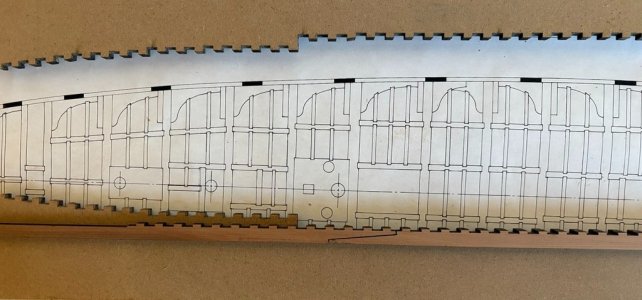
I did not check to see if the plans for the keel and the jig are in alignment. However, the difference between plans and laser cutting could be a function of the plans changing shape with moisture content. What's most important is the jig and the keel are consistent. If one was scratch building both the jig and keel, again it would be a matter of consistency as Dave notes above.
Notice that care must be taken in assembling the two sections of the keel at the scarf joint. This must be done to preserve the width of the notch bisected by the joint. If this is not done, that notch will be the incorrect size, but more importantly it will no longer be possible to align all of the notches in the keel with the respective notches on the jig. If you align the fore part of the keel, all the aft slots will be out of alignment and vice versa. If you align at the notch over the scarf joint, the rest of the notches - fore and aft - will not align.
So here I see a tradeoff of having the laser cut part and scratch building the keel. If the keel is scratch built, the scarf joint can be done very nicely to join two pieces of stock a bit longer in total than the finished keel. The notches can then be created with no chance of the joint causing spacing problems. Again the notches would need to be made consistent with spacing of the assembly jig. The keel would then be trimmed to the final dimension.
But there is no visible creep when keel is compared with the jig:
I did not check to see if the plans for the keel and the jig are in alignment. However, the difference between plans and laser cutting could be a function of the plans changing shape with moisture content. What's most important is the jig and the keel are consistent. If one was scratch building both the jig and keel, again it would be a matter of consistency as Dave notes above.
Notice that care must be taken in assembling the two sections of the keel at the scarf joint. This must be done to preserve the width of the notch bisected by the joint. If this is not done, that notch will be the incorrect size, but more importantly it will no longer be possible to align all of the notches in the keel with the respective notches on the jig. If you align the fore part of the keel, all the aft slots will be out of alignment and vice versa. If you align at the notch over the scarf joint, the rest of the notches - fore and aft - will not align.
So here I see a tradeoff of having the laser cut part and scratch building the keel. If the keel is scratch built, the scarf joint can be done very nicely to join two pieces of stock a bit longer in total than the finished keel. The notches can then be created with no chance of the joint causing spacing problems. Again the notches would need to be made consistent with spacing of the assembly jig. The keel would then be trimmed to the final dimension.