
-
SUBSCRIBE TO SHIPS IN SCALE TODAY!
The beloved Ships in Scale Magazine is back and charting a new course for 2026!
Discover new skills, new techniques, and new inspirations in every issue.
NOTE THAT OUR NEXT ISSUE WILL BE July/August 2026 -

Win a Free Custom Engraved Brass Coin!!!
As a way to introduce our brass coins to the community, we will raffle off a free coin during the month of August. Follow link ABOVE for instructions for entering.
You are using an out of date browser. It may not display this or other websites correctly.
You should upgrade or use an alternative browser.
You should upgrade or use an alternative browser.
His Majesty's Ship Fowey (44) 1744 by AllanKP69



- Joined
- May 4, 2026
- Messages
- 36
- Points
- 68

Ah so I can enlighten you on this subject. It is around the early 1780s that you get widespread use of copper alloy bolts and fasteners below the waterline.Hi Richard,
Iron bolts would not work under water for very long. Copper bolts were used on the scarphs below the waterline according to Peter Goodwin, The Construction and Fitting of English Ships of War, page 7. I looked at a dozen contracts and scantling from the Establishments and while they give size and number of bolts none that I can find give the material used for making the bolts. It was much later, but bolts in the Victory keel were found to be copper. Barring any contemporary information explaining otherwise, I am pretty sure copper is appropriate.
Allan
Now copper alloy bolts may have been used sometimes before this point, but it certainly wasn't widespread. I have a whole bunch of letters from the period where middleton is experimenting with the use of copper bolts below the waterline and arguing that they should be more widespread.
The tone of the letters suggest that prior to that point iron was the norm. Give me some time and I can go dig back into my notes on the subject. I have only transcribed a few of the documents at this point, but the thrust seems pretty consistent.
Now this is all in the context of copper sheathing and the problems of the interaction between copper and iron (which they didn't understand at the time). But given the much higher costs for copper I would be hesitant to say any ship before this had copper bolts unless you found some sort of positive evidence to suggest they were used.
- Joined
- Oct 2, 2025
- Messages
- 492
- Points
- 158

Well, Just about every ship history in Winfield that had a life of any length is full of "small repair" and "great repair". Replacing rusted fasteners = a part of the repair process?
They do seem to try to waterproof the iron fasteners. Environmental fluctuation dooms that to fail.
I think that the keel assembly is an area where what waterproofing they could do would not fit.
It is a lesson still unlearned. Reinforced concrete with any possibility for exposure to water infiltration - If there was economical rebar that is immune to oxidation - It would cost jobs in the repair and replacement field and reduce content for some TV shows.
They do seem to try to waterproof the iron fasteners. Environmental fluctuation dooms that to fail.
I think that the keel assembly is an area where what waterproofing they could do would not fit.
It is a lesson still unlearned. Reinforced concrete with any possibility for exposure to water infiltration - If there was economical rebar that is immune to oxidation - It would cost jobs in the repair and replacement field and reduce content for some TV shows.

Thanks,Ah so I can enlighten you on this subject. It is around the early 1780s that you get widespread use of copper alloy bolts and fasteners below the waterline.
Now copper alloy bolts may have been used sometimes before this point, but it certainly wasn't widespread. I have a whole bunch of letters from the period where middleton is experimenting with the use of copper bolts below the waterline and arguing that they should be more widespread.
The tone of the letters suggest that prior to that point iron was the norm. Give me some time and I can go dig back into my notes on the subject. I have only transcribed a few of the documents at this point, but the thrust seems pretty consistent.
Now this is all in the context of copper sheathing and the problems of the interaction between copper and iron (which they didn't understand at the time). But given the much higher costs for copper I would be hesitant to say any ship before this had copper bolts unless you found some sort of positive evidence to suggest they were used.
I guess copper mining was a mature industry becuase of the need for bronze in earlier cannons.

- Joined
- Mar 1, 2022
- Messages
- 803
- Points
- 353

I can confirm this statemet: the copper wire I bought and installed in my Hoy ist still perfectly bright, then I suppose the greenish patina needs outer, aggressive envirovement to settle down.Interesting idea. Then again, I have spools of copper wire that are ten years old that have no protective coating yet they are not tarnished at all.
Time will tell....... as Dean said, rust never sleeps......
Allan
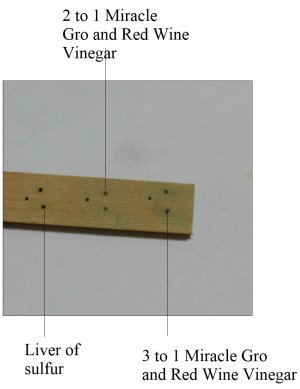
Test piece. Thanks to the paper Thukydides sent to me I am comfortable with iron bolts as well as copper for 1744. Copper bolts became the predominant material below the waterline with the advent of copper bottoms due to the accelerated corrosion caused to iron bolts from bi-metallic action of the plates laying against the bolts in the keel and elsewhere.
Allan
The hole to the left of each pair is empty
Allan
The hole to the left of each pair is empty
- Joined
- Oct 2, 2025
- Messages
- 492
- Points
- 158
Allan,
Looking at your experiment:
one - the effect on copper is almost a mono layer, entirely superficial, prone to sloughing off.
two - it put me in mind of Bamboo doing the same job.
three - then I thought - Bamboo is a bundle of rods and about half are dark - for planking they can never not show contrast with planking.
four - then I thought - the rods are actually straws. They will suck up a concentrated dye solution. Even if the dye is in water - Bamboo grain will not be raised and if they do it will be sideways. wood or Bamboo never gets longer. The color will be a deep part of the Bamboo, no sloughing
(Now, the wood of the keel will expand and contract with temp and water vapor concentration changes. Both copper and Bamboo may stand proud if conditions cause the wood to contract.)
My suggestion: use Bamboo dowels - dip them in stamp pad black or India ink if black is what is desired = iron.
A mixture of blue and green aniline dye - saturated conc. for verdigris.
File and sand the end to final surface before dipping. Make the hole a push fit - shellac or PVA "knotting" (Underhill's term I believe) makes a lubricant before I becomes a bonding agent. Any loss of color during insertion will be fixed with a micro drop of dye on the end of a pin.
Dean
Looking at your experiment:
one - the effect on copper is almost a mono layer, entirely superficial, prone to sloughing off.
two - it put me in mind of Bamboo doing the same job.
three - then I thought - Bamboo is a bundle of rods and about half are dark - for planking they can never not show contrast with planking.
four - then I thought - the rods are actually straws. They will suck up a concentrated dye solution. Even if the dye is in water - Bamboo grain will not be raised and if they do it will be sideways. wood or Bamboo never gets longer. The color will be a deep part of the Bamboo, no sloughing
(Now, the wood of the keel will expand and contract with temp and water vapor concentration changes. Both copper and Bamboo may stand proud if conditions cause the wood to contract.)
My suggestion: use Bamboo dowels - dip them in stamp pad black or India ink if black is what is desired = iron.
A mixture of blue and green aniline dye - saturated conc. for verdigris.
File and sand the end to final surface before dipping. Make the hole a push fit - shellac or PVA "knotting" (Underhill's term I believe) makes a lubricant before I becomes a bonding agent. Any loss of color during insertion will be fixed with a micro drop of dye on the end of a pin.
Dean
From what I could find, the green will stay put if coated with an acrylic clear. In the end I decided to go with copper darkened with liver of sulfur.
And now the fun begins with joinery. The scarfs are not so difficult but the boxing joint is still as difficult as ever. They were lined with material so I went with blackened glue to represent the material used on the actual joints. The black is 0.56" thick. I have no idea what the thickness of the material that was used but I think is was far less than 1/2" when squeezed together. If I do redo it thinner I may just go with a clear joint. Still have time to soak it in alcohol and dismantle and go with plain glue. On one hand I want it to be clearly visible, on the other hand nearly invisible.
Allan
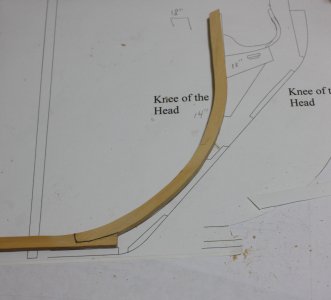
And now the fun begins with joinery. The scarfs are not so difficult but the boxing joint is still as difficult as ever. They were lined with material so I went with blackened glue to represent the material used on the actual joints. The black is 0.56" thick. I have no idea what the thickness of the material that was used but I think is was far less than 1/2" when squeezed together. If I do redo it thinner I may just go with a clear joint. Still have time to soak it in alcohol and dismantle and go with plain glue. On one hand I want it to be clearly visible, on the other hand nearly invisible.
Allan
Last edited:
- Joined
- May 4, 2026
- Messages
- 36
- Points
- 68
I like to mix burnt umber heavy body acrylic paint in a 50-50 mix with my wood glue for these black joints. I find the brown towns down a little from the black which can stand out a bit much.
That being said the joint looks good, the only issue I would say is that the joint for the two stem pieces is almost invisible, but the boxing is very visible. I would say you should have them both look similar. Or is the stem joint not glued yet?
That being said the joint looks good, the only issue I would say is that the joint for the two stem pieces is almost invisible, but the boxing is very visible. I would say you should have them both look similar. Or is the stem joint not glued yet?
Thanks Daniel,the joint for the two stem pieces is almost invisible
Consistency is indeed an important thing. Then again, with the bottom being painted white, I sometimes wonder why I go to all this trouble.
 The only reason I did not make the stem out of a single piece is that I did not have a board wide enough to fit it all on one slat. The strength from using more than one long grain piece is not a concern at this scale using a tight grained wood like castello. I am playing with the joint again now, and will share the outcome.
Allan
A note as an aside. I learned only recently that the HMS prefix did not come into use until later in the 18th century. 1789 (The First Recorded Abbreviation): The earliest documented use of the initials HMS in an official Royal Navy context was applied to the frigate HMS Phoenix. Not that it matters that much, but I don't know how to change the title of my build log.....
Allan
Allan
From what I could find, the green will stay put if coated with an acrylic clear. In the end I decided to go with copper darkened with liver of sulfur.
And now the fun begins with joinery. The scarfs are not so difficult but the boxing joint is still as difficult as ever. They were lined with material so I went with blackened glue to represent the material used on the actual joints. The black is 0.56" thick. I have no idea what the thickness of the material that was used but I think is was far less than 1/2" when squeezed together. If I do redo it thinner I may just go with a clear joint. Still have time to soak it in alcohol and dismantle and go with plain glue. On one hand I want it to be clearly visible, on the other hand nearly invisible.
Allan
View attachment 610865
Why did they line the joints in this fashion?

@JimskyNot that it matters that much, but I don't know how to change the title of my build log.....

@AllanKP69 Just let me know your preferred title, and I'll make the magic happen.
All set! That said, I still have a bit of magic left up my sleeveTHANK YOU!!!!!!
His Majesty's Ship Fowey (44) 1744
Great question.Why did they line the joints in this fashion?
The best explanation I have found is that flannel and other similar materials soaked in tar or white lead between the overlapping timbers of keel scarphs act as a gasket, sealing the joint against water intrusion, discouraging dry rot, and preventing friction between the heavy timbers.
Allan
Cutting the rabbet in the keel, post and stem is not a fun endeavor, but it needs to be done. I use a modified version of the explanation given by David Antscherl in The Fully Framed Model, Volume 1. As he strongly points out, RAZOR SHARP tools are key.
Step 1- I set the micrometer to scribe a line that is the bottom edge of the rabbet.
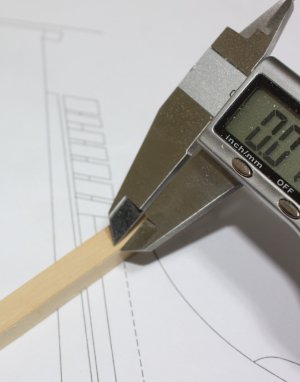
Step 2, I run a sharp pencil point in the shallow scribed groove so it is easier to see.
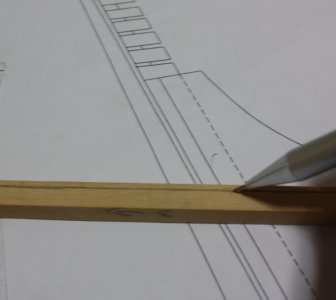
Step 3. I start a cut with a new scalpel blade. If care is taken there is no need for a straight edge guide. Slow and steady wins this race.
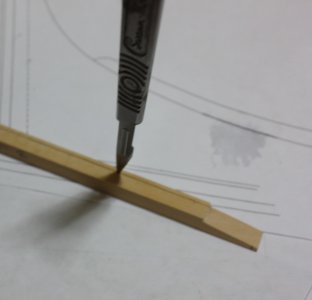
Step 4 - Chisel out the groove. The initial groove and scalpel cut help keep everything straight. The angle will change aft to nearly a straight up and down step. The angle also changes forward of the dead flat, but if it is a little off, the edge of the garboard planking can be filed to fit.
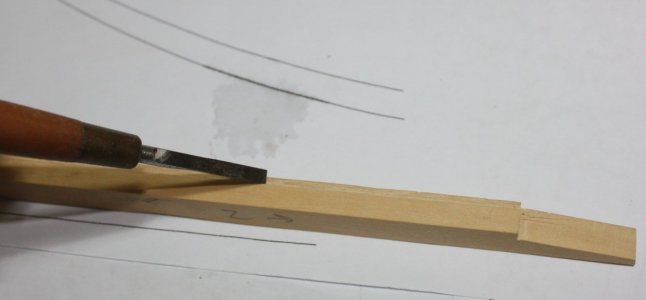
A jeweler's triangular or square file is then run along the rabbet to smooth things out if necessary.
Step 1- I set the micrometer to scribe a line that is the bottom edge of the rabbet.
Step 2, I run a sharp pencil point in the shallow scribed groove so it is easier to see.
Step 3. I start a cut with a new scalpel blade. If care is taken there is no need for a straight edge guide. Slow and steady wins this race.
Step 4 - Chisel out the groove. The initial groove and scalpel cut help keep everything straight. The angle will change aft to nearly a straight up and down step. The angle also changes forward of the dead flat, but if it is a little off, the edge of the garboard planking can be filed to fit.
A jeweler's triangular or square file is then run along the rabbet to smooth things out if necessary.
IF anyone has a different way to cut the rabbets accounting for the angle being dynamic from one end to the other, please share. I will be testing at least the midships portion with an 90 degree pointed end mill on my milling machine. I have my doubts, but it may be worth a try.
Allan
Allan
I am decidedly unworthy to counsel you on anything related to ship modeling...IF anyone has a different way to cut the rabbets accounting for the angle being dynamic from one end to the other, please share. I will be testing at least the midships portion with an 90 degree pointed end mill on my milling machine. I have my doubts, but it may be worth a try.
Allan
But for the Kingfisher I did try to use a mill for the section where a mill would work (most of the flat portion of the keel), but found the set up tedious and the result disappointing (power tools can make work efficient - when they are not making mistakes just as efficiently).
My interest in the hobby hovers around doing things by hand unless the work is repetitive and mechanical. I don't place the rabbet in that category. Like you I ended up using chisels/V gouges (ala Antscherl/Herbert)... and I also created a short series of consecutive scrapers to refine the dynamic profile. Inefficient but satisfying.
Of course, unless you are going to leave a portion of the hull unplanked - the rabbet needs to be more functional that perfect.