


• SUBSCRIBE TO SHIPS IN SCALE TODAY!

    The beloved Ships in Scale Magazine is back and charting a new course for 2026!
    Discover new skills, new techniques, and new inspirations in every issue.

    NOTE THAT OUR NEXT ISSUE WILL BE MARCH/APRIL 2026
  • Win a Free Custom Engraved Brass Coin!!!
    As a way to introduce our brass coins to the community, we will raffle off a free coin during the month of August. Follow link ABOVE for instructions for entering.

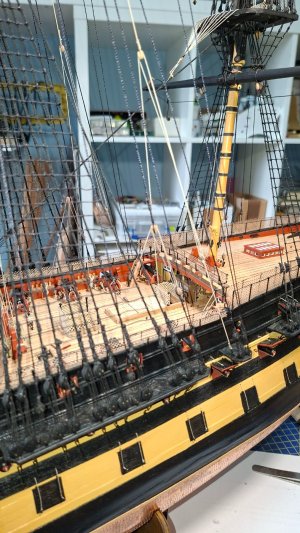
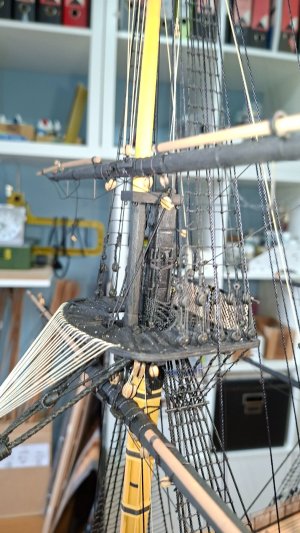
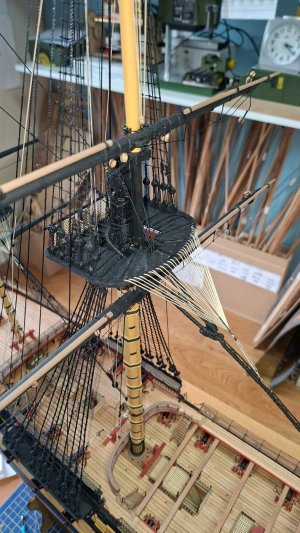
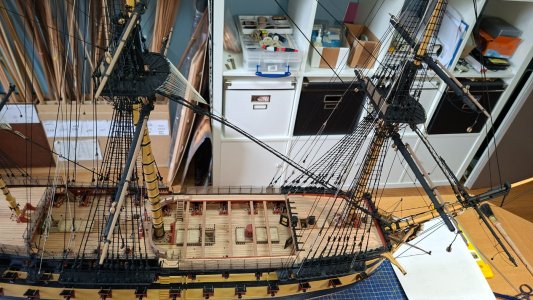
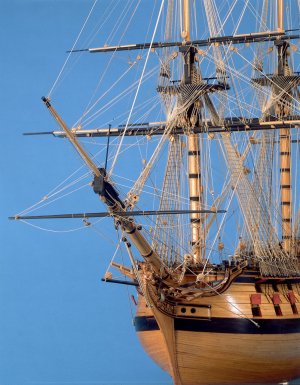
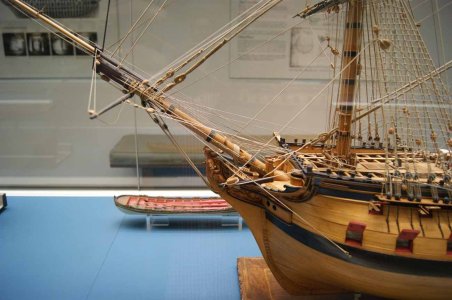
HMS Agamemnon by Caldercraft

Just found this thread, thank you for posting. It’s enjoyable to see your work.

This ship is in my stash, thinking it may be next up on my workbench.

Have a great day.

-Rich
 
I have a question:
how sailors in the 18th century rolled up their hammocks?
I would like to add them between the nets.

I following correct?

  1. Lay the hammock flat
    The sailor spread the canvas hammock on the deck or held it lengthwise.
  2. Fold in the sides
    The sides were folded inward around the bedding or blanket inside.
  3. Roll tightly from one end
    Starting at one end, the hammock was rolled into a compact cylinder. Tight rolling was important because inspections were strict on many naval ships.
  4. Secure with “clews” or lashings
    The rope ends (called clews) or separate cords were wrapped around the rolled hammock and tied firmly.
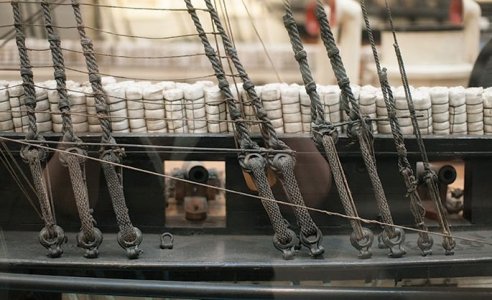
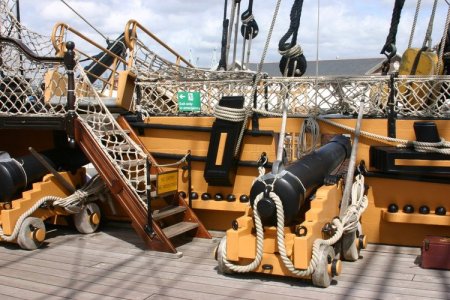
  5. Stow in nettings along the rails
    On warships, the rolled hammocks were often placed in hammock nettings along the ship’s sides. These rows of hammocks also provided a bit of protection against musket fire and splinters during battle.
A properly rolled hammock looked something like a long canvas sausage or bedroll, tightly bound with rope. On ships of the Royal Navy, sailors could even be punished for sloppy stowage.
 
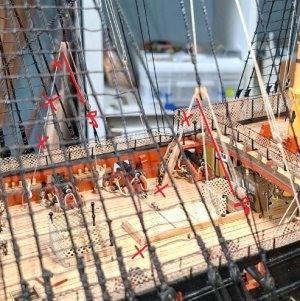
Mark, you forgot about the mattress and pillow. But I'll give you a hint: the folded bunk was 5 feet long and 1 foot in diameter. But I've also come across data with a diameter of 3 1/2 feet, but no indication of the cylinder's height. The rolls in the berth net were inclined at a 60-degree angle. All figures are for large ships; smaller ships had different standards. In any case, Mark, I'd like to discourage you from making bunks, because they always look sloppy and unsightly on models.

f91138621e9d58ea8184e44f517738db.jpg
 
Last edited:
Mark, you forgot about the mattress and pillow. But I'll give you a hint: the folded bunk was 5 feet long and 1 foot in diameter. But I've also come across data with a diameter of 3 1/2 feet, but no indication of the cylinder's height. The rolls in the berth net were inclined at a 60-degree angle. All figures are for large ships; smaller ships had different standards. In any case, Mark, I'd like to discourage you from making bunks, because they always look sloppy and unsightly on models.

View attachment 606683
Thank you Iutar...as always the perfect answer :)
 
Gentlemen,

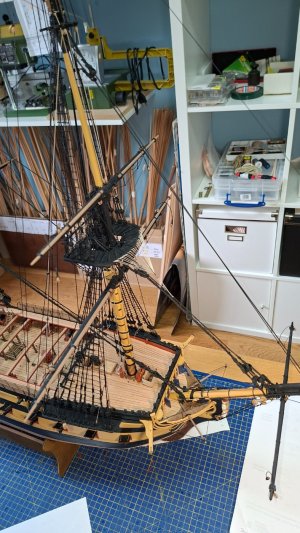
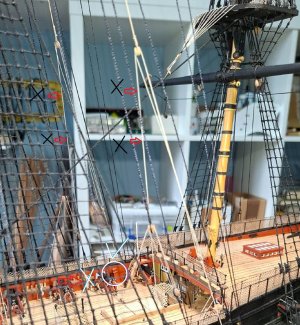
In the meantime, I have already made significant progress with the rigging. This involves a lot of research, and naturally, I am trying to complete the rigging as faithfully as possible. Hence, the following question.

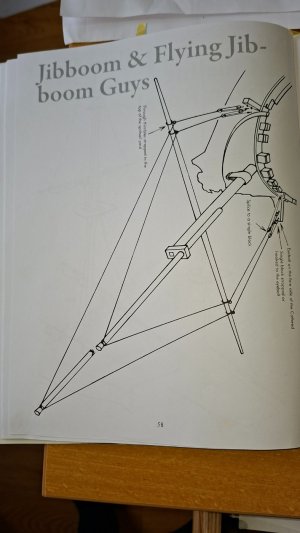
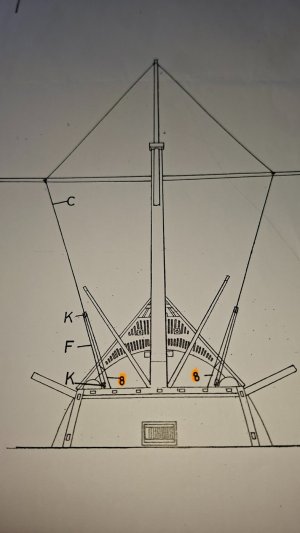
I have my doubts regarding the accuracy of the Jibboom rigging as shown on the plans (see 2nd drawing). Can someone clarify for me what the correct method is?


I have, of course, already looked at many old ship models and searched in books, but it still remains unclear.... :mad:

Aga890.jpg

Aga891.jpg

Aga892.jpg
 
It appears to me that the jib boom guys are designed to keep the boom from rotating such that one tip will move down too far toward the water, all the while allowing the angle of the boom to be changed in the horizontal plane to set the angle of the spritsail relative to the wind. The tension of the guy lines is adjustable to accomodate the angle of the jib boom in order to maintain tension.
 
Dear Mark! Both diagrams are incorrect! They don't represent the Agamemnon.

The problem is that they assume a bare yard, with no sail already attached. But third- and fourth-rate ships of the period had a sail, meaning the yard moved in the correct direction, making it impossible to pass guys through it.

d3335_2.jpg

gallery_10197_920_48190.jpg
 
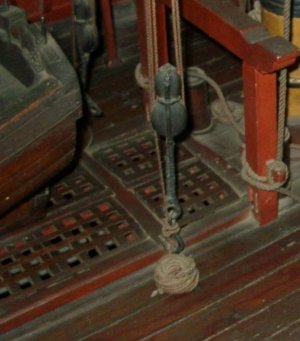
All ropes in the tackles must be parallel. If you end up with a triangle, you've misdirected the rope. For tackles raising the topsail yard, the free turnbuckle is placed on the side bollard.


Aga898.jpg
10_0780d99baee61ddfce0dc2d738b5f544 — копия.jpg
 
Last edited:
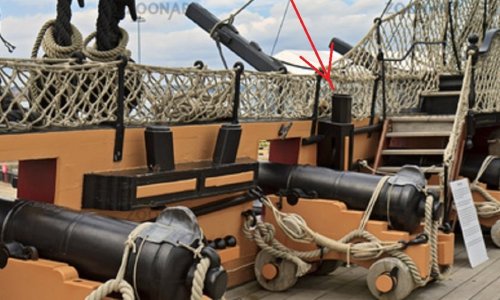
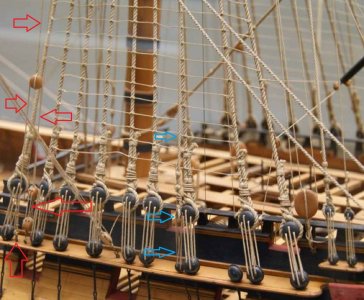
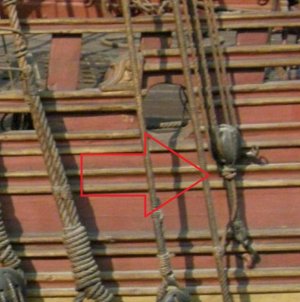
The first backstay was tensioned with tackles, the turnbuckle was placed on a ring on the channels (red arrows). The second backstay was tensioned with deadeyes (blue arrows).


gallery_10197_920_14963 — копия.jpg


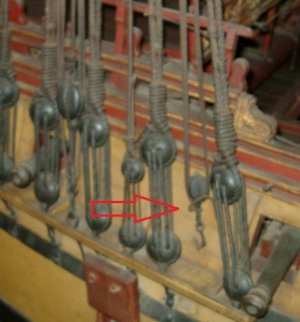
You have a triangle on your backstay tackles again. In your case, the turnbuckle needs to be pulled under the bottom block and tied under it. This method is called "self-tying." The backstays rarely slackened, so there's no need to tie the turnbuckle on the dowel pin; it wastes space.


Aga898 (1).jpg

The "self-on" method is shown below. The turnbuckle is lowered under the lower block and secured with a few turns to the knot under the block.

111.jpg112.jpg113.jpg
 
It appears to me that the jib boom guys are designed to keep the boom from rotating such that one tip will move down too far toward the water, all the while allowing the angle of the boom to be changed in the horizontal plane to set the angle of the spritsail relative to the wind. The tension of the guy lines is adjustable to accomodate the angle of the jib boom in order to maintain tension.
Dear Kurt,

I would like to thank you for your feedabck.
I learned something new...again ;)
 
Dear Mark! Both diagrams are incorrect! They don't represent the Agamemnon.

The problem is that they assume a bare yard, with no sail already attached. But third- and fourth-rate ships of the period had a sail, meaning the yard moved in the correct direction, making it impossible to pass guys through it.

View attachment 609702

View attachment 609703
Dear dear Igor,


I don't know how to thank you again for your feedback. So it's best not to take their drawings into account, which I largely already did. For every tackle, shroud, etc., I consult your documents, but it is not easy.Thx again.

Marc
 
Back
Top