• Win a Free Custom Engraved Brass Coin!!!
    As a way to introduce our brass coins to the community, we will raffle off a free coin during the month of August. Follow link ABOVE for instructions for entering.

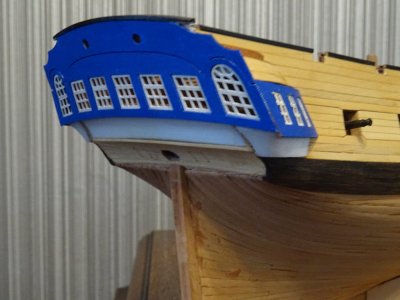
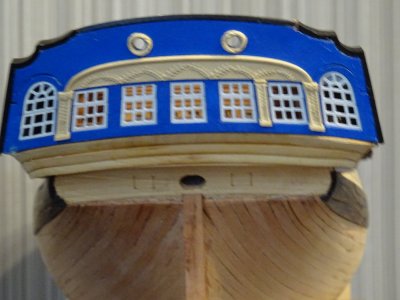
HMS Pandora - Modelship Dockyard - Build log

I ordered the Pandora for one of our club members in FL... I was entrusted with a rather sizable amount of money to pick some unique kits .I chose the Royal Caroline in 1/50, the Pandora and the Zebec... The Pandora , primarily to aid some of our members who were uncomfortable with bow and stern work. So there is a niche for these hybrids
 
so I decided to assemble the binnacle to give me guide for the supports spacing but something is badly amiss
Hi Roger
Hope the following is a bit of help. The binnacle sat on top of the deck planks, often without additional support such as beams. As it sat on the QD there would not be any carlings or ledges. It was held down and in place with ropes tied to eyes anchored in the deck planking and removed when not at sea. If you look at the inboard profile of similar 24 gun ships of that era it would appear the binnacle actually lays between, or maybe touched above one beam. Interestingly, by an order from the Admiralty, the number of binnacles on a ship was reduced from three to two. Lavery comments that it is not clear where the extra ones were placed, possibly below as spares.

Allan

HMS Squirrel (24) 1785
1751558906801.jpeg

5th rate contemporary model 1780
1751558957989.png
 
Last edited:
side walls planking has to be fitted before the decks so lots of acetone and time and it amazingly came of with no damage
Too late now as you went to all the work to remove the planking but for the 18th century I think if the waterway is fitted first it does not matter if the spirketting and quick work go on first or the margin plank and deck planking.
Allan

From Peter Goodwin's The Construction and Fitting of the English Man of War, page 44 for the 18th century:

1764341736850.jpeg

Do the plans call for the battens on the gratings to run athwartships instead of the normal fore and aft direction? The kit looks to be really good, and accurate so this seemed odd that they would have the gratings 90 degrees in the wrong direction.
Thanks
Allan
 
Hi Allan
The kit comes with no instructions or plans in the box the online plans (downloaded from modelship dockyard site) are just 3D rendered drawings no real instructions but very good customer support
The gratings are laser cut to match the laser cut holes in the decking so they can only be fitted one way so i assume this is just a slight error
 
There was a similar discussion on the gratings of the Granado in Uwe's thread, where the battens fore passageway has them running athwartships instead of the normal fore and aft direction. This is shown by Goodwin as being correct.

I think I have some reasoning on this, indicating both the Granado and the above case: MOST gratings in size are longer fore-to-aft than they are athwartships. This seems fairly common. Unlike scale model gratings, the upper battens are thinner strips (1x2" on the Granado), so are fairly weak and flexible, while those crossing and supporting the upper battens are double that thickness, or so. The strongest possible construction will be to have the lower/stronger battens across the shorter length, while the upper/weaker battens go the longer length of the hatch and are supported by the lower. This means that on a "normal" grating which is longer fore-to-aft than it is athwartships the upper battens will go the "normal" direction, fore to aft.

However, in the above case there are three smaller gratings, each wider than long. And in the case of the fore grating on the Granado, it is also wider than long. So my hypotheses is that the lower/thicker members should always go across the shorter length of the grating, while the upper battens will run the long direction, regardless of the direction the hatchway.

This makes sense to me, at least, meaning all examples I've seen are correct, and all's right with the world. ;-)
 
The gratings are laser cut to match the laser cut holes in the decking so they can only be fitted one way so i assume this is just a slight error
As they are precut there is no choice, but Signet makes a valid point.
This makes sense to me
It does make some sense to me as well, but apparently not to many of the old ship model builders or shipbuilders. :) I found one exception so far. The second photo shows the battens running athwartships on the Minerva (38) 1780 model at Preble Hall. But, this model was renovated/repaired in 2015 so may not be as originally built.
1764412863872.jpeg


Minerva Model at Preble Hall
1764413992409.jpeg
Victory gratings today. I HOPE they replicated the way things were done in 1803. Five or six long ledges athwartships, 11 short battens fore and aft
1764414691328.png
 
Last edited:
Unlike scale model gratings, the upper battens are thinner strips so are fairly weak and flexible,
Not all scale gratings are made the same. Many that I have seen by some modelers are made like the actual gratings and they are extremely strong. They can be heat bent to round as well when appropriate, without damage. If you have not already seen it check out the recent post on making gratings in the Tricks of the Trade thread here at SoS. The method shown is pretty much the way Frolich teaches in his book The Art of Ship Modeling and I have found it to work very well.

I did a bit more research and found the following statements.

English ships in the 18th century had battens that normally ran fore and aft
This practice was a standard in British naval architecture.

Details of Grating Construction
Battens vs. Ledges: Gratings were constructed with two main components: ledges (the deeper, stronger timbers that ran athwartships, or side-to-side) and battens (thinner strips of timber that ran fore and aft, or lengthwise).
Assembly: Recesses were cut into the ledges to house the battens. The outermost battens were often deeper to provide structural integrity to the entire assembly.
Purpose: The primary purpose of gratings was to provide ventilation and light to the lower decks while preventing people from falling into the open hatches.
Exception: While the general rule was for battens to run fore and aft, historical sources suggest there were exceptions, such as the beakhead gratings, where the battens ran athwartships.
So, while not every single grating in every single corner of a ship followed this rule, it was the prevailing and expected standard for nearly all deck gratings in the 18th-century Royal Navy.
 
Back
Top