• SUBSCRIBE TO SHIPS IN SCALE TODAY!

    The beloved Ships in Scale Magazine is back and charting a new course for 2026!
    Discover new skills, new techniques, and new inspirations in every issue.

    NOTE THAT OUR NEXT ISSUE WILL BE MARCH/APRIL 2026
  • Win a Free Custom Engraved Brass Coin!!!
    As a way to introduce our brass coins to the community, we will raffle off a free coin during the month of August. Follow link ABOVE for instructions for entering.

HMS Sphinx - Vanguard Models 1:64 by Ronald-V

By the way....I see in many building logs that people keep this curve too sharp, and sometimes it almost looks like it makes an angle. I think people are sometimes too afraid to remove too much from the final bulkhead. I really recommend taking a good look at contemporary models to see how the lines should run.
That’s probably one of the changes I’ll make to my *SOTS* when I reach that stage; I prefer the look of the curved, uniform planking on the port and starboard sides over the straight transom. I know this specific issue sparks debate and disagreement among modeler groups, but ultimately, we’re the ones who decide how to build our models and that’s the best part of the hobby. Of course, the goal is to make it as close to the original as possible, but anyway, I don’t want to derail your thread with these comments.
 
That’s probably one of the changes I’ll make to my *SOTS* when I reach that stage; I prefer the look of the curved, uniform planking on the port and starboard sides over the straight transom. I know this specific issue sparks debate and disagreement among modeler groups, but ultimately, we’re the ones who decide how to build our models and that’s the best part of the hobby. Of course, the goal is to make it as close to the original as possible, but anyway, I don’t want to derail your thread with these comments.
Sounds good Jack! Looking forward to that build :)
 
Stern/side gallery update:

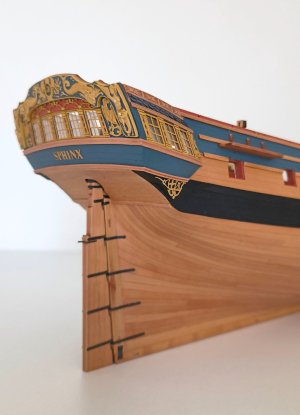
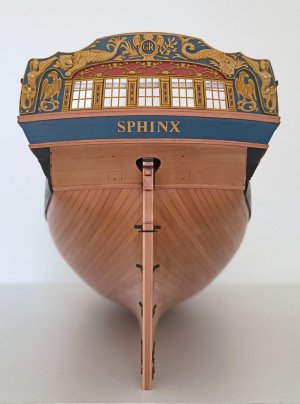
finally finished with the decoration for the stern and side gallery...and she carries proud her name now :)


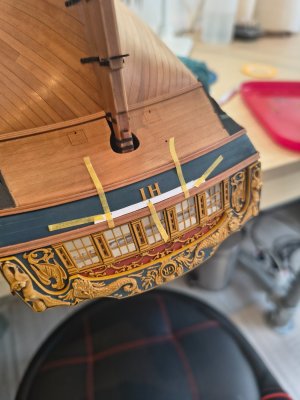
Mounting the name on the stern had to be done a bit the old-school way. Chris had very nicely laser-marked the exact placement of the letters, but I sanded those away because otherwise I wouldn't get a nice transition to the adjacent parts. So I placed the letters mainly by eye, with the help of some guidelines (a centerline, etc.). It was a little bit stressful because it looks pretty silly if the letters aren't positioned correctly, but in the end, it turned out fine.

IMG_20260531_153405926_HDR.jpg


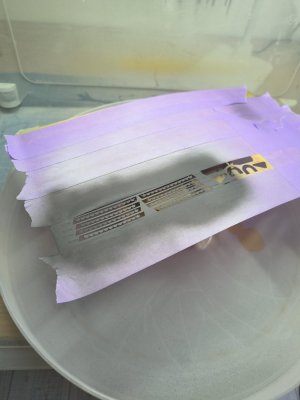
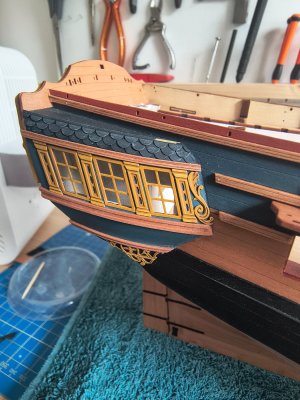
The roof tiles of the side gallery consist of PE strips. These were first sprayed with the airbrush in the respective color. (vallejo black/grey 70.862)

IMG_20260531_144610812.jpg


Then glued down with CA adhesive, not the entire strip at once, but starting with the first two tiles, then a few in the middle, and finally two drops on the last 2 tiles. They need to be bent sideways a very small amount to create the curve. This must be done very carefully a little bit everywhere so that nothing buckles.

IMG_20260601_191757345_HDR.jpg


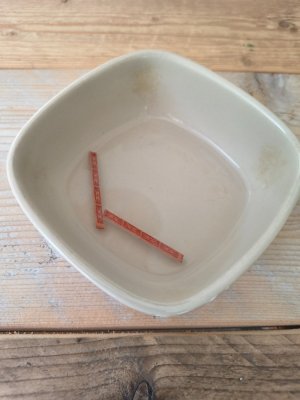
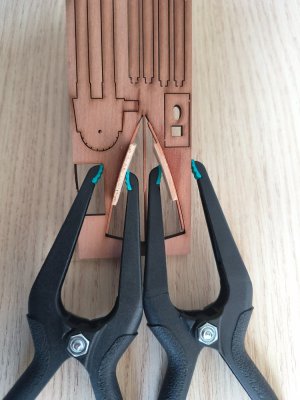
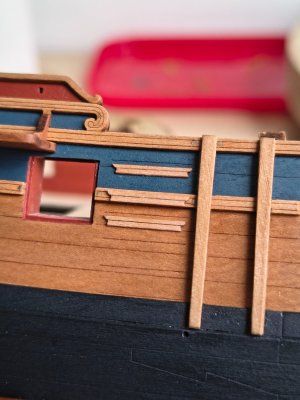
Two laser-cut decorative strips of pear wood will be added on top. Because the side gallery has a slight curve, I first soaked them and then clamped them into the pieces of pear wood from which the roof of the side gallery came. This still retains the negative shape of that, so it works out nicely. Naturally, I let them dry overnight.

IMG_20260603_151320322.jpg
IMG_20260603_152309803.jpg


When I was busy gluing these pieces of wood above the gallery...at first it wasn't quite right and I carefully pulled it off again...unfortunately, I pulled a piece of paint off the roof tiles along with it...sigh Cautious

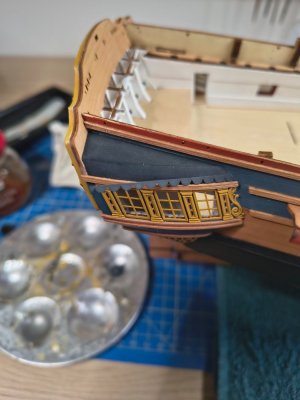
So metal primer again, color...As you can see, I also dry-brushed the roof tiles a bit with a lighter color. It's certainly not the best version haha, but I'm not dissatisfied with it either. It could be much better, but I think this effect has something going for it, so I'll leave it like this (before I mess it up).

IMG_20260608_152511541_HDR.jpg


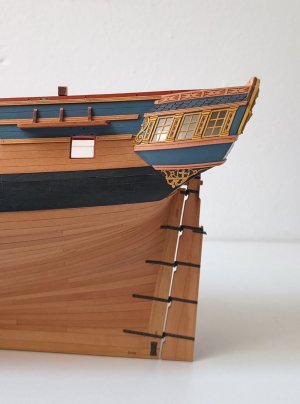
End result

IMG_20260609_142539929.jpg


IMG_20260609_142038864.jpg
IMG_20260609_141348521.jpg


And that brings this chapter to an end. For now, this decoration is finished and I’m leaving it as is. On the top of the stern, you can still see bare wood that blends in a bit with the side. I don't know exactly what I'm going to do with this yet, probably put a nice black caprail on it (is that what you call it?). I did saw that in some other builds. But that’s all for later.

 
Last edited:
Stern/side gallery update:

finally finished with the decoration for the stern and side gallery...and she carries proud her name now :)


Mounting the name on the stern had to be done a bit the old-school way. Chris had very nicely laser-marked the exact placement of the letters, but I sanded those away because otherwise I wouldn't get a nice transition to the adjacent parts. So I placed the letters mainly by eye, with the help of some guidelines (a centerline, etc.). It was a little bit stressful because it looks pretty silly if the letters aren't positioned correctly, but in the end, it turned out fine.

View attachment 610675


The roof tiles of the side gallery consist of PE strips. These were first sprayed with the airbrush in the respective color. (vallejo black/grey 70.862)

View attachment 610674


Then glued down with CA adhesive, not the entire strip at once, but starting with the first two tiles, then a few in the middle, and finally two drops on the last 2 tiles. They need to be bent sideways a very small amount to create the curve. This must be done very carefully a little bit everywhere so that nothing buckles.

View attachment 610673


Two laser-cut decorative strips of pear wood will be added on top. Because the side gallery has a slight curve, I first soaked them and then clamped them into the pieces of pear wood from which the roof of the side gallery came. This still retains the negative shape of that, so it works out nicely. Naturally, I let them dry overnight.

View attachment 610676
View attachment 610677


When I was busy gluing these pieces of wood above the gallery...at first it wasn't quite right and I carefully pulled it off again...unfortunately, I pulled a piece of paint off the roof tiles along with it...sigh Cautious

So metal primer again, color...As you can see, I also dry-brushed the roof tiles a bit with a lighter color. It's certainly not the best version haha, but I'm not dissatisfied with it either. It could be much better, but I think this effect has something going for it, so I'll leave it like this (before I mess it up).

View attachment 610678


End result

View attachment 610679


View attachment 610672
View attachment 610670


And that brings this chapter to an end. For now, this decoration is finished and I’m leaving it as is. On the top of the stern, you can still see bare wood that blends in a bit with the side. I don't know exactly what I'm going to do with this yet, probably put a nice black caprail on it (is that what you call it?). I did saw that in some other builds. But that’s all for later.

If you don't mind me asking, Roland, I can't recall right now if you used two layers of planking. I wanted to ask if you made that final layer using 0.05mm veneer strips or perhaps another material? That’s pear wood, right? The more I look at your photos, the more amazed I am by the detailed curvature of the stern and how perfect, aligned, and crisp the planking looks along the keel!! I’m speechless my friend!!!!
 
I continue to enjoy following your excellent work, Ronald!
Thank you! :)

If you don't mind me asking, Roland, I can't recall right now if you used two layers of planking. I wanted to ask if you made that final layer using 0.05mm veneer strips or perhaps another material? That’s pear wood, right? The more I look at your photos, the more amazed I am by the detailed curvature of the stern and how perfect, aligned, and crisp the planking looks along the keel!! I’m speechless my friend!!!!
Thanks again for the compliment! Yes I used two layers of planks. The first layer just the standard linden wood and for the second layer 0.8mm pearwood. The kit comes standard with 0.8mm pear wood for the hull. But I did replaced this with my own purchased wood, not because the kit supplied wood was not good, but because I needed different width's and I didn't want too much color difference. So I purchased everything by one supplier (Hobbymill, which I can recommend). You could use ofcourse also the kit wood and mix it with a few wider planks if the color difference isn't too much or you like the appearance of that.
 
Thank you! :)


Thanks again for the compliment! Yes I used two layers of planks. The first layer just the standard linden wood and for the second layer 0.8mm pearwood. The kit comes standard with 0.8mm pear wood for the hull. But I did replaced this with my own purchased wood, not because the kit supplied wood was not good, but because I needed different width's and I didn't want too much color difference. So I purchased everything by one supplier (Hobbymill, which I can recommend). You could use ofcourse also the kit wood and mix it with a few wider planks if the color difference isn't too much or you like the appearance of that.
Hi Ronald-V I take it 0.8 mm is the width correct? What about the thickness? My concern is how it will handle bending around the curve of the stern; do you have any advice on that? Thanks for the wood supplier contact info; the downside is that they are in the EU and I live in the US. Orders from the EU have become a real headache, they're charging customs fees I’ve never had to pay before, plus there are delays of weeks, sometimes nearly a month. Thanks a lot for your reply; I’ll definitely keep your recommendation in mind. I need to take a good look at the wood in my kit. Best regards.
 
Hi Ronald-V I take it 0.8 mm is the width correct? What about the thickness? My concern is how it will handle bending around the curve of the stern; do you have any advice on that? Thanks for the wood supplier contact info; the downside is that they are in the EU and I live in the US. Orders from the EU have become a real headache, they're charging customs fees I’ve never had to pay before, plus there are delays of weeks, sometimes nearly a month. Thanks a lot for your reply; I’ll definitely keep your recommendation in mind. I need to take a good look at the wood in my kit. Best regards.
No the thickness was 0.8mm. The average width of the planks is still the 4mm that came with the kit. And I used planks 12cm long. All of this seemed to come reasonably close to a real ship in terms of dimensions (not exact, of course, but for me it's good enough). However, I needed some different widths, especially for the plank running to the sternpost. These flare out more if you don't use stealers. And here and there you need some wider planks. And it's also nice to know that you have enough in stock in a few different sizes... so you can start things over, or experiment a bit.

You can achieve the curve around the stern in various ways. You can try them out yourself and see which one you prefer in which position. Sometimes you need a combination. Personally, I find the "Form a strip" from Amati quite handy, I used that for most curves, just use careful, frequent squeezes and don't try to bend the strip 90 degrees in 2-3 squeezes. I find this little device very convenient because you don't have the hassle with water etc... just nice and simple without any fuss.

And if I didn't get the desired result with that, I simply soaked the boards. However, I avoided that as much as possible because it takes so long to dry before you can glue. And sometimes heat is also somewhat handy, but I only used that on the first board just below the wales. By the way...when soaking the planks...leave them quite a bit longer than they need to be, because if you try to bend only the end...that becomes rather difficult. ;)

As for the wood... I'm sure there's a good supplier over there in America too? Maybe so members know a good one over there across the pond.
 
Last edited:
No the thickness was 0.8mm. The average width of the planks is still the 4mm that came with the kit. And I used planks 12cm long. All of this seemed to come reasonably close to a real ship in terms of dimensions (not exact, of course, but for me it's good enough). However, I needed some different widths, especially for the plank running to the sternpost. These flare out more if you don't use stealers. And here and there you need some wider planks. And it's also nice to know that you have enough in stock in a few different sizes... so you can start things over, or experiment a bit.

You can achieve the curve around the stern in various ways. You can try them out yourself and see which one you prefer in which position. Sometimes you need a combination. Personally, I find the "Form a strip" from Amati quite handy, I used that for most curves, just use careful, frequent squeezes and don't try to bend the strip 90 degrees in 2-3 squeezes. I find this little device very convenient because you don't have the hassle with water etc... just nice and simple without any fuss.

And if I didn't get the desired result with that, I simply soaked the boards. However, I avoided that as much as possible because it takes so long to dry before you can glue. And sometimes heat is also somewhat handy, but I only used that on the first board just below the wales. By the way...when soaking the planks...leave them quite a bit longer than they need to be, because if you try to bend only the end...that becomes rather difficult. ;)

As for the wood... I'm sure there's a good supplier over there in America too? Maybe so members know a good one over there across the pond.
Hi Ronald,
Wow, thanks a million for such a detailed explanation. You're right it's always better to have extra material on hand so you don't end up tearing your hair out later over missing a couple of strips because you needed different widths. I actually noticed you used varying thicknesses when analyzing your photos; I like to zoom in, I think it's the best way to pick up those kinds of details. I'll definitely check out the tool you recommended; I might not have it yet. From what you said, I gather you built a formidable, robust double-planked hull I assume the first layer was of a similar thickness? Am I right about that? To wrap things up and not bother you any further, did you happen to add a filler block at the curve of the transom, near the last few bulkheads? I've heard that's recommended to help the planks adhere better. And sorry for asking so many questions; It will be my second ship; I’m not intimidated by the difficulty level, but I am concerned about the number of errors in those kits, and I want to do the best job possible. I’m just studying taking notes and analyzing the steps to improve my kit, and obviously trying to make as few mistakes as possible, though I realize I’ll inevitably make some. Of course, we learn from our mistakes, too; nobody’s perfect in this world. Sending you a big hug!! I’ll keep following your progress here. Thanks in advance for your reply.
 
Hi Ronald,
Wow, thanks a million for such a detailed explanation. You're right it's always better to have extra material on hand so you don't end up tearing your hair out later over missing a couple of strips because you needed different widths. I actually noticed you used varying thicknesses when analyzing your photos; I like to zoom in, I think it's the best way to pick up those kinds of details. I'll definitely check out the tool you recommended; I might not have it yet. From what you said, I gather you built a formidable, robust double-planked hull I assume the first layer was of a similar thickness? Am I right about that? To wrap things up and not bother you any further, did you happen to add a filler block at the curve of the transom, near the last few bulkheads? I've heard that's recommended to help the planks adhere better. And sorry for asking so many questions; It will be my second ship; I’m not intimidated by the difficulty level, but I am concerned about the number of errors in those kits, and I want to do the best job possible. I’m just studying taking notes and analyzing the steps to improve my kit, and obviously trying to make as few mistakes as possible, though I realize I’ll inevitably make some. Of course, we learn from our mistakes, too; nobody’s perfect in this world. Sending you a big hug!! I’ll keep following your progress here. Thanks in advance for your reply.
I will later answer your questions, but I just made a little video about how I used the Amati tool. Some people hate that thing and some people find it quite handy. I'm the latter one ;) it's just sort of cheap tool you can experiment with...If it's not for you... at least it won't cost you a fortune.

And ofcourse, I don't know if it works this way with very thin veneer, but with my planks (0.8mm thick) it works fine!

 
I will later answer your questions, but I just made a little video about how I used the Amati tool. Some people hate that thing and some people find it quite handy. I'm the latter one ;) it's just sort of cheap tool you can experiment with...If it's not for you... at least it won't cost you a fortune.

And ofcourse, I don't know if it works this way with very thin veneer, but with my planks (0.8mm thick) it works fine!

Excellent, Ronald thanks for sharing. Now I see the sense in what you said about not applying too much pressure to the board; I’ve seen, just as you mentioned people leaving marks on the wood, and that must be because they’re using too much force! and I gather that the technique applies to both the bow and the stern. Thanks a million for sharing.
 
Hi Ronald,
Wow, thanks a million for such a detailed explanation. You're right it's always better to have extra material on hand so you don't end up tearing your hair out later over missing a couple of strips because you needed different widths. I actually noticed you used varying thicknesses when analyzing your photos; I like to zoom in, I think it's the best way to pick up those kinds of details. I'll definitely check out the tool you recommended; I might not have it yet. From what you said, I gather you built a formidable, robust double-planked hull I assume the first layer was of a similar thickness? Am I right about that? To wrap things up and not bother you any further, did you happen to add a filler block at the curve of the transom, near the last few bulkheads? I've heard that's recommended to help the planks adhere better. And sorry for asking so many questions; It will be my second ship; I’m not intimidated by the difficulty level, but I am concerned about the number of errors in those kits, and I want to do the best job possible. I’m just studying taking notes and analyzing the steps to improve my kit, and obviously trying to make as few mistakes as possible, though I realize I’ll inevitably make some. Of course, we learn from our mistakes, too; nobody’s perfect in this world. Sending you a big hug!! I’ll keep following your progress here. Thanks in advance for your reply.
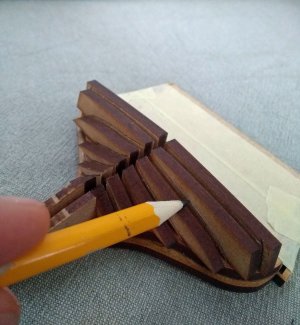
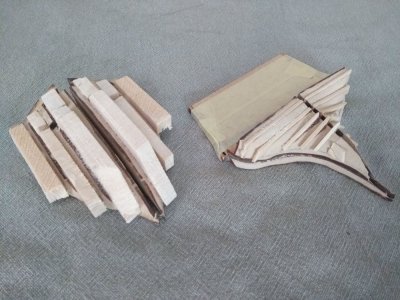
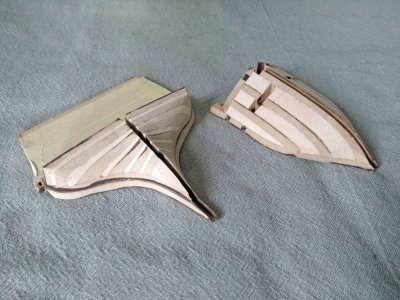
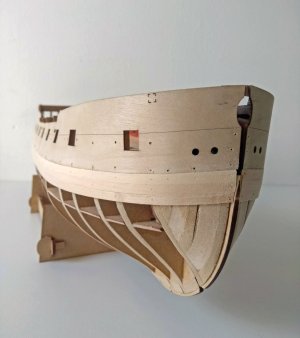
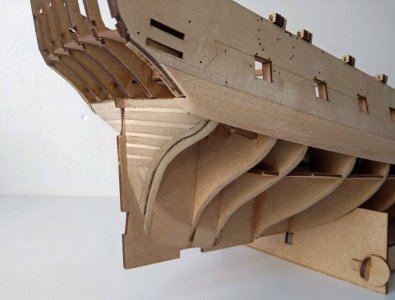
I'm not entirely sure what you mean by me using different thicknesses of planks :) . I only used 0.8mm for the final layer. And for the first layer, I think I used 1mm or so, depending on what came with the kit. It could also have been 1.5mm. I would have to check that if that is really important to you. Not really used a filler block, but I did fill the remaining spaces between slots that was in the design of the kit. Like you see in the below pics. This was more a visual aid for me to see if the curve was right with the fairing process. Not persé for more grip strength. But it definitly wouldn't hurt!

In the last photos, it wasn't the right shape yet. I only realized that when I was already halfway through the first layer! I broke away the last planks and tried again to get the right shape in the bow and stern. You can still see all of that at the beginning of the build log.

Don't be too hard on yourself and view everything as a learning process. It is important that you keep enjoying it, and that always involves a bit of figuring things out and finding a balance in how you get the most out of it.

IMG_20230729_162755606.jpg
IMG_20230730_145912889.jpg
IMG_20230731_122649481.jpg

IMG_20230923_144553369.jpg
IMG_20230923_144637404.jpg
 
Last edited:
Hi, Ronald! As always, I'm delighted to see your progress. Excellent work! Thank you for your informative support! When I was working on the body cladding stage, I considered using the Amati tool for bending the slats, but for some reason, I decided not to purchase it and instead used an iron to bend the slats after steaming them in hot water. However, after watching your Instagram video on using this tool, I realized how convenient it is, and I am impressed by the excellent results. I think I will definitely get such a tool for future projects.

Yours sincerely, FriCap.
 
Hi, Ronald! As always, I'm delighted to see your progress. Excellent work! Thank you for your informative support! When I was working on the body cladding stage, I considered using the Amati tool for bending the slats, but for some reason, I decided not to purchase it and instead used an iron to bend the slats after steaming them in hot water. However, after watching your Instagram video on using this tool, I realized how convenient it is, and I am impressed by the excellent results. I think I will definitely get such a tool for future projects.
Yours sincerely, FriCap.
Thanks Fricap! It's definitely worth a try in my opinion. At the Amati site it costs only 9,50 euro. Ofcourse by your local hobbyshop a bit more, but it isn't a really expensive tool
 
Back
Top