
• SUBSCRIBE TO SHIPS IN SCALE TODAY!

    The beloved Ships in Scale Magazine is back and charting a new course for 2026!
    Discover new skills, new techniques, and new inspirations in every issue.

    NOTE THAT OUR NEXT ISSUE WILL BE MARCH/APRIL 2026
  • Win a Free Custom Engraved Brass Coin!!!
    As a way to introduce our brass coins to the community, we will raffle off a free coin during the month of August. Follow link ABOVE for instructions for entering.

HMS Victory - Limited Edition by Occre, 1:87

Good comments. Jim, I had Floyd playing on my first session. I was at the desk from Meddle through Division Bell. Their music & model ship building go well together.

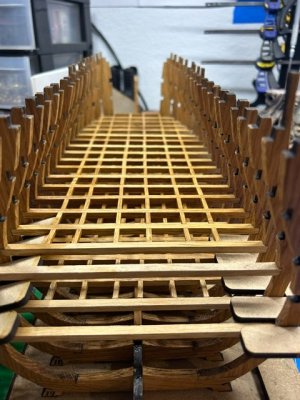
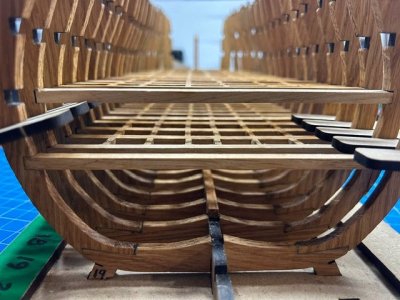
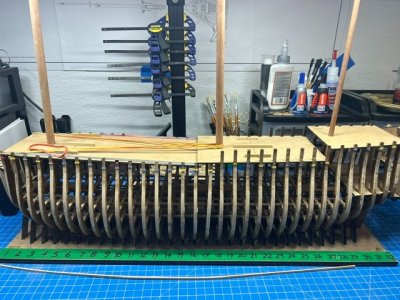
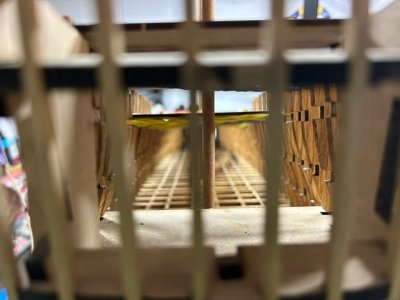
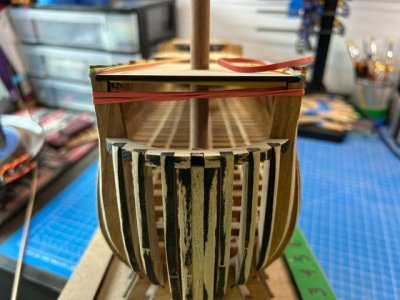
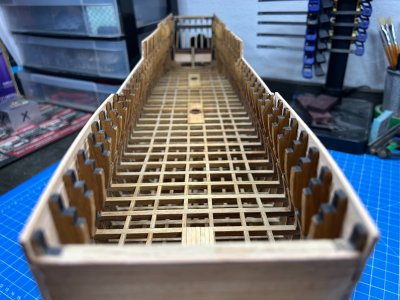
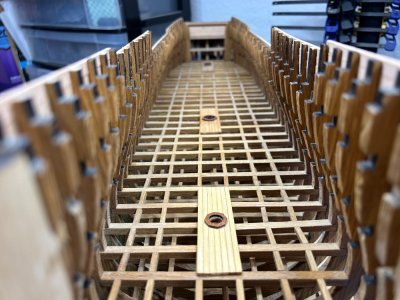
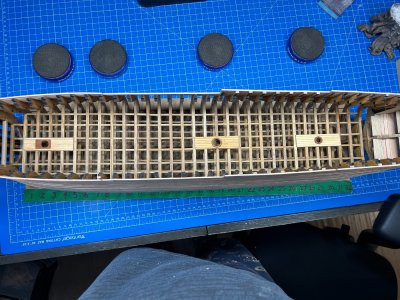
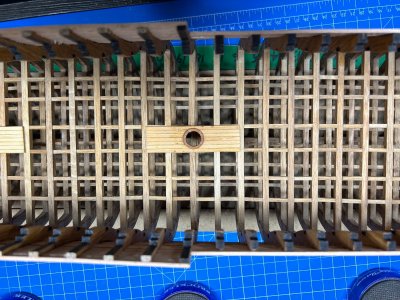
This is slow going. Those giblets suck. I never liked giblets anyway. But, I have to admit, once they are glued in, the whole structure is definitely more stable. I am on rib 19 of 32, 2nd deck. I've had 3 of the oak ribs just snap at weird places, not joints. They were tensioned only with very loose fitting rubber bands. The oak is very porous, dry & brittle. It soaked up 2 coats of danish oil immediately. It's imperative that the supplied spacers stay on. The upper parts of ribs have a tendency to drift.

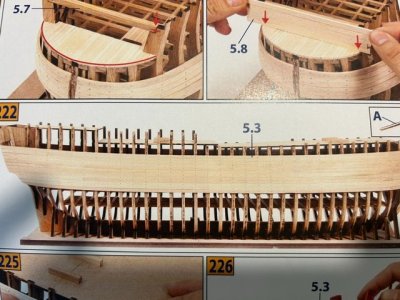
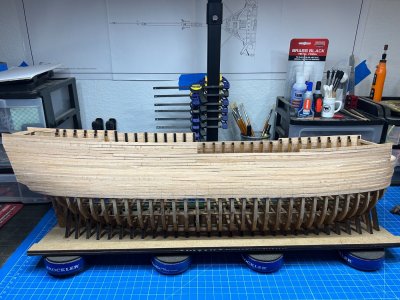
I think I'm on track according to the pic. The straightness of my giblet placing was much improved on the second deck. This would be much easier & straighter cutting rabbets on the oak beams with a mini table saw.
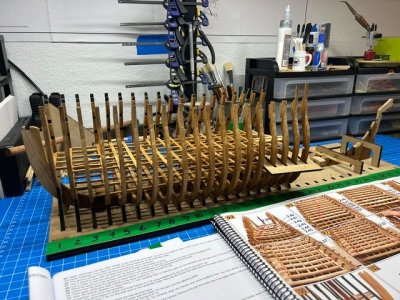
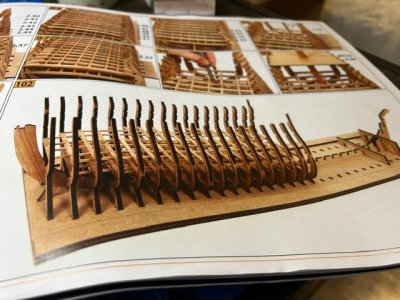
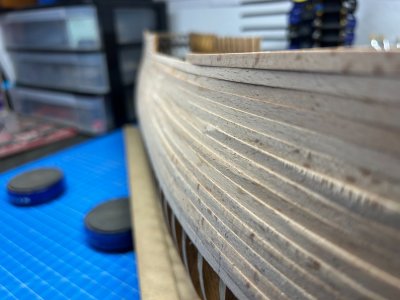
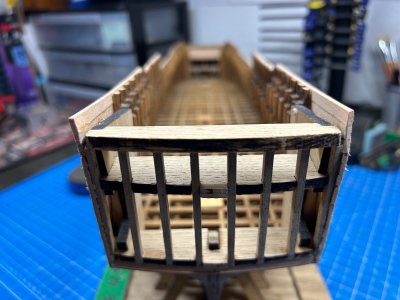
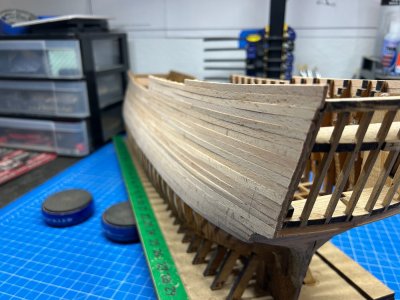
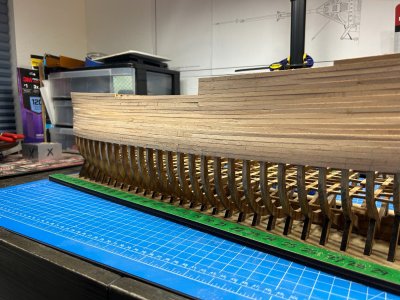
IMG_1377.jpegIMG_1382.jpegIMG_1378.jpegIMG_1380.jpeg
 
Hull completed in 6 weeks. I'm able to sit at the desk almost every night. I'm a night owl, so I have 2-3 hours each night if I choose. It's nice that I don't have a time line on this project, unlike my last decades of woodworking, as I was always scrambling to get gifts made or something built.

Sanding the ribs even to accept planking has begun & is a slow process. As I stated earlier, the oak ribs are very brittle. I've had to repair a few more ribs since last post.

My thoughts so far:
- Did I bite off more than I can chew having this massive kit as my first build? Not yet.
- Do I wish I would have started with a simpler kit? Not yet.
- I have even more appreciation for the members work & passion on this forum.
- I need to be more precise & not so sloppy on my glue placement.
- Sand or file EVERY glue joint that has the black char from the laser. I had to go back & repair a few pieces that did not bond because the char prohibited a good glue joint.
- I need to read the instructions further ahead than I have been.
- I am having a blast & I am challenged every session.

My question for the upcoming, dreaded planking:
Occre's instructions show nails in every rib & every plank. Even though this kit is only half-planked, that's still a butt load of nails. Since the oak ribs are very dry & brittle, I'm concerned I will be making more repairs if I go that route. Advise?

IMG_1389.jpegIMG_1391.jpegIMG_1392.jpegIMG_1393.jpeg
 
I would not use nails. However, you will need to "pre-shape" every plank before you put it on the ship. So, the plank will have the bend of the bow on it before you install it. That way there is no stress on the glue joint.
 
Ah...I think I misread your earlier post. I thought you were wondering about adding treenails. Is Occre asking you to use actual nails on the hull planks? To what end? To hold the plank in place?
 
Exactly! Zoom in on the last pic. Those are all nails with the heads clipped. I understand nails at the curves of the bow & stern, but the rest?

I like the look of all the nails, but that can be done with drilling & filling. My concern is putting 30 holes (15 planks on each side) & nails in each oak rib. The ribs are already compromised being so brittle & fragile.
 
Hull completed in 6 weeks. I'm able to sit at the desk almost every night. I'm a night owl, so I have 2-3 hours each night if I choose. It's nice that I don't have a time line on this project, unlike my last decades of woodworking, as I was always scrambling to get gifts made or something built.

Sanding the ribs even to accept planking has begun & is a slow process. As I stated earlier, the oak ribs are very brittle. I've had to repair a few more ribs since last post.

My thoughts so far:
- Did I bite off more than I can chew having this massive kit as my first build? Not yet.
- Do I wish I would have started with a simpler kit? Not yet.
- I have even more appreciation for the members work & passion on this forum.
- I need to be more precise & not so sloppy on my glue placement.
- Sand or file EVERY glue joint that has the black char from the laser. I had to go back & repair a few pieces that did not bond because the char prohibited a good glue joint.
- I need to read the instructions further ahead than I have been.
- I am having a blast & I am challenged every session.

My question for the upcoming, dreaded planking:
Occre's instructions show nails in every rib & every plank. Even though this kit is only half-planked, that's still a butt load of nails. Since the oak ribs are very dry & brittle, I'm concerned I will be making more repairs if I go that route. Advise?

View attachment 605953View attachment 605954View attachment 605955View attachment 605956
I am working on the SantĂ­sima Trinidad by Occre (1:90) and I am omitting the treenails, but I did apply caulking lines.
 
If it is any help, I have been working on the same model and didn't use any nails.
Yep @ Crypton. I have your build log open on it's own tab, as well as Julian & Neil's. I refer back to each before I proceed to the next step. I am almost done with planking. I only went with nails on the first 4 rows of planks. I'm tired of repairing ribs. I will drill & fill the rest. Your work is amazing. If my finished ship is half as good as yours, I will be pleased. Question: I also read your build log on the Le Requin. How was that build compared to this Victory?
 
My first ever planking attempt. A few proud edges & a few small gaps that a sanding block & beech dust+PVA will hopefully fix. Otherwise, it turned out better than I was expecting. I am pleased. I am 200 hrs into this build. 2000 more to go. Even though this ship is only half-planked, it was still a challenge. First time I have ever worked with beech. I am not a fan of the grain pattern, but I like working with it. Not too hard, not too soft.

Next steps per Occre are to sand down the hull, paint the planks from top to bottom on the inside of the hull with diluted PVA & then on to cutting out over 100 gun ports.

"And now, for something completeIy different"...
I love the look of the open hull. I'm contemplating removing the bottom 3 rows of planks from each side & have the lower row of cannons sitting on the deck in the open hull. That look would add to the Admiralty style & give a clear view of the cannons/carriages/rigging instead of just seeing the barrels poking through gun ports. There would still be 2 full rows of cannons with the planking above. From first glance, removing the 3 rows would not interfere with any other attachments to the hull. the first pic is from Occre's website.
Thoughts?


1781155619808.pngIMG_1408.jpegIMG_1409.jpegIMG_1410.jpegIMG_1411.jpegIMG_1412.jpegIMG_1413.jpegIMG_1414.jpegIMG_1415.jpegIMG_1416.jpeg
 
Thoughts?
Hi Mike,

Does the kit call for a second layer of planking? If not, forget the rest of this post. If it does, the following may be of interest depending on what you are looking to do. You did ask, so here goes.

OcCre has no clue on how a ship is planked, or worse, they know but ignore it. You may want to take some time and read up on how planking is done on a ship. It is your time and yours alone so your choice on how to spend it regarding the model. The best sources have been brought up many times here at SoS, so if this is a repeat for you, my apologies. As you are stuck with straight sticks for planking you cannot spile the planks so you will have to edge bend before hand to avoid the lifting that you are getting. The best video on how to do this is probably the four part video here;
There are variations, but the key is to take away the spring of the plank before adding it to the hull. If done right, the plank can be held in place with finger pressure for a minute or less even using PVA glue and it will hold tight.

As the videos show, the strakes of planks are not the same breadth from end to end. They taper from the dead flat to the stem. Some strakes actually get broader as they approach the stern post and counter. The hull has to be lined off to find out the breadth along each strake. Planking expansion drawings show this. https://www.rmg.co.uk/collections/search/Planking expansion plans

The planking looks like it parallels the sheer of the gun ports/gun decks. With the exception of some 6th rates or smaller, this was not done on the outboard planking. (The inboard planking from the lower gun deck and above usually did run parallel to the sheer of the deck.) It is easiest to see the run of the planking on contemporary models by looking at the sheer of the wales. Note how they cut into the gunports fore and aft in the photo of 74 below.
1781200032854.png

I have to ask and I know this is probably just a terminology/translation problem. Above you mention giblets. I like them in turkey gravy but never saw them on a ship other outside the mess hall. :) What are they?
Allan
 
Last edited:
Hi Mike,

Does the kit call for a second layer of planking? If not, forget the rest of this post. If it does, the following may be of interest depending on what you are looking to do. You did ask, so here goes.

OcCre has no clue on how a ship is planked, or worse, they know but ignore it. You may want to take some time and read up on how planking is done on a ship. It is your time and yours alone so your choice on how to spend it regarding the model. The best sources have been brought up many times here at SoS, so if this is a repeat for you, my apologies. As you are stuck with straight sticks for planking you cannot spile the planks so you will have to edge bend before hand to avoid the lifting that you are getting. The best video on how to do this is probably the four part video here;
There are variations, but the key is to take away the spring of the plank before adding it to the hull. If done right, the plank can be held in place with finger pressure for a minute or less even using PVA glue and it will hold tight.

As the videos show, the strakes of planks are not the same breadth from end to end. They taper from the dead flat to the stem. Some strakes actually get broader as the approach the stern post and counter. The hull has to be lined off to find out the breadth along each strake. Planking expansion drawings show this. https://www.rmg.co.uk/collections/search/Planking expansion plans

The planking looks like it parallels the sheer of the gun ports/gun decks. With the exception of some 6th rates or smaller, this was not done on the outboard planking. (The inboard planking from the lower gun deck and above usually did run parallel to the sheer of the deck.) It is easiest to see the run of the planking on contemporary models by looking at the sheer of the wales. Note how they cut into the gunports fore and aft in the photo of 74 below.
View attachment 611152

I have to ask and I know this is probably just a terminology/translation problem. Above you mention giblets. I like them in turkey gravy but never saw them on a ship other outside the mess hall. :) What are they?
Allan

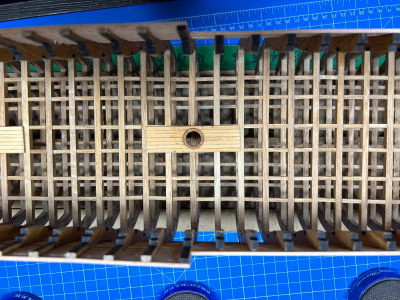
ROTFThey are the 2x2 mm beams that are perpendicular to the 5x5 beams running the length of the ship. They are all cut to appx 15mm. Someone else on here called them "Nuggets or Noggins". There are hundreds of them. Me tagging them "Giblets" is from my Hillbilly upbringing in Southern Illinois & Kentucky. I have no idea as to the exact terminology. See pic below. The hardest part is keeping them all in a straight line. My second deck of giblets were much straighter than the first deck. I have one more deck to go with them.
This kit is single planked with 5x2 mm beech. The path on the hull was straight. Last night, I was able to scrape down the proud edges easily with a utility razor blade. Now I am on to sanding. As for now, I don't think I will need a file. I'll know in the next few days. Thanks for the info on the second planking. I'm still thinking about removing the first 3 rows of planks. I will build a few carriages & cannons & set them on the first deck, which is supposed to be bare & see how they look sitting by themselves.

I agree with you on the "springing" of the planks. Luckily, the few planks with proud edges are all secure to the ribs. I found bending the beech planks easier than I was expecting, but I broke 1 out of 5. What I failed to do was tweak a few planks with more water & heat to eliminate the spring on the curve of the hull. Rookie mistake. It will not be my last. I just need to be diligent about learning from my mistakes. So far, this has been an incredible challenge & loads of fun.

Call me Bat-$hit crazy, but I am actually looking forward to the rigging!!!!!! I might change my tune once I dive into it though. The rigging on this ship looks very complex. As for now, I am leaning towards "furling" the sails. Correct terminology?

My next post will be after sanding the hull.

1781206855822.png
 
Back
Top