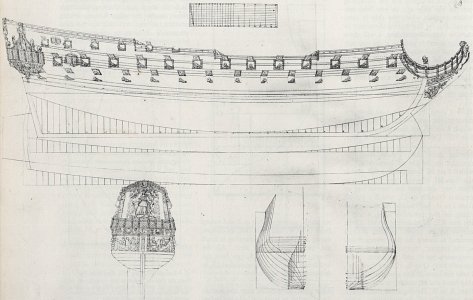





For HMS Sovereign of the Seas from 1637, Deane's Treatise of 1670 is far too late and is not the basis upon which the Sovereign was designed. Peter Pett documented the hull molding of the Sovereign, so using the information provided by the very man who built the ship is a no brainer. The Petts had their own methods of designing hulls in the earlier days. John McKay made the mistake of applying Deane's methods to the Sovereign. Square peg, round hole. If I was building a late 17th century model, then Deane's Treatise would probably be the way to go.I once had ambitions in that direction. The complexity, lack of contemporary plans, the time - I chased several plans (Prince, Royal Katherine) that leave much to be desired. I even followed Antony Deane's design instructions for recreating Royal Charles or Royal James. Then my sanity returned. I do highly recommend taking the time to follow Deane's design method. I put my level of understanding plans at a more serious level. I was trying to find a way to loft frames without plotting them. Deane only gives directions for producing three stations. I thought it was Deane being lazy. I was wrong about that. He only used three. Battens were used to connect the three points plus the stem and stern. Once they were fair with a smooth run, the other stations are plotted - exactly what I was trying to avoid.
I am going Georgian Royal Navy - 1719 - 1776. instead of 17th C. I just picked 1670 because that is my guide star - the conditions and materials do not change until maybe the 20th C.
I do not think that the acidity of Titebond II is something to worry about - if the model is a case that has enough ventilation for volume exchange Q12H to Q24H. There is not all that much volume of acidic acid to begin with. Being volatile at RT, it will out gas in weeks if not faster. Lineco Neutral PVA is pH7, but I do not think that the bond strength come near that of carpenter's PVA.
Repeating something I wrote recently:
Someone asked in the Chinese junk thread "what will become of MY models in 90 years". It got me to thinking. To survive with following generations - whose world will be much more constrained and less privileged than ours - models will have to be cased and small enough to rate having shelf space. For 1:48, 1:60, 1:72 a model and its case is huge, heavy, and the case unsustainably expensive.
A much smaller case would be easier to fabricate and the glazing be thin - low cost per size - light weight - with no need for any safety factors. As long as you stay far away from the "better living thru Chemistry materials, stability over time should be no problem.
I am at present exploring possibility of 1:120 - which is essentially 1:128 or 3/32":1' for anyone who wishes to stay Imperial. It is an academic exercise for me. The savings on wood are huge and the actual build goes much faster. Fabricating those parts that are too small to use wood to build them is probably going to be a major challenge.
Too bad Lineco Neutral PVA is not as strong as Titebond II. I really like how fast Titebond II sets up, especially when the coating is thin. As long as a plank is pre-formed to the hull shape and not springy from being forced in place, Titebond II works perfectly. It's worth the time to pre-bend your planks before attachment since it actually saves you time over that spent waiting for a springy plank to stay in place with almost fully cured glue.
Perhaps smaller vessels would last longer, perhaps not. The factors involved with which models are chosen to last the ages are hard to fathom, and often luck has more to do with it than anything. Building smaller than 1:100 for me creates difficulty in maintaining the level of detail I prefer. Other members on this forum are much better at fabricating micro-details than I am.