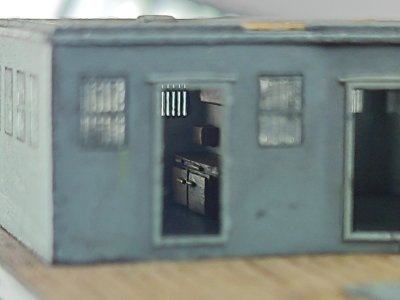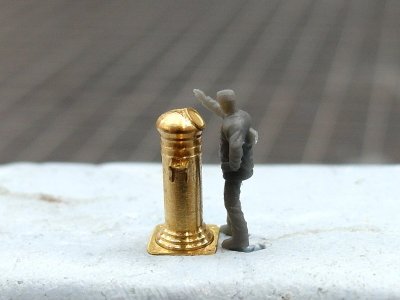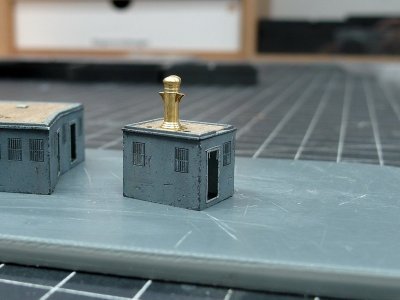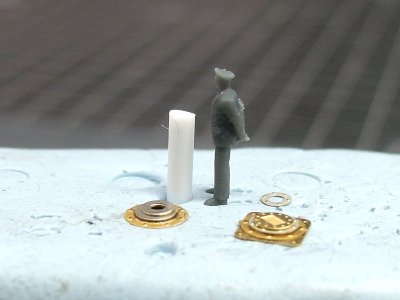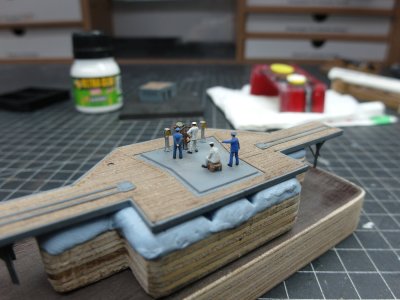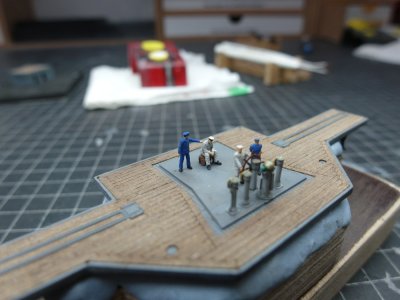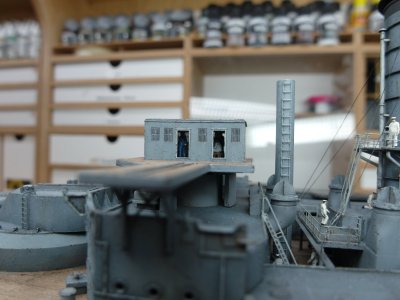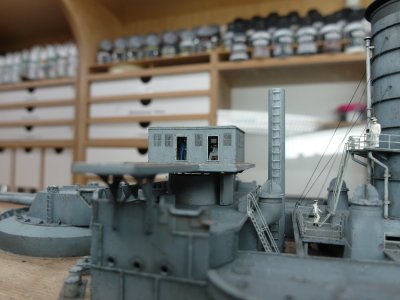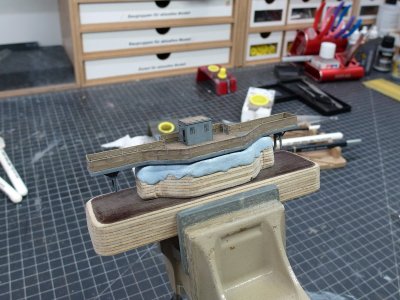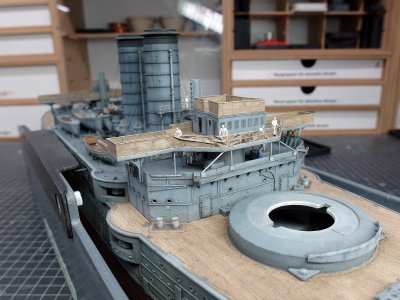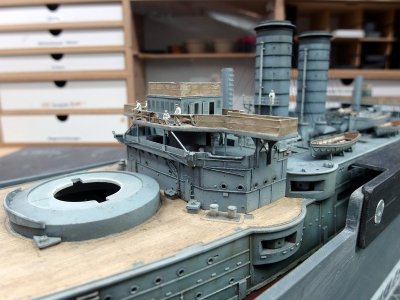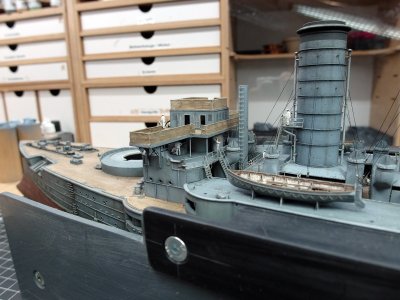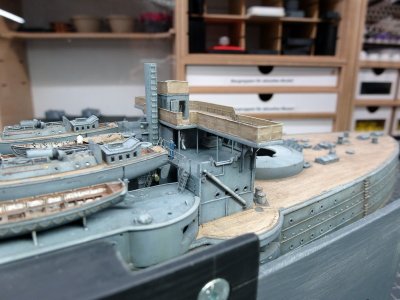


• Win a Free Custom Engraved Brass Coin!!!
    As a way to introduce our brass coins to the community, we will raffle off a free coin during the month of August. Follow link ABOVE for instructions for entering.
  • SUBSCRIBE TO SHIPS IN SCALE TODAY!

    The beloved Ships in Scale Magazine is back and charting a new course for 2026!
    Discover new skills, new techniques, and new inspirations in every issue.

    NOTE THAT OUR NEXT ISSUE WILL BE MARCH/APRIL 2026

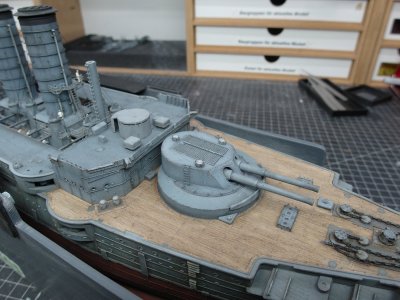
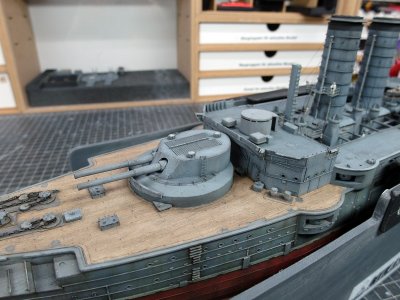
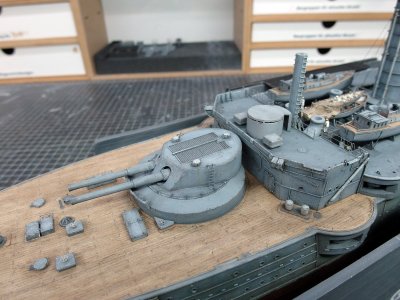
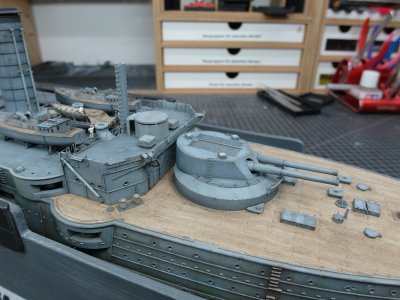
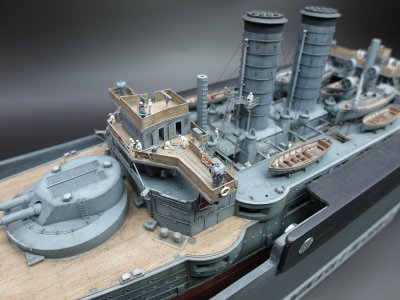
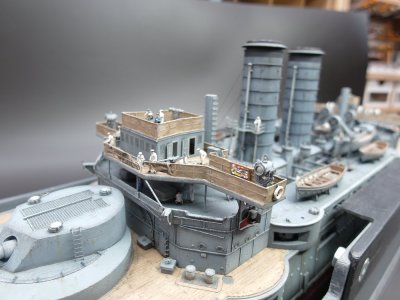
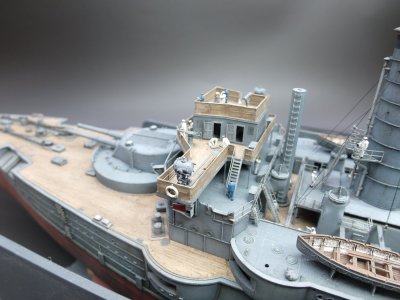
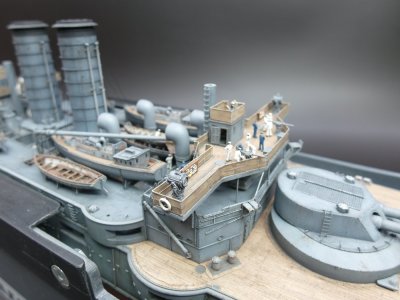
IJN Pre-Dreadnought Battleship Mikasa by Merit 1:200 with Pontos and KA Models

Thank you very much for the kind words.

We (not just me) would appreciate it if you could teach us the basics of weathering techniques here, or even open another thread dedicated to weathering. I am also assembling plastic models, and would love to learn weathering.

I'd be happy to do that, Jim.
I've already written something about this in one or two forums. I'll find the report right away and post it here.

Another GREAT build. I followed the Pontos build. You're very talented. Do you build on the model every day? How many hours do you think was expended on the Pontos. How many do you expect for this build. Also, your worksop looks very organized and well equipped. I'm impressed. Thanks for sharing.

I'm always happy to share my projects.
Hmm, it's really hard to say exactly when I work on my model. A little bit during the week, and regularly on weekends if I don't have anything else on.
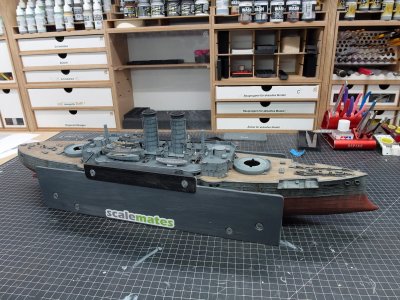
I can't really put a number on it. I just roughly estimate it in months. So, I spent two years and three months working on the Bismarck. Now, I've been working on the Mikasa for one year and eight months. And I estimate it will be finished in three months. But I'm already quite a bit further along than this build log shows. Let's see how far I get with today's time-lapse report.

It is the first plastic ship I will build in 53 years. So I am starting over. I will refer to your post to help guide me through my build.

I'm glad that helps you. That's exactly what forums are for, in my opinion. I've also picked up so many tips and tricks from build reports.
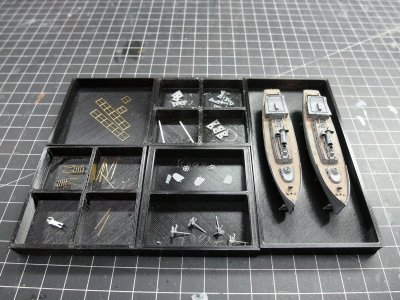
 
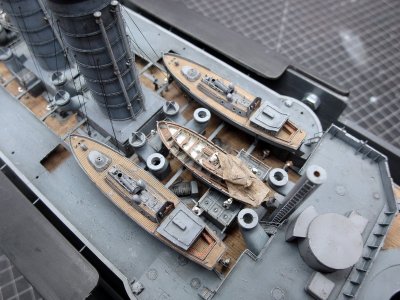
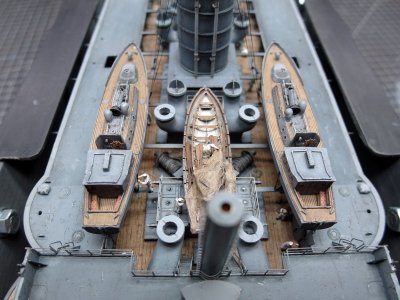
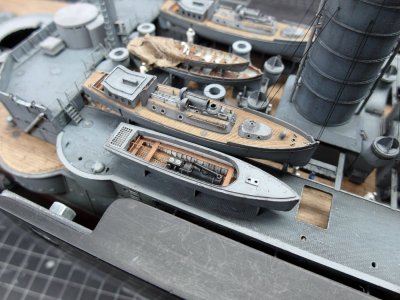
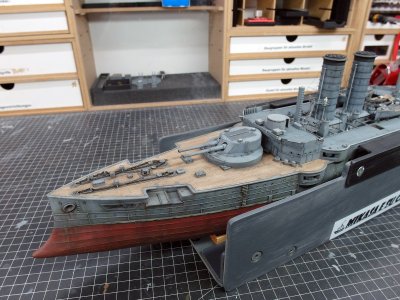
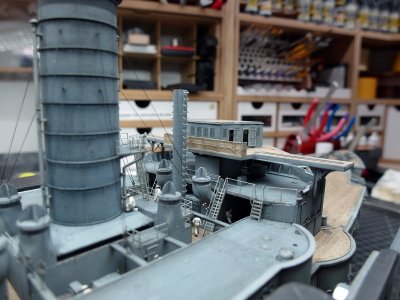
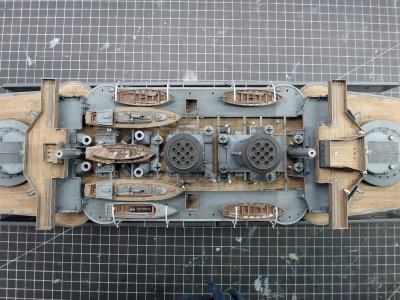
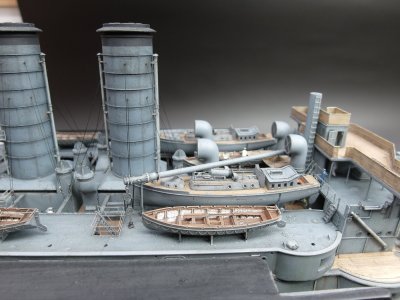
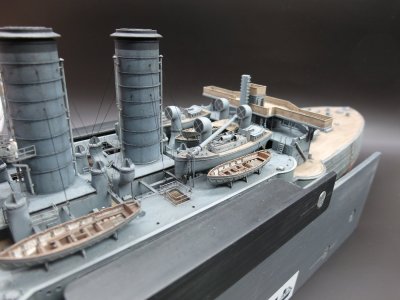
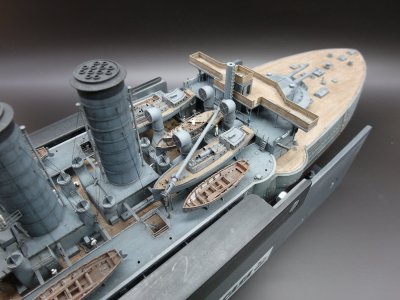
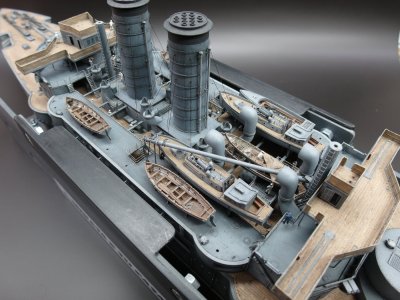
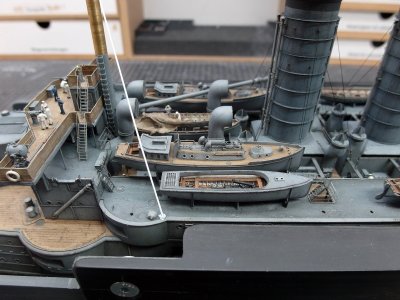
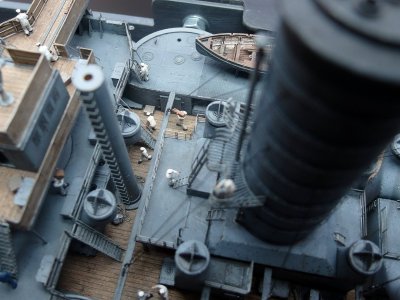
The funnels were already laid and installed, but a few small parts were still missing from the pinnaces, which I intended to add just before the end. Things like the rudder and propeller were easily torn off again.

64a.JPG

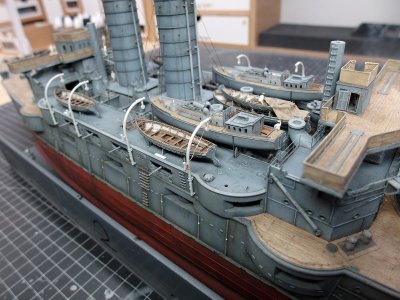
Two more boat hooks scratched on each pinnace and the portholes glazed.

64b.JPG

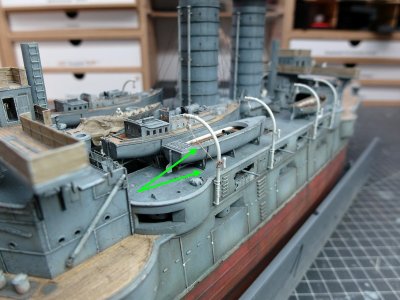
A chain hoist is installed to secure the boats.

64c.JPG

Railings and companionways mounted on the foredeck.

64d.JPG

I need to refinish the deck where the pinnaces rest. During all the adjustments, I scratched the paint surface and had to patch it up. I’ll have to go back to that.

64e.JPG

Slowly life comes into the place.

64f.JPG

A new sailor has also started his service.

64g.JPG

He checks the tension on the pinnace’s chain hoist.

64h.JPG

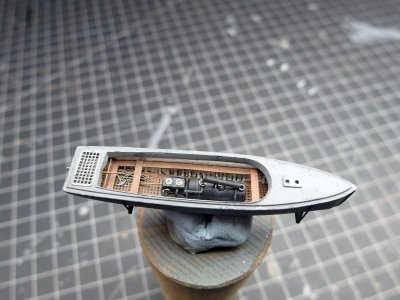
Let’s move on to the next boats: the small steam launch.
I haven’t found a 3D printer for this one, so I emulated it.
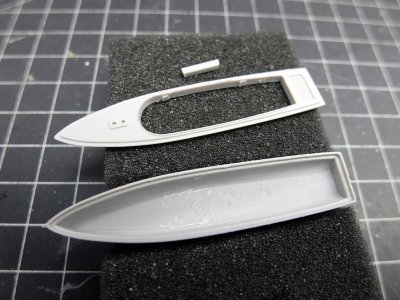
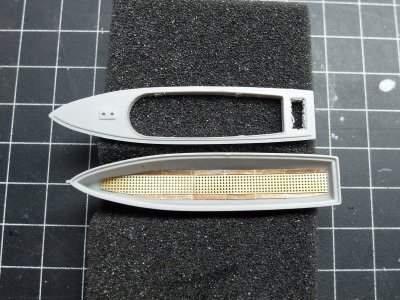
Originally made from the box, the boat really doesn’t look anything like it. First, I removed the rough outline of the engine and the bulky center bar of the upper section.

65.JPG

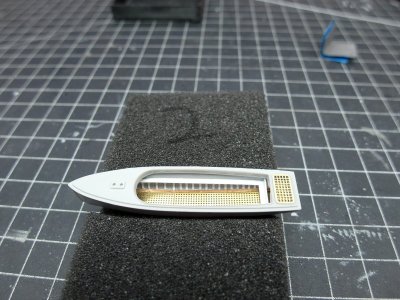
Then I inserted a grating floor. The Bismarck’s former bridge wing was trimmed and fitted. Cheers to the etched parts grab bag. And I removed the suggested grating at the rear.

65a.JPG

Now I made a bench seat and glued in the ribs from profiles. I attached an etched grille from the KA set to the rear.

65c.JPG

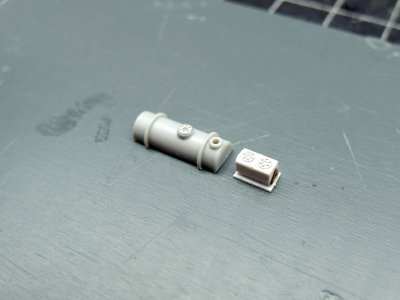
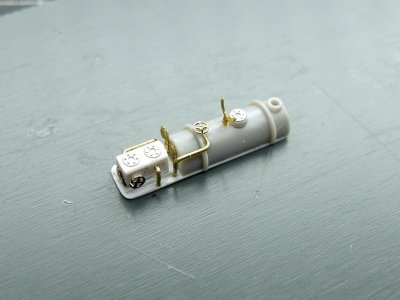
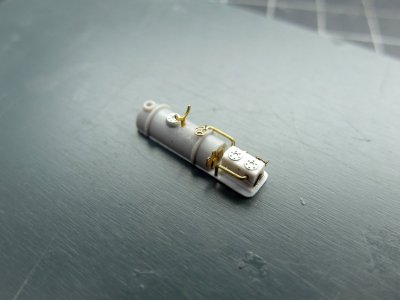
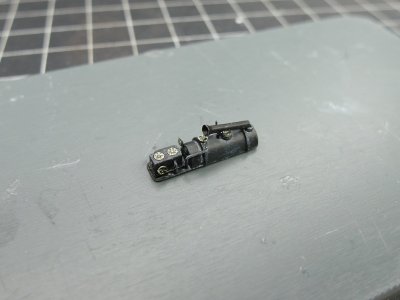
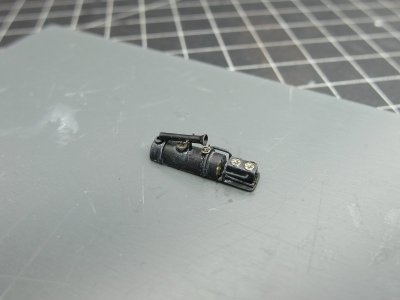
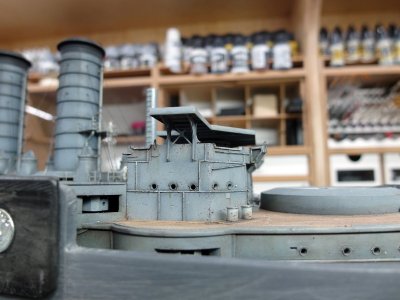
We still need a boiler. It’s also only rudimentarily represented in the original, so there’s room for more. A small profile should represent the engine and its cylinders. A few flanges on top—you can never have enough. :D

65d.JPG

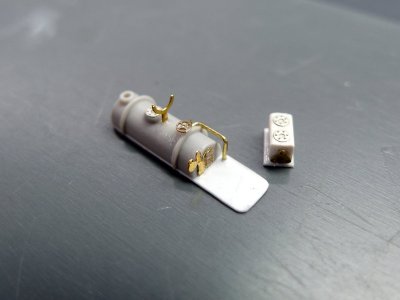
Then, little by little, more details were added: piping, a handwheel, and a support for the tilting funnel. A small instrument panel at the front rounds it all off. Everything is then mounted on a styrene strip for easier handling.

65e.JPG

More piping and a second handwheel. It never hurts.
65f.JPG

And then I am very satisfied with the overall result.

65g.JPG

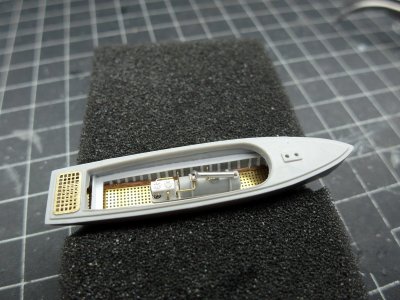
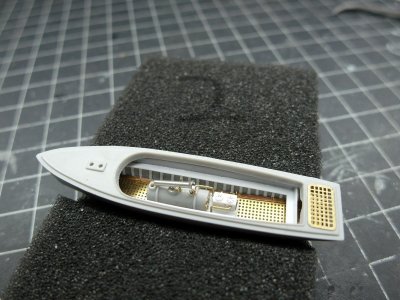
Let’s put the whole thing in the little boat. Let’s put the funnel in for a test.

65h.JPG

Wire end ferrules are really great for small funnel.

65i.JPG

Then make the boiler black.

65l.JPG

I painted the flanges brass-colored to simulate seaworthy bronze. This is how I increase the contrast.

65m.JPG

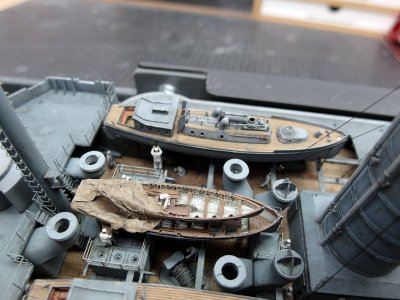
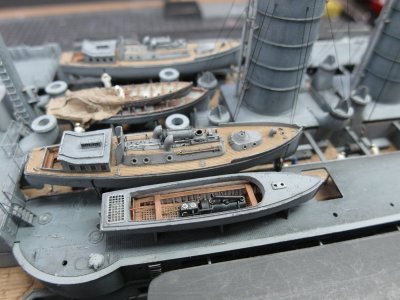
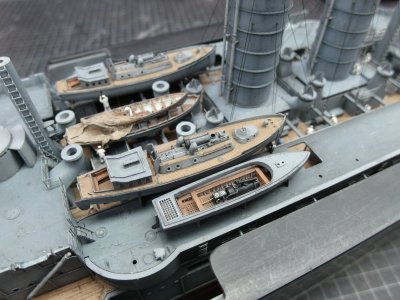
And so the entire machinery arrived in the barge.
Placed on the deck in its cradle for testing.

65n.JPG

The space is very limited and it is damn tight.

65o.JPG

Since the davits are still missing, the barge isn’t secured yet. The chain hoists for lashing it down aren’t attached either.

65p.JPG

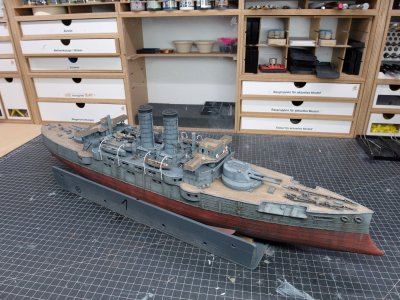
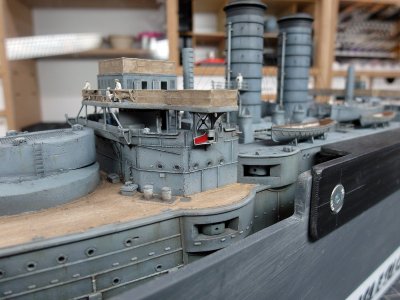
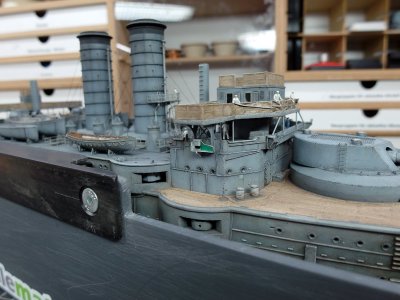
Mikasa's form is slowly taking shape.

65r.JPG
 
Last edited:
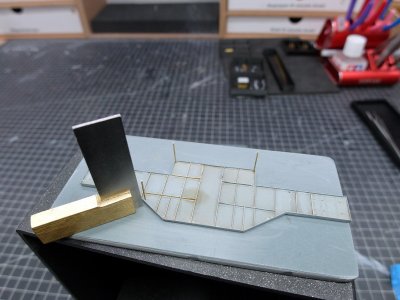
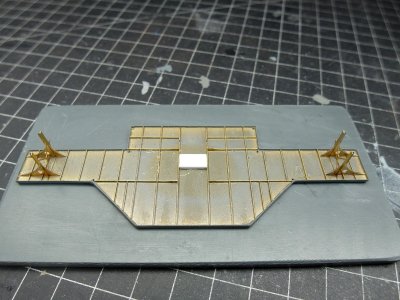
Then I started on the rear bridgewing.
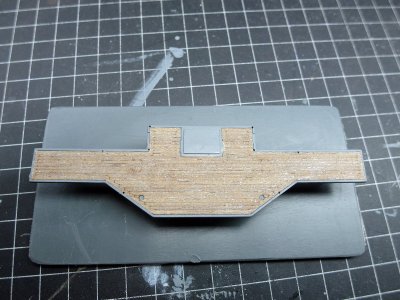
First, I laid the wooden deck while I could still exert pressure on the plastic part.

66.JPG

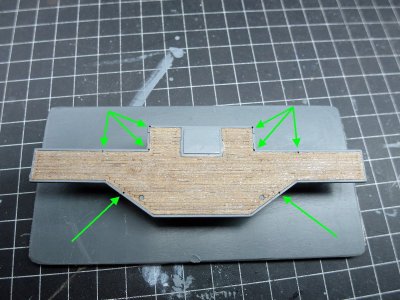
This will stop once the underside has received its large brass component with the gusset plates.

66a.JPG

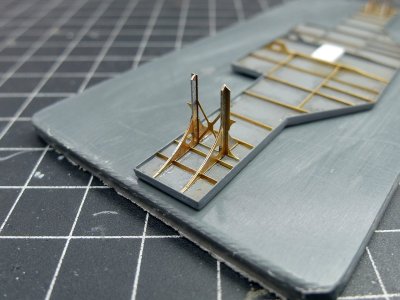
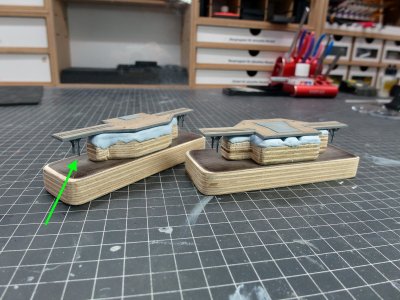
After everything had thoroughly dried, I wanted to attach the posts that support the bridge on the bridge house. They were originally made of plastic, but I immediately rejected that idea. I cut some out of brass to give them more stability.
Attaching them, however, turned out to be a real test of patience.

66b.JPG

After testing the bridge, I realized, no, not like that. It’s completely unstable.
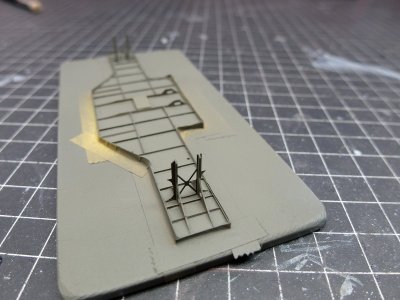
So I’m starting from the back. I drilled holes for the posts so I could push them through from above later.

66b1.JPG

Next, the outer support structure was attached. What a delicate construction phase. But it looks so good.

66c.JPG

After I had completed that satisfactorily, I had to carefully tape everything off to avoid dirtying the wooden deck with the primer.

66d.JPG

The base coat is applied, and then the moment of truth. Does everything fit?!

66e.JPG

Yes, it fits.
66f.JPG

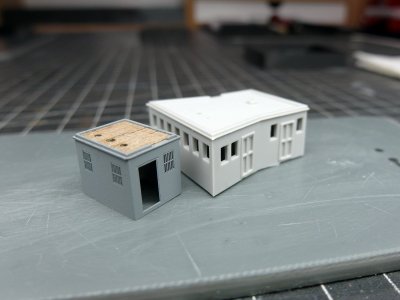
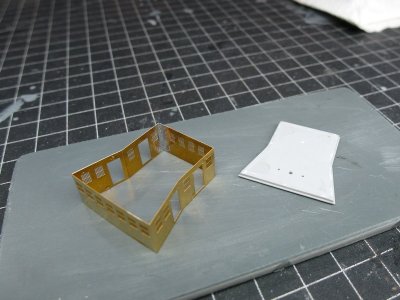
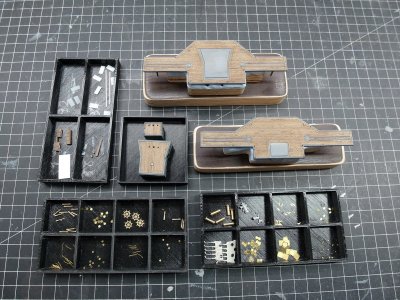
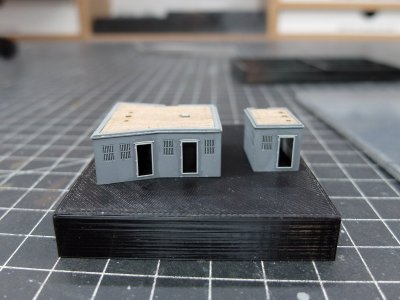
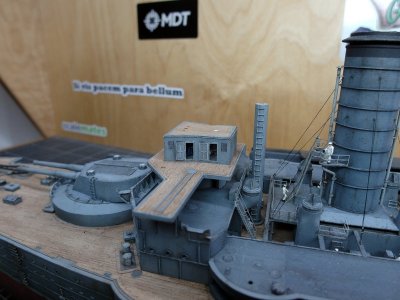
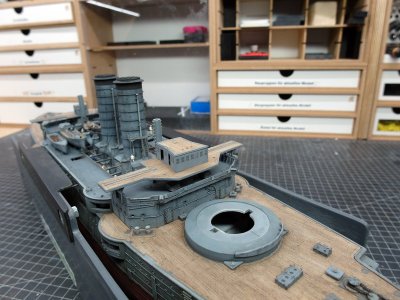
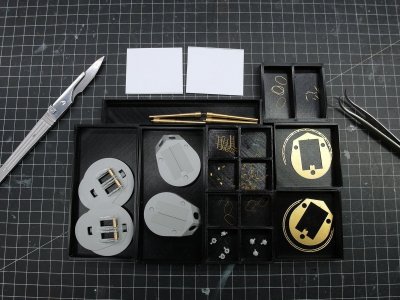
The wheelhouse at the stern is completely soldered. Pontos replaces the walls entirely with thin brass. This makes it possible to leave the doors open without seeing a meter-thick wall. The same applies to the windows. This can be clearly seen here on the original component.
67.JPG

The front wheelhouse has also been soldered and assembled.

67a.JPG

And the deck, too. I added a small styrene profile in the middle. This ensures the deck rests firmly on the armored control station and gives the whole thing stability. You can’t see any of it.

67b.JPG

And also placed on the lower bridge house for testing.

67c.JPG

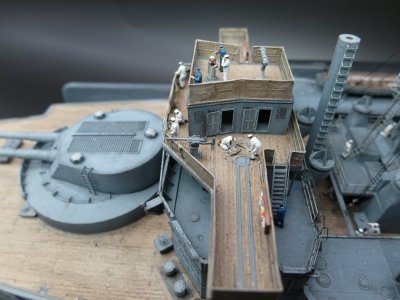
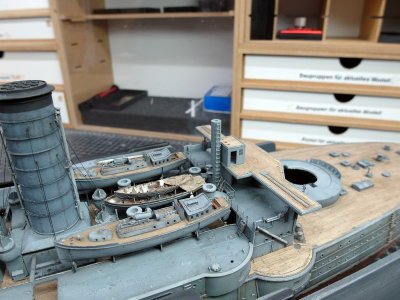
And that’s how the Mikasa got its two upper levels. stern…

67d.JPG

...and towards the bow.

67e.JPG
 
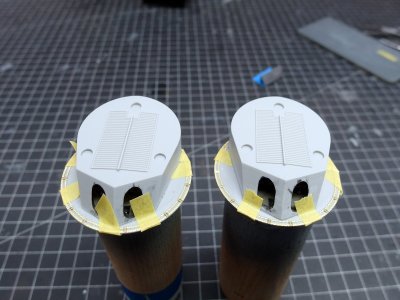
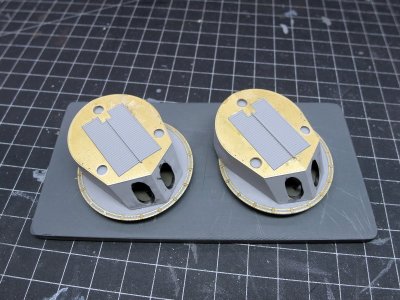
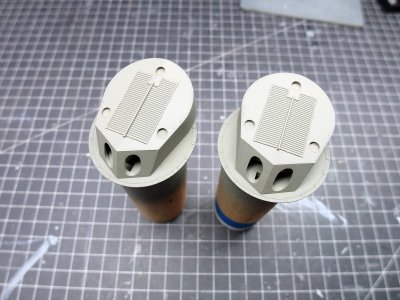
I didn't feel like dealing with small stuff and wanted to make something big, my eyes immediately fell on the large towers.
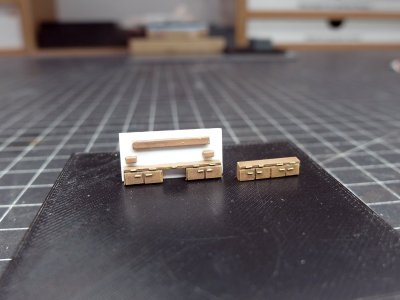
First, I cut out everything and collected it.

68.JPG

The interior was already prepared and only needed to be glued to the hood. Then the brass ring was attached to the base.

68a.JPG

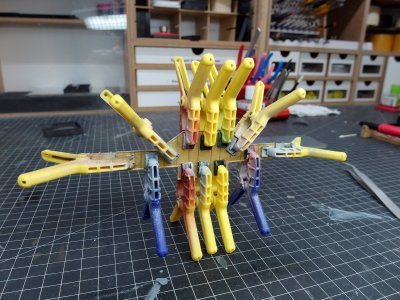
Things got a bit more difficult with the large brass component that goes on the turret lid. But that wasn’t a problem with MIG’s acrylic glue. Of course, unlike with superglue, you have to hold the whole thing in place while it dries.
But that’s no problem.

68b.JPG

Then I primed it, checked for cracks, and closed them.
So far, so good.

68c.JPG

And then came the unexpected setback.
Getting the brass gun barrels into their mounts proved surprisingly difficult. The turret openings were very narrow and in some cases, the primer was peeling off the barrels. Furthermore, the barrels didn’t fit particularly well in their brass mounts and were relatively unstable. I then filled them with a lot of glue.
Thankfully, you won’t notice any of that later.

68d.JPG

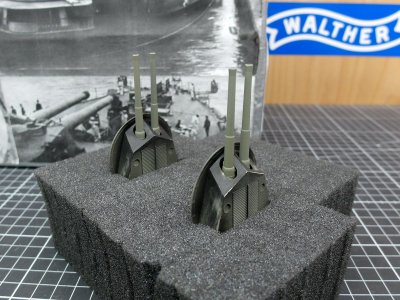
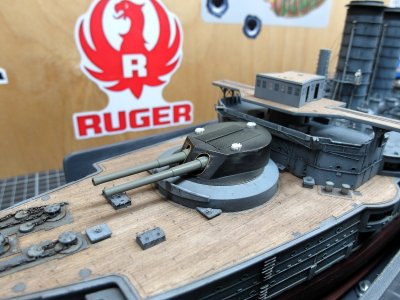
So the turrets are now standing upright, and I'm letting them dry thoroughly before continuing.
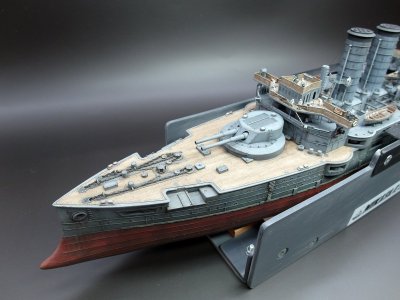
The gun barrels are now firmly mounted, glued, and stable. This doesn't bother me, since I always build the main gun turrets facing the ship's direction of travel anyway.

68e.JPG

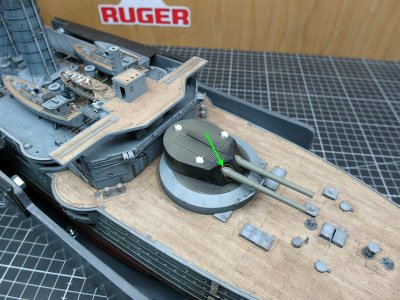
The green arrow shows the defective primer. After painting, you shouldn't notice any of it anymore.

68f.JPG

The primer was smoothed and repaired again in the damaged areas with 1000-grit sandpaper.
Then I cleaned and attached a lot of microscopic parts.
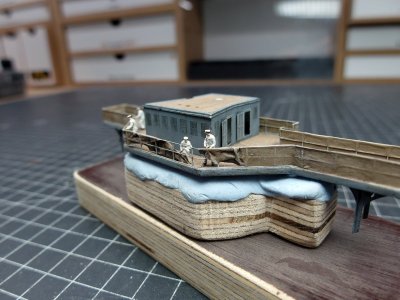
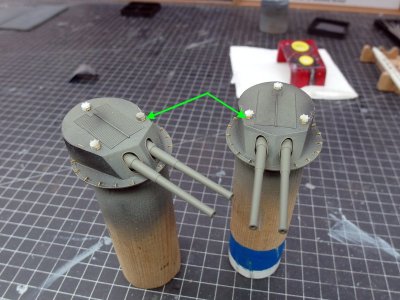
The turrets are made almost entirely from the Pontos kit. Only the armor plates of the small turrets were provided by the KA kit.
See green arrow.

68g.JPG

This allowed the base coat and the wash to be applied. Bow...

70.JPG

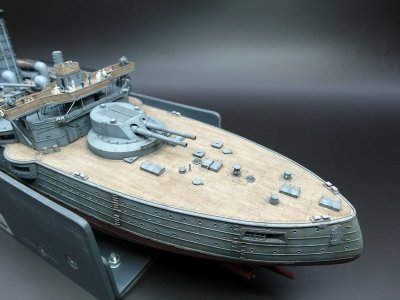
And stern. Into the barbettes. With their wedge shape, they could still win a design award today, I think.

70a.JPG

And towards the rear. Its unusual shape is truly impressive.

70b.JPG

This completes the main armament and I can now focus on the bridge.

70c.JPG

The Mikasa looks so cool from the front.

70d.JPG
 
Thank you so much, Bill, that's too kind. But please continue. :D

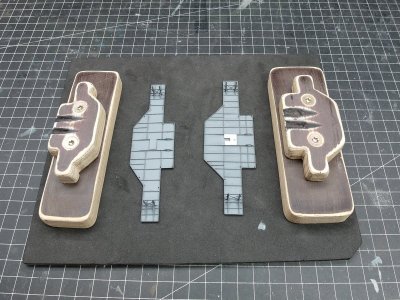
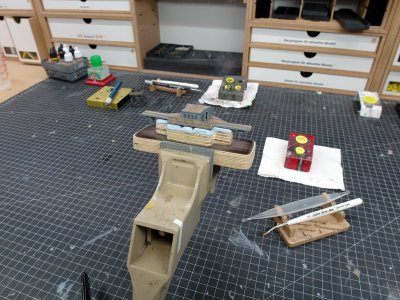
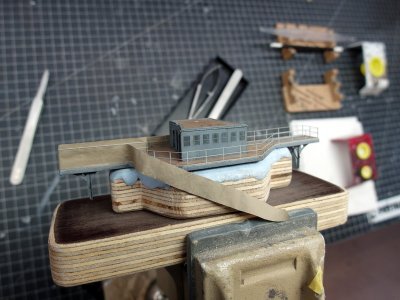
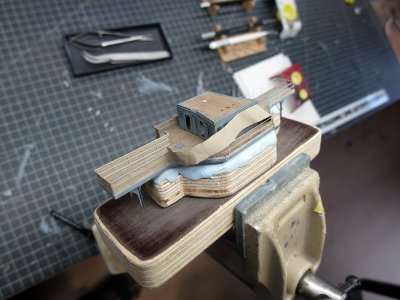
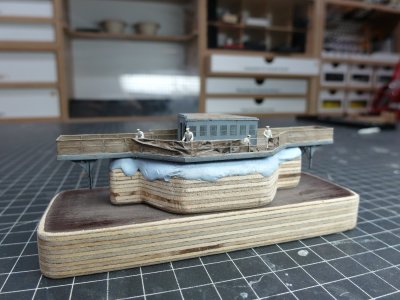
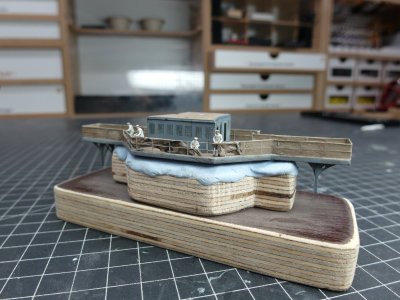
Before I start on the bridge wing and the wheelhouse, I wanted to make a few neat handrails to simplify and make things safer.
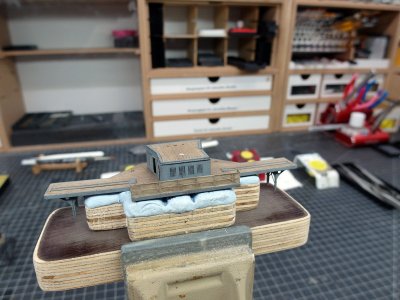
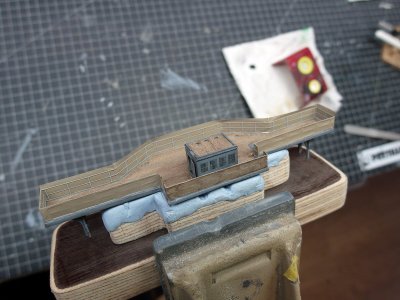
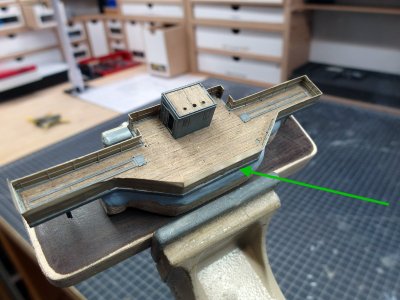
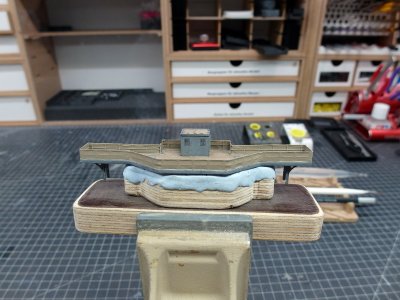
For this, I made small, custom-made handrails out of a multiplex board.

71.JPG

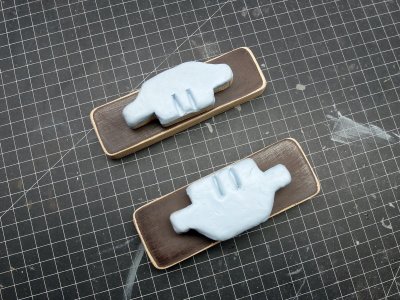
Then cover the surface with BluTack.

71a.JPG

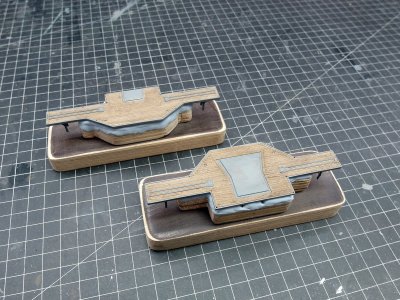
And the two components were placed on top.

71b.JPG

Now I can work on them properly without having to worry about tearing off the outer support struts again.

71c.JPG

I always play it safe whenever possible.
Then, the ingredients for the next construction phase.

72.JPG

First, the door frames were installed. These were painted with a slightly lighter grey to increase the contrast.

72a.JPG

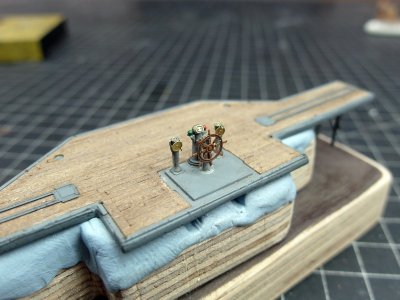
The partition wall and interior fittings for the wheelhouse were then made from styrene.

72b.JPG

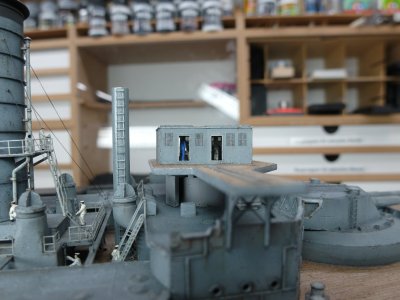
Difficult to capture with the camera, but you can get a sense of the room’s interior. More staff will arrive there later.

72c.jpg

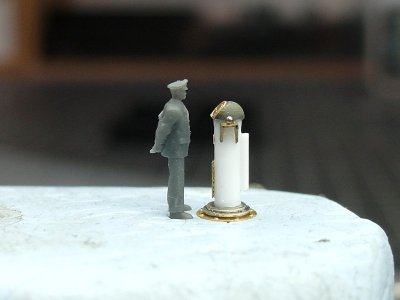
Next, the standing compass was assembled. Then, together with a sailor, I placed the compass on a piece of modeling clay and wondered, were they really that big, or did Trumpeter and KA Models make a slight mistake with the dimensions?

Kompass.JPG

When I placed the huge thing on the small wheelhouse at the stern, I thought to myself, something’s not right.

Kompass9a.JPG

So, I’m starting my compass challenge now. Well, I have plenty of styrene profiles and quickly found the right thickness: 1.5 mm instead of just over 2 mm should be correct. Then I roughly cut them to size to see how they look on a person. Next to it you can already see the attempt to create a foot from the good old scrap box.

Kompass4.JPG

So, I’ve finished my first test compass.

73g.JPG

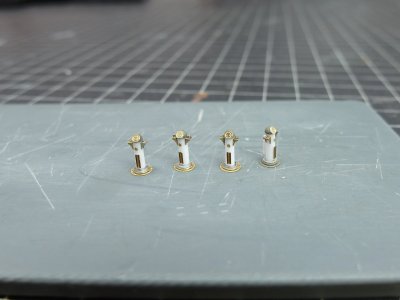
I made four of them.

74.JPG

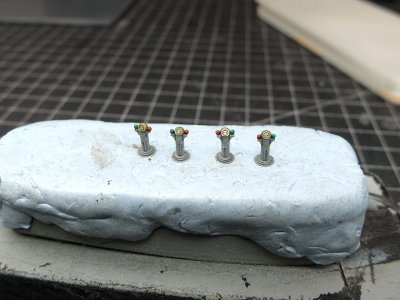
And painted.

74a.JPG

And now a small step further.
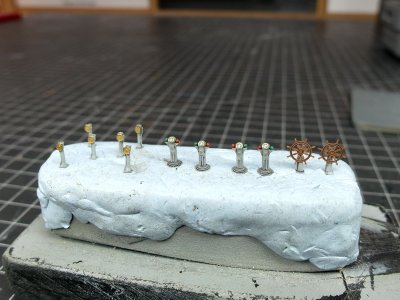
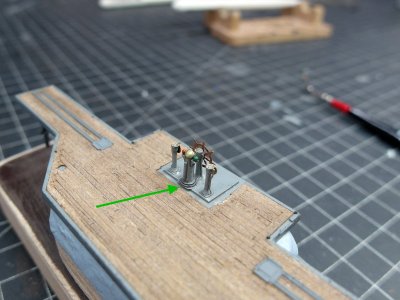
Both steering wheels and the engine telegraphs are finished.

75.JPG

Let’s start with the small wheelhouse towards the stern. It’s quite cramped. The floor is still a bit shiny from the glue, so I touched it up with matte clear varnish.

75a.JPG

I initially wanted to put figures in here, but I decided against it. Otherwise, it would look too cramped.
I also did a little trick with the compass. I cut a piece off the bottom part with a scalpel so I could get it as close as possible to the front wall of the wheelhouse and the steering wheel would fit properly behind it. You can’t see any of it afterward.

75b.JPG

And I even tried placing it on the Mikasa to see how it works.

75c.JPG

You probably know how it is. Making and preparing repetitive parts is often a tedious and boring task. But when it comes to arranging them on the model, it’s like Christmas and Easter all rolled into one. That’s when I really enjoy it.
That’s exactly what happened in the Mikasa’s wheelhouse. I arranged the individual parts as shown in the pictures of the museum ship. Again, I positioned them a little further away from the base of the compass mast to save space.

76.JPG

Officer and sailor on deck and full speed ahead.

76a.JPG

In room two, a sailor I had modified sits in front of the desk. The officer is shouting instructions.

76b.JPG

Let’s put the lid on and see what else is visible of the whole scene.

76c.JPG

It’s very difficult to get a proper exposure with the camera. Because I have to get the lens very close to the wheelhouse, I’m blocking the light from the work lamp.

76d.JPG

However, I think you can see enough to guess what is going on in the room.

76e.JPG

Now all we need are the doors and the Wheelhouses will be finished.

76g.JPG
 
Thank you so much, Jeff, that's so kind.
Then I'll try to add a few more details about the bridge for you.

Now that I’ve mastered the doors, I’m moving straight on to the next section, which I was dreading again.
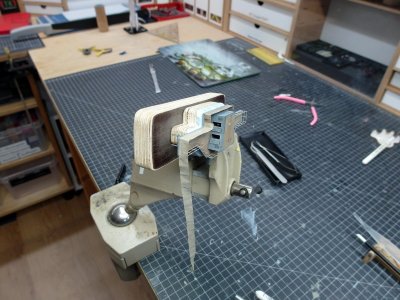
The mere thought of the tarpaulin that attaches to the railing made me break out in a sweat. This is where my homemade handle really comes in handy and calms me down a bit. It securely holds the part in my vise, making it much easier to work on.

77.JPG

I first cut tissue paper to the correct size using my paper cutter and dyed it brown. Then, using a very thin mixture of water and MIG acrylic glue, I applied the paper to the railing.
Shaped and aged, I’m already satisfied with my first attempt.

77a.JPG

Placed on the ship again for testing and it fits.
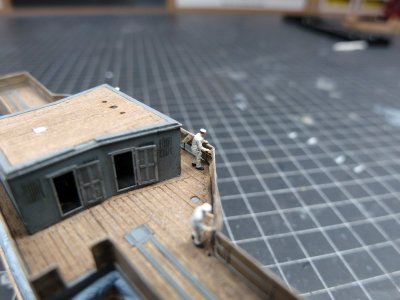
77b.JPG

I am making a long strip of colored tissue paper is placed around the remaining railing of the bridge and cut at the corners.
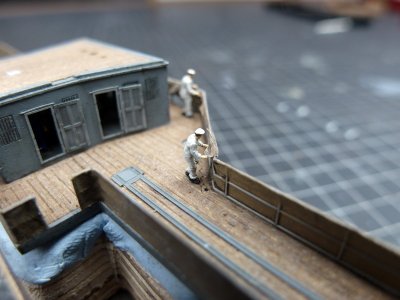
78.JPG

Once the strip has dried, I can fold over the top edge between the cuts and glue it down.
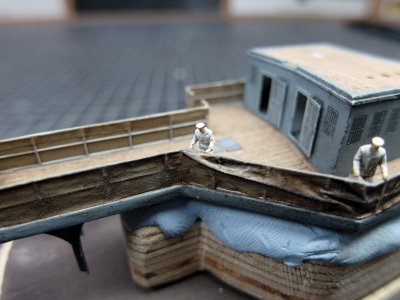
78a.JPG

A small model-making spatula with a ball head helps to neatly shape the tarpaulin against the railing.

78a1.JPG

Then age again and you’re done.

78b.JPG

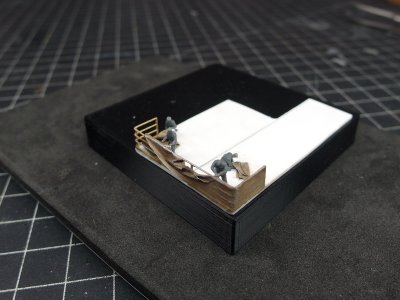
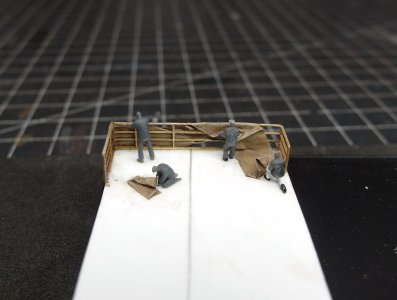
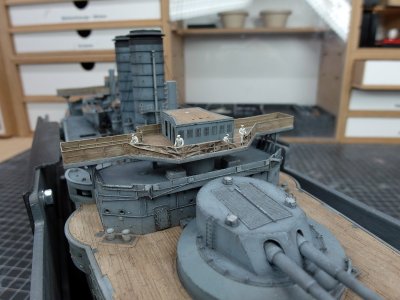
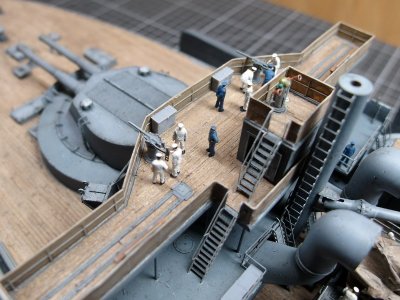
Once that was done, I looked at my work and thought, hmm, how could I make it a little more interesting? Maybe create a little scene where the crew is attaching the tarpaulin to the railing?

78d.JPG

So I started this test run…

78e.JPG

…with styrene, an old railing and a few sailors.

78f.JPG

So far so good.

78g.JPG

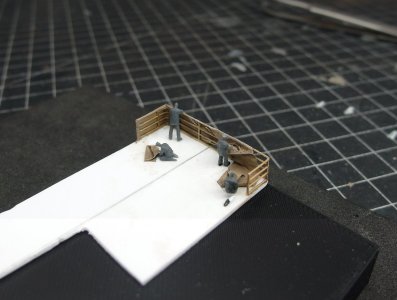
So, let’s create a scene facing the bow.First, cut the paper to size again and attach it to the railing with glue.

79.JPG

I then attach it up to just before the point where I want to drive it in.

79a.JPG

Cut the corners and fold the top edge over lengthwise, then glue it down. This makes the whole thing quite stable and durable, even though I’m still struggling with the wrinkles.

79b.JPG

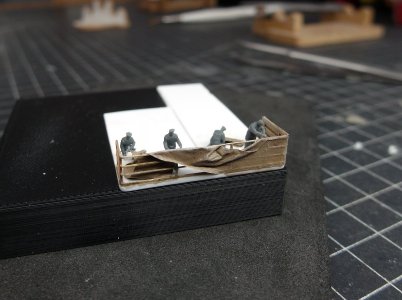
After aging the figures, I incorporated the shadows and highlights into the folds of the garment and set up the scene.

80.JPG

It was important to me that the figures looked as if they were actually working with the tarpaulin. That's why I shaped the crouching sailor's figure so that it would fit over his knee.

80a.JPG

I’m trying to get the sailors to interact with each other on stage. I think I hear the two on the right quietly saying, “Hey, how do you tie that tarp again?”

80b.JPG

It was also important to me to create reasonable points of contact between the boys and the tarpaulin.

80c.JPG

It should look as if they are pulling on the tarp to get it into the right position.

80d.JPG

So that people will believe they are in the process of attaching the tarpaulin to the railing.

80e.JPG

And last but not least, it was played on the Mikasa.

80f.JPG
 
Last edited:
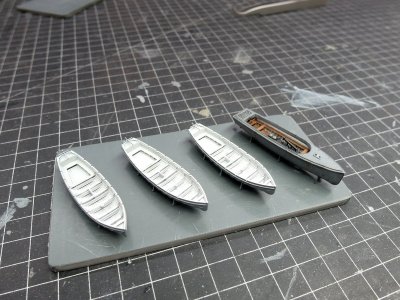
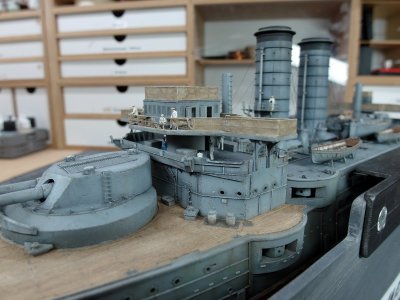
Since the bridge is roughly finished, I wanted to continue working amidships before attaching it to the Mikasa.
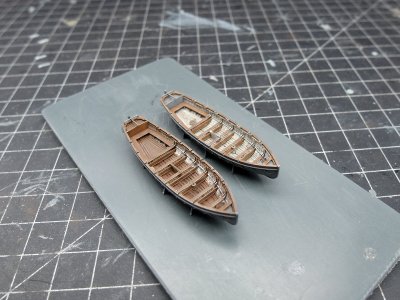
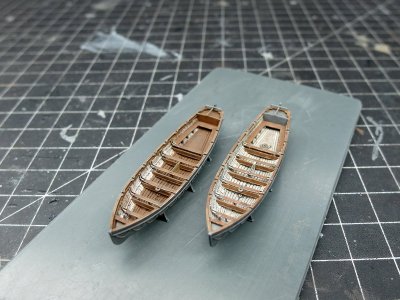
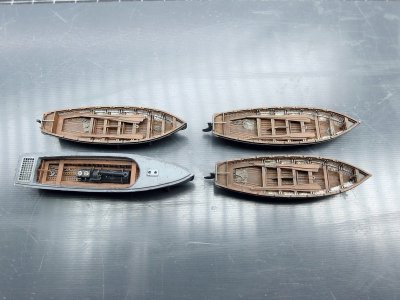
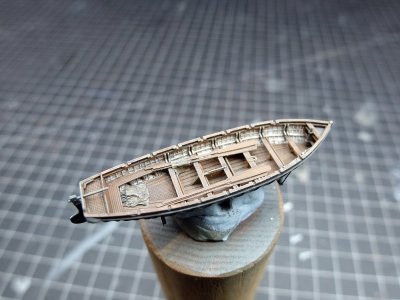
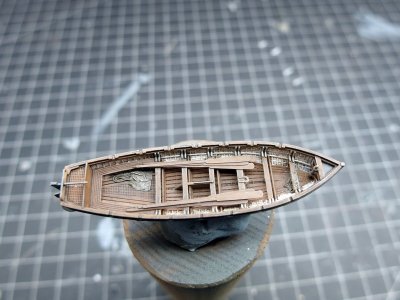
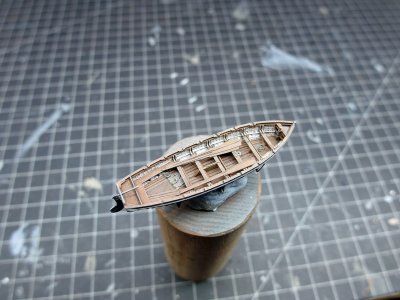
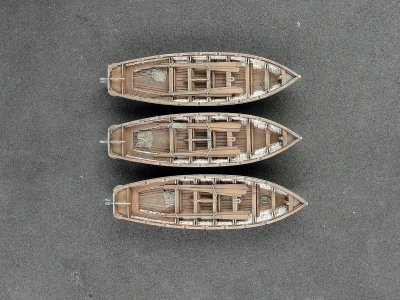
So I turned my attention to the three missing lifeboats. With Micro Master truly first-class 3D prints.

81c.JPG

I was thinking about the 32-foot cutter and its color scheme. I know that the inside surfaces were painted white, but what color are the planks on the floor? I tried both options on the boats.

81i.JPG

It didn’t seem right to me that the tidy Japanese would soil the white floorboards with their feet. The floor would get dirty very quickly. So I painted the floor in wood tones. I think it looks much better now.

81j.JPG

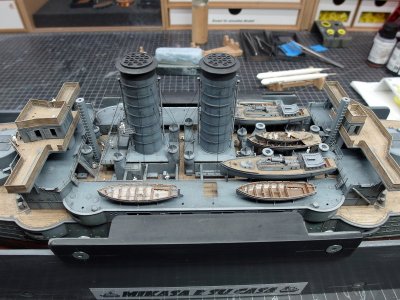
And placed on the deck. Yes, brown is better.

81k.JPG

So we'll make them brown.

83.JPG

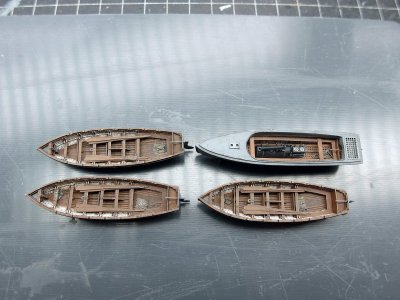
The oars have been distributed among the cutters.
83a.JPG

Here are the details again.

83b.JPG

I’ve distributed some more ropes.

83c.JPG

And I packed a little bit of tarpaulin into the boats. That’s how I tried to make them a little more varied.

83d.JPG

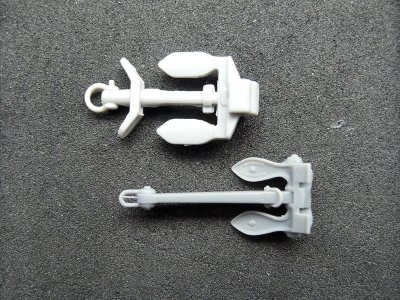
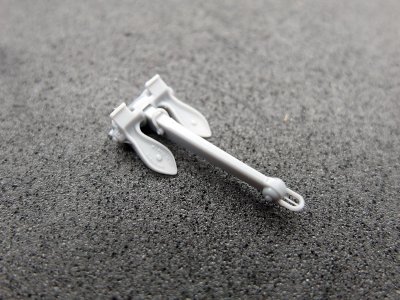
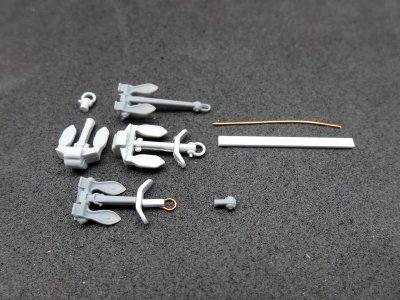
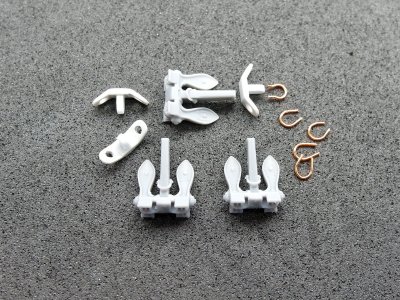
The barge has also been given a small anchor.

83e.JPG

I have a small addendum regarding the cutters. It didn't seem right to me to leave the oars unsecured in the boat.
So I secured them with a rope to prevent them from slipping.

83h.JPG

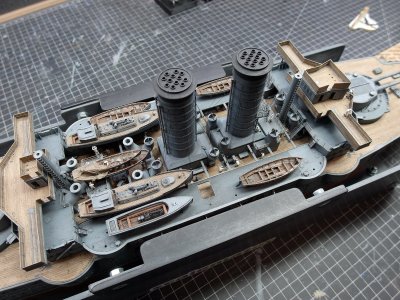
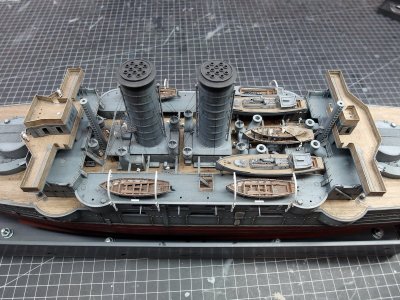
And this is what it looks like now on the Mikasa.

83i.JPG

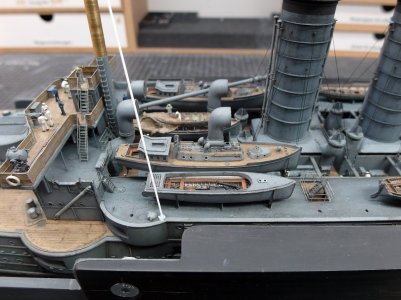
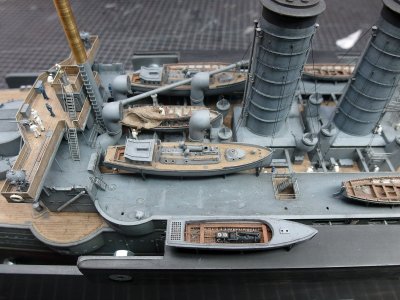
I’ve slightly opened up my assembly jig again to determine the positions of the launch and cutter.
To do this, I removed the davits from their injection-molded frames and inserted them into the designated holes. Then, using a small strip of styrene profile, I positioned the boats at the same distance from the outer edge of the hull.

84.JPG

So far, it’s looking pretty good. It’s definitely a tight fit, but I can get all the little boats in place. Before I secure them, though, I’ll make sure everything is perfectly aligned.

84a.JPG

I simulated the rope of the pulley system with a wire, and it fit quite well on the cutters.

84b.JPG

However, this doesn’t work with the barge. The arrow shows where the rope hits the stop and the barge has shifted backward. Here I need to raise the davits or modify the pulley system.

84c.JPG

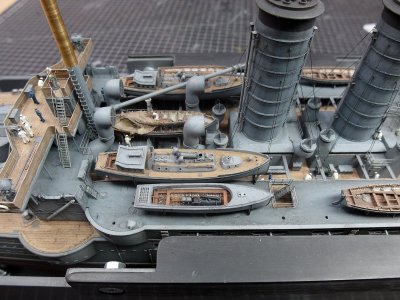
And so the ship continues to take shape.

84d.JPG
 
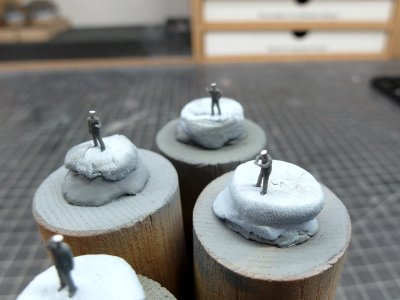
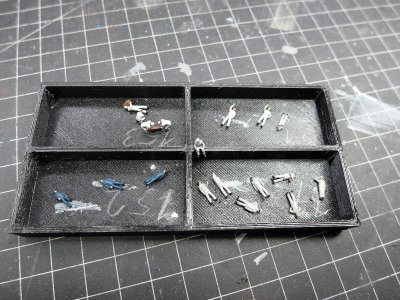
I used my time to recruit even more crew.
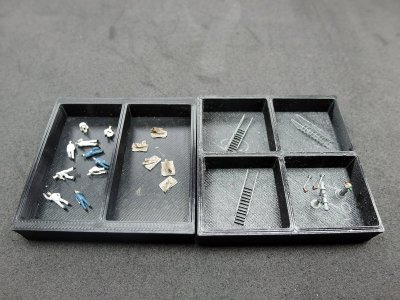
They’re actually members of the German Navy. But as soon as they received a nice new styrene flat cap, they started speaking Japanese.
So I’m further increasing the number of available figures.

85.JPG

Everyone dressed up and ready to board the ship.

85a.JPG

I remembered the words of an user from a German forum, who spoke of group formation, and I hope I’ve implemented it adequately. With a group of sailors talking amongst themselves.

85b.JPG

What could the boys possibly be chatting about as soon as the officer turned his back on them?!

85c.JPG

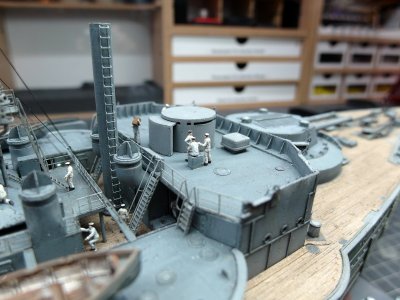
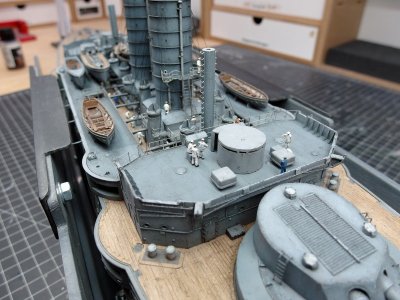
Something needs to be repaired on the fan cover, and a sailor is bringing more equipment to the storage lockers.

85d.JPG

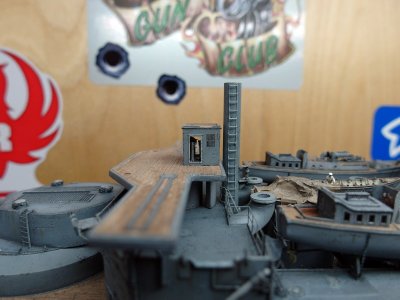
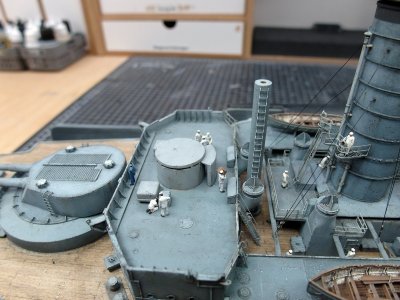
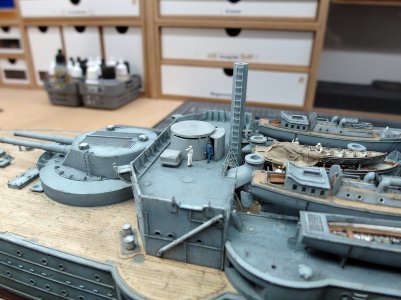
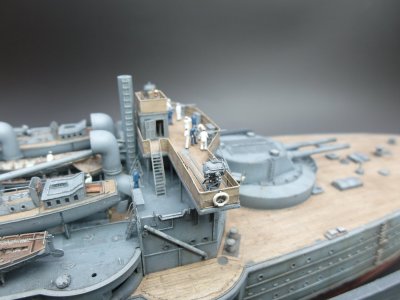
An officer steps out of the armored command post and the sailor gives a brisk salute.

85e.JPG

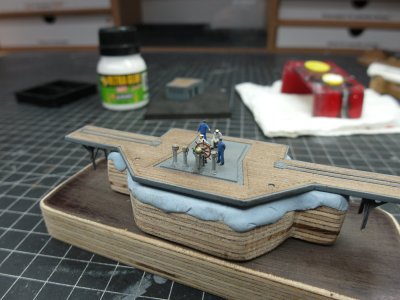
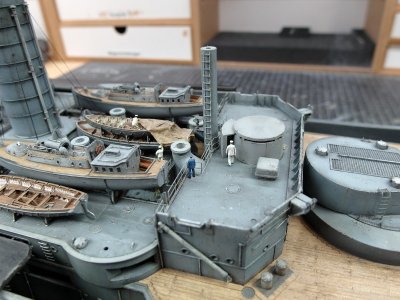
At the stern, a sailor goes into the control station, and an officer keeps an eye on the boys working in the pinnace.

85f.JPG

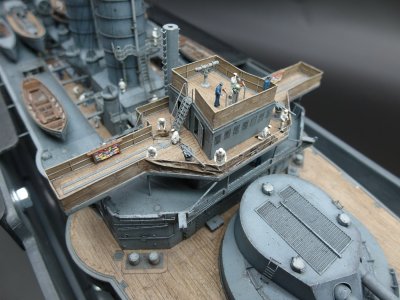
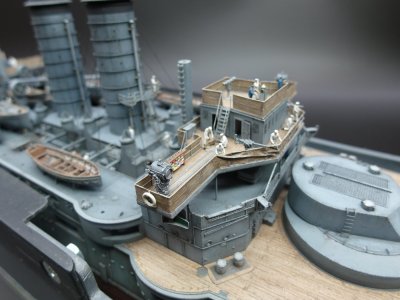
I’ve already distributed the figures on the lower deckhouse, so now the upper bridge with the cams can finally be installed.

85g.JPG

I would have difficulty reaching those spots afterwards, so that’s how I did it before.

85h.JPG

Even these figures are barely visible afterwards, but again they give the model depth and a touch of life. The good thing is that I could easily use the DKM sailors with their incorrect clothing.

85i.JPG

Next came another tricky task. You might recall that I wanted to proceed differently than planned when attaching the bridge piers to the bridge deck. First, I glued the bridge securely in place and let it dry thoroughly for a day. Then I pushed the piers through the prepared holes.

86.JPG

The profiles at the top were cut to size, and that was it. A little brown paint, and you can’t see them anymore.
Then I attached the support pillars at the front. That was a bit tricky, to be honest, but it worked. Thanks in part to my assembly stand, which allowed me to lay the model on its side again and made the job much easier.

86a.JPG

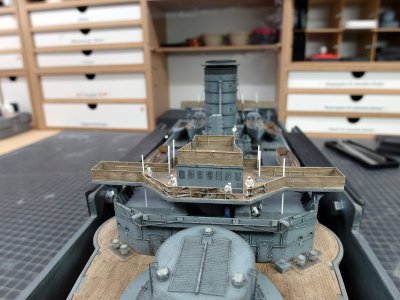
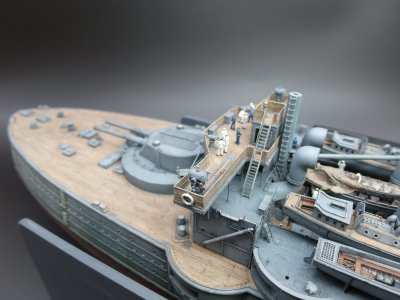
And so the bridge and its supports are now in place.

86b.JPG

It wasn’t easy to align all the support pillars perfectly straight and parallel to each other.

86c.JPG

I really like working with the team below me.

86d.JPG

The posts still need to be aged.

86e.JPG

I completed a small but exquisite detail.
But first, the forward bridge building was still missing some colored lights—the navigation lights.
Port...

87.JPG

And starboard…

87a.JPG

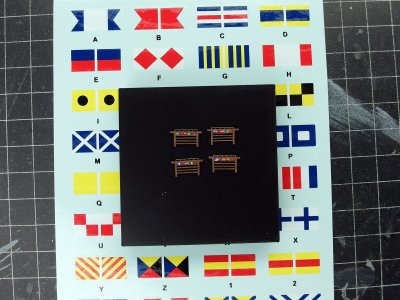
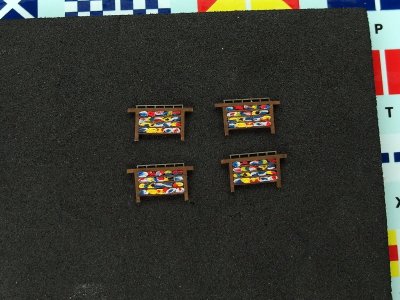
Then I started building my own shelves to hold the signal flags. First, I cut many profiles to the correct size.

87b.JPG

Painstakingly glued together and painted brown. I folded long strips of tissue paper using an accordion-like technique, colored the ends, and then cut them off. That’s how each letter was created.

87c.JPG

Here you can see A to E.

87d.JPG

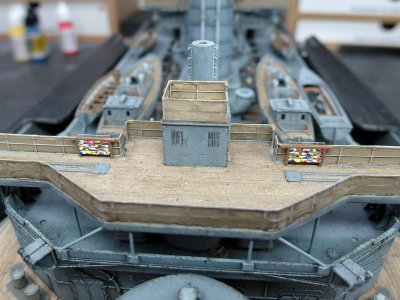
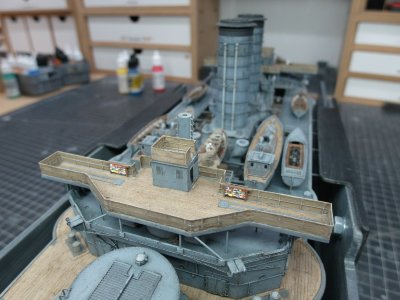
I couldn’t get more than five in a row, so in the end there are only 20 letters on the shelf. Please forgive me. ;)

87e.JPG

Then I set it up on the object of my desire to test it out and let it work. I really like it.

87f.JPG

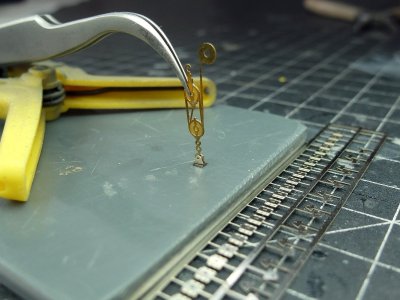
I also added attachment points for the ropes. I made these from halved photo-etched ladder.

87g.JPG
 
Last edited:
Next, I tackled the crane boom and the wind vents.
I’m actually installing the crane boom very early on, for two reasons.
First, this allows me to finish the work on the amidships deck, and second, I want to put the upper part of the masts in place as late as possible. On the Mikasa, they are much taller and more delicate than on the Bismarck, making the model quite unwieldy.
And so I got started.
First, I created a mounting for the pulley on the boat deck. This consisted of two deck eyes and a base plate. The nice thing about this was that it gave me a little more leeway when aligning the crane boom. The hook could be moved up and down a bit in the bracket, which simplified things.

88.JPG

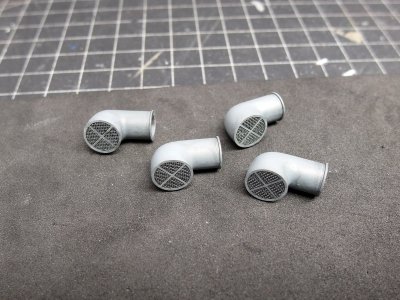
Then I assembled the missing wind vents.

88a.JPG

And without further ado, let’s get all that stuff onto the model.

88b.JPG

The crane boom is placed on a support.

88c.JPG

And the pulley system can be conveniently parked on the deck.

88d.JPG

It’s a damn tight fit, but it works.

88e.JPG

And here’s the material for the next step.

89.JPG

Curtain up:

90e.JPG

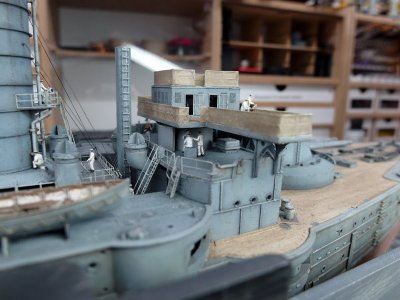
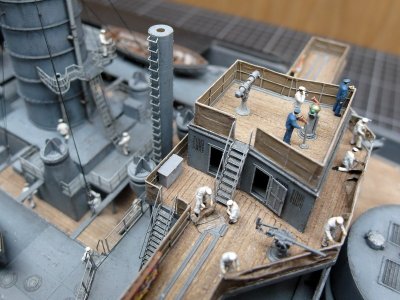
The crew folds up the excess tarpaulins for storage. An officer supervises the work from above.

90f.JPG

Finally, my compass, into which I had put so much work, could also be placed on the model.

90j.JPG

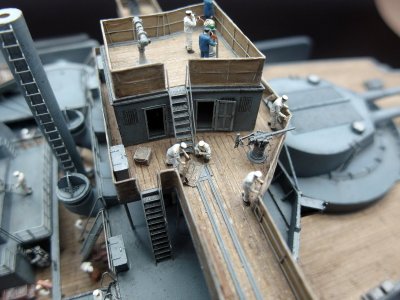
And the first Hotchkiss were also allowed to take their places.

90g.JPG

The crew is being trained on the cannons, under the strict supervision of the officers.

90h.JPG

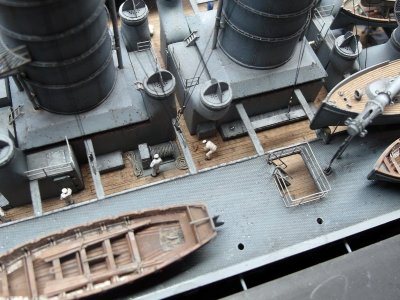
That means I’ve now finished everything amidships. As always, following my crafting maxim, I’m working from the inside out.

90i.JPG
 
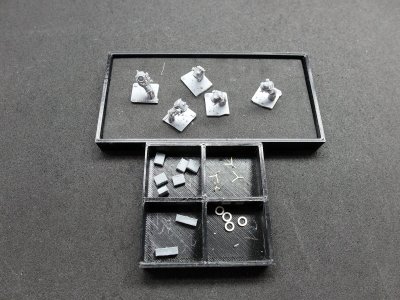
Now on to the next 3D printed items: the searchlights.
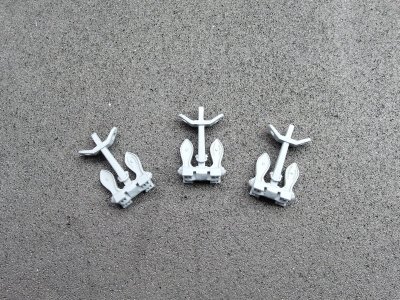
Neither Pontos nor KA-Models impressed me here. The Pontos searchlights were okay, but the KA-Models ones were a disaster. They were so small that they weren’t visible over the railing. They would only have been useful if you’d lost your keys in the dark on the bridge wing and needed to search for them. :D
Then there were also ammunition boxes and lifebuoys.

91d.JPG

And here Micro Master once again demonstrates its strength in printing details. The searchlights are amazing.

91e.JPG

The only difficult part is cutting them out of the print support without destroying the fine, delicate details.

91f.JPG

You even have to look very closely to avoid mistakenly detaching something that you think is a support but is actually a small lever or something similar.

91g.JPG

I then simply painted the lenses with Vallejo’s Metal Color paint in silver.

91h.JPG

The boxes I set up are somewhat overshadowed by my fascination with the spotlights. But let me tell you, they’ve ended up where they were supposed to be.

91i.JPG

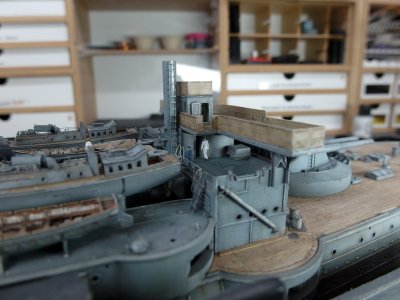
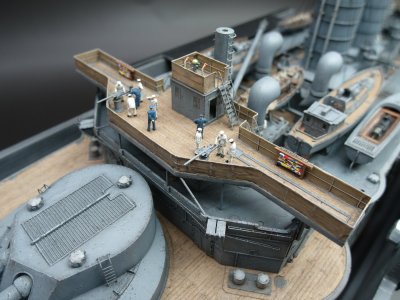
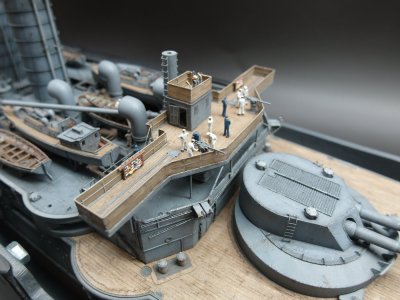
The bridge and wing are almost finished. All that’s missing is the scene with the raising of the signal flags.
For that, however, I need a mast. :rolleyes:

91j.JPG

And I’ll only attach the semaphores at the very end. They would just get in the way when I’m rigging the signal lines. It shouldn’t be a problem to secure them later with a drop of glue.
And therefore, the bridge wing is finished..

91k.JPG

What can I say? There's news from the shepherd shipyard, but unfortunately, no progress.
Now comes the time when model-building steps I've completed interlock with new ones. And since I've mixed many things together, be it the two detail sets from Pontos and Ka-Models or the printed parts from Micro Master, you can now see what fits and what doesn't.
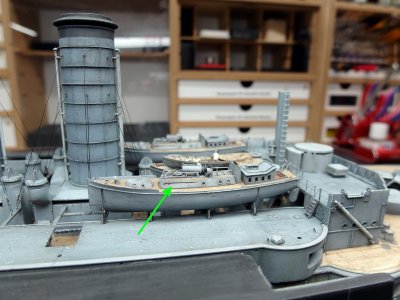
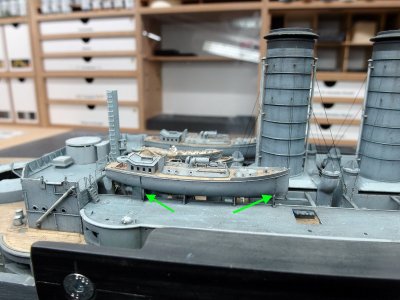
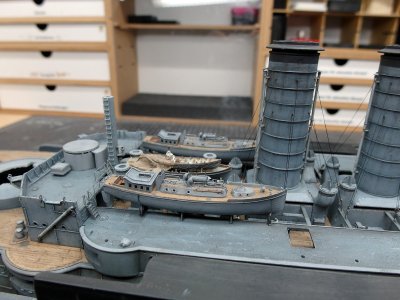
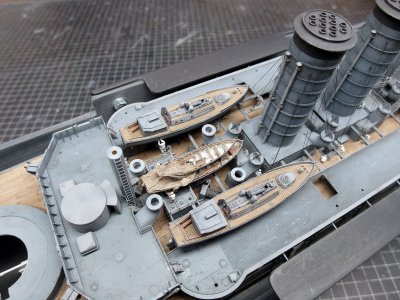
In this case, it's about the guy wires for the masts. I checked them at their attachment points because I had a strange feeling about them. I attached the middle section of the masts as a test and simulated the guy wires with thin styrene rods. Unfortunately, I had to find that my feeling was right. The small steam launch is too far back and is in the way.

92.JPG

Oh dear, what to do?
First, I tried to relocate the anchor points for the ropes. But that didn't work; there simply wasn't enough space, and it wouldn't have been right anyway. The old photos of the Mikasa clearly show that the backstays were attached exactly where the deck eyes are now. So, the only option left was to reposition the launch.
So, carefully, I took it down. I'm so glad I only use superglue very rarely now. The acrylic adhesive really has good strength but is much easier to remove. I carefully loosened the cradles with a scalpel and removed them without breaking anything. A little paint was lost, but it can easily be touched up.

92a.JPG

Then, as a test, the barge was moved forward.

92b.JPG

And lo and behold, now the guy lines are working again. All the other cutters can stay where they are; I have no problems with their guy lines.

92c.JPG

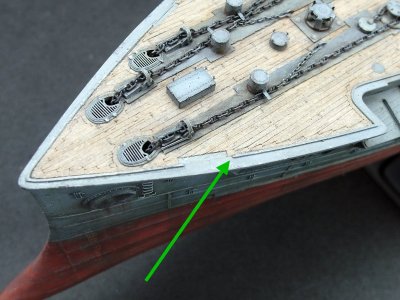
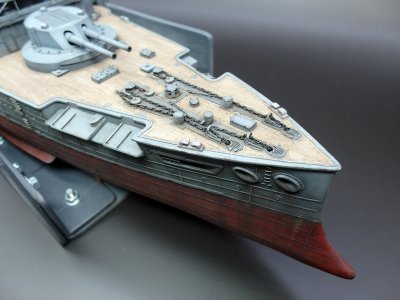
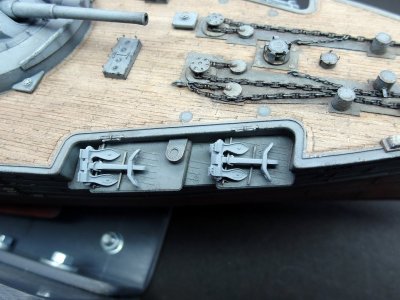
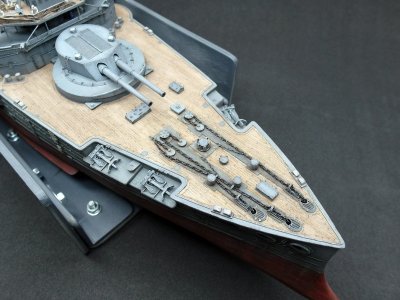
And once again, I’ve made a little more progress. Next, I tackled the bow fairleads. These are used to guide ropes over the hull, for example, for mooring lines. Here, too, some rework was necessary, as Pontos wasn’t entirely clean with the cutouts for them in the wooden deck. Almost all of them were affected.

91.JPG

Using a scalpel, I cut away the section where the wooden decking protruded and reinserted it on the other side. The wooden decking is quite forgiving in this respect, and you won’t see any trace of it in the end.

91a.JPG

Now the fairleads fit seamlessly into the recesses of the model.

91b.JPG

This closes another gap in the truest sense of the word.

91c.JPG

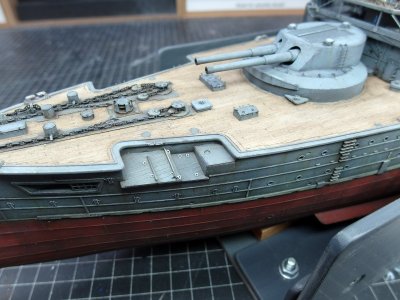
I took care of the main deck amidships one last time.
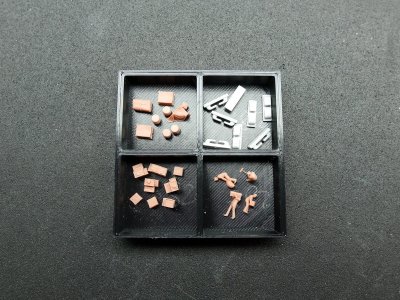
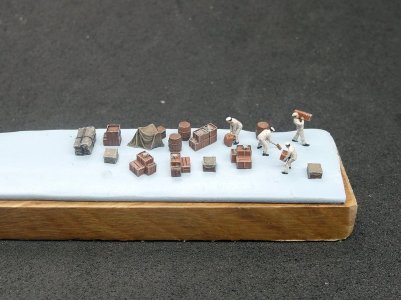
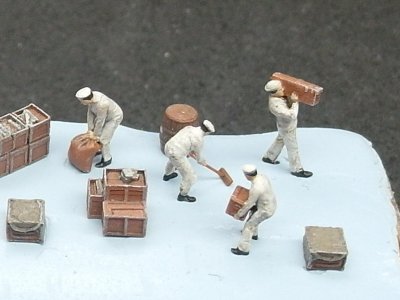
I found a new manufacturer for 3D printed parts and got in touch with the owner. We had a very pleasant and productive exchange of ideas, and now he's selling crates and cargo in my scale.
These are primarily intended for a harbor diorama, but there are enough individual crates and barrels to populate my model. He also offers figures.
And so I've put together a small selection.

93.JPG

Painted and aged, they make a very good impression.

93a.JPG

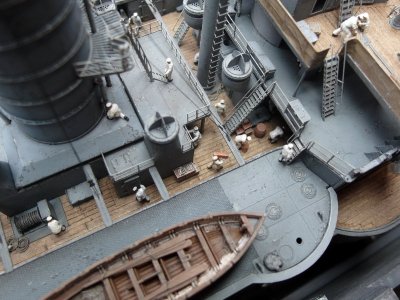
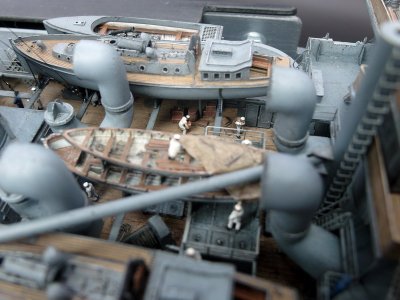
So, let's get it onto the ship. We still need to stock up on provisions.

93b.JPG

You can still see quite a bit from the port side as well.

93c.JPG

It took me several attempts to get the crates and barrels photographed under the pinnace. But I think I've added some depth to the model.

93d.JPG

The bridge also received a box in which the tarpaulin is stored.

93e.JPG

And someone has to sweep up the mess....

93f.JPG
 
Absolutely amazing work. Love the huge amount of detail and paint work quality you have put into this project. All the crew members with the variety of jobs they are completing simply brings the model to life.

Jim
 
Back
Top