• Win a Free Custom Engraved Brass Coin!!!
    As a way to introduce our brass coins to the community, we will raffle off a free coin during the month of August. Follow link ABOVE for instructions for entering.
  • SUBSCRIBE TO SHIPS IN SCALE TODAY!

    The beloved Ships in Scale Magazine is back and charting a new course for 2026!
    Discover new skills, new techniques, and new inspirations in every issue.

    NOTE THAT OUR NEXT ISSUE WILL BE MARCH/APRIL 2026

Juan Sebastian Elcano / The Moshulu Build Log

I have a strong feeling that the kit designers are always trolling us :D to accept the obvious mistakes or do a part of the build on our own. It is not a scratch build, of course, but makes us to do something, except assembling & painting.
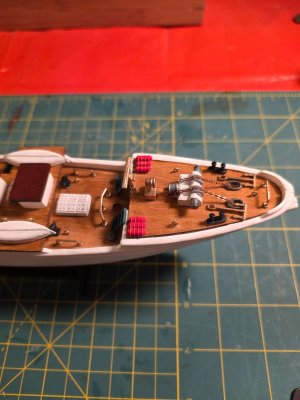
Boatman - I'm with you. Building this kit as described on the video instructions would result in a mostly white build. I totally went off script and used my own color scheme just to make the model more visually interesting and to be able to tell each component from the others. It is more work, but otherwise, the cleats, bollards, capstan, stairs, rails and other parts would all be white and hard to tell apart.
 
Real ships work in a harsh environment. Kit sellers’ attempts to glamorize them do not represent reality. For example brass is restricted to a few areas; the bridge equipment, the ship’s bell, and perhaps the quarterdeck to impress visitors. Brass anchor chains, hatch ringbolts, and any other fitting subject to loading would not be made from brass. It’s not strong enough.

Roger
 
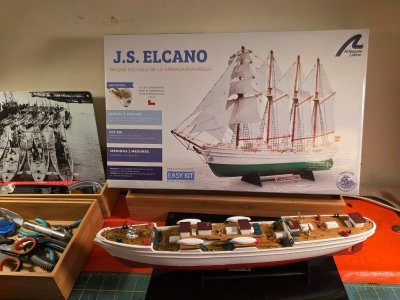
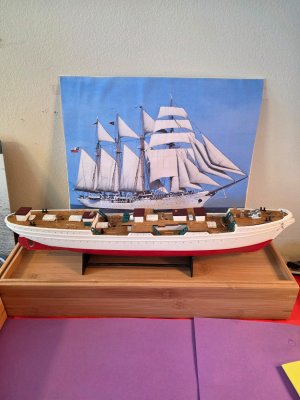
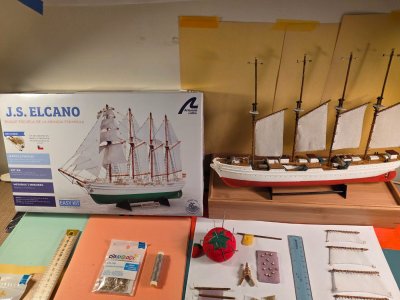
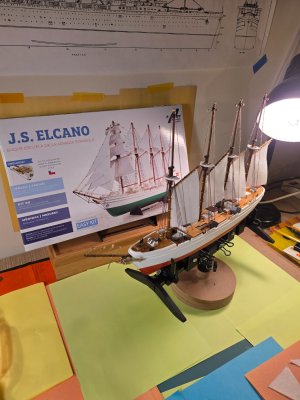
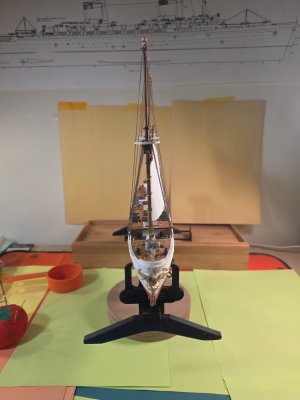
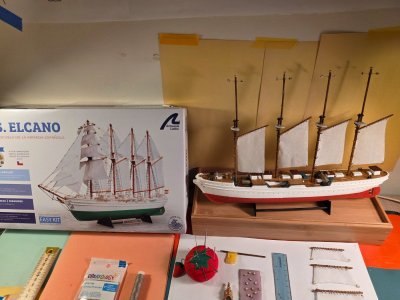
9. Getting back in to the build log for the Juan Sebastian de Elcano after doing a few other small projects. Time to start planning how to rig the ship which for me will my first time doing "realistic" rigging, considering that this kit is considered an Easy Skill Level 1 and the rigging is very basic.

I have never rigged a model ship before...at least not using different strings and blocks & tackles. This kit has very rudimentary DIY blocks and tackles, which I may replace with upmarket versions from Model Expo.

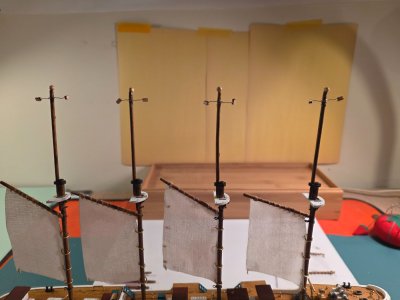
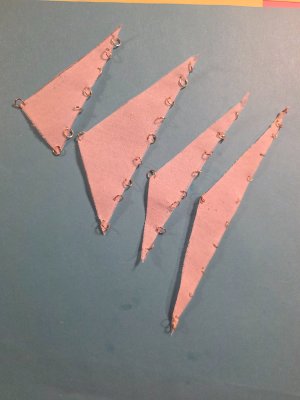
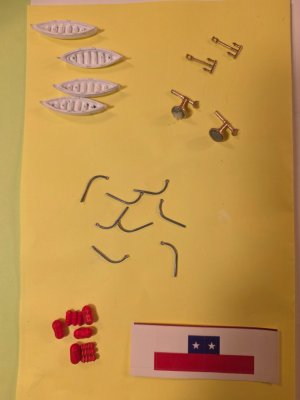
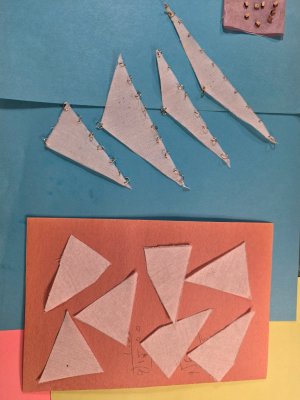
I'll see how far I get on assembling the jiggermasts, which need to be done before the mainmast and the bowsprit. Then sewing the eye hooks to the jibs, attaching the davits for the life boats, and sewing my first ever shrouds from scratch coming up.

*****

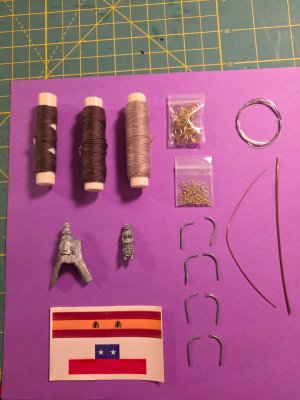
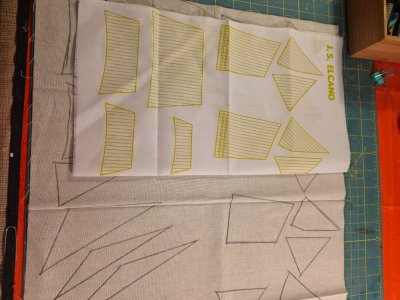
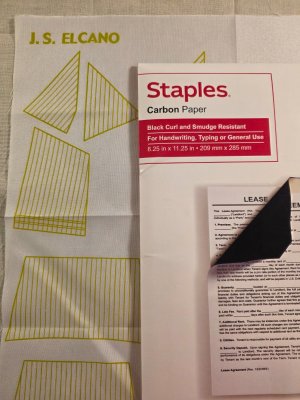
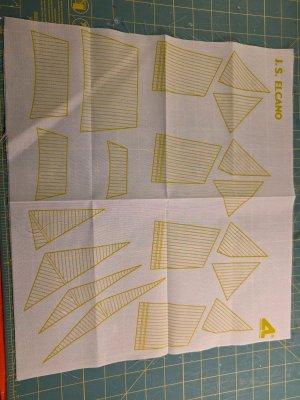
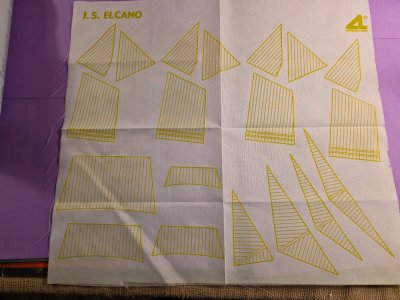
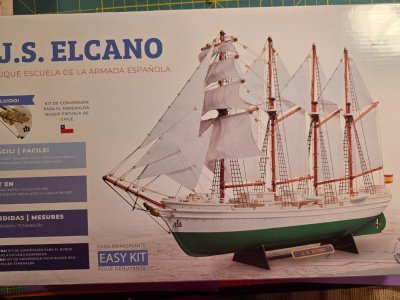
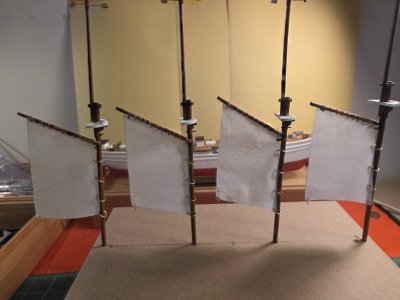
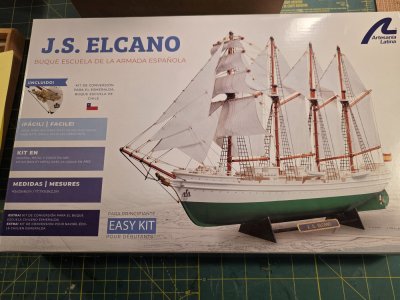
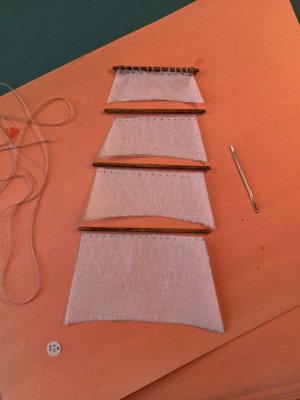
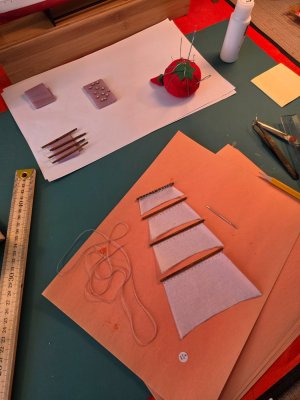
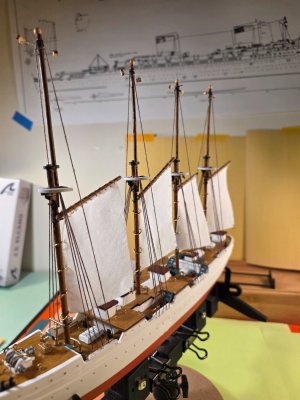
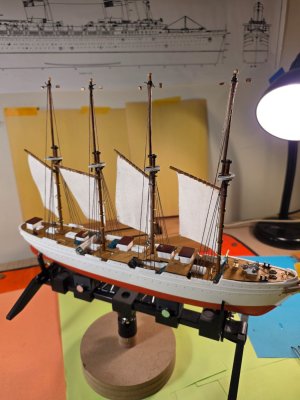
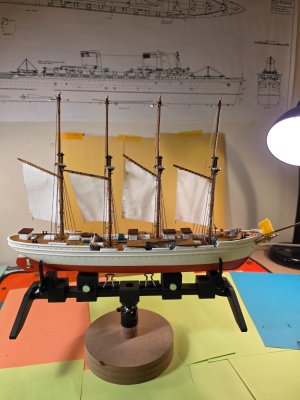
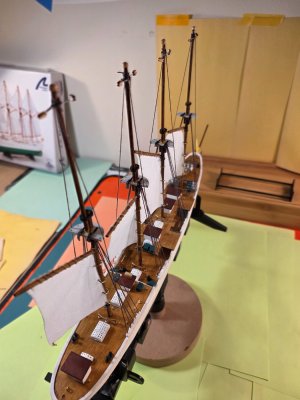
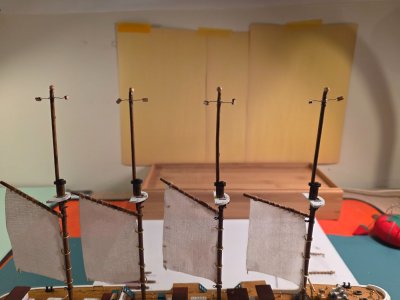
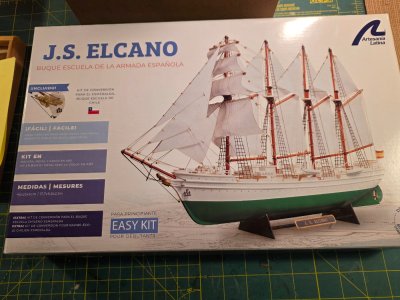
As you can see, the kit came with what I can only describe as "play sails" because they look childish and do not match the white sails on the boxtop. The gold lines on the front and back make this look more like a viking ship than the great windjammer the Elcano is in real life.

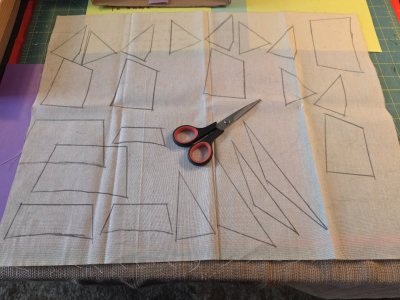
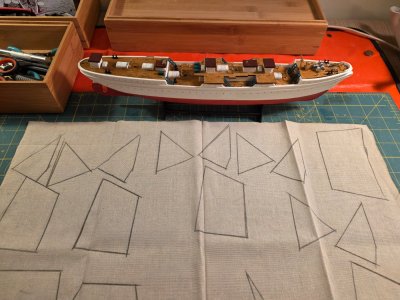
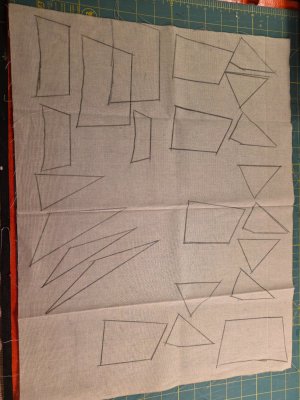
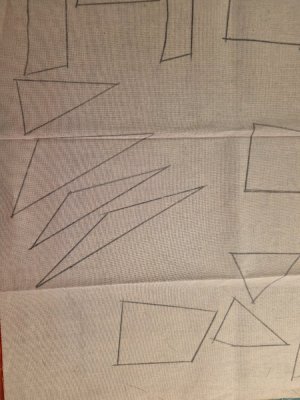
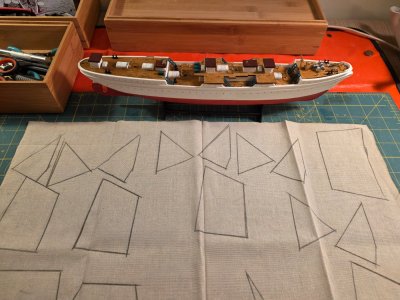
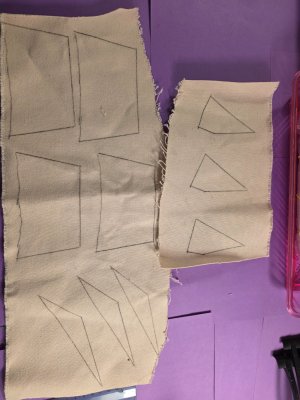
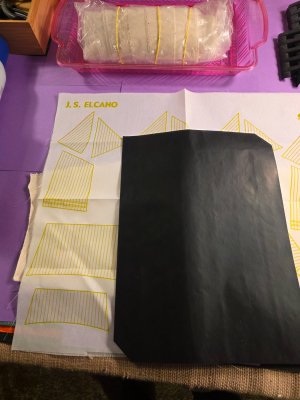
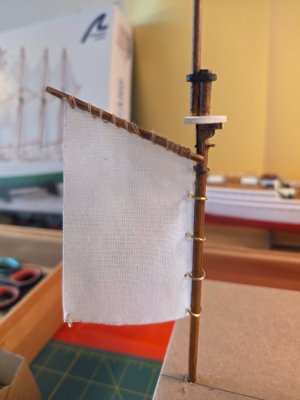
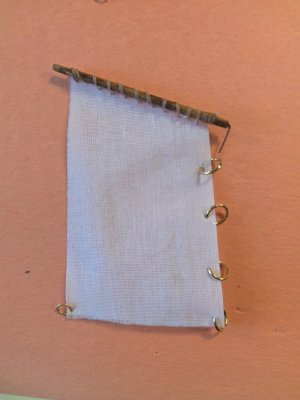
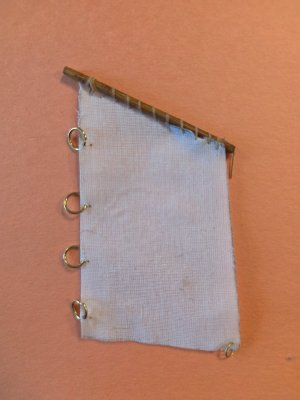
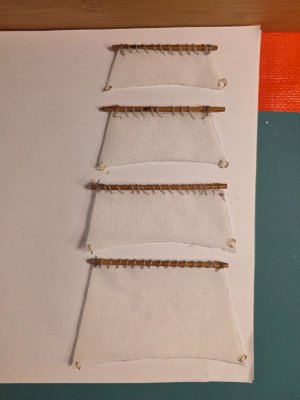
I used carbon paper to trace the sail outlines onto a sheet of raw canvas I had left over from my HMS Victory hull-only build. I had to trace the mainsail a couple of times to get the size right. I tried to match the direction of the weave of the raw canvas to match the weave (warp and weft) of the "play sails."

The next video in the Juan Sebastian de Elcano Artesania Latina build series has me sewing 10 or more eye rings onto each jib and attaching them to the bowsprit below and the foremast above.

The sail plan for the foremast and foresail/mainsail looks like the traditional set of square rigged sails - the mainsail, the topsail, the topgallant and the royal. The 3 jiggermasts together look very simplistic and only have fore-and-aft rigged sails with only shrouds / ratlines connecting them to the mainmast and decks.

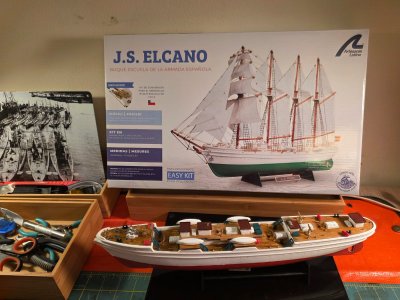
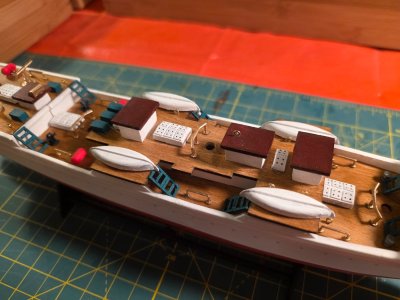
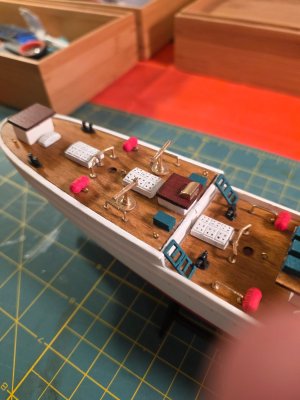
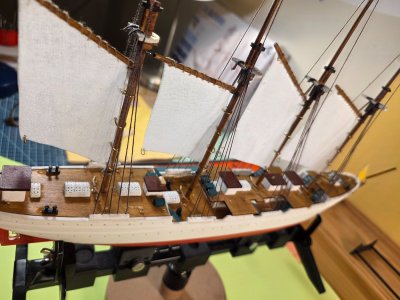
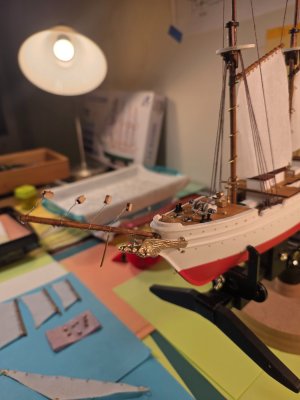
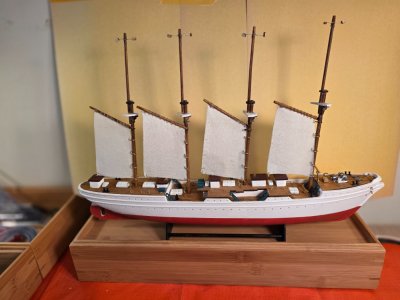
For more variety, I added several red painted personal flotation devices (PFDs) on deck to add a small splash of red, my favorite color. I kit-bashed them from my Smit Rotterdam Ocean Tugboat. I like how the different colors work together. The top deck has a more interesting look and we get beyond the "paint everything white" approach the kit and the real J.S.E. demand. Now, with my color scheme, the Juan Sebastian de Elcano looks more like a pepperoni pizza!

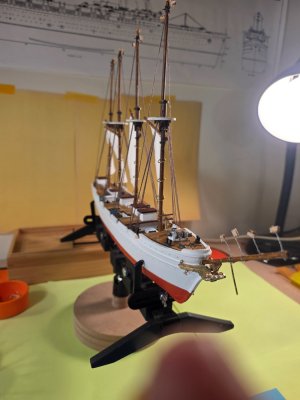
Staining and assembling the mast components, spars, bowsprit, gaffs and booms up soon.

20260323_224534.jpg

20260323_224012.jpg

20260323_223627.jpg

20260323_223539.jpg

20260323_222856.jpg

20260323_222541.jpg

20260323_222700.jpg

20260323_220156.jpg

20260323_202841.jpg

20260323_222811.jpg


20260323_223606.jpg
 
Last edited:
10. QUESTION FROM BEGINNER RIGGER:
If you are working with raw canvas for all the sails, do you pre-treat the sails before you sew them to the rigging? The box looks like the sails are hung flat / lifeless off the masts. Is there a way to shape the sails so they look wind-filled? Is there also a way to present the sails furled up to the spars? What about after the build - what do you spray on the sails to protect them? Not matte enamel, right?

1774407195782.jpeg

20260323_224534.jpg
 
Last edited:
11. Today's labors on the Juan Sebastian de Elcano / Esmeralda.

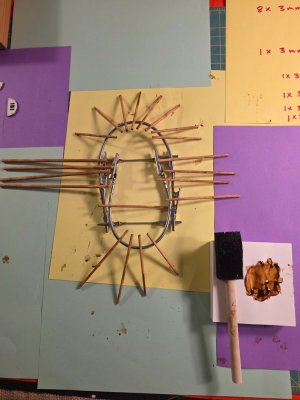
I stained the masts, yards and jibs with two coats of teak stain. I like using teak because I know what color I am getting with 1, 2, 3, or 4 coats.

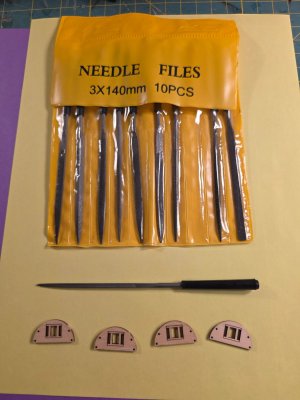
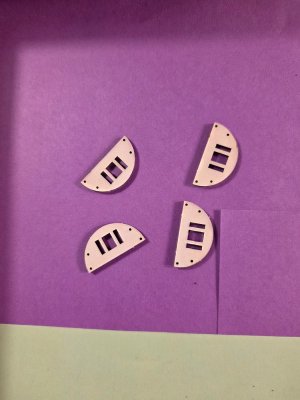
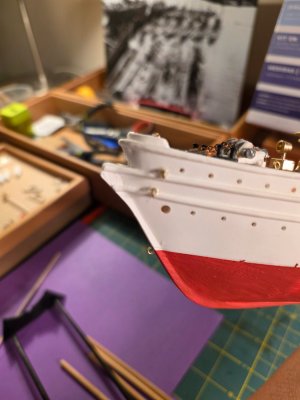
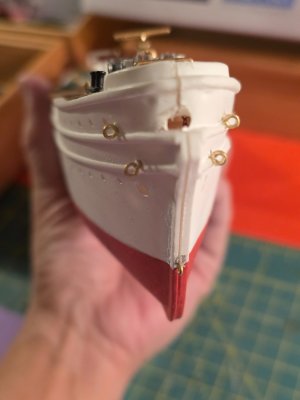
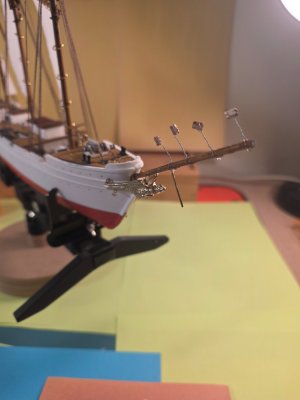
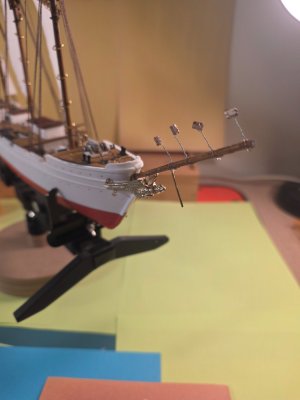
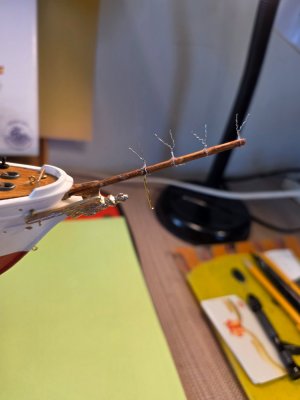
Also put a set of 5 eye hooks on the bow and filed the mast caps to fit my 4 mm masts. I applied a thin white stain on the caps.

Went ahead and ordered 1.5 mm blocks for the rigging to replace the DIY blocks that come with the kit.

20260324_221317.jpg

20260324_221333.jpg

20260324_221329.jpg

20260325_211811.jpg

20260325_212235.jpg

20260325_215242.jpg

20260325_221410.jpg

20260325_210624.jpg

20260325_202807.jpg

20260325_202746.jpg
 
Last edited:
If you are working with raw canvas for all the sails, do you pre-treat the sails before you sew them to the rigging? The box looks like the sails are hung flat / lifeless off the masts. Is there a way to shape the sails so they look wind-filled? Is there also a way to present the sails furled up to the spars? What about after the build - what do you spray on the sails to protect them? Not matte enamel, right?
There are options.
1) you can use a PVA (white) glue mixed with water 50/50. When the canvas is wet, you can give it any form, using any supporting materials to make the sail look filled with wind. Once the fabric dries, it will be flexible but generally preserving its shape. You can cut it out without any risk, since the threads are glued together
2) it is still possible, even when the sails are already mounted on the model: you give them a desired shape using any rags and so on and use... a hair fixing spray :D I once asked my wife to buy me one, and after 10 years the effect was still in place - you just need to protect the other parts of the model from it.

PS I would highly recommend avoiding pleats on the canvas - and place your sail contours on an even part of fabric. There is no way to eliminate a pleat completely, it will always remain on your sail.
 
Booking my vacation plans around the upcoming "Sail Boston: The Tall Ships Return to Boston Harbor," event on July 11-16, 2026 in Boston, Massachusetts US. More than 50 sailing vessels, training ships, schooners, and military vessels have been invited to participate, including 4 ships that are on my radar screen right now:

The Esmeralda (currently building as Juan Sebastian de Elcano for my "Windjammer Navy" model club project).
Full Sail Esmeralda.jpg

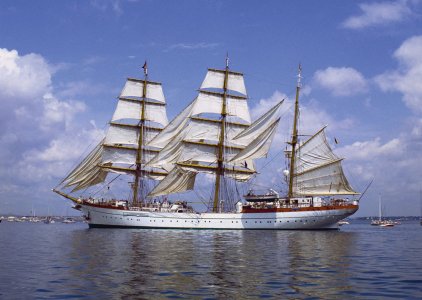
The Gorch Fock (in the queue for my "Windjammer Navy" model club project).
GORCH-FOCK_min-1.jpg

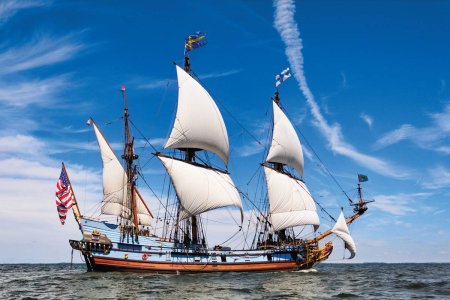
The Kalmar Nyckel (recently added to my "Philadelphia Navy" model club project).
Kalmar Nyckel underway.jpg

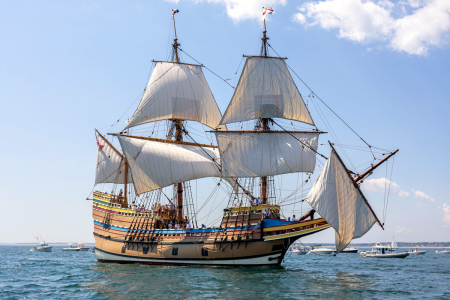
And the Mayflower II (next build after JS Elcano, from the Mayflower 1620 1/140 scale kit from Corel).
1774532711850.png

I am excited to see so many "windjammers" (steel hull cargo vessels / training ships under sail with supplemental diesel or steam power) that I have never seen before, up close and hopefully open to the public for tours. Windjammers invited to Sail Boston 2026 include:

ARA Libertad (Argentina)
Amerigo Vespucci (Italy)
Bima Suci (Indonesia)
Cuauhtemoc (Mexico)
Dar Mlodziezy (Poland)
USCG Eagle (USA)
HMS Gladan (Sweden)
ARC Gloria (Columbia)
BAE Guayas (Ecuador)
Juan Bautista Cambiaso (Dominican Republic)
ARA Libertad (Argentina)
Mircea (Romania)
Picton Castle (Cook Islands)
Sagres (Portugal)
Sudarshini (India)
BAP Union (Peru)
STV Vela (British Virgin Islands)

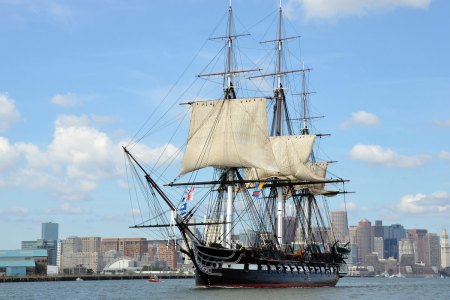
The U.S.S. Constitution ("Old Ironsides") will be participating in Sail Boston 2026 as well.
1774535123150.png

It will be a high-time for Windjammer nerds such as myself...

 
Last edited:
12. Build log of the Juan Sebastian de Elcano

More work before the masts are assembled and the rigging goes up.

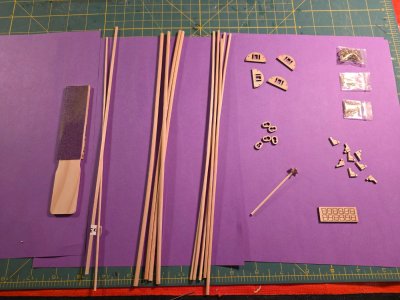
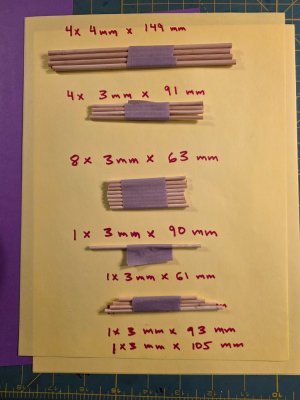
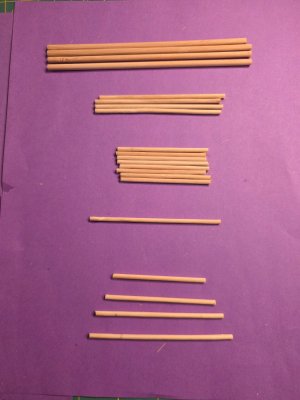
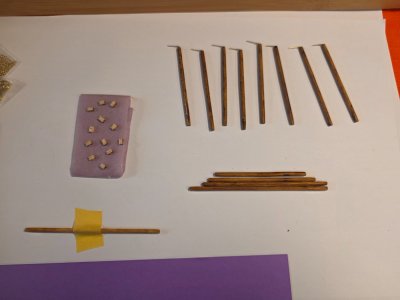
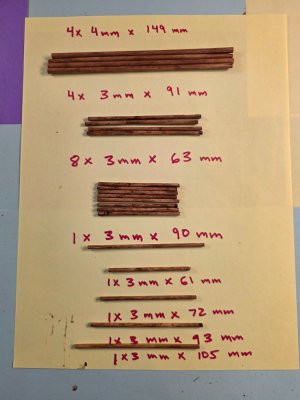
Cut all the dowels to spec, applied one coat of teak, then weathered the wood dowels with 220 grit sandpaper, before applying 2nd coat of teak stain. They are the light teak color that I prefer and they will match the teak stain decking on top decks.

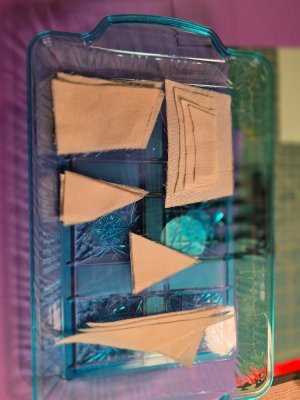
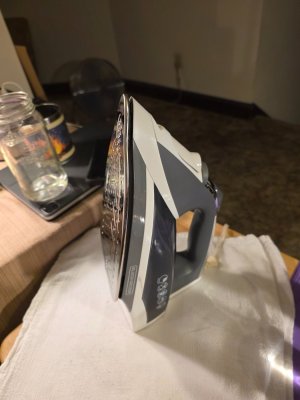
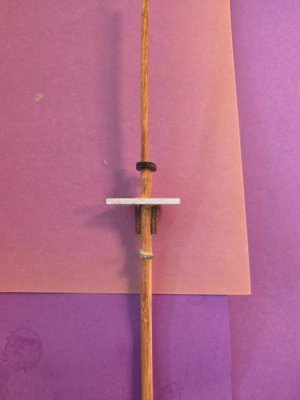
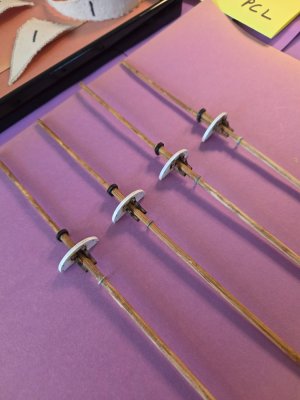
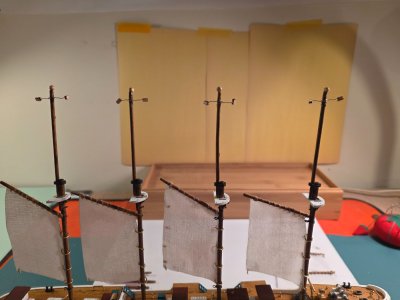
I cut out the sails, trimmed them and ironed them. Then stained all of the mast cap connections / knees, stained the lower and upper masts, bowsprit, gaffs, and spars. I used white stain, teak stain and black stain on the mast components.

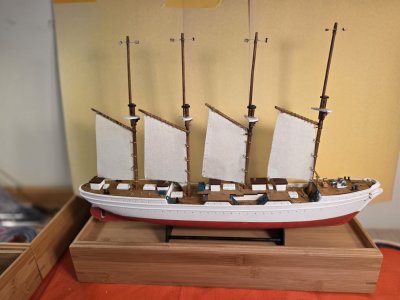
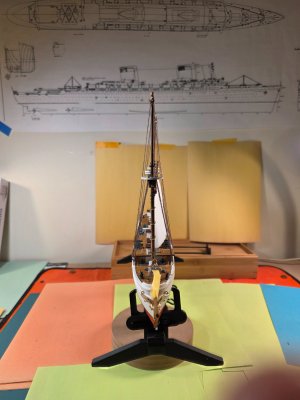
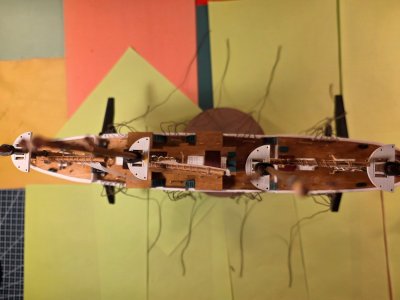
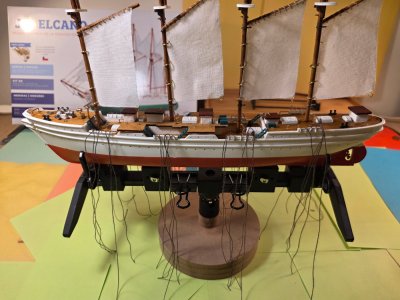
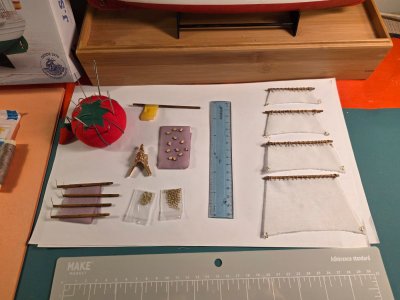
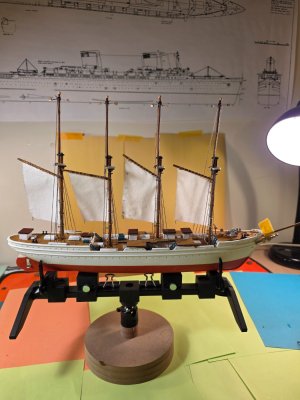
Lots of busy work to get to my first ever rigging job. The JS de Elcano is a 4-masted Barque (Barquentine?) with the foresail rigged square and the main, mizzen, and aft sails rigged fore-and-aft. While there is some "realistic" rigging on the 4 bowsprit jibs and the foresails (mainsail, topsail, topgallant, and royal), it ends there. The aft 3 masts are only rigged with shrouds and minimal stays.

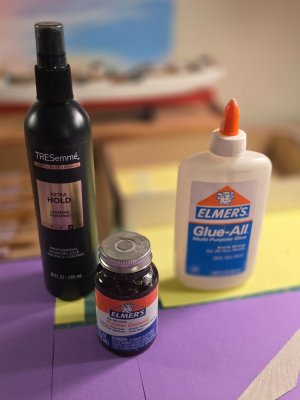
Now I need to treat and shape the raw canvas sails because I want to present the vessel underway with full sails (see last picture of the Esmeralda). I've got 3 possibilities:

1. Paint the sails with a 50/50 mix of Elmer's Glue-All and water. Then shape them on forms.
2. Pretreat the sails with hairspray and shape them on forms. Spray hairspray on both sides of the form.
3. Paint the sails with Elmer's Rubber Cement (tacky glue) mixed with a few drops of Bestine Thinner & Solvent (N-Heptane). Then shape them on forms.

Thanks to SoS member Boatman for suggesting 2 out of 3.

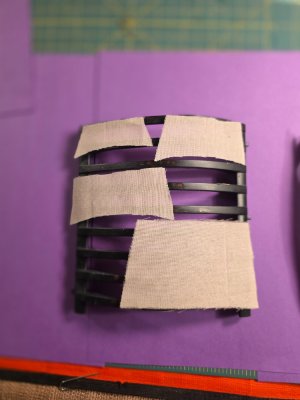
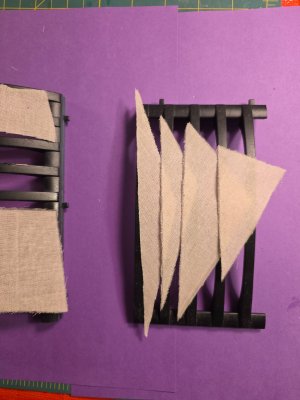
I found some perfect plastic forms in an old plastic napkin caddie. And I'm giving up the idea of showing the sails all furled up, because (lazy) probably more effort than flying the sails.

What method do you use to treat raw canvas sails? Any of the above? Other methods?

I probably wont get around to treating the sails for a week or so, because I'm waiting on my 1.5 mm blocks and tackles (1/250 scale) from Model Expo and I have to assemble the mast components first, each of which have 2 or 3 blocks and a 3 mm bead attached to the mast above the royal sail.

Wondering if the treated and shaped sails are harder to sew than just the raw canvas?

I'm inclined to go with #1 to use 50/50 Elmer's Glue-All and water. I think the hairspray probably leaves a sheen on the fabric that I don't want. And I don't want to inhale N-Heptane if I can help it. Most people who use Bestine Thinner & Solvent probably use OSHA grade face masks/filters. Maybe will do some fabric testing on some scrap sail canvas.

Perhaps wisely, the order of fabricating and mounting the masts starts with the fourth fore-and-aft mast/sail, then third fore-and-aft mast/sail, then main mast fore-and-aft mast/sail. Probably so you can mount the square-rigged foresail to the second mast before you attach the gaffs and booms. Not sure if I'm using all the right nautical terms, but I'm learning!

The last picture of the Esmeralda is how I want the full sails to look.

At the end of the day if someone says to me "your Level 1 build of the Juan Sebastian de Elcano looks like a Lego toy (or a pepperoni pizza), but your rigging, sails, and masts look seaworthy," I would be a happy man.
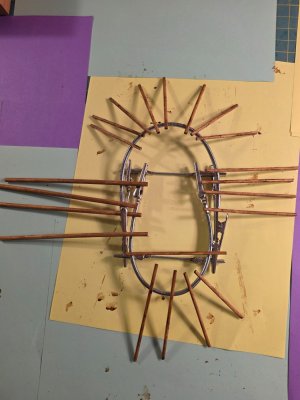
20260326_074328.jpg

20260325_221351.jpg

20260326_165850.jpg

20260325_221411.jpg

20260326_170025.jpg

20260326_165922.jpg

20260326_200026.jpg

20260326_200127.jpg

20260326_200840.jpg

20260326_200843.jpg

20260326_201022.jpg

20260326_201541.jpg

20260326_201919.jpg

FB_IMG_1774579926764.jpg
 
Last edited:
Now I need to treat and shape the raw canvas sails because I want to present the vessel underway with full sails (see last picture of the Esmeralda). I've got 3 possibilities:

1. Paint the sails with a 50/50 mix of Elmer's Glue-All and water. Then shape them on forms.
2. Pretreat the sails with hairspray and shape them on forms. Spray hairspray on both sides of the form.
3. Paint the sails with Elmer's Rubber Cement (tacky glue) mixed with a few drops of Bestine Thinner & Solvent (N-Heptane). Then shape them on forms.

Thanks to SoS member Boatman for suggesting 2 out of 3.
No problem, you're always welcome. Take a look at this video, it explains how the approach with PVA/Elmer's glue is working, although here it is used in lower proportion, maybe 10:90, and is done two times - for the fabric itself and when the sail is getting its final shape:

PS To avoid any confusion, the video is not mine, but it shows how to make a sail of a complex shape with water and white glue.
 
Last edited:
No problem, you're always welcome. Take a look at this video, it explains how the approach with PVA/Elmer's glue is working, although here it is used in lower proportion, maybe 10:90, and is done two times - for the fabric itself and when the sail is getting its final shape:
Thanks Boatman. The lower ratio glue to water and 2 applications make sense. Gives you a chance to apply less glue the 2nd time round. Do you know if pretreated sails are harder to sew in the boom/gaffs rings? Looks like a piece of cake with a sewing machine, but I'm going to have to sew my sails freestyle.
 
Last edited:
Thanks Boatman. The lower ratio glue to water and 2 applications make sense. Gives you a chance to apply less glue the 2nd time round. Do you know if pretreated sails are harder to sew in the boom/gaffs rings? Looks like a piece of cake with a sewing machine, but I'm going to have to sew my sails freestyle.
The more glue you add the more the fabric behaves like paper: it becomes less flexible, less stretch, but easier to cut and sew. Glue without any water will make it a kind of thin plastic. The white glue is temperature-sensitive, so you can see the author easily makes folds with an iron. And he needs the fabric to stay flexible enough to furl the sail later, but less stretching to sew a straight seam, cut and fold it. Then the author of the video uses it a second time to make the fabric wet and flexible and to fix the final shape when it dries

PS I would experiment with the fabric scraps you have and the different glue ratios to decide what would be the best for you.
 
Last edited:
13. Juan Sebastian de Elcano

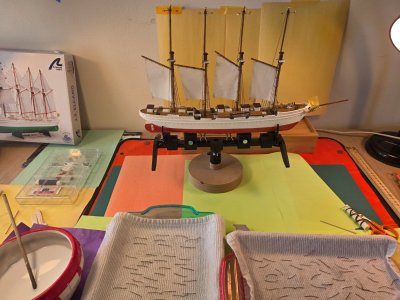
While I wait for my 1.5 mm blocks and fittings (1/250 scale) to arrive, I am going to experiment with pre-treating the raw canvas sails for my Juan Sebastian de Elcano build. The sails that came with the Artesiana Latina kit were cheap looking, so I used raw canvas left over from my HMS Victory 1/150 scale hull-only build that was sitting around the shop.

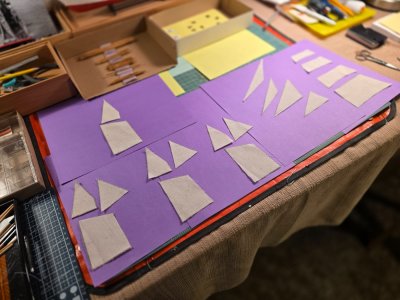
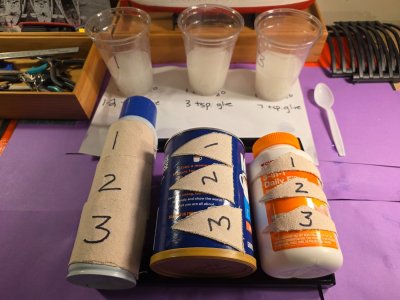
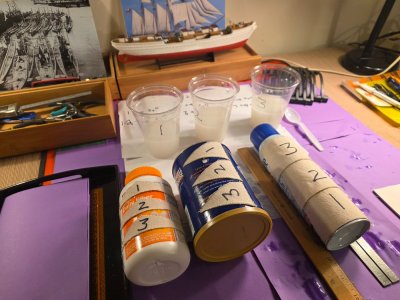
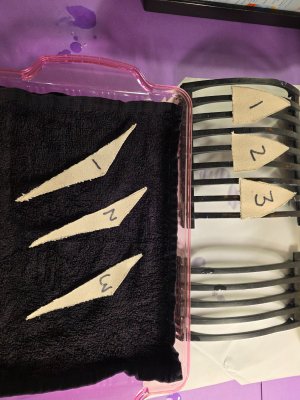
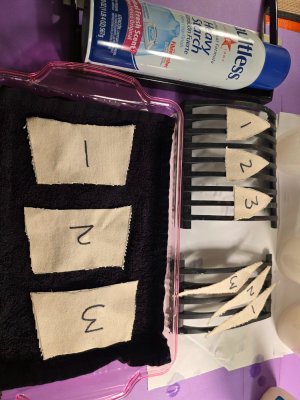
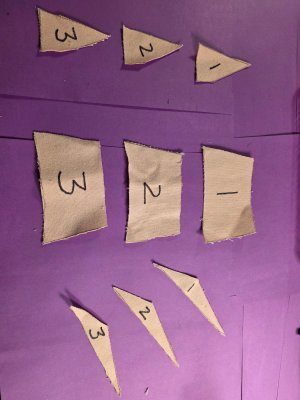
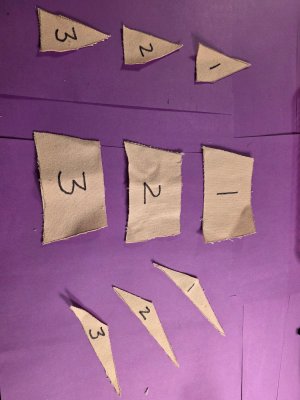
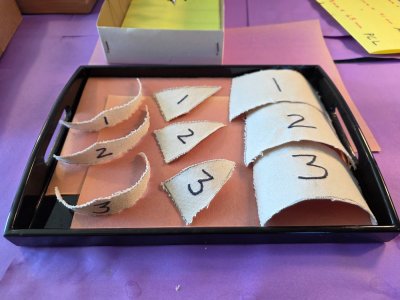
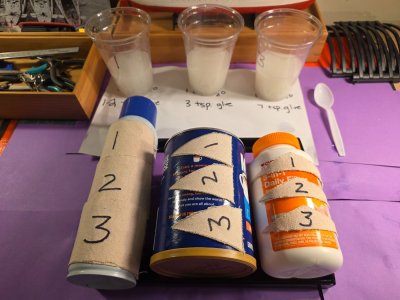
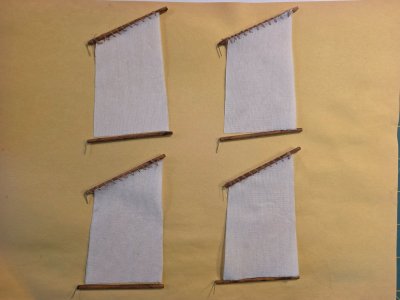
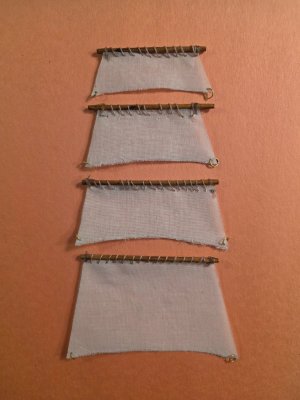
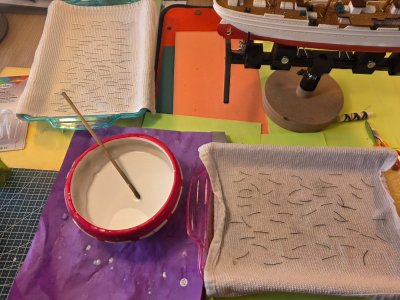
In a test suggested by Boatman, I pre-treated raw canvas "dummy sails" to see how they would take to different solutions of Elmer's Glue-All and water - a common way to shape sails to appear full of wind for presentation. These sails are the same dimensions as the sails Im using for the JSE. Thank goodness for carbon paper.

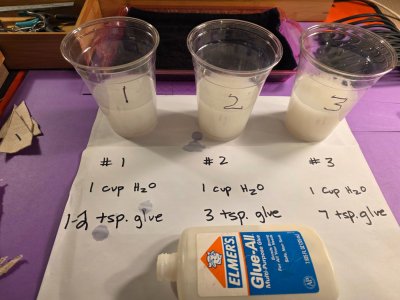
As you can see, I used the following concentrations of 1 cup water, then
white glue: 1+ teaspoons, 3+ teaspoons, and 7+ teaspoons. Soaked each dummy sail for about 5-6 minutes to impregnate the canvas.

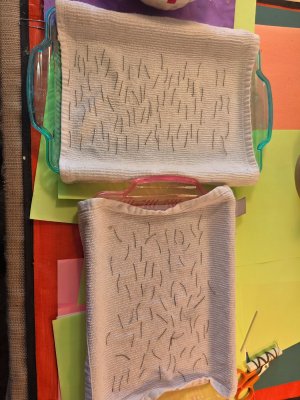
Then laid them all out on a rounded form to see if they hold shape. My napkin holder forms had a subtle bend (prolly good for the final build), but I wanted to go with a more dramatic bend to test the glue/water mixture and see what kind of bend and stiffness I get with each set of sails (1, 2 or 3). I really want to match the fullness of the sails on the picture of the Esmeralda attached.

The beauty of this method is that if the sails need more glue/water solution -- for example to add more stiffness, I can always soak them some more in the glue solution tomorrow. I'll check back tomorrow to see how the 3 solutions performed. I'm looking to see whether the pretreated raw canvas sails can be bent or formed with the right amount of stiffness for final attachment to the bowsprit, the foremast, and the 3 aft jiggermasts.

************

As an aside, I just noticed that the picture of the Esmeralda/JS de Elcano attached has a weird configuration of the 4 sets of davits for the 4 tenders/jolly boats attached above decks. In the picture of the real vessel, the forward tender is suspended by davits turning inward from each side (hanging over the deck), whereas the aft tender is suspended by davits hanging over the side of the ship (hangin gover the ocean). That's weird, so I checked how the jolly boats/tenders are presented in the original Artesiana Latina kit.

The model kit has all 4 tenders suspended by davits hanging over the side of the ship and dangling over open ocean. Definitely not something I'm going to do until the very end of this build. Also, the 4 tenders in the model are more towards the aft of the boat than in the real vessel that has the boats all at mid-ships.

We will check on the dummy sails tomorrow after they have a chance to dry.

20260328_215403.jpg

20260328_214202.jpg

20260328_213610.jpg

20260328_211418.jpg

20260328_212040.jpg

20260328_210909.jpg

20260328_205632.jpg

20260328_204255.jpg

20260328_203157.jpg

20260328_203058.jpg

20260328_205632.jpg

FB_IMG_1774579926764.jpg

20260323_224421.jpg
 
Last edited:
14. Juan Sebastian de Elcano Build Log

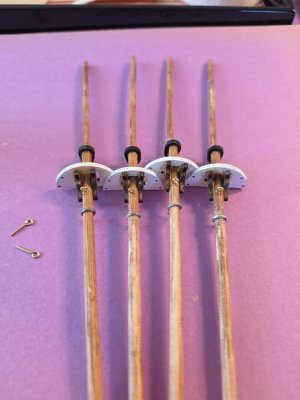
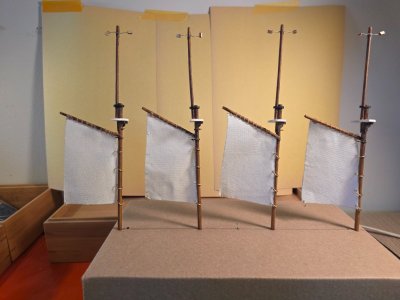
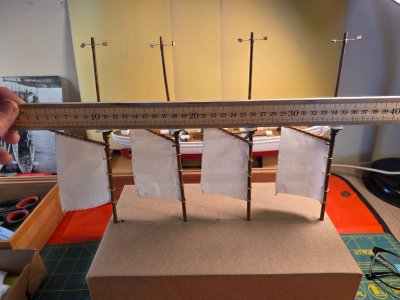
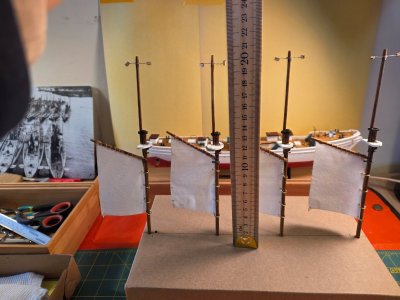
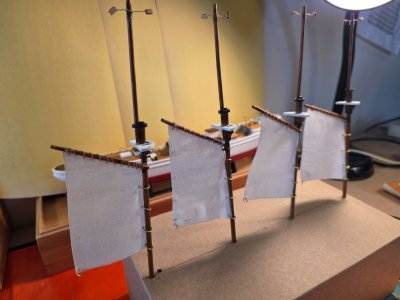
Moving right along, I fabricated all 4 masts and I have the results of the Pre-treat Raw Canvas Sails experiment.

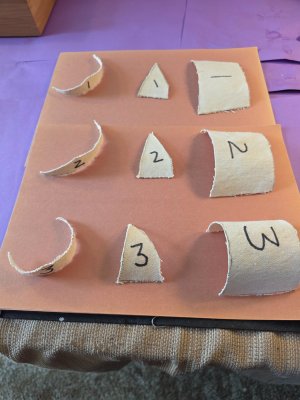
I decided to use the Elmer's Glue-All + water method of pretreating the raw canvas "dummy sails." As expected, the more glue in the soaking solution leads to "better" more shape-able sails. More glue means that the sails will maintain their shape better and looks like I can trim the sails easily.

The winner in my book is #3, more glue and more soak time: a solution of 1 cup water and 7 teaspoons of Elmer's Glue-All, for a total of about 20 minutes of soaking. I like the effect and will probably add 12 to 15 teaspoons of glue next time.
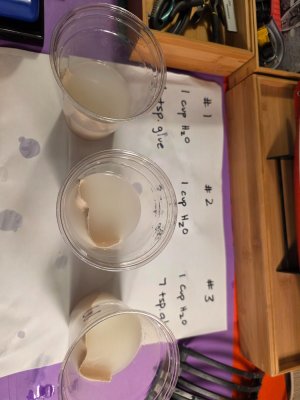
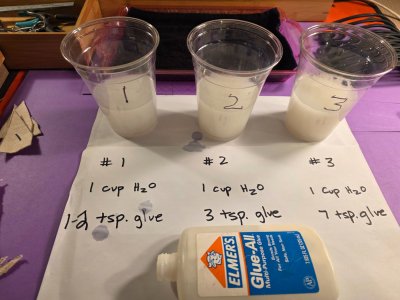
The glue water solution makes the sails firm and malleable at the same time. I can always go back and add more glue or wash the sails with water, if I want to furl the sails later. It's an easy technique, but glad I learned how to do this before I set into rigging the sails in earnest.
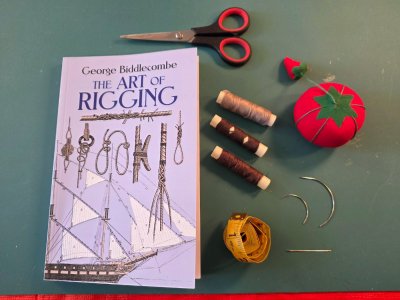
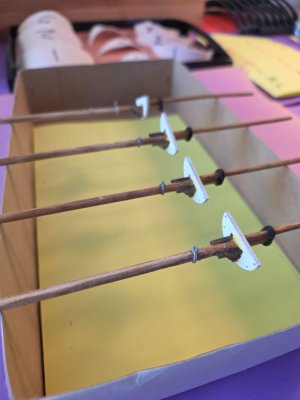
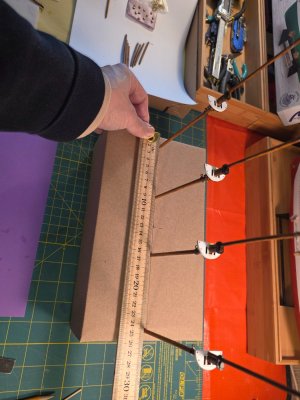
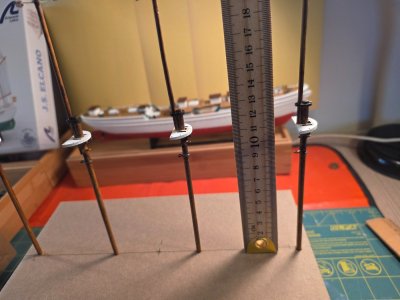
The masts were a bear to fabricate...the fitted rings were too small for the 4mm dowels, so had to sand them masts down a bit. Then had to re-stain the masts again. Not ideal because I prefer a uniformed weathered look on the masts. I am trying to use only PVA glue on the masts because I may need to stain more later, and I don't want to have any superglued spots that wont take stain or paint.

I still do not like the YouTube 28 instructional videos for this kit. I mean, there are no drawings of the boat at all. And the videos are made to appeal to every language, so no narration. This coupled with some poorly fit components (esp. foil stairs, rudimentary blocks, inconsistent wood dowels) they (Artesiana Latina) didn't seem to put too much effort into this kit.

Nevertheless, the build is still quite enjoyable. I'm trying to be patient, by doing 1 or 2 small tasks a day, giving glue time to set, and staying organized.

20260329_160937.jpg

20260328_215403.jpg

20260329_151118.jpg

20260329_155123.jpg

20260329_155109.jpg

20260329_155657.jpg

20260329_155829.jpg

20260329_160819.jpg


20260329_155155.jpg


20260329_155332.jpg

20260328_210909.jpg

20260329_160125.jpg
 
Last edited:
Back
Top