
That extra furniture looks awesome! Thanks for sharing.

-

SUBSCRIBE TO SHIPS IN SCALE TODAY!
The beloved Ships in Scale Magazine is back and charting a new course for 2026!
Discover new skills, new techniques, and new inspirations in every issue.
NOTE THAT OUR NEXT ISSUE WILL BE MARCH/APRIL 2026 -

Win a Free Custom Engraved Brass Coin!!!
As a way to introduce our brass coins to the community, we will raffle off a free coin during the month of August. Follow link ABOVE for instructions for entering.
- Home
- Forums
- Ships of Scale Group Builds and Projects
- Le Coureur 1776 1:48 PoF Group Build
- Le Coureur 1776 1:48 Group Build Logs
You are using an out of date browser. It may not display this or other websites correctly.
You should upgrade or use an alternative browser.
You should upgrade or use an alternative browser.

- Joined
- Mar 1, 2023
- Messages
- 211
- Points
- 298

Brad, the chest and wardrobe look pretty straight forward, but the framing around the panels was the thinnest wood veneer. You only had to breathe and it would break. If you look closely at the right hand side of the chest you can see I had to make a repair…
Now on to the stern. The deck for the area behind the cargo hold went in OK in the end. The kit has plywood templates which you fit and trim to size. The framing and planking are then made based on this and hopefully everything slips neatly into place. I had to do small amount of trimming on the sides, particularly aft, to get the deck to the right height as there are two walls port and starboard which finish level with the deck beams.
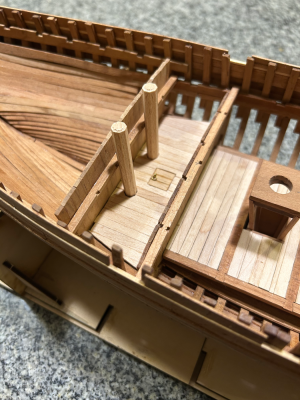
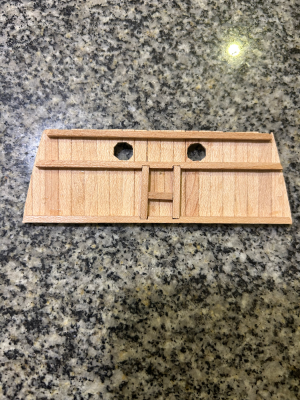
The are octagonal openings for the bilge pumps. There’s little room for error as there are deck frames and carlings on either side of each pump, but again I seem to have judged things OK and everything will fit.
Kind regards
Salty
Now on to the stern. The deck for the area behind the cargo hold went in OK in the end. The kit has plywood templates which you fit and trim to size. The framing and planking are then made based on this and hopefully everything slips neatly into place. I had to do small amount of trimming on the sides, particularly aft, to get the deck to the right height as there are two walls port and starboard which finish level with the deck beams.
The are octagonal openings for the bilge pumps. There’s little room for error as there are deck frames and carlings on either side of each pump, but again I seem to have judged things OK and everything will fit.
Kind regards
Salty


Nice precise modeling, Salty. This is a great looking model done really well by others. Yours's will be another excellent outcome.
- Joined
- Mar 1, 2023
- Messages
- 211
- Points
- 298
Paul, yes, I agree there’s a numbers of fine examples of Le Coureur. I think she’s very much worth considering as a prospective model for others despite the fact that the “group” part of the group build might have finished.
I have finished the area immediately behind the cargo hold with two partitions with sliding hatches.
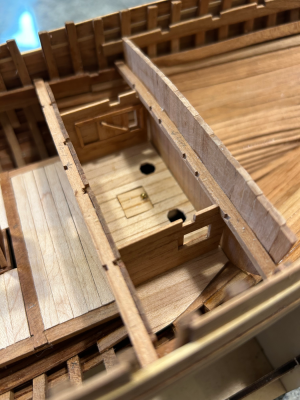
I’m not sure what would have been kept in this area. It’s pretty small and there’s not much headroom to speak of. I think it’s main purpose would have been to access to the bilge as underneath the deck in the cargo hold might have been filled with rock ballast.
I think the sliding hatches would have been quite big and perhaps spare ropes could have been store in the compartments behind them.
Kind regards
Salty
I have finished the area immediately behind the cargo hold with two partitions with sliding hatches.
I’m not sure what would have been kept in this area. It’s pretty small and there’s not much headroom to speak of. I think it’s main purpose would have been to access to the bilge as underneath the deck in the cargo hold might have been filled with rock ballast.
I think the sliding hatches would have been quite big and perhaps spare ropes could have been store in the compartments behind them.
Kind regards
Salty
- Joined
- Mar 1, 2023
- Messages
- 211
- Points
- 298
The next compartment is storage for the charges for the cannons. To keep the gunpowder dry, the compartment is lined with lead (provided with the kit) which goes under the deck and up the ceiling planking. This follows the pictures on the CAF website (although it’s not clear in the instructions). It probably worked in practice, although lining the bulkheads as well would have provided better protection.
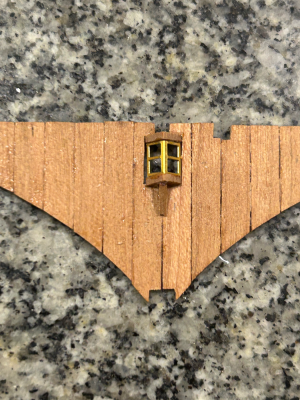
There is also a tiny lamp in the bulkhead as the area is buried in the bottom of the ship.
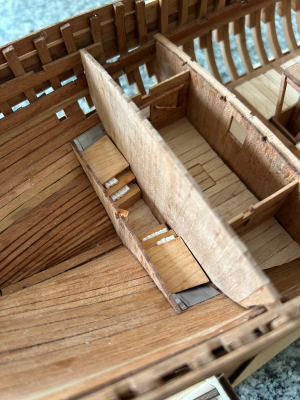
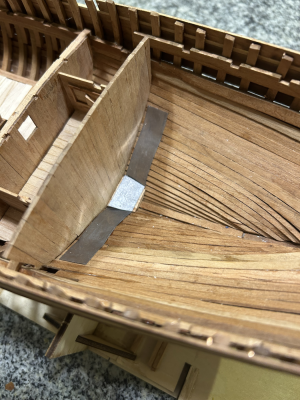
The deck of the aft cabin will completely cover this compartment, but at least I’ll be able to say it’s there.
Kind regards
Salty
There is also a tiny lamp in the bulkhead as the area is buried in the bottom of the ship.
The deck of the aft cabin will completely cover this compartment, but at least I’ll be able to say it’s there.
Kind regards
Salty
- Joined
- Mar 1, 2023
- Messages
- 211
- Points
- 298
Thanks to everyone who has been following my progress. I thought I might be hidden away in this corner of SOS, but apparently I was wrong.
This is the deck for cabin in the stern.
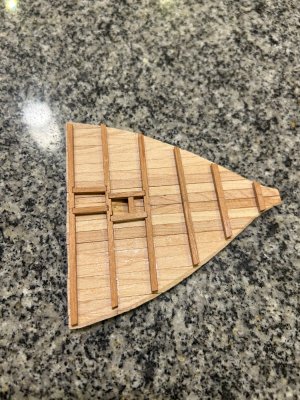
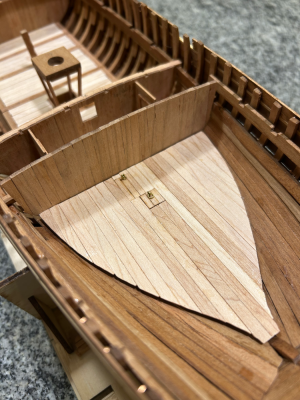
The larger hatch goes to the gunpowder room and the other to the area underneath the cabin proper. I have chosen to use one (rather than two specified in the instructions) eye and ring fittings on each hatch as I prefer a simpler look.
The plans have drawing of the deck and there was also a plywood template which really helped construction because there’s a lot to get right. The edges sit flush on the ceiling planking, the deck frames need to get through the gunpowder room bulkhead and the deck itself needs to be at the right height above the keel.
Kind regards
Salty
This is the deck for cabin in the stern.
The larger hatch goes to the gunpowder room and the other to the area underneath the cabin proper. I have chosen to use one (rather than two specified in the instructions) eye and ring fittings on each hatch as I prefer a simpler look.
The plans have drawing of the deck and there was also a plywood template which really helped construction because there’s a lot to get right. The edges sit flush on the ceiling planking, the deck frames need to get through the gunpowder room bulkhead and the deck itself needs to be at the right height above the keel.
Kind regards
Salty
Last edited:
- Joined
- Mar 1, 2023
- Messages
- 211
- Points
- 298
For something a little different, I have been working on some barrels for the cargo hold.
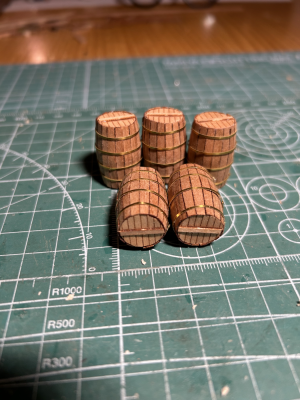
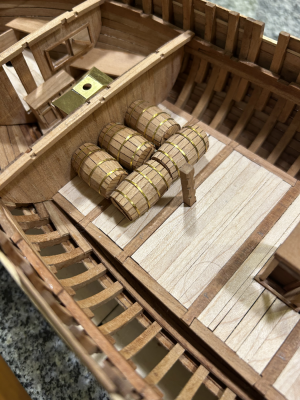
I used a kit from CAF and am pleased with the results, but there was a surprising amount of work and patience required to get them just right. There were enough staves for a second layer, but I was pretty happy with the first layer and I didn’t think it would really add anything. The photo etched hoops are a nice touch. They are slightly conical like real hoops so they sit flat against the staves.
Kind regards
Salty
I used a kit from CAF and am pleased with the results, but there was a surprising amount of work and patience required to get them just right. There were enough staves for a second layer, but I was pretty happy with the first layer and I didn’t think it would really add anything. The photo etched hoops are a nice touch. They are slightly conical like real hoops so they sit flat against the staves.
Kind regards
Salty
- Joined
- Mar 1, 2023
- Messages
- 211
- Points
- 298
Thank you to everyone who has visited and left a like.
Today I built the first of the two officers’ cabins in the stern.


For the first time, I found the bulkhead temple didn’t fit exactly but was a few millimetres too tall. I can’t really tell why that might be the case and reluctantly decided to remove material from the bottom edge of the bulkhead and doors. Probably the most difficult part was shortening the veneer strips which form the door frames. Because they are so thin, they are really brittle and difficult the repair if they break (which happened once).
Fitting bunks and lockers wasn’t straightforward either the panels in front of the bunks needed a bit of adjustment to get them to fit neatly. It was also tricky making and fitting the tiny hinges. For reference, it’s a 10 mm square on the green mat.

Kind regards
Salty
Today I built the first of the two officers’ cabins in the stern.
For the first time, I found the bulkhead temple didn’t fit exactly but was a few millimetres too tall. I can’t really tell why that might be the case and reluctantly decided to remove material from the bottom edge of the bulkhead and doors. Probably the most difficult part was shortening the veneer strips which form the door frames. Because they are so thin, they are really brittle and difficult the repair if they break (which happened once).
Fitting bunks and lockers wasn’t straightforward either the panels in front of the bunks needed a bit of adjustment to get them to fit neatly. It was also tricky making and fitting the tiny hinges. For reference, it’s a 10 mm square on the green mat.
Kind regards
Salty
- Joined
- Mar 1, 2023
- Messages
- 211
- Points
- 298
Onto the last cabin:


Each cabin has had its challenges and this was no different. This time it was getting the panels to fit neatly with the beams which runs across the middle of the cabin and making sure they don’t cross under any carlings.
This is the end of the internal fittings and it’s onto the deck next.
Kind regards
Salty
Each cabin has had its challenges and this was no different. This time it was getting the panels to fit neatly with the beams which runs across the middle of the cabin and making sure they don’t cross under any carlings.
This is the end of the internal fittings and it’s onto the deck next.
Kind regards
Salty
- Joined
- Mar 1, 2023
- Messages
- 211
- Points
- 298
Here are the stern decorations:
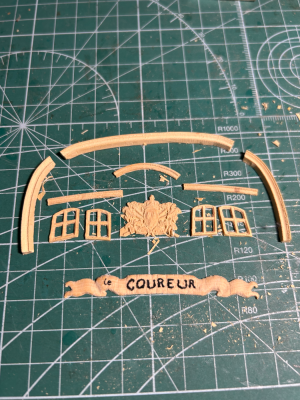
Yes, the lettering is painted and no, I had no clue they made such small paintbrushes before I went to my local hobby shop.
All these pieces are CNC machined from boxwood and some of the detail is not really obvious when you start working on them. With a bit of care, however, the features emerge although not many will probably notice them after they are on the ship.
Here is the finished transom:
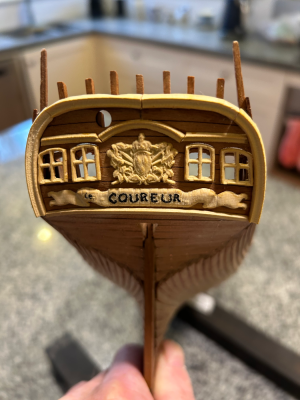
I am happy it all went together reasonably smoothly, although I had to take a bit of material off the transom planking (which came as one piece) so it fitted neatly inside the hull planking. I’m not sure the stern windows match the ANCRE monograph or the CAF plans exactly, but the nothing seems out of place. The transom timbers protruding above the boxwood will be trimmed later and capped.
Kind regards
Salty
Yes, the lettering is painted and no, I had no clue they made such small paintbrushes before I went to my local hobby shop.
All these pieces are CNC machined from boxwood and some of the detail is not really obvious when you start working on them. With a bit of care, however, the features emerge although not many will probably notice them after they are on the ship.
Here is the finished transom:
I am happy it all went together reasonably smoothly, although I had to take a bit of material off the transom planking (which came as one piece) so it fitted neatly inside the hull planking. I’m not sure the stern windows match the ANCRE monograph or the CAF plans exactly, but the nothing seems out of place. The transom timbers protruding above the boxwood will be trimmed later and capped.
Kind regards
Salty
- Joined
- Mar 1, 2023
- Messages
- 211
- Points
- 298
As a side project, I have been building a rope walk:
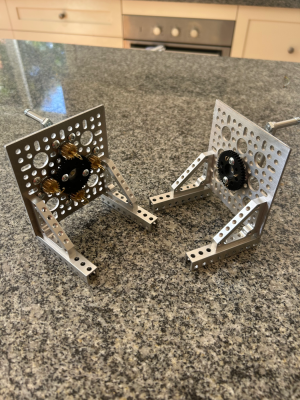
It’s based on the pictures in Frolich’s The Art of Ship-modelling. Most of the components are from goBilda.com and are very much like Meccano for those of us who are old enough to remember. I used some 3 and 4 mm brass rod for the shafts for the cogs and brass wire for the hooks. I could have added motors but I just wanted something that worked, more out of curiosity than any desire to go into the rope making business.
Anyway, here is an attempt at 3 strand hawser laid rope of made of 50 weight cotton (apologies for the non-nautical colours as it’s made from a random reel from the sewing box):
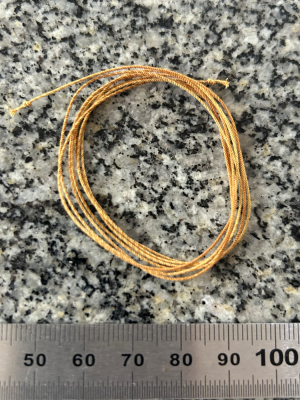
It’s about 0.7 mm in diameter. I started with strands of 1.2 m which shrank to 1.0 m after being laid up.
I just made sure there was a good amount of tension between the stocks throughout both twisting the strands and laying them up and I just kept winding until I felt the line was about to kink both times. I didn’t have any problems with the rope wanting to unravel when I cut it free - it just held its shape while I knotted the ends! In some ways, it’s surprising how can break down the strands and reform them into a new structure which retains its shape.
I’m happy to share more details if anyone is interested.
Kind regards
Salty
It’s based on the pictures in Frolich’s The Art of Ship-modelling. Most of the components are from goBilda.com and are very much like Meccano for those of us who are old enough to remember. I used some 3 and 4 mm brass rod for the shafts for the cogs and brass wire for the hooks. I could have added motors but I just wanted something that worked, more out of curiosity than any desire to go into the rope making business.
Anyway, here is an attempt at 3 strand hawser laid rope of made of 50 weight cotton (apologies for the non-nautical colours as it’s made from a random reel from the sewing box):
It’s about 0.7 mm in diameter. I started with strands of 1.2 m which shrank to 1.0 m after being laid up.
I just made sure there was a good amount of tension between the stocks throughout both twisting the strands and laying them up and I just kept winding until I felt the line was about to kink both times. I didn’t have any problems with the rope wanting to unravel when I cut it free - it just held its shape while I knotted the ends! In some ways, it’s surprising how can break down the strands and reform them into a new structure which retains its shape.
I’m happy to share more details if anyone is interested.
Kind regards
Salty

- Joined
- Jul 11, 2023
- Messages
- 445
- Points
- 238

@Salty , a very nice ropewalk construction. I would be very interest in replicating myself. I figure some of the parts from the web site. However, I'm quite unclear on how you setup the brass rod/hook to the cogs on both side? how do you hold it in place? do you have the parts name or link for the brass rod/hook?
Last edited:
- Joined
- Mar 1, 2023
- Messages
- 211
- Points
- 298
Loracs
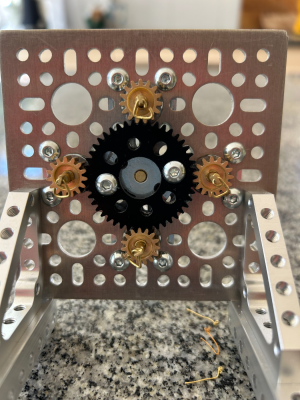
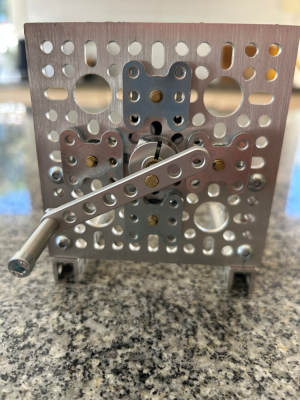
The brass rod passing through the brass cogs is held in place with small C clamps front and back made of wire and held in place with superglue. In the front, the C clamp should be glued to the cog as well so the wire hook spins. The brass rod passing through the bigger plastic cog is mounted on a steel hub with two screws which pass through the plate and is held in place from the back with a clamping collar.
The hooks were just something I made from wire. The brass rod came from the local hobby shop. I filed a flat section on each side to help drill the holes. It’s easier to start on a flat surface and kinder on drill bit if you only have 1 mm to drill through!
Here are some close ups which show the set-up:
Kind regards
Salty
The brass rod passing through the brass cogs is held in place with small C clamps front and back made of wire and held in place with superglue. In the front, the C clamp should be glued to the cog as well so the wire hook spins. The brass rod passing through the bigger plastic cog is mounted on a steel hub with two screws which pass through the plate and is held in place from the back with a clamping collar.
The hooks were just something I made from wire. The brass rod came from the local hobby shop. I filed a flat section on each side to help drill the holes. It’s easier to start on a flat surface and kinder on drill bit if you only have 1 mm to drill through!
Here are some close ups which show the set-up:
Kind regards
Salty
- Joined
- Jul 11, 2023
- Messages
- 445
- Points
- 238
@Salty this is great... thanks a lot for the pictures, it helps a lot. HA!! you filled a brass rod then drill a hole.... genius! Liking the c-clamp idea too.
Will be looking further and come back if I have more questions. Greatly appreciate your help and feedback. One thing I may look into is to have ball bearings at the center with a hex shaft that protrude back and use a drill as motor.
A practical question: is it ok to have the center cog in metal too? or if for less friction plastic to brass?
Will be looking further and come back if I have more questions. Greatly appreciate your help and feedback. One thing I may look into is to have ball bearings at the center with a hex shaft that protrude back and use a drill as motor.
A practical question: is it ok to have the center cog in metal too? or if for less friction plastic to brass?
- Joined
- Mar 1, 2023
- Messages
- 211
- Points
- 298
Loracs
In GoBilda, for two cogs to properly mesh, the sum of the teeth needs to be some multiple of 60 - e.g. 12/48, 15/45, or 30/90 etc. For some unknown reason, I used a 15 tooth brass cog but there weren’t any metal cogs with 45 teeth, so I had to make do with black acetate (nylon). They seem sturdy enough and are nicely made. If you used a 12 tooth brass cog, there is a 48 tooth aluminium cog which would work as well.
The C clamps are made of brass wire. I just wound the wire around the rod, but cut it with a gap few millimetres between the ends. After pinching the ends almost back together, you can force the wire back onto the rod and secure it with superglue.
Kind regards
Salty
In GoBilda, for two cogs to properly mesh, the sum of the teeth needs to be some multiple of 60 - e.g. 12/48, 15/45, or 30/90 etc. For some unknown reason, I used a 15 tooth brass cog but there weren’t any metal cogs with 45 teeth, so I had to make do with black acetate (nylon). They seem sturdy enough and are nicely made. If you used a 12 tooth brass cog, there is a 48 tooth aluminium cog which would work as well.
The C clamps are made of brass wire. I just wound the wire around the rod, but cut it with a gap few millimetres between the ends. After pinching the ends almost back together, you can force the wire back onto the rod and secure it with superglue.
Kind regards
Salty
Last edited:
- Joined
- Mar 1, 2023
- Messages
- 211
- Points
- 298
I just noticed there is a heater in the stern cabin:
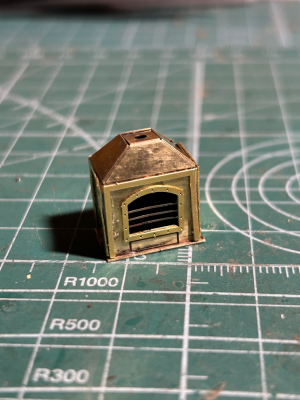
It’s in the plans, but the instructions to build it don’t appear until the last page in the book. If I waited until then it would be too late…
I also decided to paint the gunwales:
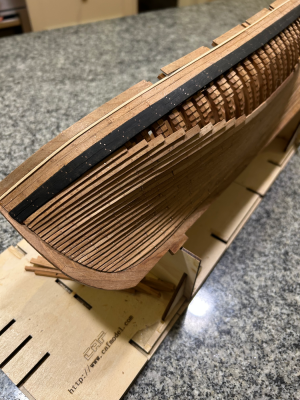
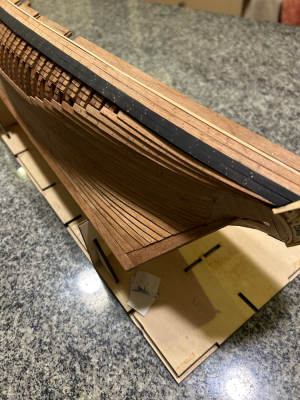
It’s just acrylic paint. It’s a nice matte finish and the copper nails show through just enough without being too shiny.
Kind regards
Salty
It’s in the plans, but the instructions to build it don’t appear until the last page in the book. If I waited until then it would be too late…
I also decided to paint the gunwales:
It’s just acrylic paint. It’s a nice matte finish and the copper nails show through just enough without being too shiny.
Kind regards
Salty
- Joined
- Mar 1, 2023
- Messages
- 211
- Points
- 298
Here is Le Coureur with all her deck beams and carlings. Most of the beams had been made previously to help with the fit out, so it was just a matter of rechecking the notches for the carlings were right and then installing the carlings.
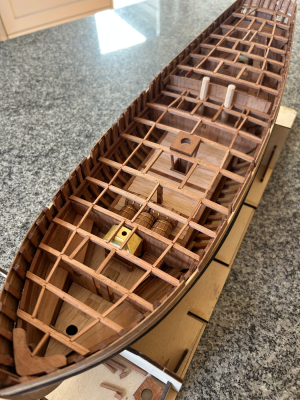
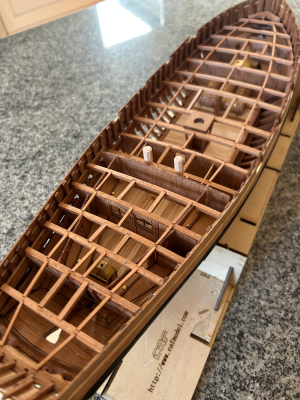
The instructions say to use 2x2 and 4x4mm for the carlings, but 4x4mm is too thick for the beams. Luckily, the kit comes with 3x3mm which is just right and I can’t really see where else to use it on the model.
All the fit out has been glued in place and I just hope it stays that way as I will struggle to fix any thing which comes loose.
Kind regards
Tom
The instructions say to use 2x2 and 4x4mm for the carlings, but 4x4mm is too thick for the beams. Luckily, the kit comes with 3x3mm which is just right and I can’t really see where else to use it on the model.
All the fit out has been glued in place and I just hope it stays that way as I will struggle to fix any thing which comes loose.
Kind regards
Tom
- Joined
- Mar 1, 2023
- Messages
- 211
- Points
- 298
Thank you to everyone who has been supporting my diary.
The instructions say to lay the deck next, but I want to build the hatches and doghouses as the deck will need to be laid around them.
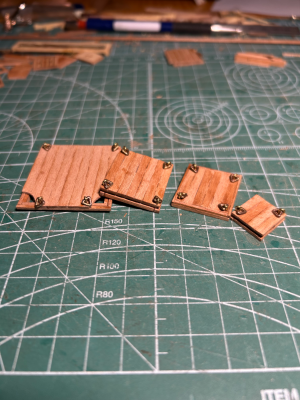
The hatch on the left covers the cargo area and has openings for the hawsers.
Boudroit and Berti seem to show the hatches and doghouses sitting on the frames. Interestingly though, it also seems there was also a lip around the hatches to stop water washing over the deck going below, but this isn’t including in the kit.
Here are the doghouses:
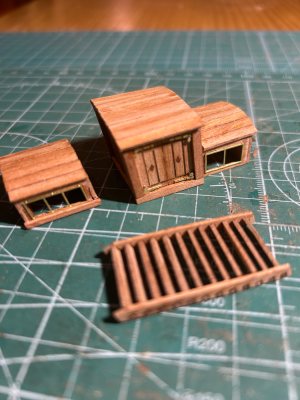
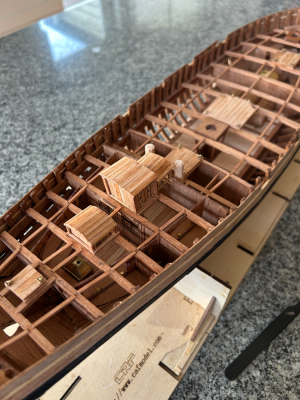
Unfortunately, the hinges don’t work. It’s just too tricky to get everything in place, but I am pleased all the same. The ladder leads down to the officers’ cabin.
Kind regards
Salty
The instructions say to lay the deck next, but I want to build the hatches and doghouses as the deck will need to be laid around them.
The hatch on the left covers the cargo area and has openings for the hawsers.
Boudroit and Berti seem to show the hatches and doghouses sitting on the frames. Interestingly though, it also seems there was also a lip around the hatches to stop water washing over the deck going below, but this isn’t including in the kit.
Here are the doghouses:
Unfortunately, the hinges don’t work. It’s just too tricky to get everything in place, but I am pleased all the same. The ladder leads down to the officers’ cabin.
Kind regards
Salty
- Joined
- Mar 1, 2023
- Messages
- 211
- Points
- 298
Next is the deck. I’m not planking all of the port side so you can see some of the fit out.
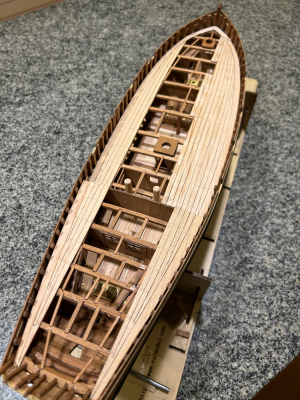
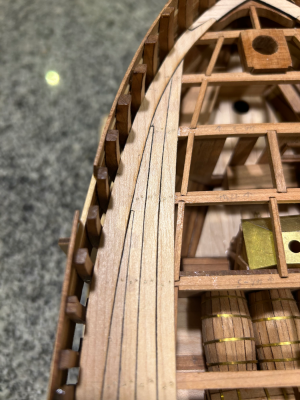
I decided to use an ink marker for the seams as well as 0.8 mm toothpick plugs. The marker has a tendency to bleed a little across the grain, but it’s only on the surface and can be sanded away. Although the plugs are quite faint, I think they are OK because they could easily overpower the white maple deck. I do the plugs before I glue the planks in place and finish them with a scraper as I think it gives a better finish than sanding.
Kind regards
Salty
I decided to use an ink marker for the seams as well as 0.8 mm toothpick plugs. The marker has a tendency to bleed a little across the grain, but it’s only on the surface and can be sanded away. Although the plugs are quite faint, I think they are OK because they could easily overpower the white maple deck. I do the plugs before I glue the planks in place and finish them with a scraper as I think it gives a better finish than sanding.
Kind regards
Salty