• Ships of Scale has incorportated an extra level of security when you log In. Please follow on-screen prompts to acknowledge that you are not a robot via a "Check Box" or a "Pictorial Check Box Puzzle". This is needed due to higher level of AI Activity Security.
  • SUBSCRIBE TO SHIPS IN SCALE TODAY!

    The beloved Ships in Scale Magazine is back and charting a new course for 2026!
    Discover new skills, new techniques, and new inspirations in every issue.

    NOTE THAT OUR NEXT ISSUE WILL BE July/August 2026
  • Win a Free Custom Engraved Brass Coin!!!
    As a way to introduce our brass coins to the community, we will raffle off a free coin during the month of August. Follow link ABOVE for instructions for entering.

Le Requin-Zebec-1750 POF 1:48 (ZHL)

Paper modeller here. Impressive build and skill so far. Congratulations @Daniel20 !!!
I could never do wooden models...
I am designing a paper xebec 1:250 scale.
I researched days over days for it on the web, especially regarding the lateen rigging.

BUT there remains one question I could not find an answer to:
Thanks to the low profile xebecs could be propelled by oars and that's why there are many wooden models containing oars stowed away on quarter deck or bundled up and hanging from the side of the hull.
But there are no benches between the cannons. Did they pulled the oars while standing? Is that even feasible?

I read through many xebec build threads here on SOS. All astonishing builds with expertise and good research. But there I couldn't find an answer to my question, too. The oars subject was never mentioned or I failed to notice.

What do you guys think?
Hello ElMax, you ask a great question that now I will try to find an answer to. My immediate thought is the men rowed from a kneeling position but wow that would be hard on the knees. And thank you for your compliments.
 
Hello ElMax, you ask a great question that now I will try to find an answer to. My immediate thought is the men rowed from a kneeling position but wow that would be hard on the knees. And thank you for your compliments.
I don't know much about rowing but imagine a pirate crew after rowing on the knee they could not board any merchant ship or fight the navyROTF
 
Hey Daniel, just catching up on your build. Beautiful work thus far! I’m looking forward to seeing your future progress.
Don’t worry about your log sitting idle due to other obligations, it’s not going anywhere. Case in point, my ship build…lol. My granddaughter reminded me recently I need to work on my ship. I have been told by a 9 year old…haha!
 
Hey Daniel, just catching up on your build. Beautiful work thus far! I’m looking forward to seeing your future progress.
Don’t worry about your log sitting idle due to other obligations, it’s not going anywhere. Case in point, my ship build…lol. My granddaughter reminded me recently I need to work on my ship. I have been told by a 9 year old…haha!
Thanks Dean, for now the other obligations are piling up.
 
Hey Daniel, just catching up on your build. Beautiful work thus far! I’m looking forward to seeing your future progress.
Don’t worry about your log sitting idle due to other obligations, it’s not going anywhere. Case in point, my ship build…lol. My granddaughter reminded me recently I need to work on my ship. I have been told by a 9 year old…haha!
If you get told that by the Admiral, then you really have some serious thinking to do…
 
Last edited:
My immediate thought is the men rowed from a kneeling position but wow that would be hard on the knees.
Good afternoon, Daniel! A xebec is not a galley; oars were used rarely—only during maneuvers. Consequently, xebecs were not built with dedicated rowing benches, as these would have been useless most of the time and would have caused significant obstruction.
The rowers worked standing up, with one men to an oar on small merchant vessels, and sometimes two men if the ship was large and heavily armed.
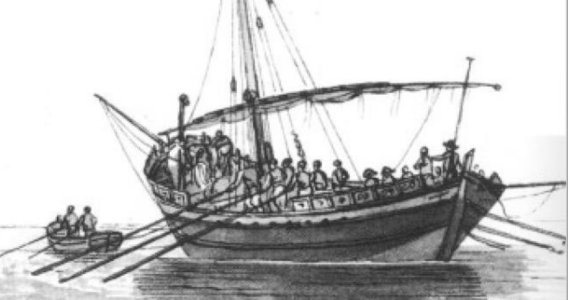
I have come across at least one image of a Mediterranean xebec from that era showing rowers standing at their oars. It is interesting that the stern platform has been removed from the ship.

dtckf.jpg

During maneuvers on xebecs, the rowers faced the bow of the ship. Interestingly, the rowers on the pilot boat towing the xebec also face forward so they can see where to maneuver. The vessel is likely heading toward a cargo berth with a particularly complex navigable channel.
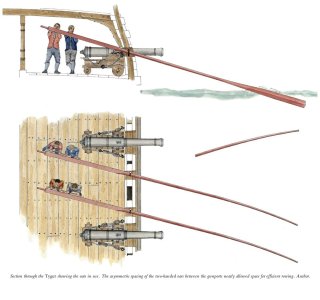
The image shows a single rower at each oar. For two people, the oars featured special handles, as shown in the picture below.

8XtXk-GP-ok (1).jpg
 
Good afternoon, Daniel! A xebec is not a galley; oars were used rarely—only during maneuvers. Consequently, xebecs were not built with dedicated rowing benches, as these would have been useless most of the time and would have caused significant obstruction.
The rowers worked standing up, with one men to an oar on small merchant vessels, and sometimes two men if the ship was large and heavily armed.
I have come across at least one image of a Mediterranean xebec from that era showing rowers standing at their oars. It is interesting that the stern platform has been removed from the ship.

View attachment 643083

During maneuvers on xebecs, the rowers faced the bow of the ship. Interestingly, the rowers on the pilot boat towing the xebec also face forward so they can see where to maneuver. The vessel is likely heading toward a cargo berth with a particularly complex navigable channel.
The image shows a single rower at each oar. For two people, the oars featured special handles, as shown in the picture below.

View attachment 643084

Thanks for this information, Igor, great illustrations. I have seen conflicting information on this subject, not surprising though considering the amount of time gone by. Below I copied and pasted a query I did on Copilot however I have found Copilots answers are not always accurate.


What position did men assume while rowing on 16th century xebecs ships, standing or sitting?


Men rowing on 16th‑century xebecs rowed sitting, not standing.

The evidence comes from how xebecs were built and how their oars were used:

The rowing position​

  • Xebecs evolved from Mediterranean galleys, which universally used seated rowers on benches.
  • Contemporary descriptions note that xebecs carried 18 oars for maneuvering in calms, directly inherited from galley practice.
  • Their low freeboard (low height of the deck above the water) made standing rowing impractical and unsafe.
  • No period source describes standing rowing on xebecs; all surviving technical descriptions align them with galley‑style seated rowing.

⚓ Why seated rowing was necessary​

  • Long, heavy sweeps required leverage best achieved from a fixed seated position.
  • Stability: standing rowers would raise the center of gravity on a narrow, shallow‑draft hull.
  • Coordination: Mediterranean rowing systems relied on synchronized seated crews.

Summary​

Xebecs were fast, hybrid sail‑and‑oar vessels. When using oars, their crews rowed seated, just like galley crews, because the hull form, oar length, and Mediterranean rowing tradition all required it.

If you want, I can also explain how many men rowed each oar, or how rowing differed between xebecs and full galleys.
 
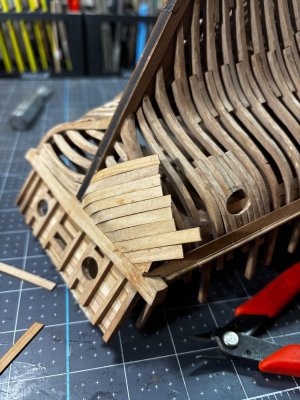
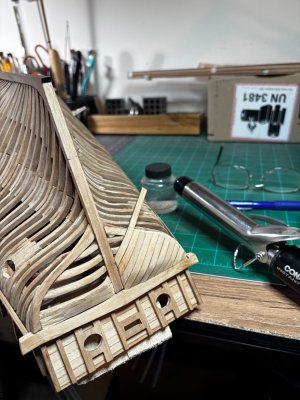
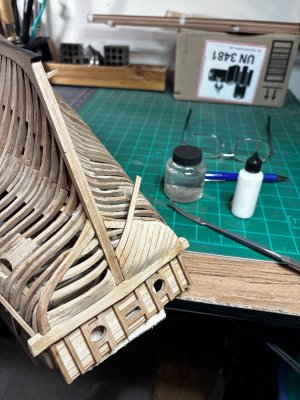
Good Monday morning all. I'm back working in the shipyard slowly planking the stern section below the transom. There is a considerable bulge requiring soaking the strakes then bending with my trusty curling iron (which so far is the best bending tool I've found). I had neglected to sand off the char at the stern post edge before I started the planking, so I had occasion to use my riffler file in the limited space which worked out perfectly.

IMG_2086.jpeg
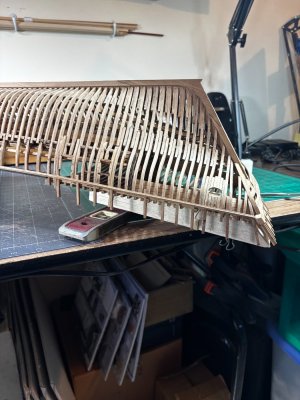
IMG_2088.jpegIMG_2091.jpeg

It would appear I have my ship perched precariously over the edge but it's just an illusion of sorts as you'll see in this next shot.

IMG_2092.jpeg
Sometimes this is the only workable position I can get.

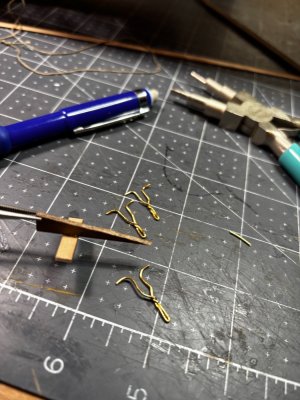
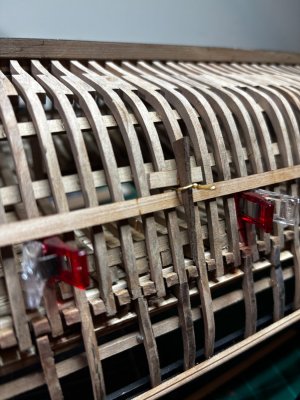
Next, I've been experimenting on planking hold down devices, the rib spacing is so close, and they are so thin I came up with a wedge system I had used previously on my Bluenose. Metal wire loops that you place between the ribs, turn it 90 degrees then place in the wedge, and it firmly holds the plank against the ribs.

IMG_2055.jpegIMG_2054.jpeg

That's it for now, thanks for looking in.
Till next time.
 
I have seen conflicting information on this subject
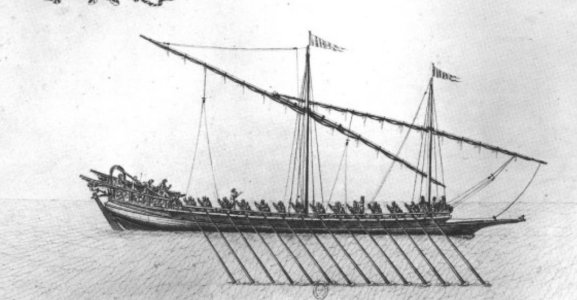
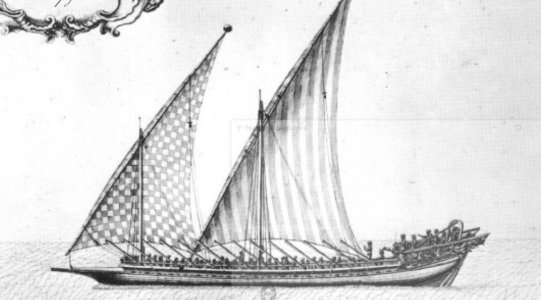
Dear Daniel! I, too, have come across conflicting information. The *Methodological Encyclopedia* of 1780 contains a description of the Mediterranean felucca. It states, among other things, that the rowers would remove the slatted hatch covers located between the guns and sit directly on the deck, bracing their feet against the deck beams below.


However, if you look at the blueprints of such ships, it is evident that sitting in that manner is very difficult. It is possible that this method was used only in dire situations—for instance, under enemy fire—whereas under normal circumstances, the rowers operated their oars while standing.

In various images of feluccas from that era, it is impossible to tell whether the rowers are standing, sitting on special benches, or sitting on the deck with their legs dangling into the hatches. I didn't find any paintings depicting xebecs with oars. The paintings of feluccas shown below most likely feature special benches, just like those found on typical galleys.

фелюка 1.jpg
фелюка 2.jpg
 
Last edited:
Good Monday morning all. I'm back working in the shipyard slowly planking the stern section below the transom. There is a considerable bulge requiring soaking the strakes then bending with my trusty curling iron (which so far is the best bending tool I've found). I had neglected to sand off the char at the stern post edge before I started the planking, so I had occasion to use my riffler file in the limited space which worked out perfectly.

View attachment 643089
View attachment 643095View attachment 643096

It would appear I have my ship perched precariously over the edge but it's just an illusion of sorts as you'll see in this next shot.

View attachment 643092
Sometimes this is the only workable position I can get.

Next, I've been experimenting on planking hold down devices, the rib spacing is so close, and they are so thin I came up with a wedge system I had used previously on my Bluenose. Metal wire loops that you place between the ribs, turn it 90 degrees then place in the wedge, and it firmly holds the plank against the ribs.

View attachment 643094View attachment 643093

That's it for now, thanks for looking in.
Till next time.
Good morning Daniel. How are things in the "Great state of Texas? Man, this is such an interesting construction. I have massive buyers remorse not buying this Xebec kit, however with my robust modelling I think many of these tiny frames etc would be broke by now ROTF. You are owning this. Cheers Grant
 
Good morning Daniel. How are things in the "Great state of Texas? Man, this is such an interesting construction. I have massive buyers remorse not buying this Xebec kit, however with my robust modelling I think many of these tiny frames etc would be broke by now ROTF. You are owning this. Cheers Grant
Thanks Grant, along the gulf coast we are finally starting to cool down, and the politicians are heating up! Ha! The upcoming holiday season is my favorite time of the year. You've no need for buyer's remorse Grant, you already have a premier version in your inventory.
 
Daniel, those planking clamps are brilliant! That's one idea I may have to "borrow". :cool:
She is coming along quite nicely. Well done!
 
Back
Top