


Thanks, Dean. The joinery obligation on each deck is getting to be a bit much so I may build a 1:72 plane soonThat is unexpected and beautiful! Congrats on completing the third deck.
 .
.
 |
The beloved Ships in Scale Magazine is back and charting a new course for 2026! Discover new skills, new techniques, and new inspirations in every issue. NOTE THAT OUR NEXT ISSUE WILL BE July/August 2026 |
|
 |
As a way to introduce our brass coins to the community, we will raffle off a free coin during the month of August. Follow link ABOVE for instructions for entering. |
|
Thanks, Dean. The joinery obligation on each deck is getting to be a bit much so I may build a 1:72 plane soonThat is unexpected and beautiful! Congrats on completing the third deck.
.
Merci beaucoup, Olivier!Chapeau, mon Ami! Bien fait!
I ran out of superlatives in English…
Thanks much, Stephan. I miss seeing your work!I agree with Brad, clean and perfect.


Me too—I haven’t been able to work on the ship in ages. My arthritis is really acting up. I can’t do any precision work, so I’m writing a lot for *De Modelbouwer* these days, making rope walks in between, and taking care of the necessary household jobs. We’re waiting for better weather—with less rain and warmer temperatures—so my joints can loosen up again.Thanks much, Stephan. I miss seeing your work!

What a nice composition of lines and curves, Paul. Top notch!Hello Friends!
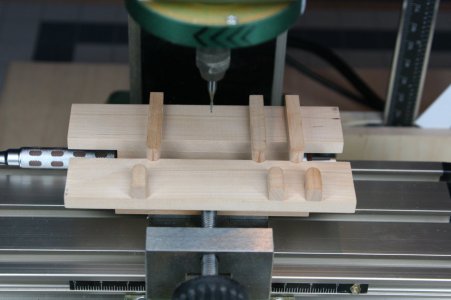
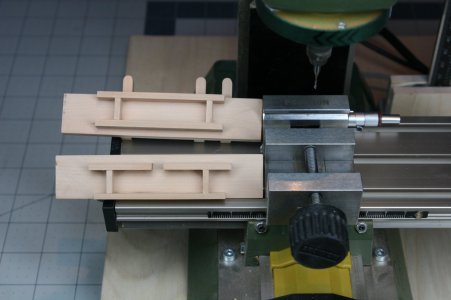
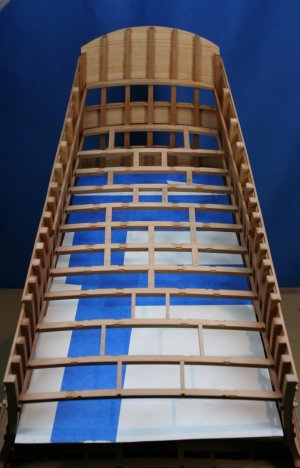
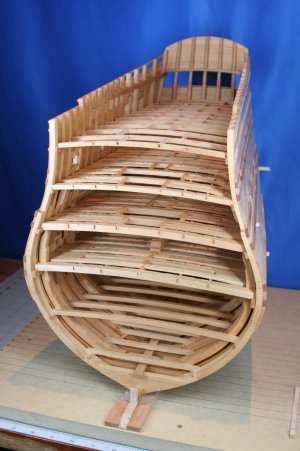
Unexpected modeling time led to an expedited completion of the third deck. Here is where she sits as of today:
View attachment 587671
View attachment 587670
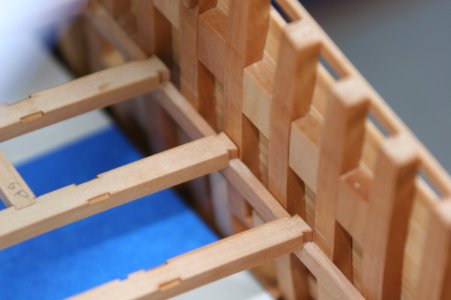
A few details:
View attachment 587674
View attachment 587675
View attachment 587673
View attachment 587672
This open-end stern section allows us to see how the construction of the decks is getting lighter the higher we go:
View attachment 587676
Thanks for visiting!

Paul, your joinery is exquisite. I really like the outcome of the horizontal knees; a mortice style joint makes good sense. It's interesting how quickly the light diminishes on the lower decks, what dungeons those lower decks must have been.Hello Friends!
Unexpected modeling time led to an expedited completion of the third deck. Here is where she sits as of today:
View attachment 587671
View attachment 587670
A few details:
View attachment 587674
View attachment 587675
View attachment 587673
View attachment 587672
This open-end stern section allows us to see how the construction of the decks is getting lighter the higher we go:
View attachment 587676
Thanks for visiting!

Excellent plan, be aware…1 leads to 100!Thanks, Dean. The joinery obligation on each deck is getting to be a bit much so I may build a 1:72 plane soon
Thank you kindly, Peter! The open end does allow some unique site-lines to see these details.What a nice composition of lines and curves, Paul. Top notch!
Regards, Peter
That's for sure, Daniel! There is a staircase near the front of my stern section but nothing else that would have allowed natural light into the depths.Paul, your joinery is exquisite. I really like the outcome of the horizontal knees; a mortice style joint makes good sense. It's interesting how quickly the light diminishes on the lower decks, what dungeons those lower decks must have been.

Outstanding work my dear friend Paul!Hello Friends!
Unexpected modeling time led to an expedited completion of the third deck. Here is where she sits as of today:
View attachment 587671
View attachment 587670
A few details:
View attachment 587674
View attachment 587675
View attachment 587673
View attachment 587672
This open-end stern section allows us to see how the construction of the decks is getting lighter the higher we go:
View attachment 587676
Thanks for visiting!
Thanks for stopping by - and for the nice comment, Shota!Outstanding work my dear friend Paul!
Thanks, Chris. I'm pretty pleased with the way this section model shows the construction details - especially in a ship of this size.Nice tip Paul thanks for sharing ! The build is looking amazing as usual
He is risen indeed!He is Risen!
Ah, the tape solves the problem of getting filler into the wood fibers around the hole. Looking forward to your test results.It really shows the complex aspects of ship construction of this era brilliantly.
I have been experimenting with some new techniques while lining out the lower planking runs on the hull I thought may be of interest. I want a subtle appearance with treenails. You take a piece of packing tape - and apply it over your planking, then drill the holes for the nails - at this scale .4mm - thru the tape into the wood. Then rub in walnut wood filler over the nail holes on top of the tape, let it dry and peel off tape. You have perfect subtle nailing with less trouble.
I also ordered this product this morning - sounds similar to your mix of tung with drying additives. I love the Liberon product range - should be a good comparison with Shellac.
amazon.com/Liberon-003815-Finishing-Oil-Liter/dp/B000TAWCIO


I agree with you, Christian! I am really happy to be able to see (and show) the construction I am working so hard on. I have looked at lots and lots of stern section models. Many leave the interior empty, others finish it out like a doll house. This is more in the middle, and I have to say it is turning out better than I envisioned. This example is also longer than most stern sections - just about 1/4 of the total ship length. I think this is giving a feeling of substance to the model. In fact, I wish I had made it a bit longer so I could show the termination of the quarter deck - but I wasn't smart enough to see that issue when I started. Hindsight...The last foto is looking really impressive. It's really nice, to see all the different beams and timbers of the construction.