• Win a Free Custom Engraved Brass Coin!!!
    As a way to introduce our brass coins to the community, we will raffle off a free coin during the month of August. Follow link ABOVE for instructions for entering.
  • PRE-ORDER SHIPS IN SCALE TODAY!

    The beloved Ships in Scale Magazine is back and charting a new course for 2026!
    Discover new skills, new techniques, and new inspirations in every issue.

    NOTE THAT OUR FIRST ISSUE WILL BE JAN/FEB 2026

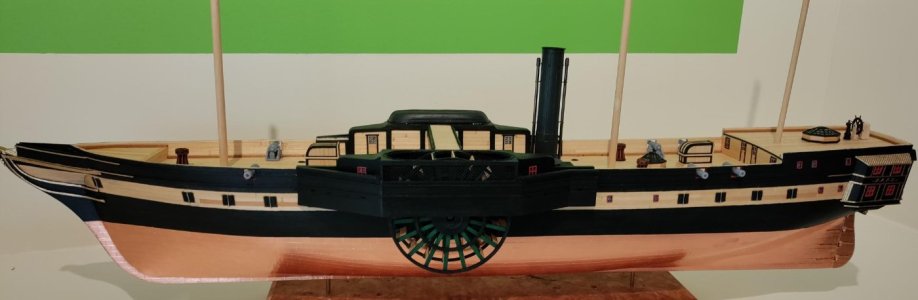
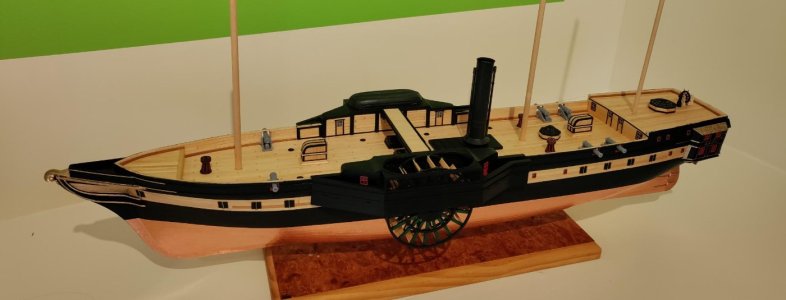
L'Orenoque Mamoli 1:100 scale

so as i know nothing of cannons i went looking but my overall impression is of unpainted wood... if you want to go for some colour i would suggest ocre, either yellow or red. or somewhere in between, as in the photo of mines from Rustrel in france. This was widely used in france for centuries. Lovely deck fixtures , nicely made and she is looking very shipshape, but I'll wait to see where you are placing your hold access before commenting the decks ;). I like photoetch gratings at that scale or smaller.

02-rustrel-vue-d-en-hautjpg-2_12828.jpeg
 
so as i know nothing of cannons i went looking but my overall impression is of unpainted wood... if you want to go for some colour i would suggest ocre, either yellow or red. or somewhere in between, as in the photo of mines from Rustrel in france. This was widely used in france for centuries. Lovely deck fixtures , nicely made and she is looking very shipshape, but I'll wait to see where you are placing your hold access before commenting the decks ;). I like photoetch gratings at that scale or smaller.

View attachment 576998
Martin! Thanks for the insight! I'll see what I can do for color based on this great photo. I also look forward to seeing where I'll place my hold access ROTF

Blessings. Peace. Gratitude.
Chuck
 
Fantastic sunlights and companionways!
Namabiiru! Thank you! But there's a problem. I like the companionways so much I'm thinking about a do-over on the crankhouses. I'm going to enlarge them a bit so we'll have plenty of space for activities. I'll keep the green windows to satisfy Paul. I am also thinking about adding cove molding to the bottoms of the skylights. Here's what happened: I have been pretty happy so far with my ability to manage the wood and black color scheme inboard. Somehow I got it in my head that I couldn't do the crankhouses the in wood with black. Go figure.

Blessings. Peace. Gratitude.
Chuck
 
Namabiiru! Thank you! But there's a problem. I like the companionways so much I'm thinking about a do-over on the crankhouses. I'm going to enlarge them a bit so we'll have plenty of space for activities. I'll keep the green windows to satisfy Paul. I am also thinking about adding cove molding to the bottoms of the skylights. Here's what happened: I have been pretty happy so far with my ability to manage the wood and black color scheme inboard. Somehow I got it in my head that I couldn't do the crankhouses the in wood with black. Go figure.

Blessings. Peace. Gratitude.
Chuck
Bigger crankhouses sounds good to me, they look to be a bit on the narrow side for the mechanics involved. Did you take the size direct from l'Aigle ?
 
Final shots for today. But, before we get the treat . . .

I did some searching for photo etch gratings and came up with the big ZERO. I did find that Model Shipways has wooden gratings in cherry at 0.8 mm openings so I'm likely to give that a try if I don't get any more advice - looking at all of you! ROTF

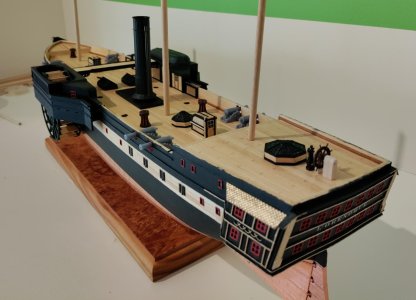
Look aft. I decided to go with the dead-aft location for the wheel (which needs finishing) and you can see the binnacle just forward of the wheel. I'm a tad bit concerned about the position of the horse/traveler for the boom sheet - (if I got the terms wrong I know you know what I'm talking about;)).

Blessings. Peace. Gratitude.
Chuck

lo today 1.jpglo today 2.jpglo today 3.jpg
 
Bigger crankhouses sounds good to me, they look to be a bit on the narrow side for the mechanics involved. Did you take the size direct from l'Aigle ?
Martin! I took the size directly from l'Aigle - but she carries 3. Spirit guide at it again - wider was my thought too. I went with two crankhouses based on what I could understand from French the plans for "similar" ships and my English "Paddle Warships" reference book.

LO crank house laigle 2 plus.jpg

Blessings.
Chuck
 
Martin! I took the size directly from l'Aigle - but she carries 3. Spirit guide at it again - wider was my thought too. I went with two crankhouses based on what I could understand from French the plans for "similar" ships and my English "Paddle Warships" reference book.

View attachment 577017

Blessings.
Chuck
Having looked again then it seems there is enough width for the crank webs, but there are only two cylinders on l'Aigle , as you say , so the third light is not obligatory. You have plenty of space anyway in that area.
 
by the way, those guns look huge. Wouldn't want to mess with her.
Exactly! Regardless of her origins, she was a warship and she carried large modern guns. IMHO it's neat to start seeing the difference between the floating bordello/casino the kit would have you build and what she might have looked like :p.

Blessings.
Chuck
 
Chuck,
Did you try Syren for your gratings? Never dealt with them personally but others give them good reviews.

Roger
Roger! Thank you for the thought. I did check - they don't have the right scale. Not an issue of quality - I've always been happy with my purchases from Syren.

Blessings.
Chuck
 
Namabiiru! Thank you! But there's a problem. I like the companionways so much I'm thinking about a do-over on the crankhouses. I'm going to enlarge them a bit so we'll have plenty of space for activities. I'll keep the green windows to satisfy Paul. I am also thinking about adding cove molding to the bottoms of the skylights. Here's what happened: I have been pretty happy so far with my ability to manage the wood and black color scheme inboard. Somehow I got it in my head that I couldn't do the crankhouses the in wood with black. Go figure.

Blessings. Peace. Gratitude.
Chuck
What size/style gratings are you looking for? I have a couple of PE options in the stash serving no real purpose. Grabbed them when the LHS in Newport went out of business. Yours if they might suit your needs.
 
What size/style gratings are you looking for? I have a couple of PE options in the stash serving no real purpose. Grabbed them when the LHS in Newport went out of business. Yours if they might suit your needs.
Namabiiru! Thanks for the offer shipmate! I'm thinking flat gratings with openings of about 0.8 mm. Flat because they will lie right on the deck. The combings will be no more that 1/32" high. The openings scale out to about 3 inch squares. You be the judge my friend. If you think you have something that might fit the bill I'd love to have them. :)

Blessings. Peace. Gratitude.
Chuck
 
What ho, shipmates! I don't know about you, but for me it's Friday Funday!

The plan for the weekend is: new crankhouses; work on the hatches (expecting elves from ModelShipways this afternoon with the tiny gratings I ordered:p); work on other deck furniture - pumps, cinder trays.

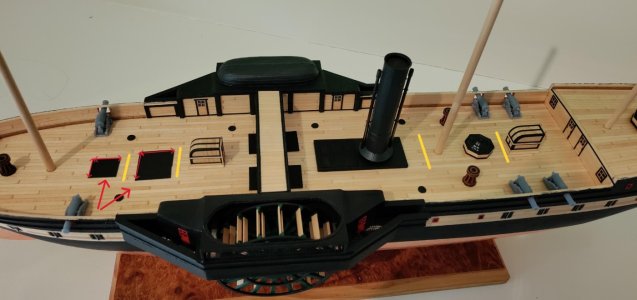
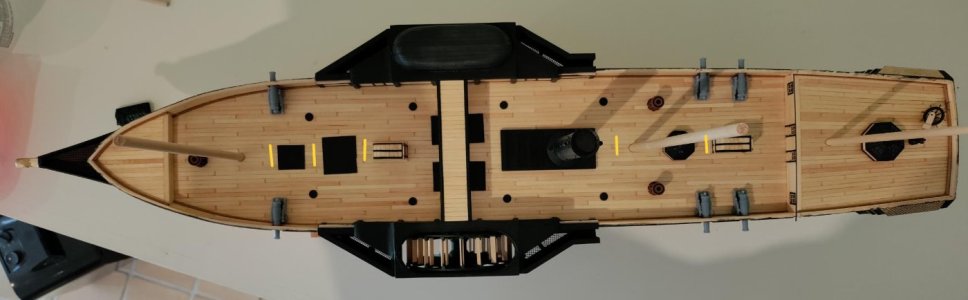
I took some time this morning to work on the redisign of the crankhouses and to scale out the hatches. I used black artists paper cut to size to give an idea of the footprint of these objects on deck. Martin got me thinking about busyness and accessability. so I decided to get a picture of the space these things will occupy once on deck.

Below are two shots of L'Orenoque. The hatch dimensions are based on the proportions of the hatches on Descartes. I used Descartes because I have the deck plan and she's closest to L'Orenoque in hoursepower which I have decided to equate with size (both ships also had three masts). The main hatch on Descartes was square measuring 21% of the width of the deck. She also had a smaller secondary hatch. On L'Orenoque the main hatch is 1 1/8 square and the secondary hatch is 3/4" square. I think that the footprints of the furniture pass the business test and the test for scale accessability. In other words, my artist's eye likes what it sees. Happy to hear from you about hatch placment and necessity for the secondary hatch.

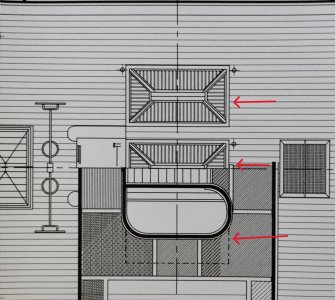
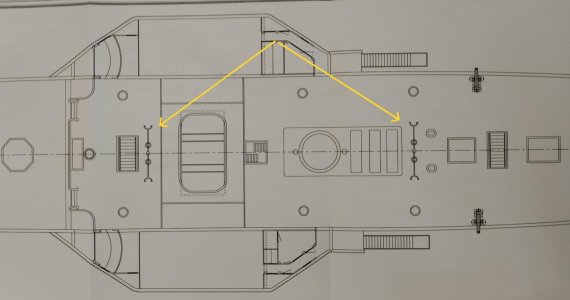
The yellow lines are proposed positions for the pumps, one set forward one set aft. I have included part of L'Aigle's deck plan to show the form and placement of her pumps. I notice that her pumps are located mid-ship with the forward pump just forward of the funnel base. I don't have that placment marked on L'Orenoque's pics, but I'll need to think about the fact that the crankhouses on L'Aigle were aft of the funnel base and the reverse is true on L'Orenoque. I think pumps immediately forward of the funnel base on L'Orenoque would interfere with the engineering space and the engine's operation.

I look forward to your imput, shipmates!

Blessings. Peace. Gratitude.
Chuck

lo deck furniture 1.jpg

lo deck furniture 2.jpg

lo deck furniture l'aigle pumps.jpg
 
First of all, Chuck, thank you for being so open to discussion. It is refreshing, and also intellectually stimulating to bend my head around some of your interrogations.
I would indeed be basing any opinion i may have largely upon Descartes, allthough the layout of the Sphinx series is similar in as much as the entire centre section is occupied with boilers, machinery and coal bunkers. this divides the ship into two halves, with a main loading hatch descending through the ship to the hold space.... at both the front and the rear. These seem to have been equiped with removable stairways, allthough there are secondary stairwells at both front and rear presumably for use when loading and to increase crew access. The loading hatches would seem to be placed for the use of the gaff spars as a loading crane, as well as Burton pendants, so relatively close behind the masts.
The main difference between the Descartes plan and L'Orenoque is the poop castle. Personally i would have expected the rear companionway/stairwell to have been inside such a structure, while the main rear loading hatch would as i have said, be equiped with removable stairs. I would expect a forward companionway to access crew quarters and perhaps a galley at the front of the ship rather than the forward hold, this would perhaps equate to the secondary hatch you have indicated.
The Descartes carries one pump below decks behind the mast, for the rear hold and bilges, and a second above decks which covers the forward hold towards midships. This is true for both the Sphinx and the L'Aigle also, allthough they are all above decks.
I would imagine for stability that the boilers and bunkers would be built to sit as low as possible into the bilges of the ship, leaving little or no empty space beneath them to fill with bilge water.
These are just thoughts and observations, bear in mind that i am no expert.
You may wish to do a little waltz on the dance floor, or maybe not !
I advise taking time over this sort of work, especially when there is so little real documentation. Build some masts while you are reflecting !
 
Last edited:
The power output of any reciprocating engine (HP) is measured by the formula CPLAN where:

N= Revolutions of, in this case, the propeller shaft per minute
A= Area of the piston which varies by the square of the cylinder diameter. D
L= Length of the piston stroke in the cylinder
P= Average cylinder pressure throughout the piston stroke
C= Constant factor to convert to watts or hp.

The factor P is determined by a complex procedure using an instrument called an indicator. Fortunately in your case, boiler technology meant that the steam pressures were very low. The operating pressure range would have between 10-15 psi and whatever vacuum was created by the condenser. Therefore the factor P would not vary greatly between two engines of the same era.

N is also determined by the interaction between the engine and propeller and again would be similar for two of these massive slow turning engines.

The length of the stroke L is therefore proportional (not equal) to: HP/A, and of course A is proportional to the square of the diameter. D^2

Therefore: L(1)/L(2) = HP(1)xD(2)^2/HP(2)xD(1)^2

Long story short, the diameter of the path that the crank takes is equal to the length of the stroke. So if you know the power outputs of two similar engines plus the cylinder diameter of both you can calculate how much larger your crank house needs to be.

Roger
 
First of all, Chuck, thank you for being so open to discussion. It is refreshing, and also intellectually stimulating to bend my head around some of your interrogations.
I would indeed be basing any opinion i may have largely upon Descartes, allthough the layout of the Sphinx series is similar in as much as the entire centre section is occupied with boilers, machinery and coal bunkers. this divides the ship into two halves, with a main loading hatch descending through the ship to the hold space.... at both the front and the rear. These seem to have been equiped with removable stairways, allthough there are secondary stairwells at both front and rear presumably for use when loading and to increase crew access. The loading hatches would seem to be placed for the use of the gaff spars as a loading crane, as well as Burton pendants, so relatively close behind the masts.
The main difference between the Descartes plan and L'Orenoque is the poop castle. Personally i would have expected the rear companionway/stairwell to have been inside such a structure, while the main rear loading hatch would as i have said, be equiped with removable stairs. I would expect a forward companionway to access crew quarters and perhaps a galley at the front of the ship rather than the forward hold, this would perhaps equate to the secondary hatch you have indicated.
The Descartes carries one pump below decks behind the mast, for the rear hold and bilges, and a second above decks which covers the forward hold towards midships. This is true for both the Sphinx and the L'Aigle also, allthough they are all above decks.
I would imagine for stability that the boilers and bunkers would be built to sit as low as possible into the bilges of the ship, leaving little or no empty space beneath them to fill with bilge water.
These are just thoughts and observations, bear in mind that i am no expert.
You may wish to do a little waltz on the dance floor, or maybe not !
I advise taking time over this sort of work, especially when there is so little real documentation. Build some masts while you are reflecting !
Martin! I'm very happy to have all the input I can get! I managed to avoid building another bath-tub-toy on Harriet Lane because shipmates like you were willing to share expertise I couldn't have obtained in a lifelime. Take Roger's extraordinary solution to the precise size of the crank house! All of your input has made my build a better one. The historical record for L'Orenoque's details is practically non-existant. Without your help and Roger's I would have added ventillators :eek: among other errors that, but for you, I would certainly have made. I thank you all for your counsel!

I have been thinking through your post. I understand that the likelihood is that the main-deck skylight I built is not accurate. There should be a hatch aft. I also understand what you say about access to the lower decks being in the poop deck rather than an aft companionway. I'm not sure about your thoughts on the forward hatches and companion way. Are you suggesting that I delete the forward main hatch or the secondary hatch? Either way seems like your suggestion involves having only one hatch forward.

So, working from forward aft - one hatch aft of and close to the fore mast, then companion way, then crank houses, then one hatch aft of and close to the mainmast. If I adopt all of your suggestions, I delete one hatch forward and the maindeck skylight and the aft companion way.

I can get behind everything except for losing the aft companion way. The main reason I am likely to commit the heresey of inaccuracy-on-purpose is that I really like the companion ways:p! Your logic is forceful and fully supports not having it. My inner 8-year-old boy frequently ignores forceful logicROTF. Also, I spent the summer of 1978 aboard the USS Lexington CVA 16 cruising the Gulf of Mexico. I have many memories of that adventure, but I was always stuck by the notifications of what was "Officers Country." In this build, I transposed that separation between officers and crew to a line: the doors to officers country started at the poop. For that reason non-officers would need a way to get below. I also thought about L'Orenoque's actual uses. We know that, of her class, she led a much less glamorous life than some of her sister ships. For example, I recall that Magellan saw active service in the Crimean War. In any event, carrying troops was one of the things these ships did. Given the size of the ship, I imagine it was not small shipments of soldiers. Accordingly, there should be (my "logic") a forward AND an aft companion way to get the soldiers, and the crew, on deck or below decks without violating my fictional injunction against crossing the border of "officers country".

Now you know why I'll likely keep the aft companion way:).

As you say, Martin, I have time to keep thinking about things. Nothing is attached to the deck yet and I don't mind making extra tiny things. My admiral has a growing collection of "prototypes" which now include the first set of crank houses and will include the main deck skylight.

I very much hope that, as my spirit guide on this build, you'll keep sharing your wisdom with me - even when I fail to adopt some of it. [To the Administrators: We really do need a heart emoji or maybe jazz-hands?]ROTF

Blessings. Peace. Gratitude.
Chuck

 
The power output of any reciprocating engine (HP) is measured by the formula CPLAN where:

N= Revolutions of, in this case, the propeller shaft per minute
A= Area of the piston which varies by the square of the cylinder diameter. D
L= Length of the piston stroke in the cylinder
P= Average cylinder pressure throughout the piston stroke
C= Constant factor to convert to watts or hp.

The factor P is determined by a complex procedure using an instrument called an indicator. Fortunately in your case, boiler technology meant that the steam pressures were very low. The operating pressure range would have between 10-15 psi and whatever vacuum was created by the condenser. Therefore the factor P would not vary greatly between two engines of the same era.

N is also determined by the interaction between the engine and propeller and again would be similar for two of these massive slow turning engines.

The length of the stroke L is therefore proportional (not equal) to: HP/A, and of course A is proportional to the square of the diameter. D^2

Therefore: L(1)/L(2) = HP(1)xD(2)^2/HP(2)xD(1)^2

Long story short, the diameter of the path that the crank takes is equal to the length of the stroke. So if you know the power outputs of two similar engines plus the cylinder diameter of both you can calculate how much larger your crank house needs to be.

Roger
Roger! Thank you! You are a wonder-of--the world! And a reason why I enjoy sharing my work and thoughts and errors on SOS!

Blessings. Peace. Gratitude.
Chuck

 
You are about right in your understanding . I can totally understand why you like the deck fixtures from the imperial yacht, that is why i have decided to build it myself ! I realised your preferences before writing my last post. You can certainly keep the front companionway instead of the forward secondary hatch. If you can handle the companionway in traverse as fitted on L'Aigle it can probably fit between the loading hatch and front mast , i don't know what plans you have for taffrails but it should be possible. Or you can keep it back towards the crankhouses as it is. Or indeed fit it in front of the foremast, which would be more logical, allthough a bit cramped with a capstan already fitted there rather than behind the mast. I think you will have to do a bit of shuffling and see what suits you. I am glad you agree to a rear loading hatch as there is a lower gun deck , and changing out heavy armament through a decorative skylight is a bit difficult to imagine ! I am certain that this main hatch would have provided the access for troops without encroaching on officers quarters, but i see no reason you cannot also keep a rear companionway , again sideways if you decide you lack space. Shuffling again .
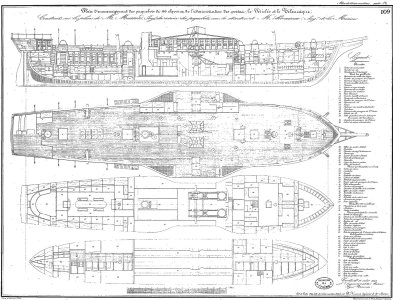
I have added a cross section of the Sphinx class corvettes which shows just how many stairwells were in use (five on a small ship)and some positioning options Allthough i have none for the frigates i would imagine they are similar in construction.GM02PL0109.jpeg
 
Back
Top