• Win a Free Custom Engraved Brass Coin!!!
    As a way to introduce our brass coins to the community, we will raffle off a free coin during the month of August. Follow link ABOVE for instructions for entering.
  • PRE-ORDER SHIPS IN SCALE TODAY!

    The beloved Ships in Scale Magazine is back and charting a new course for 2026!
    Discover new skills, new techniques, and new inspirations in every issue.

    NOTE THAT OUR FIRST ISSUE WILL BE JAN/FEB 2026

L'Orenoque Mamoli 1:100 scale

Chuck,

Thanks for your kind words. Yesterday I spent much quality time at the grocery store while my wife examined the sell by dates of everything that she purchased so had time to think.

The great problem of the steam paddle engine was designing the mechanical linkage from the cylinder to the paddle shaft. Modern internal combustion engines are “single acting” the force in the cylinder acts on only one side of the piston. Steam engines are “double acting;” steam pushes alternatively from each side. Therefore, the piston rod from the cylinder passes through a tight gland that restricts is motion to one direction. The crank of course required a rotary motion so there were many different linkages to convert the piston rod’s linear motion to the motion required to turn the crank.

To do this, the British developed the Side Lever Engine where an oscillating lever transmitted power to the crankshaft. If L’Orenque (sp?) was equipped with side lever engines, my analysis would be incorrect as the movement of the crankshaft would depend on the location of the lever’s fulcrum.

Americans used Direct Acting engines where the engine cylinder was mounted in an inclined plane. Again, one would need to know the slope of the incline for my analysis to work.

There are also oscillating engines where the cylinders oscillate. Toy steam engines sold today are often of this design. It’s quite possible that oscillating engines powered L’Orenque. If so, my analysis would be correct.

Roger
 
Chuck,

Thanks for your kind words. Yesterday I spent much quality time at the grocery store while my wife examined the sell by dates of everything that she purchased so had time to think.

The great problem of the steam paddle engine was designing the mechanical linkage from the cylinder to the paddle shaft. Modern internal combustion engines are “single acting” the force in the cylinder acts on only one side of the piston. Steam engines are “double acting;” steam pushes alternatively from each side. Therefore, the piston rod from the cylinder passes through a tight gland that restricts is motion to one direction. The crank of course required a rotary motion so there were many different linkages to convert the piston rod’s linear motion to the motion required to turn the crank.

To do this, the British developed the Side Lever Engine where an oscillating lever transmitted power to the crankshaft. If L’Orenque (sp?) was equipped with side lever engines, my analysis would be incorrect as the movement of the crankshaft would depend on the location of the lever’s fulcrum.

Americans used Direct Acting engines where the engine cylinder was mounted in an inclined plane. Again, one would need to know the slope of the incline for my analysis to work.

There are also oscillating engines where the cylinders oscillate. Toy steam engines sold today are often of this design. It’s quite possible that oscillating engines powered L’Orenque. If so, my analysis would be correct.

Roger

Roger! Thank you again for sharing your wonderful expertise!

Blessings. Peace. Gratitude.
Chuck
 
What ho, shipmates!

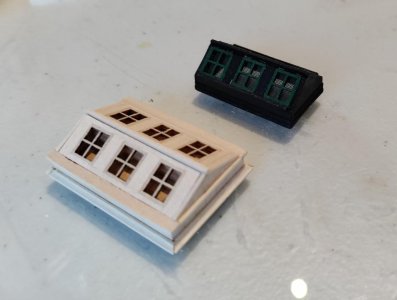
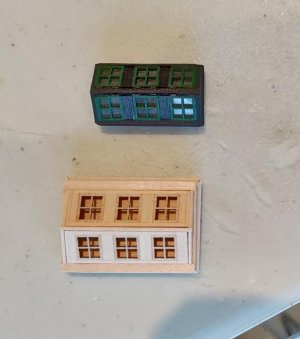
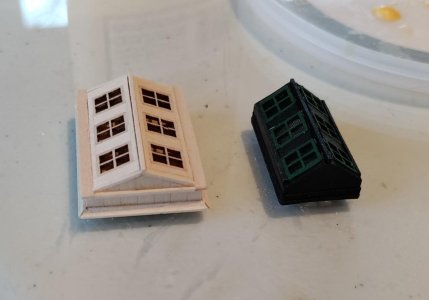
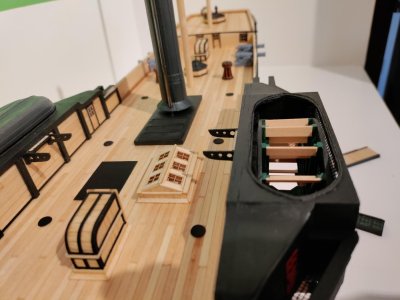
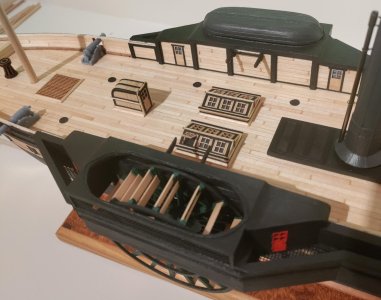
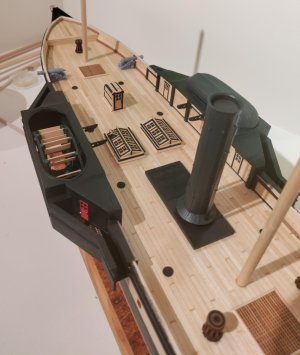
Just a few snaps comparing the new to the old crank houses. Both new crank houses are finished and have been oiled. Today I add the windows, screens and some black detailing to harmonize them with the color scheme. Sorry to say that the green window frames didn't make the cut. Don't you worry, Paul! We'll figure somehting out ROTF.

Blessings.
Chuck

LO crank new 1.jpglo crank new 2.jpglo crank new 3.jpglo crank new 4.jpglo crank new 5.jpg
 
Last edited:
You are about right in your understanding . I can totally understand why you like the deck fixtures from the imperial yacht, that is why i have decided to build it myself ! I realised your preferences before writing my last post. You can certainly keep the front companionway instead of the forward secondary hatch. If you can handle the companionway in traverse as fitted on L'Aigle it can probably fit between the loading hatch and front mast , i don't know what plans you have for taffrails but it should be possible. Or you can keep it back towards the crankhouses as it is. Or indeed fit it in front of the foremast, which would be more logical, allthough a bit cramped with a capstan already fitted there rather than behind the mast. I think you will have to do a bit of shuffling and see what suits you. I am glad you agree to a rear loading hatch as there is a lower gun deck , and changing out heavy armament through a decorative skylight is a bit difficult to imagine ! I am certain that this main hatch would have provided the access for troops without encroaching on officers quarters, but i see no reason you cannot also keep a rear companionway , again sideways if you decide you lack space. Shuffling again .
I have added a cross section of the Sphinx class corvettes which shows just how many stairwells were in use (five on a small ship)and some positioning options Allthough i have none for the frigates i would imagine they are similar in construction.View attachment 577926
Martin! Thank you for your thoughtful and informative response - as per usual!

I am thinking about all of your input and the plan you sent is very helpful! At this point I am building all that I think I may need and planning to try out a variety of arrangements before I ever attach any of it to the deck. I have scrapped the idea of a main deck skylight. I was odd there and the hatch gratings look more appropriate. Yes, the hatch grating material I sourced from @Model Shipways got here fast and was, with patience, easy to use. The cherry wood of the gratings make a nice contrast with the "wood color" and the openings seem very much to scale. Pics later!

Blessings. Peace. Gratitude.
Chuck
 
What ho, shipmates!

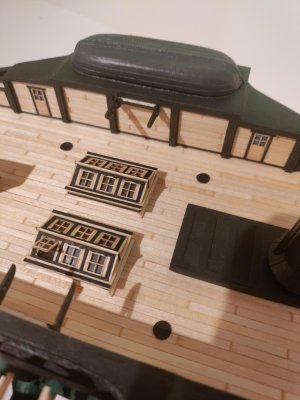
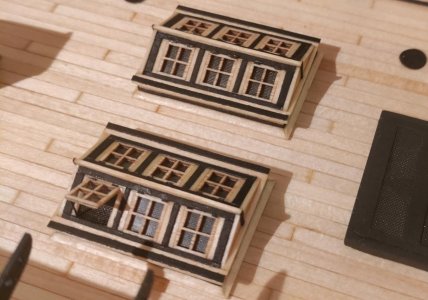
I had a pretty successful weekeend in Shagri-la Shipyard! Got the new crank houses finished. Got the hatches finished and revised the base of the grand sky-light on the poop deck. I also discovered a better way to indicate hinges at this scale - tiny slivers of the black artists paper! I was concerned about the tiny bits of 28 gauge wire I was using for hinges. It sticks out a mile when there is no dark paint to cause it to shrink visually. Nevertheless I used them on the starboard crank house and was not unhappy with the result. During the finishing process, however, I noticed a tiny sliver of the black paper and thought: Hmm . . . Much much better - I used paper on the port crank house.

lo df 1.jpglo df 2.jpglo df 4.jpglo df 3.jpglo df 5.jpg
 
What ho, shipmates!

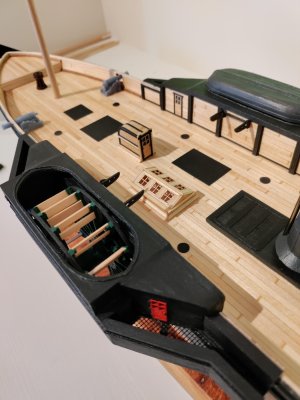
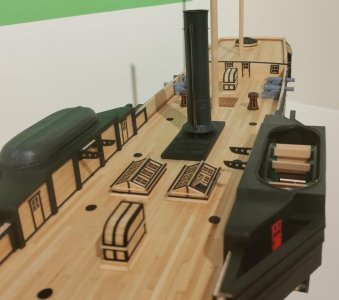
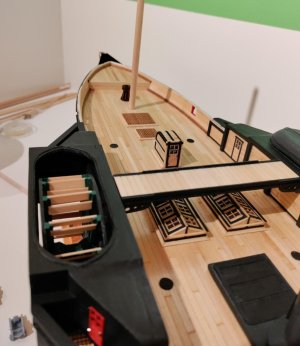
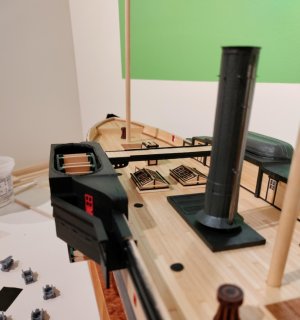
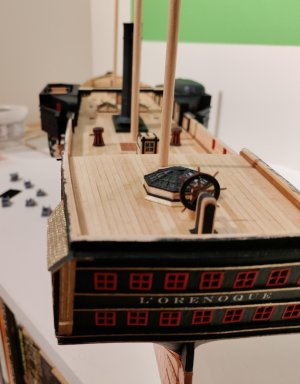
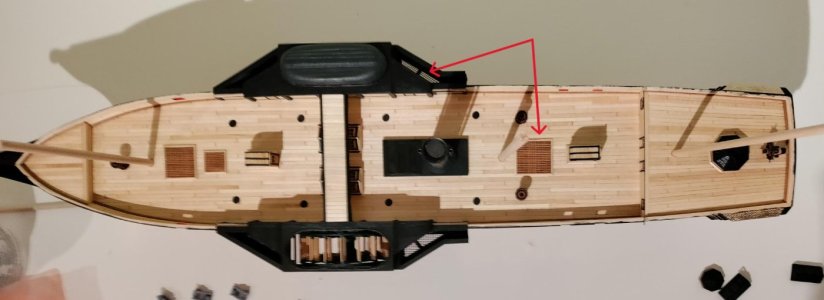
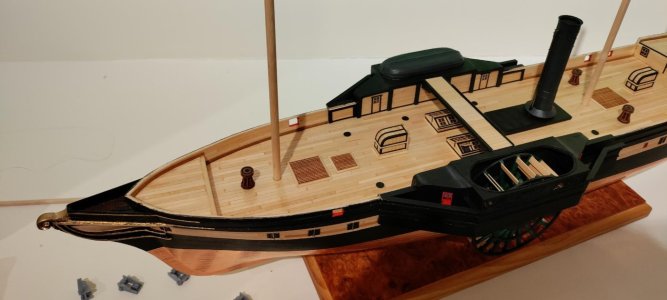
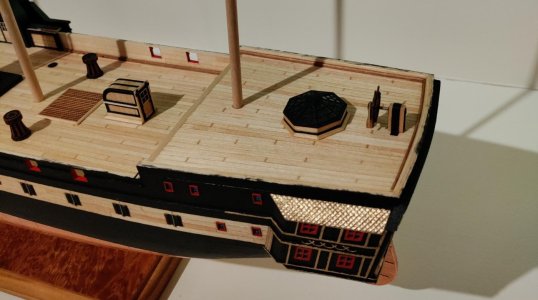
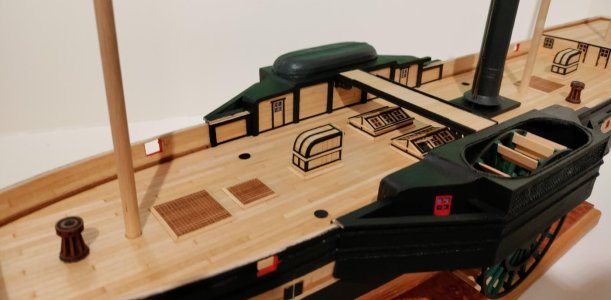
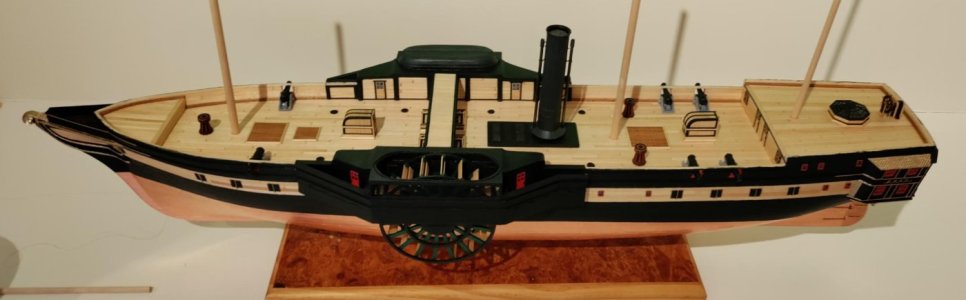
Just some pics today. Imagine you are a tiny drone doing a flyover. :p I did finish the helm and (start getting excited!) painted the cannon from The Jerry Todd Miniature Cannon Foundry!
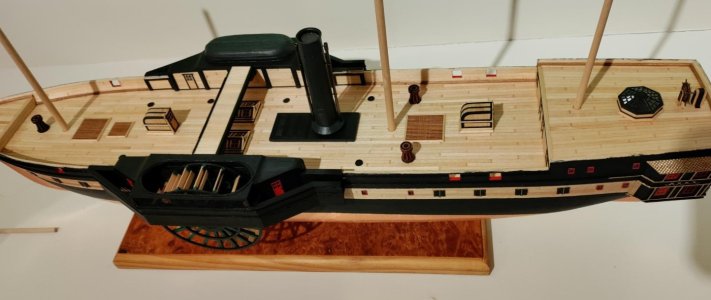
Under the heading: "I wish I had . . ." I wish I had gotten the gratings from @Model Shipways when I built the sponsons! Just look at the red arrows and you'll see what I mean. Call me a lubber, but I am not doing a do-over.

Have a great day!

Blessings. Peace. Gratitude.
Chuck

lo so far 1.jpglo so far 2.jpglo so far 3.jpglo so far 4.jpglo so far 5.jpglo so far 6.jpglo so far 7.jpglo so far 8.jpglo so far 9.jpg
 
The coloring and construction of the crank houses look great!! The detail of the paper on the hinges worked awesome. I love that you propped one open for visual interest.

Glad the cannons are now black :D !

Can't wait to see the scratch built pumps, once you finish!
 
well i have to say that i now have NO intention of buying this kit, ever ! ROTF I was so in love with it !:eek:
Martin! Say it ain't so!ROTF

It could be a great kit with substantial revision if the goal is to give the builder an historical ship project. Since you are presently engaged in a scratch build of L'Aigle, I don't see why you would make the investment. And even if you weren't so engaged . . . . It's somewhat sad. The period is fascinating and the subject too. Perhaps Dusek will take note and revise the kit.

Blessings.
Chuck
 
Martin! Say it ain't so!ROTF

It could be a great kit with substantial revision if the goal is to give the builder an historical ship project. Since you are presently engaged in a scratch build of L'Aigle, I don't see why you would make the investment. And even if you weren't so engaged . . . . It's somewhat sad. The period is fascinating and the subject too. Perhaps Dusek will take note and revise the kit.

Blessings.
Chuck
i just think it would be rather expensive for the few pieces i might want IE paddle wheels and maybe a figurehead. I could always scratch one now with all the plans i have collected, either your frigate version or a floating dancehall, i have plenty of wood and a few sets of pumps. ;)

i even have a baggie of cannons somewhere...

but as you say i have got quite enough projects to be getting along with for the next few years:p (i've gotten seduced by the swedish royal yacht at the moment)
 
Last edited:
The coloring and construction of the crank houses look great!! The detail of the paper on the hinges worked awesome. I love that you propped one open for visual interest.

Glad the cannons are now black :D !

Can't wait to see the scratch built pumps, once you finish!
Brad! Thank you for the compliments, shipmate! The cannons - right! I couldn't believe what a difference that made even on the unpainted carriages. I feel the way you do about the pumps, Brad. Can't wait to see them ROTF On that note, I ordered soldering flux paste to experiment with on the micro-soldering that I'll need to learn to make a halfway decent job of the pumps and the miles of railings and davits. Also planning to watch YouTube for tutorials:D.

Blessings. Peace. Gratitude.
Chuck
 
On that note, I ordered soldering flux paste to experiment with on the micro-soldering that I'll need to learn to make a halfway decent job of the pumps and the miles of railings and davits. Also planning to watch YouTube for tutorials:D.

Blessings. Peace. Gratitude.
Chuck
We're in the same boat...a micro-soldering kit arrived via Amazon yesterday. Scouring YouTube for tutorials.

In my spare time, I'll start experimenting before I get to a point in the build where I NEED to execute. Keep up the good work!
 
Back
Top