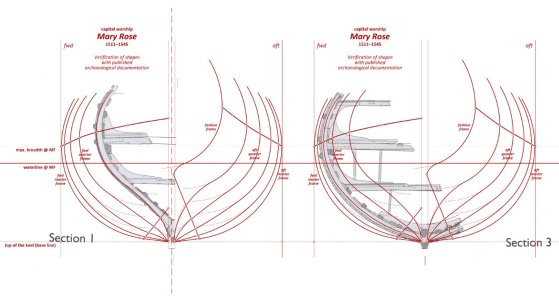
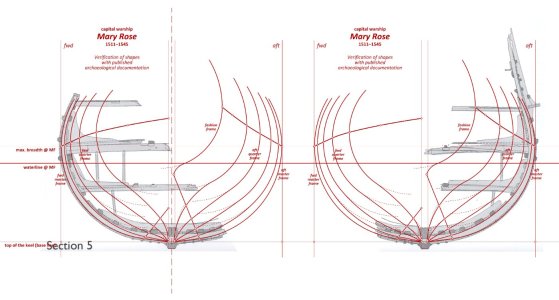
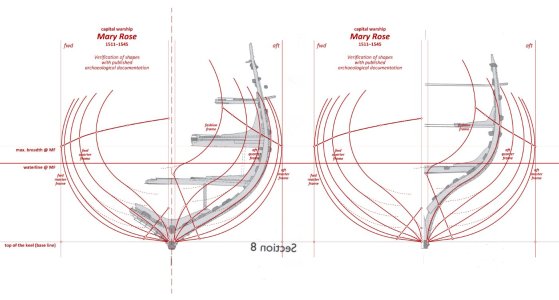
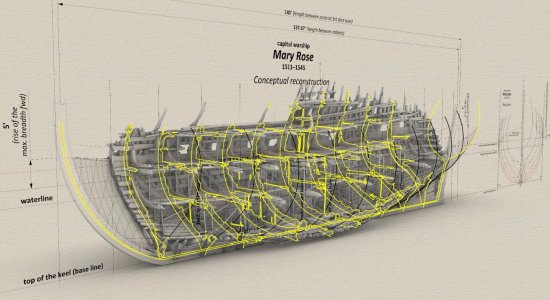
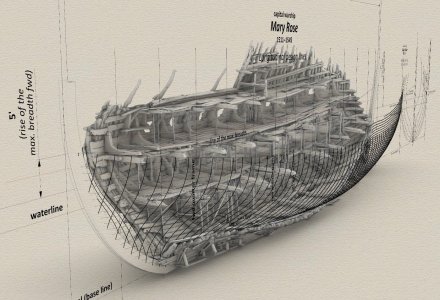
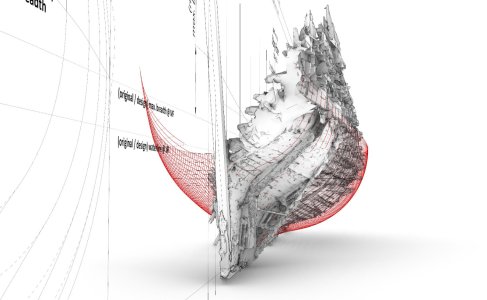
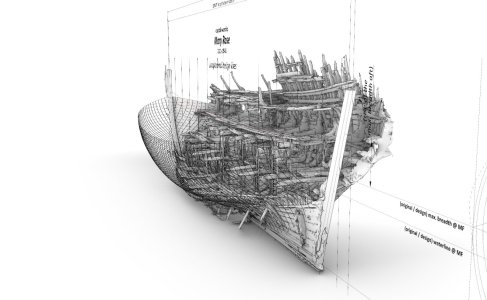
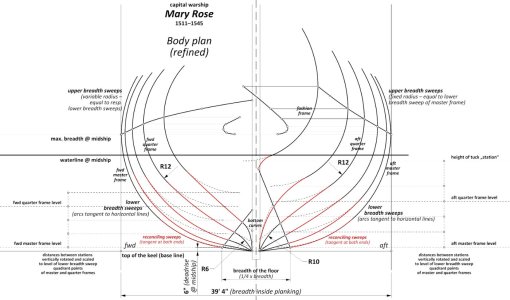
.
Did the Mary Rose have to capsize?
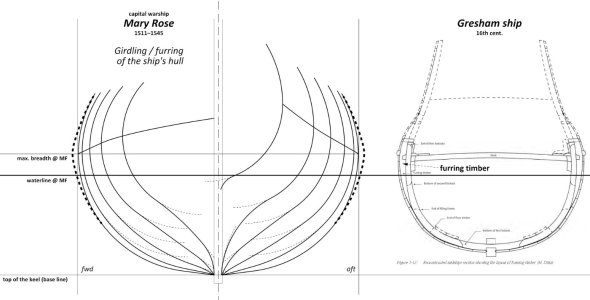
Apart from a better, or more prudent, vertical distribution of weights on the ship, a very effective and often used way to improve the lateral stability of ships sporting tumblehome was to increase their breadth. However, this does not mean increasing the breadth of the hull
per se or by any means, but ideally this had to be done in such a way as to “maximise” the breadth above the draught line (typically 2–3 feet) while keeping it as intact as possible at the water level itself. This is shown in the diagram below (dashed lines). In this way, a dramatic improvement in so-called shape stability (as opposed to ballast stability) can be achieved. This procedure was called furring or girdling, depending on the structural way it was performed (for more on this see, for example, Cate Wagstaffe,
Furring in the Light of 16th Century Ship Design, 2010).
In an archaeological context, such a case is exemplified by the so-called Gresham ship of the 16th century (for more on this see Jens Auer, Thijs J. Maarleveld,
The Gresham Ship Project. A 16th-Century Merchantman Wrecked in the Princes Channel, Thames Estuary, 2014) and a graphic from this report specifically illustrates the essence of this commonly used solution for unstable ships on a concrete extant shipwreck. It is no coincidence that the Gresham ship also features a round hull section having a very narrow bottom, precisely as the
Mary Rose 1511.
* * *
On 5/21/2025 at 12:41 PM,
Waldemar said:
However, this does not mean increasing the breadth of the hull
per se or by any means, but ideally this had to be done in such a way as to “maximise” the breadth
above the draught line (typically 2–3 feet) while keeping it as intact as possible at the water level itself.
But you have increased the width on the max breadth level, i.e. the exact same place where the waterline was located at her latest configuration. And even Gresham ship shows that the furring specifically raises the max breadth of the hull above the original level.
* * *
On 5/21/2025 at 3:28 PM,
Martes said:
But you have increased the width on the max breadth level, i.e. the exact same place where the waterline was located at her latest configuration. And even Gresham ship shows that the furring specifically raises the max breadth of the hull above the original level.
This is correct, because we do not know precisely this level after the ship's refit, and in any case it was variable depending on the actual weight of the cargo. Thus, of necessity, these particular diagrams simply show the general principle or idea of carrying out this process that could have been applied, without exact dimensional reconstruction. There is no need for this anyway, as it has not been put into practice.
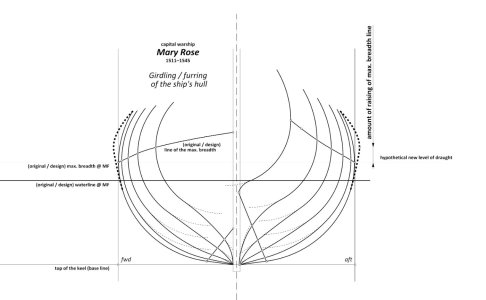
As for the illustration showing the Gresham ship, it may not show the geometry very accurately. It is rather a more or less loose graphic reconstruction, also out of necessity. Please see how fragmentary the preserved parts of this wreck are (illustration also from the report mentioned above). Actually, the greatest breadth of the hull need not or should not be far away from the draught level. Thus, if the ship's draught was not planned to increase, there was no need to raise it.
To show graphically what Martes had in mind, here is another diagram showing the possibility of girdling/furring, hopefully in a more realistic way, nevertheless, like the previous one laden with dimensional uncertainty so it should rather be taken as an illustration. As a reminder, as the draught of a ship increases (e.g. proves to be too great after launching and fitting out, which is particularly the case for warships), broadening the hull by girdling/furring should also raise the greatest breadth of the hull accordingly, so as to maintain the desired distance, usually 2–3 feet.
* * *
They had to do this very trick to the repro GH [Golden Hind — WG] to make it seaworthy, as shown in the image below. After the modification, it sailed around the world.

* * *
Concerning weight, I suppose heavy artillery + high castles + a lot of heavy infantry combined with insufficient ballast and stores in the hold (because there was no intention for a long voyage and they probably had to reduce the weight of the stores not to raise the waterline even more) brought about the result.
There is a question of how the larger Great Harry (that is assumed to have been built to the same, only enlarged design) had survived.
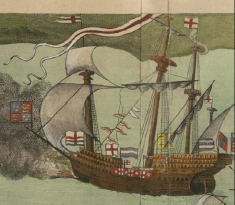
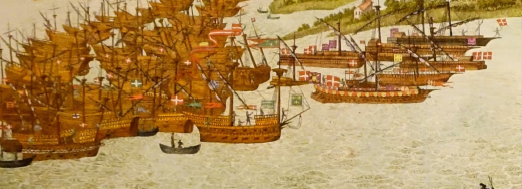 The French fleet
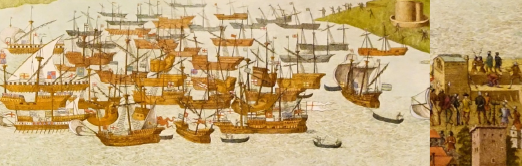 the rest of the English fleet
* * *
On 5/21/2025 at 10:46 PM,
Snug Harbor Johnny said:
They had to do this very trick to the repro GH to make it seaworthy, as shown in the image below. After the modification, it sailed around the world.

Thank you for showing this
. And a huge round of applause to today's marine engineers for this essentially makeshift repair! It's not the only case they have struggled with the specifics of old designs, and this despite the same applicable laws of physics now and then and all the scientific apparatus available today. Shame...
I was also reminded of a case in which a professor made serious calculations from which it was irrefutably clear that the length of a ship had to be at least about three and a half times its breadth to be capable of controlled navigation. Just how to reconcile the results of these calculations with the vessel
San Juan of about 1550, with a ratio of 2.8 : 1 on the draught line, which not only crossed the entire Atlantic, but still hit the exact spot it was intended to reach with a whole fleet of similar whalers.
* * *
MSW member Alvb:
I am just a little surprised that on the one hand people had experience with such stability problems and knew methods to mitigate them, but on the other hand they built ships with these very deficiencies.
* * *
On 5/22/2025 at 3:10 AM,
Martes said:
Concerning weight, I suppose heavy artillery + high castles + a lot of heavy infantry combined with insufficient ballast and stores in the hold (because there was no intention for a long voyage and they probably had to reduce the weight of the stores not to raise the waterline even more) brought about the result.
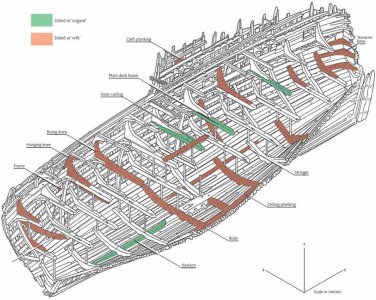
Yes, that's probably the best summary. A few dozen extra tons of difference in the original and new artillery configurations, a few dozen extra tons of battle crew with their heavy equipment. And if the repair of the ship in 1536 was mainly to reinforce her existing structure, as incidentally was done quite routinely in later times, then an additional few tens of tons of all the new reinforcing elements can be added, especially the standard knees and diagonal braces. The results of the dendrochronological studies are admittedly quite piecemeal, but at least they now suggest or at least do not contradict just such a repair scenario. All in all, at least 100 additional tons, perhaps as much as 150, and most of it at a height quite unfavourable to the ballast stability of the ship. And if still the “whole” crew was on the wrong side at the wrong time, then...
Below is a graphic showing clearly which items have been examined for their age and what the results of this research are (from David Childs,
The Warship Mary Rose. The Life & Times of King Henry VIII's Flagship, 2007):
[quote: I am just a little surprised that on the one hand people had experience with such stability problems and knew methods to mitigate them, but on the other hand they built ships with these very deficiencies.]
It can probably be explained in some simplistic terms that initially, with the usual use of ships to carry cargo low in the holds, there was no major problem with this phenomenon, and even a certain “softness”, provided by the round sections, may have been desirable so that more violent gusts of winds would not break the masts. It was only when dedicated warships with heavy artillery began to emerge, and at an height unfavourable from the point of view of stability, that the problem hit particularly hard. The general conclusion is, although hardly surprising, that in reality there is no such thing as a universal solution for all applications, or at least it is rarely possible.
* * *
Patrick (
@Baker;
@Backer64 on this platform) came up with the idea to post copies of the publications mentioned above in this thread as well (thanks, Patrick), so they are always ready to be consulted. I think it's a good idea and that they are both in the public domain.
Voilà.
Cate Wagstaffe,
Furring in the Light of 16th Century Ship Design, 2010:
Jens Auer, Thijs J. Maarleveld,
The Gresham Ship Project. A 16th-Century Merchantman Wrecked in the Princes Channel, Thames Estuary, 2014:
* * *
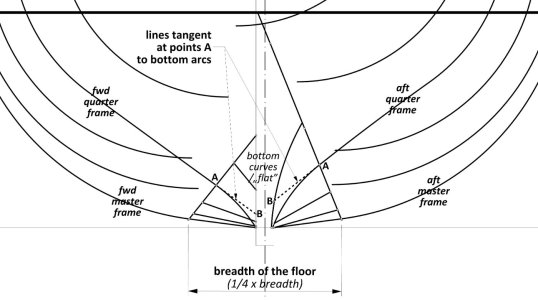
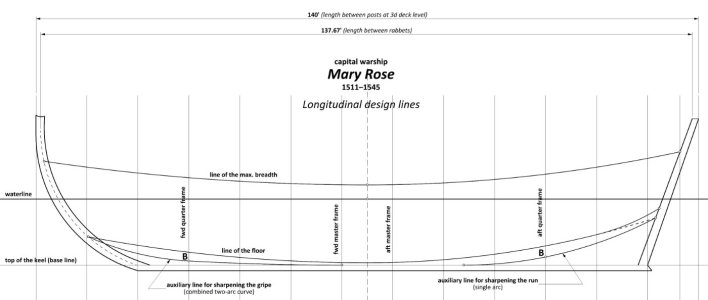
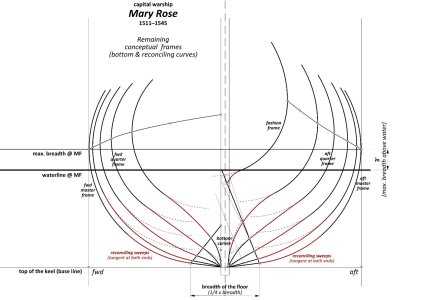
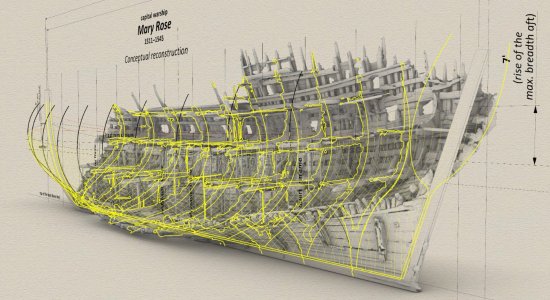
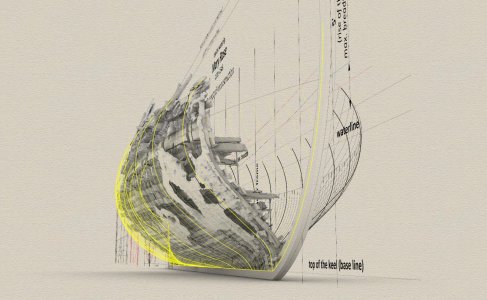
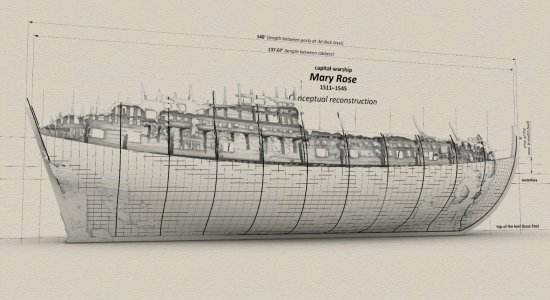
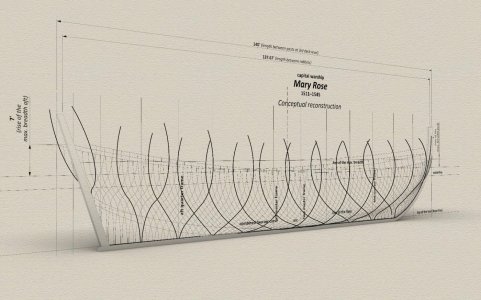
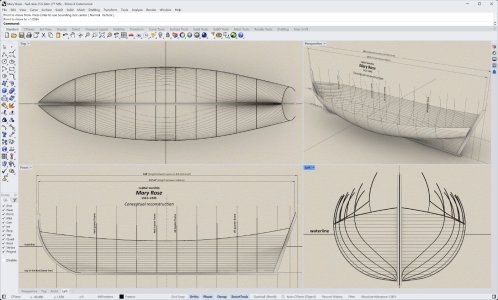
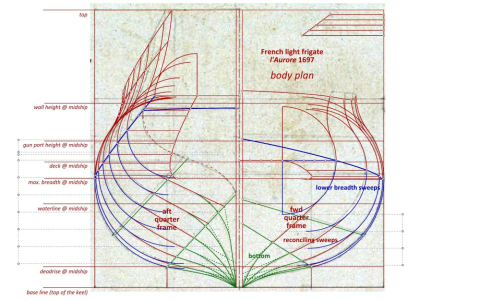
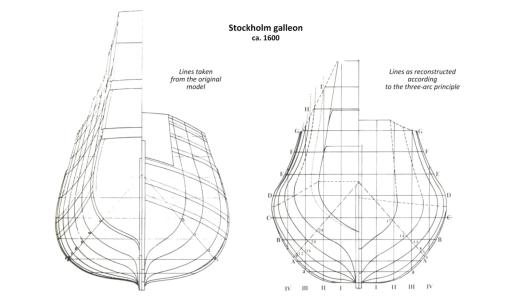
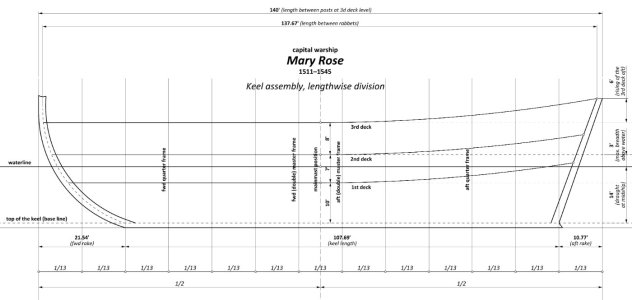
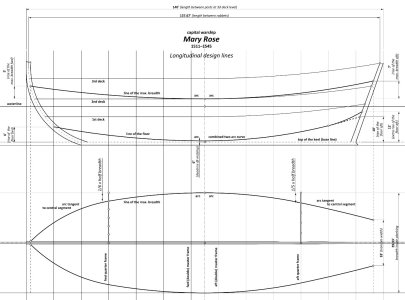
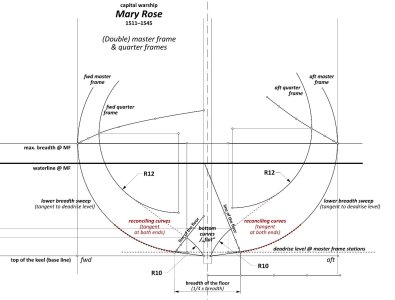
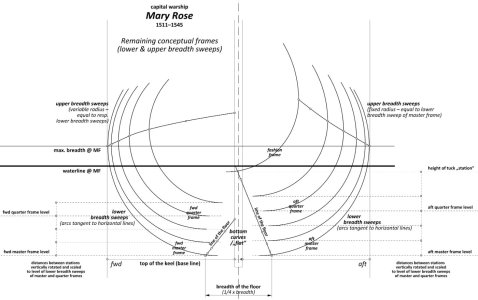
If one assumes, in line with the results of the investigation so far and with the present, general state of knowledge, that the Mediterranean methods together with its multi-arc frame construction (usually three) were only widely implemented in England at the times of Mathew Baker, i.e. in the second half of the 16th century, and that until then only the frame construction appropriate to the Northern European tradition, that is sporting just one arc (not counting reconciling or bilge sweep), but of variable radius, was employed, as shown in this presentation using the
Mary Rose as an example, then this circumstance can be used to interpret perhaps more rationally and confidently other archaeological finds from this early period in a poorer state of preservation than the
Mary Rose.
For instance, in the first volume of the
Mary Rose monograph (Peter Marsden,
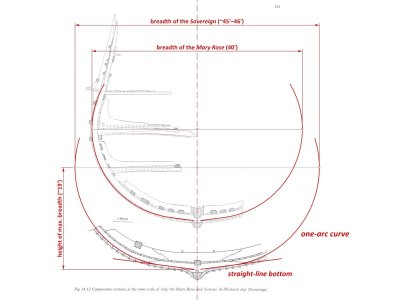
Sealed by Time. The Loss and Recovery of the Mary Rose, 2003), on page 141, there is an interesting juxtaposition of cross-sections of two important wrecks dating from the “pre-Mediterranean” period in England on an equal scale — the
Mary Rose 1511 and the so-called Woolwich ship (possibly
Sovereign 1487). The assumption of design homogeneity in this early period, specifically the single-arc frame design, allows the breadth and its height of the
Sovereign to be determined quite accurately solely on the basis of the modest surviving fragment of the bottom section of the hull (subject, of course, to its minimal geometric distortion), as demonstrated illustratively in the diagram below.
* * *
Thank you for your attention so far,
Waldemar Gurgul
.




 .
.