• SUBSCRIBE TO SHIPS IN SCALE TODAY!

    The beloved Ships in Scale Magazine is back and charting a new course for 2026!
    Discover new skills, new techniques, and new inspirations in every issue.

    NOTE THAT OUR NEXT ISSUE WILL BE MARCH/APRIL 2026
  • Win a Free Custom Engraved Brass Coin!!!
    As a way to introduce our brass coins to the community, we will raffle off a free coin during the month of August. Follow link ABOVE for instructions for entering.

Muscongus Bay Lobster Smack from Model Shipways by DocTom - Build Log

Great work. I built the Midwest Lobster Smack kit which is slightly different but follows the same general look. I did not like the copper wire for the blocks either, so I followed Olha Batchvarov's use of varying sized polyester threads. Here is the video where she is showing the technique of using heavy thread with lighter weight seizing. The detail starts around 1:21 on this YouTube video:
. They are much more elegant and feel visually accurate but I had a hard time understanding the exact size thread - so I guessed. Good luck with your build!
Thanks for the link. I had started to watch this series, but stopped when I saw it was a different kit. She’s a very talented modeler. She said she used 0.38 mm thread for the 3 mm blocks.
 
Post 12 - Slowly Approaching Rigging

After pondering the suggestions from here and MSW, and after combing through some research, I've decided to use 0.4 mm line for my throat and peak halyards (instead of the 0.7 mm supplied in the kit, 0.4 mm dark brown line for the stays (again instead of 0.7 mm), 0.35 mm line for the jib sheets and halyard, and 0.5 mm line for the main sheet. I have some of this from Ropes of Scale, and have ordered the rest from Ebay. It will be interesting to compare quality. I'm leaning toward stropping my blocks with line to get the practice, rather than using internally stropped blocks from Syren Ship Models. When I looked at them, I couldn't figure out how to accurately attach them to the inaccurate eyebolts.

When I was reviewing the rigging instructions, I realized I had neglected to make the sheave for the topping lift. This i shown in the plans, but only obliquely mentioned in the instructions - they tell you you have the option of improving the sheave, but never tell you to actually make it. My drill press dealt with that. I created the groove to simulate the sheave with a small jeweller's file, and used a #2 pencil to darken it.

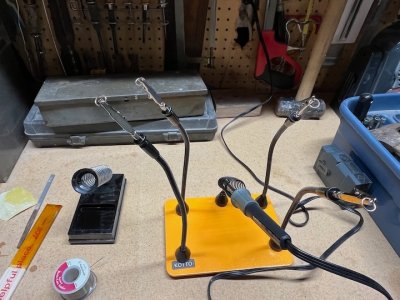
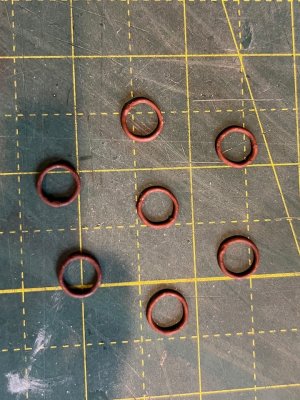
I then soft soldered the copper mast hoops shut. I hadn't used a soldering iron since 1974, but think I did a credible job. I guess it's like riding a bicycle - you don't forget how to do it! I then primed and painted them brown with craft paint (Art Deco Dark Chocolate) to simulate wood.
Soldering.jpeg

painted hoops.jpeg

Not great, but I think they'll pass the 3 foot test.


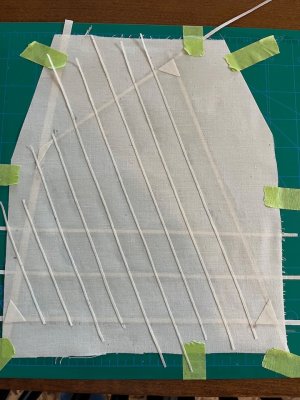
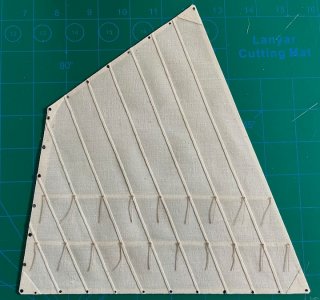
I then started on the mainsail. It took a bit of steam and sprayed water to iron the folds out of the cloth. I copied the sail plan and cut it out to use as a template. When I made my Norwegian Pram the sail ended up being too large. I therefore taped the template to the spars to make sure it was the right size.

IMG_5188.jpeg

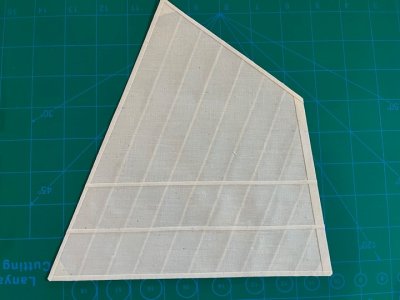
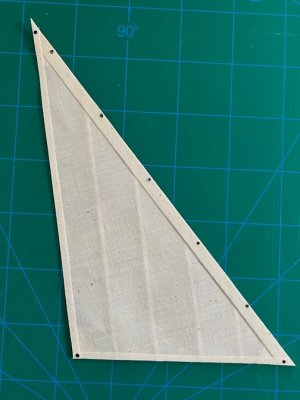
I decided to use 1/16" strips of cloth to simulate the seams.

making the sail.jpeg

After cutting it out:


sail cut out.jpeg

Weirdly, the dilute PVA glue pulled some of the printing on my cutting mat onto the sail - faint silver lines. I was able to remove them with a dampened paper towel. I used a 55g drill bit to make the holes for the lacing and hoops, and a 52 g bit for the lashing holes. I tried to simulate grommets by dabbing a small Tamiya Q-tip dipped in Deco Art matte Iron paint on the holes.

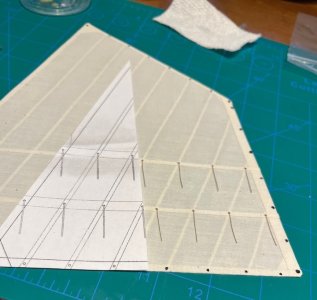
This rainy, wet and cold afternoon I started adding the reef points. I re-taped the template to the spars to make certain the angle on the sail plan made them hang straight down. It did. I then cut a piece of the template to use as a jig as I glued on the reef points. The instructions have you cut them 1" long, and then trim them to 3/4" after you install them. That didn't make a lot of sense to me, so I tied a knot in the 3.5 mm line, secure it with CA glue, trimmed the tail off, and then cut it 3/4" from the bottom of the knot. I used PVA glue to secure them to the sail. I did 9 of the needed 38 this afternoon before admitting this was a job that needs to be done fresh, after a good night's sleep.

lining up the reef points.jpeg

Hopefully the next post will see the sail and spars rigged to the mast.
 
DocTom...Came across this thread this afternoon and spend most of Memorial Day evening reading it. Thank You for putting this log up. I have just finished fairing the hull on the Smack after completing the Dory and Pram also. Beautiful smack sir. For a novice airtbrusher you have truly exceled. I have a few dozen projects, mostly styrene aircraft using a Badger Patriot. I could not have done any better. I have found using 50/50 distilled water with the Model Expo paint gives me the best outcome on wood after trying a handful of Youtube "magic elixers". BTW. I was raised in the Berkshires, went to high school in Dalton, a LONG time ago.

Currently up in north central PA chasing trout in our RV. Brought the NRG half hull planking project along as I believe I have cascaded down the ship building rabbit hole at a very rapid rate. I'm glad I did. Five solid days of hard rain, including Memorial Day weekend. Have all the frames on her now. Nice weather arriving the next week so fishing will take center stage. Now I have another project to work on when I get back to the bench. Building it on an RV table with a portable canvas bag of tools was a challenge. Patience and a patient wife saw it through.

Nice work Sir. It sounds like you also have found absolute pleasure in building. It shows!
 
DocTom...Came across this thread this afternoon and spend most of Memorial Day evening reading it. Thank You for putting this log up. I have just finished fairing the hull on the Smack after completing the Dory and Pram also. Beautiful smack sir. For a novice airtbrusher you have truly exceled. I have a few dozen projects, mostly styrene aircraft using a Badger Patriot. I could not have done any better. I have found using 50/50 distilled water with the Model Expo paint gives me the best outcome on wood after trying a handful of Youtube "magic elixers". BTW. I was raised in the Berkshires, went to high school in Dalton, a LONG time ago.

Currently up in north central PA chasing trout in our RV. Brought the NRG half hull planking project along as I believe I have cascaded down the ship building rabbit hole at a very rapid rate. I'm glad I did. Five solid days of hard rain, including Memorial Day weekend. Have all the frames on her now. Nice weather arriving the next week so fishing will take center stage. Now I have another project to work on when I get back to the bench. Building it on an RV table with a portable canvas bag of tools was a challenge. Patience and a patient wife saw it through.

Nice work Sir. It sounds like you also have found absolute pleasure in building. It shows!
Thanks for the kind words. I'm glad the build log helped someone! Thanks for your tip on the paint. I probably had the paint too thick, and will try 50/50 with my next project, which I plan to be the Model Shipways Harriet Lane, the 4th kit in the series. After that, the NRG half hull before I tackle a model with "real" planking. You're right, I have fallen in love with wooden ship modeling. It reawakened my enjoyment of building things that was a big part of my childhood.

Enjoy the trout fishing. I have family in New Albany, PA which is south of Towanda. The Berkshires are still wonderful. We're about to start summer tourist season!
 
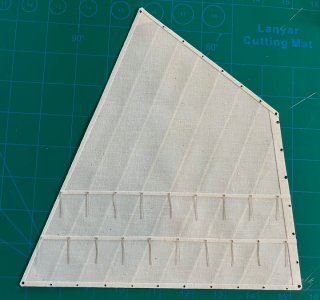
Post 13 - Reef Points Finished

I added the rest of the reef points today. Got into a rhythm and it didn't take as long as I had feared. Good use of a rainy Memorial Day morning after attending services at Stockbridge Cemetery. Service members dating back to the American Revolution are buried there. I used Ropes of Scale line, which was easy to work with, but I noticed the ends fraying, so I started adding a drop of CA glue and wiping it between my fingers, which solved the problem.

Port reef points.jpeg


Starboard reef points.jpeg


I'll make sure they are plumb once I have the mast installed. Not certain if I should glue them down then, as they seem very biddable. I now have to wait for correct-sized blocks and line to arrive before I can start the rigging. I will at least make the jib in the meantime. Hoping to finish up before a vacation on June 17.
 
Post 14 - Attaching the Mainsail.

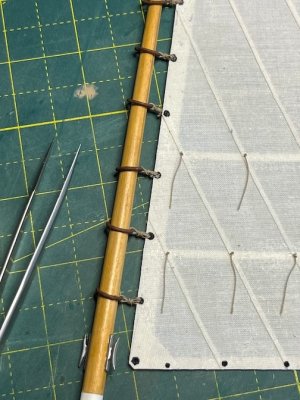
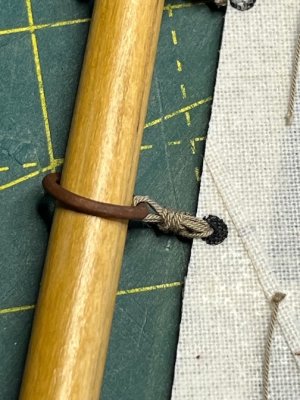
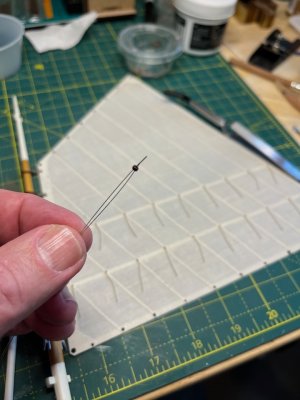
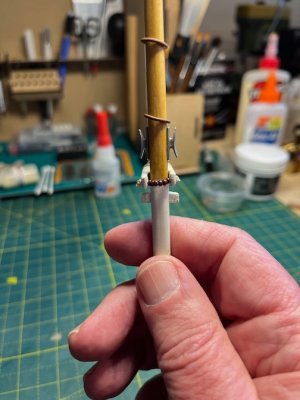
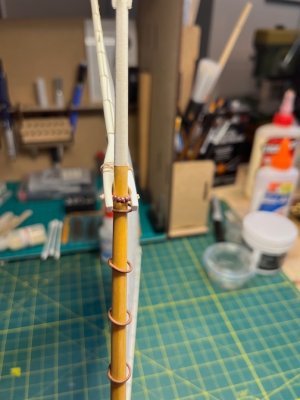
Well, that was fun! I now have a new appreciation of why some people dislike rigging! I started the day by watching YouTube videos on surgical knot tying with tweezers. I learned how to do it in Med School 40 years ago, but the muscle memory faded. My first task was lashing the mainsail to the mast hoops. @Bob Cleek will be heartened to know I remembered to put them on the mast first! I taped wooden spacers between the mast and the sail to set the distance. Again used 0.35mm Ropes of scale line. Used a beading needle to thread the holes. They came out fairly well, I thought.

Mast hoops.jpeg Cclose up hoop.jpeg

Although the instructions have you attach the sail to the boom and gaffe before attaching them to the mast, I did the opposite, so the spars wouldn't be flopping around so much. I used 1mm (size 11/0) brown seed beads for the parrel trucks, and the supplied 0.4mm Model Expo line. It is not nearly as nice as the Ropes of Scale line. Again used a beading needle.

Threading parrel trucks.jpeg

I ended up with 6 trucks on the boom, and 5 on the gaffe.

Boom parrels.jpeg Gaffel parrel.jpeg

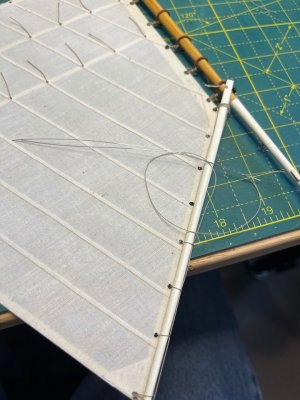
Next lashed the corners of the gaffe, and then did the lacing. I used CA glue where the lacing crossed itself to keep it taut.

Lashing sail to gaff.jpeg

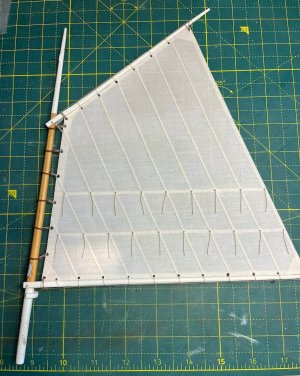
Did the same with the boom. Only lost one reef point in the process! The finished mainsail:

Mainsail rigged to mast.jpeg

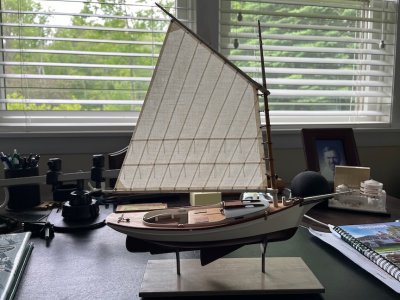
I couldn't resist a quick tet to see how it looked on the model

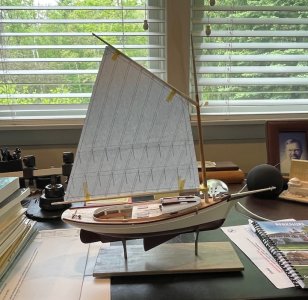
Tem0prary sail.jpeg


I'm waiting for appropriately sized blocks and line to arrive before I do any more rigging. In the meantime I will make the jib.

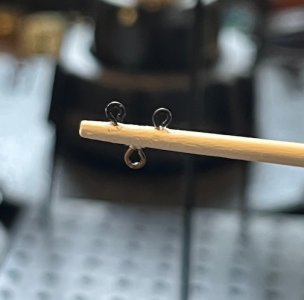
I almost forgot to mention that I attempted to blacken the brass eyelets. I removed them, and used Jax Pewter Black. I clearly need to do some more reading and testing, as the black came off very easily. I ended up using matte black paint to touch them up, but I like the look without the shiny brass.


Blackened eyes.jpeg
 
Post 15 - Third Time's the Charm

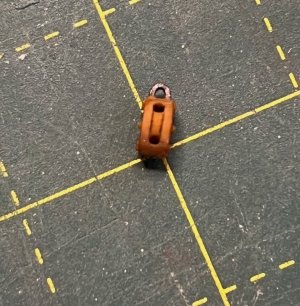
The Syren internally stropped blocks I ordered arrived late last week. They come with something on either end of the block - just strops, a strop on one side and strop with thimble on th other, or a strop/thimble - strop/shackle combo. You can snip off the strop you don't want to make whatever combo you need. I ordered 1/4" blocks for the traveler and main sheet, 3/16" for the main halyards, and 1/8" for the jib halyards.

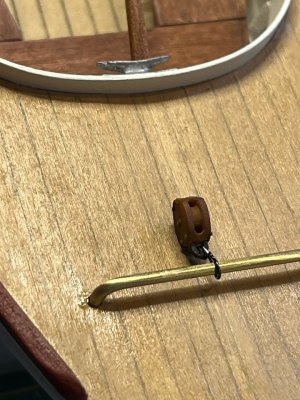
I was unhappy with my second attempt at the traveler block - the rope stropping is probably not accurate, and the wire I used for the hook was too big. I replaced it with one of the new blocks, using 26 g black wire for the hook. I'm finally satisfied.

Traveler block #3 (1).jpeg

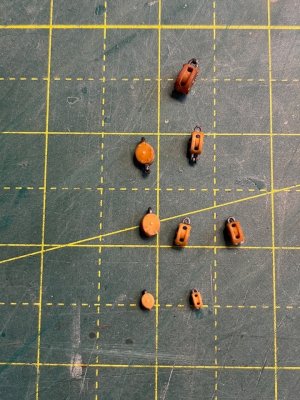
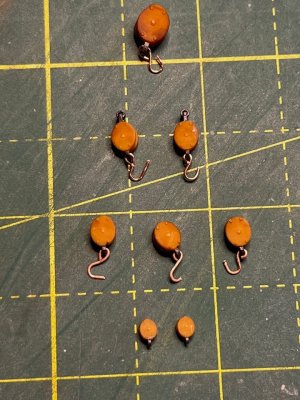
I trimmed the blocks to make the configurations I needed. A few swipes with a 240 grit sanding stick smoothed the snipped edges down. I painted the strops with a combination of FolkArt matte Iron Black and metallic Nickel paint. FolkArt Coffee Bean paint was a great match for touching up the blocks where I snipped off strops. I left the blocks themselves as they came.
painted blocks (1).jpeg
side view.jpeg

I'm very pleased with the quality of the blocks.

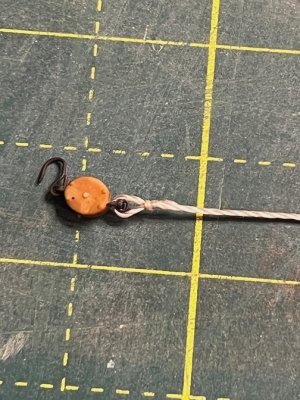
I used 26 gauge copper wire to make the hooks. I've never done this before. I first tried to make it off the block, bending around a drill bit and opening the loop enough to get the strop in it, but closing it back up was problematic. I think I need smaller needle-nosed pliers. I then bent the loop around the strop and snipped the end as close as I could. That worked better, but left some overlap. I bent the hooks with my bending pliers, leaving them a little long (mostly). Any advice on how to do this properly would be greatly appreciated. They came out not too badly.
new blocks.jpeg

I'm waiting on 28 and 30 gauge wire before I make the hook for the smaller blocks. I plan to blacken the hooks with liver of sulphur. I'll see if I like that any better than the Jax.

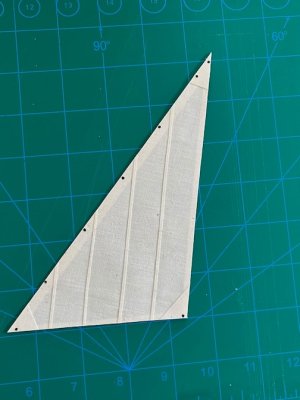
After the blocks I made the jib. Pretty straightforward after the Mainsail, and no reef points to attach!


Jib.jpeg jib port.jpeg

After I blacken the copper I can start the rigging. My plan is to deviate from the instructions by rigging the throat halyard, but then make the loops for the tops of the stays and place them on the mast before rigging the peak halyard. That way I can make them on a jig and just slip them on the mast. However, I'm waiting on appropriately colored and sized line that I ordered on Ebay. It's unfortunately coming from China (shoulda paid more attention when I bought it!), and may take another 3 weeks to get here! Arrgh! I might need to start my next build to keep my modeling itch satisfied.
 
Post 15 - Third Time's the Charm

The Syren internally stropped blocks I ordered arrived late last week. They come with something on either end of the block - just strops, a strop on one side and strop with thimble on th other, or a strop/thimble - strop/shackle combo. You can snip off the strop you don't want to make whatever combo you need. I ordered 1/4" blocks for the traveler and main sheet, 3/16" for the main halyards, and 1/8" for the jib halyards.

I was unhappy with my second attempt at the traveler block - the rope stropping is probably not accurate, and the wire I used for the hook was too big. I replaced it with one of the new blocks, using 26 g black wire for the hook. I'm finally satisfied.

View attachment 608659

I trimmed the blocks to make the configurations I needed. A few swipes with a 240 grit sanding stick smoothed the snipped edges down. I painted the strops with a combination of FolkArt matte Iron Black and metallic Nickel paint. FolkArt Coffee Bean paint was a great match for touching up the blocks where I snipped off strops. I left the blocks themselves as they came.
View attachment 608658
View attachment 608663

I'm very pleased with the quality of the blocks.

I used 26 gauge copper wire to make the hooks. I've never done this before. I first tried to make it off the block, bending around a drill bit and opening the loop enough to get the strop in it, but closing it back up was problematic. I think I need smaller needle-nosed pliers. I then bent the loop around the strop and snipped the end as close as I could. That worked better, but left some overlap. I bent the hooks with my bending pliers, leaving them a little long (mostly). Any advice on how to do this properly would be greatly appreciated. They came out not too badly.
View attachment 608662

I'm waiting on 28 and 30 gauge wire before I make the hook for the smaller blocks. I plan to blacken the hooks with liver of sulphur. I'll see if I like that any better than the Jax.

After the blocks I made the jib. Pretty straightforward after the Mainsail, and no reef points to attach!


View attachment 608660 View attachment 608661

After I blacken the copper I can start the rigging. My plan is to deviate from the instructions by rigging the throat halyard, but then make the loops for the tops of the stays and place them on the mast before rigging the peak halyard. That way I can make them on a jig and just slip them on the mast. However, I'm waiting on appropriately colored and sized line that I ordered on Ebay. It's unfortunately coming from China (shoulda paid more attention when I bought it!), and may take another 3 weeks to get here! Arrgh! I might need to start my next build to keep my modeling itch satisfied.
Your boat looks amazing! Well done for first time airbrushing!

here is a great article from the model boatyard co. about making hooks,


They have other very useful ideas and tips as well.

Rob
 
Rob,
Thanks for the reference. I found that site at some point, but forgot about it! My question is, how do you get the preformed eye around a preexisting strop?
 
Post 16 - Experiments

I spent the day trying out techniques for the upcoming parts of my build. Started off trying out different methods of blackening. First up was Liver of Sulfur - so named because the dried compound has the color of fresh liver. I had read it is less toxic than other blackening agents, and will not affect painted parts. I diluted it as directed, and set up a work station with 3 small bowls: the LoS, baking soda dissolved in water to neutralize it, and plain water to rinse. I washed the blocks and their attached hooks in Dawn, and wore exam gloves. In goes the first piece, and nothing happens. Made the LoS solution stronger, still nothing. I got out my Jax Pewter Black, and still nothing. It finally dawned on me that the copper wire was coated with something. At that point the rotten-egg aroma of the Liver of Sulfur was getting to me, even in a garage with both doors open. I decided I would stick to the Jax, which has no smell.

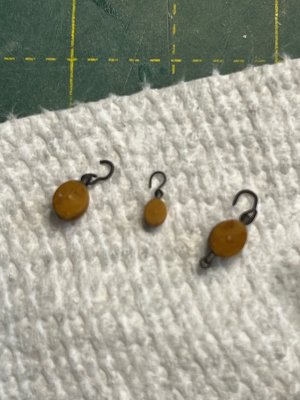
I took a piece of the wire, ran it through some sand paper, and put it in the Jax - Voila! So I removed and remade my hooks using roughed-up wire. They actually turned out better than my first attempts. I did a little more reading about Jax. The online consensus is that diluting it about 50:50 with water is best, and brushing it on is somehow better than dunking pieces. Also, if you do dip it, after it first darkens you should remove the piece, give it a wipe to remove the loose black crud that can form on the surface, and then redunk. That may be why painting works better - you remove the crud with the brush strokes. I had painted an extra Syren resin block, so I wrapped a piece of wire on the strop and put it in the Jax to see what would happen to the paint and resin. The answer is nothing, and the wire darkened nicely.

I held the blocks in one hand and applied the Jax with a brush. Each one took a few minute to darken. I finished off by giving them a quick dunk in the solution. Luckily, my 28g wire arrived today (which does not have a coating) so I could also do my smaller blocks for the jib halyard and downhaul.
Blackened hooks.jpeg

This time, the blackening did not instantly rub off, as had happened when I used full strength on my eyelets. I went ahead and blackened the hanks for the jib while I was at it.

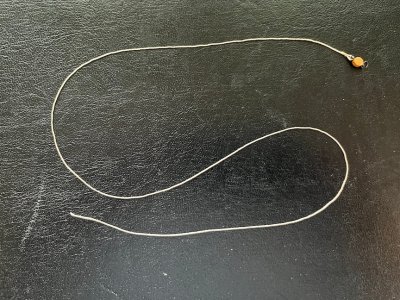
I'm using the Model Shipways 0.4mm line for my mainsail halyards. My goto YouTube modeler, HillBilly Modeler, suggested boiling the line for 3 minutes to remove the kinks. I measured the length I need for the throat halyard, boiled away, then put a self closing tweezer at each end and hung it off a table to stretch it while it dried. No kinks!
Boiled rope.jpeg

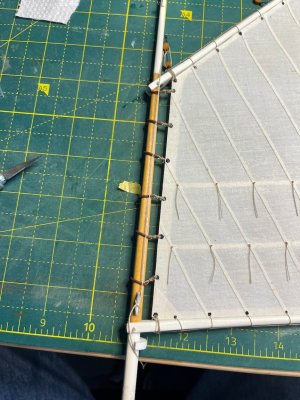
I tried making a "false glued eye splice" as kind-of described in the plans, but couldn't get it to work with PVA glue. I ended up forming a small eye and using CA glue where the line crossed itself, I then trimmed it and tried to shape with my fingers it before the glue set. It worked, but not great. I used it to rig the throat halyard.
Throat halyard.jpeg

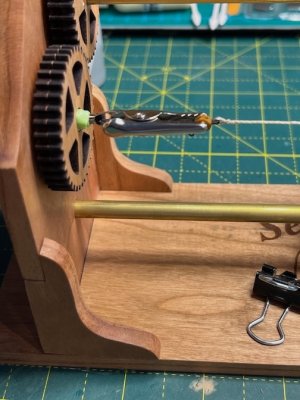
I bought a Syren Rope Serving Machine in anticipation of the bigger builds in my stash. I decided to experiment with that on the peak halyard. I jerry rigged an alligator clip to it to hold the block. I looped the line though the strop, fixed a loop with a half hitch touched with CA glue, and then used one end of the half hitch to wrap the line 4-5 times to simulate the thickness of a splice. It looks pretty good, and fells more secure than my glue only attempt.
Faking splice.jpeg Fake splice.jpeg

The only other things I can do until my dark brown line arrives is attach the halyard, downhaul and jib sheets to the jib. A good day of testing new things. I'm particularly glad that I figured out the alchemy of blackening, and that I can use Jax Pewter Black on wires already attached to blocks!

 
Tom! So impressive! Really admire your skills and desire to develop new techniques to make your boat as authentic as possibe. Keep it up…we all need you! :cool:
 
Back
Top