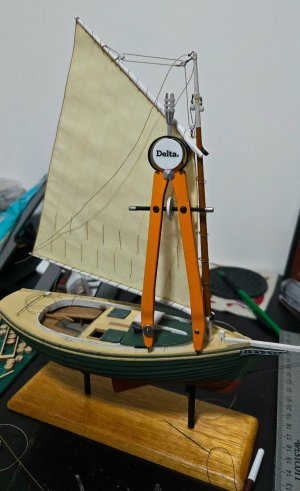
It’s interesting what you find and miss in digital archives depending on how things are classified and your search strategies! Previously I had mostly done keyword searches in the Penobscot Marine Museum's digital collections for things like “buoy” and “Friendship Sloop” (or just “Sloop”). In recent searches, though, I tried selecting broad tags like “lobster traps” and “sailboats,” ordering results by date from oldest to newest, and seeing what came up. I found some interesting images that I hadn’t come across before.
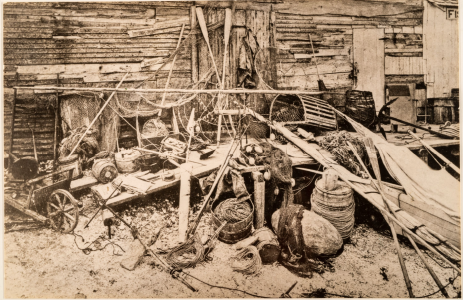
First up, there was this intriguing image from 1886 of fishing gear piled up on the Biddeford wharf (rather south of Muscongus Bay, admittedly). Quite the mess! Among other objects, there are several oars, an anchor (with a rounded crown, apparently I didn’t really need to bother with making mine angular), nets, bailing scoops, and a lobster pot. There are also a couple objects that may be lobster buoys—one just under the lobster pot, and one leaning against the barrel at bottom center. It’s hard for me to tell if that’s just what they are, though. The lower one, especially, does seem rather square-sided, I think.
 Source
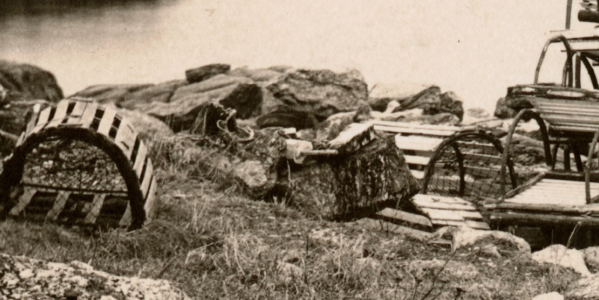
There’s also this image, a detail from a postcard of a lobster shack around 1915. Besides the lobster pots under construction at right, there’s also a squared-off buoy (with chamfered edges).
 Source
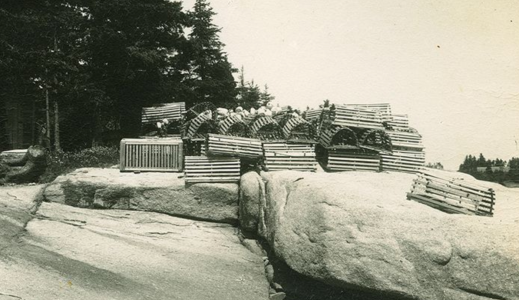
In contrast, the buoys in this image from 1920 look a bit more rounded to me.
 Source
As do these buoys from an undated, possibly much later photo.
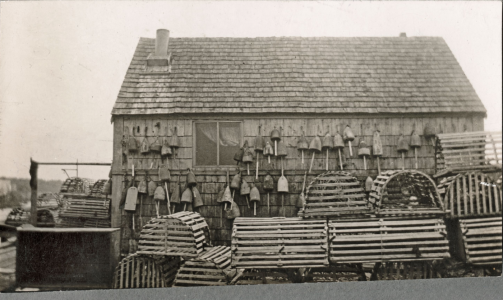 Source
Finally, this image of an undated lobster buoy does seem to have a rounded cross-section, but is also much longer and proportionally narrower than the one I made.
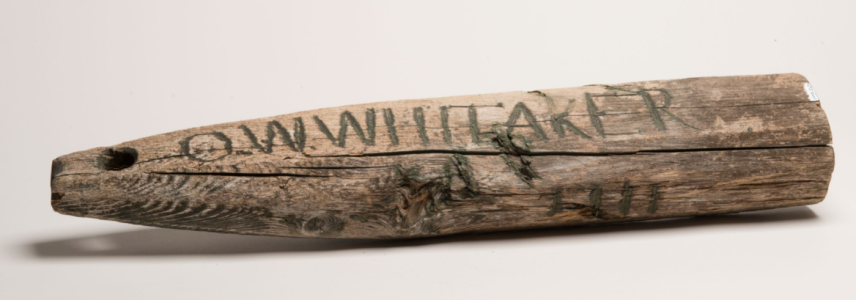 Source
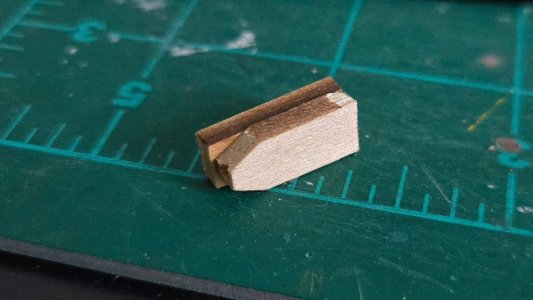
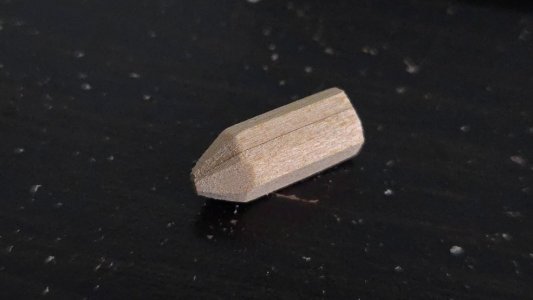
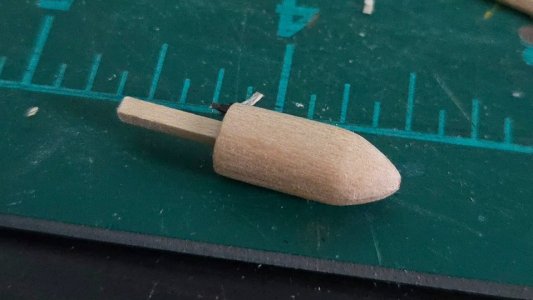
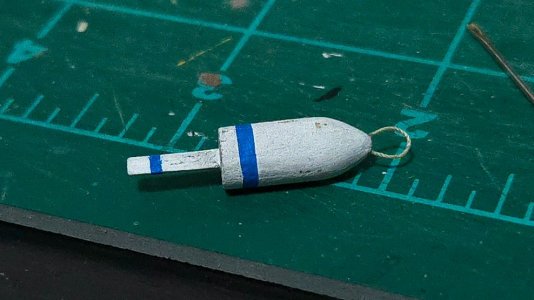
It’s hard to draw a firm conclusion from these images. I think that there were a lot of possible ways to make lobster buoys in Maine around 1880-1920. I do now think, though, that my buoy may be a little too rounded and wide, so I may make another one with a somewhat different shape. Thank you to the commenter at MSW who brought this to my attention.
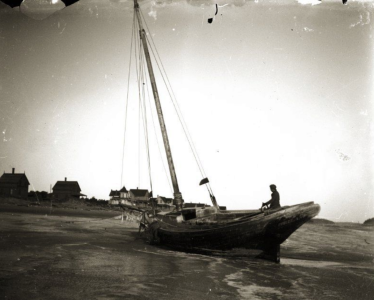
I also came across a number of photos I hadn’t seen before of small sloops in the period. The photo below from around 1900 is interesting, although the sloop is partially obscured by damage to the photo. It looks like a partially decked-in boat, possibly with an overhanging stern, but seemingly missing a cuddy forward (as far as I can tell, the photo damage is very unfortunately placed). The buoys stacked up next to the lobster pots also do have an octagonal cross-section.
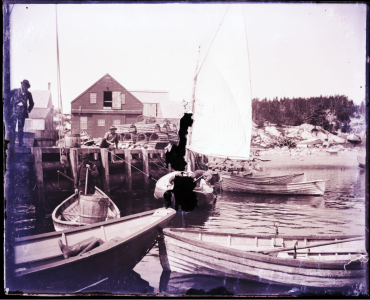 Source
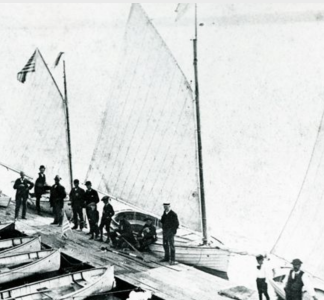
This photo dated 1887 shows women waiting to board a sloop at Gilpatrick’s Boat Slip at Mount Desert Island. I assume it’s more of an excursion vessel than a fishing boat, although I suppose there could be some seasonal overlap between the two (I have no idea how fancy Mount Desert Island was). Notably, the sloop they’re boarding appears to have a gaff topsail. There’s also a smaller, lapstrake sloop (with very wide strakes) anchored among the rowboats, as shown in the detail shot.
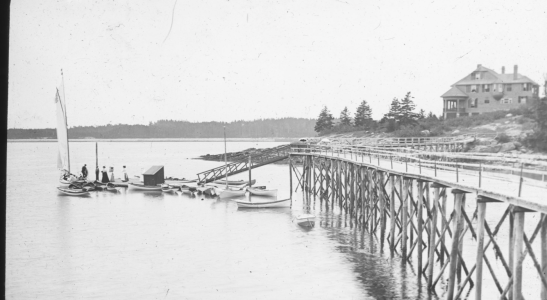
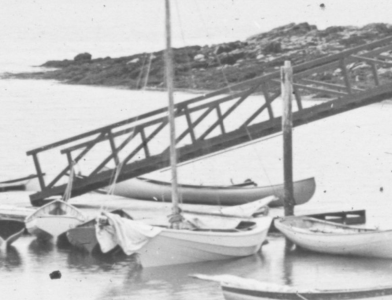 Source
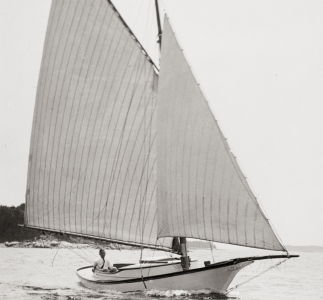
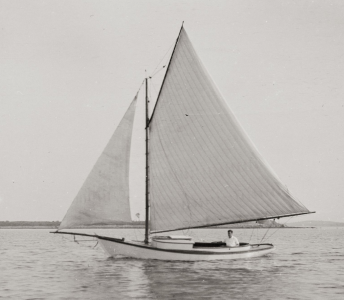
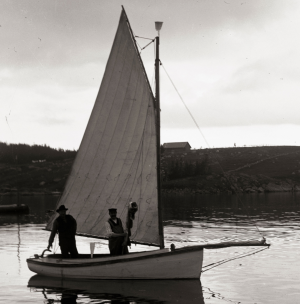
Longtime readers may remember my difficulties in finding many photos of lapstrake-planked sloops early in this project. I found a few more, although they’re of rather smaller vessels than the one I’m modeling. I do have to wonder how many Muscongus Bay sloops were close to the design I’ve made, which is basically a lapstrake and centerboard Friendship Sloop, instead of the smaller, simpler, plumb-bowed types I’ve more often seen in photos. Perhaps my efforts at a more accurate model are less accurate than I thought. On the other hand, Chapelle is pretty clear that he thought there were lapstrake vessels like this, and I did find those photos of a lapstrake clipper-bowed sloop (at what looked to be a yacht club) and a lapstrake clipper-bowed schooner with a similar, so I suppose it’s fine. It really is something, though, to see how much variation existed among this broad vessel type. I increasingly think that a wholly accurate early Muscongus Bay sloop is something of a chimera, and there were instead so many variants that it would be difficult to pin down a single design as the most accurate (at least as far as generic models go—obviously, you could make a very accurate model of, say, the Ranger on the basis of plans and the reconstruction work I’ve discussed to add back in the centerboard that was later removed from that sloop). On the other hand, at least some of the photos I’ve found come from elsewhere on the Maine coast, and it’s possible that I’m conflating a variety of actually local types with the Muscongus Bay sloop. It may be that the Muscongus Bay sloop that Chapelle identifies as a precursor to the Friendship Sloop (and which, it shouldn’t be forgotten, also attracted the attention of Admiral François-Edmond Pâris) was simply a local variation of a broader family of small lapstrake sloops in common use across large parts of Maine, which only in Muscongus Bay developed into the better-known later types.
Anyway, the photo of Seal Harbor (not on Muscongus Bay) in 1890, below, shows a number of different sloops. Some appear to be Friendship Sloops or similar vessels. The vessel nearest to the camera is rather smaller and definitely lapstrake planked, without a cuddy.
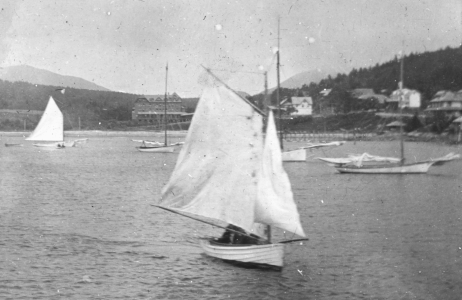 Source
Finally, this 1908 photo of a lobsterman in a small lapstrake sloop at Rockland (not on Muscongus Bay, although not far from it) is very interesting. As a small vessel, its rudder is stepped directly on the transom, instead of having the overhanging stern more associated with Muscongus Bay Sloops. It very nearly looks like a rowboat with sails added, lacking a cuddy, although it does seem to have a small rim of decking around the large cockpit. Maybe this is a good (although rather late) example of the sorts of vessels that Muscongus Bay and Friendship Sloops developed out of? Especially if this was in fact a more widely-used design further out along the coast. It’s also notable how much space the single lobster trap takes up. It’s worth asking with photos like these: is this a photo of an actual lobsterman actually working, or was it staged in some way? Given that I’ve otherwise found very few photos of lobster boats in the era actually working—most close-ups are of yachts or boats being used more for leisure, and the cases where it’s clearly showing work are generally from rather farther away—and that this photo is a well-angled closeup, I’m inclined to believe that there was an element of staging involved here. But how much? Maybe the entire scene is faked, and the photographer just wanted a good image to sell postcards of a lobsterman at work, possibly using a non-workboat and maybe even not an actual fisherman. Or maybe it is indeed a real fisherman and fishing boat, but he agreed to stage the photo. More information about the circumstances of the photo’s creation would be needed to resolve these doubts.
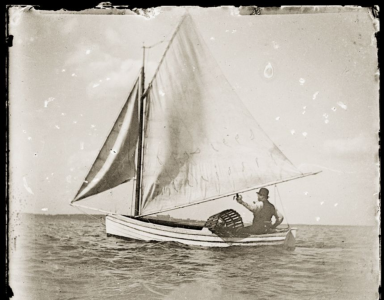 Source
Images often seem obvious and simple to interpret at first glance—how could the camera lie?—but sometimes they can raise more questions than they answer when you start getting down to it. Anyway, hopefully I’ll be able to finish up this build in the next couple week. But that would take pulling myself away from questions of historical interpretation to actually get to work!