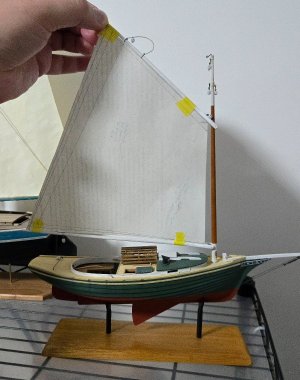



• SUBSCRIBE TO SHIPS IN SCALE TODAY!

    The beloved Ships in Scale Magazine is back and charting a new course for 2026!
    Discover new skills, new techniques, and new inspirations in every issue.

    NOTE THAT OUR NEXT ISSUE WILL BE MARCH/APRIL 2026
  • Win a Free Custom Engraved Brass Coin!!!
    As a way to introduce our brass coins to the community, we will raffle off a free coin during the month of August. Follow link ABOVE for instructions for entering.

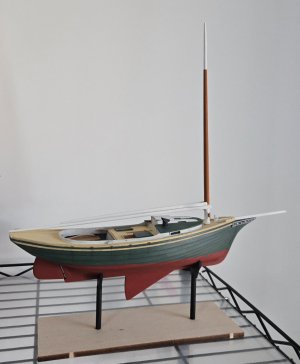
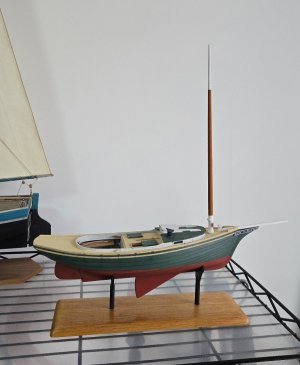
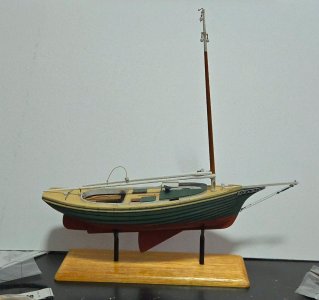
Muscongus Bay Lobster Smack - Kitbashed from Model Shipways

Most of my models have used basswood, with some exceptions. My Bateau de Lanvéoc is in alder, my NRG Capstan build is an experimental piece trying out a lot of different woods (alder, cherry, walnut, manzanillo, xochicuahuitl, and basswood), and my Trajinera was in balsa.

My experience has been that modeling wood, and indeed dimensioned lumber in sizes useful for modeling, is hard to get here. There's a craft supply chain here that is the only place I've found that carries basswood, but only in 1/16-inch thick sheets; they have more variety of balsa, hence why I used it on the trajinera. Most of my modeling wood has been brought from the US in my suitcase.

Interestingly, while Mexico City is not a good location to buy wood (almost nothing but pine, and nicer woods are very expensive), once you leave the city you can find a lot more, although it's very area-dependent as it's usually local stuff. That said, most of what I've found has been more useful for my other woodworking projects than for modeling. Xochicuahuitl (Spanish Elm) is beautiful but grainy, fairly week, and splits very easily. Manzanillo seems ok, although the grain is a little prominent, but may have some issues with toxicity. Parota is beautiful but has really prominent grain. Spanish Cedar and mahogany are very nice but, again, grain is a bit prominent. So, although I want experiment in some upcoming builds, I will probably be sticking more to basswood, alder, and cherry.

Of the woods I've used, I found balsa too soft and crumbly to be very useful. Alder is pretty nice to work with, so far, although maybe it's a little on the soft side. Cherry seems pretty nice, from what I've seen.

But basswood is probably going to be what I use most going forward. It's extremely easy to work, including just with an exacto knife, the grain is very even, and it takes paint well. I also think the pale even color can be quite nice. It has some disadvantages. Some can be dealt with easily--painting it tends to raise the grain, but you can just sand a little more between coats to smooth it out. Others are more serious: it's not great for carving tiny detailed pieces, and because it's not very strong, I'd be worried about it breaking if used for the frames in a framed model. But I think it's a great option for a lot of uses.
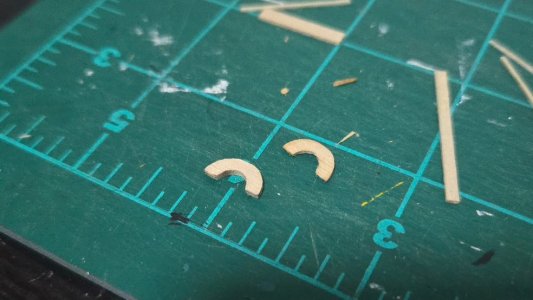
 
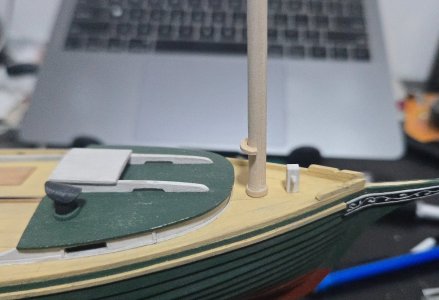
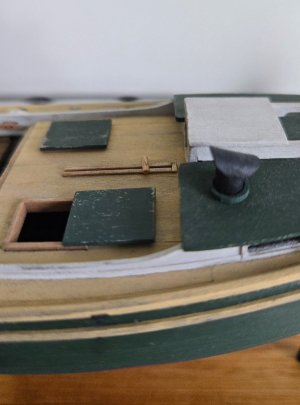
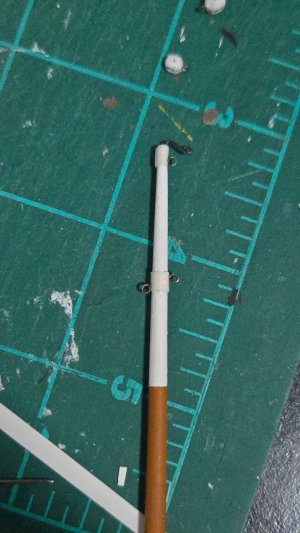
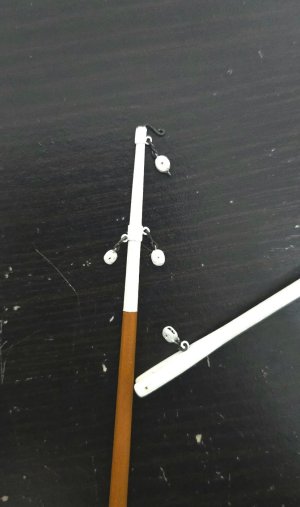
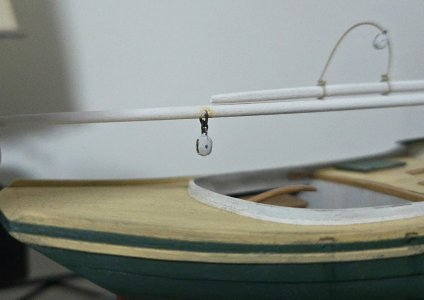
A little more progress. First, I added the boom rest to the mast. It looks too thick compared to the photos I have seen, so I split it in half and sanded it smaller once on the mast. It was located high enough that the boom can clear the chimney.
20260515_203552.jpg
20260515_220031.jpg

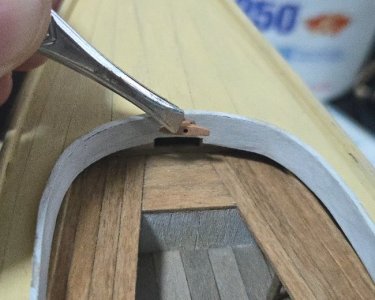
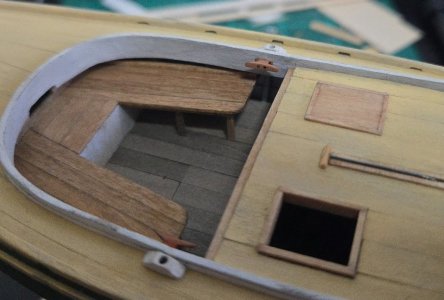
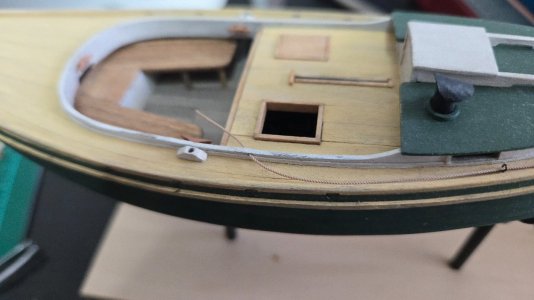
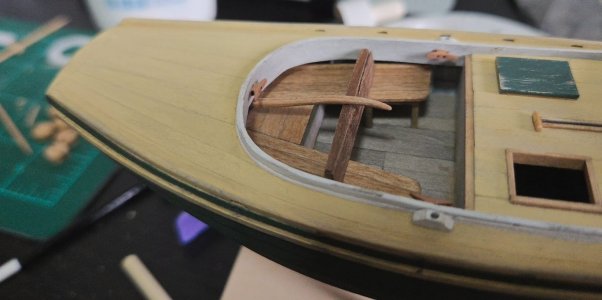
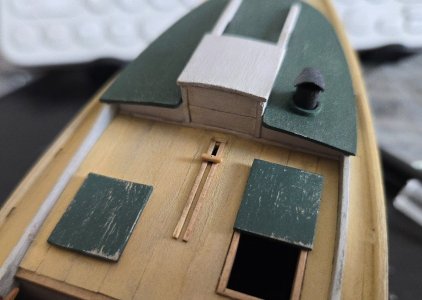
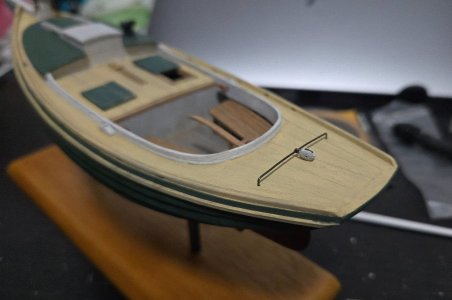
Next up, I began working out cleat locations. The cleat just above the rudder was pretty well-attested to in photos. As I will be using a single gaff halyard arrangement and no downhaul on the jib, I will not need the cleat on the bowsprit. The cleats on the mast will be located below the boom rest, rather than above it as given in the kit design, although I think I see both ways of handling it in photos (definitely below, possibly above). I saw a mix of photos showing cleats on the interior or exterior of the sides of the coamings. I was going to place mine on the exterior, but then I realized that 1) with the trim I added, there isn't much space, and 2) this would awkwardly interfere with the oarlock pads. So, I think I will be placing them inside after all, although following examples, I will be drilling a hole in the coaming for the jib sheet to run into.

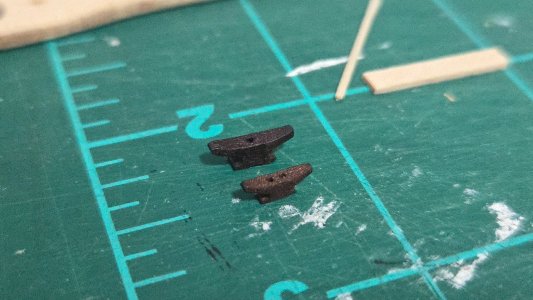
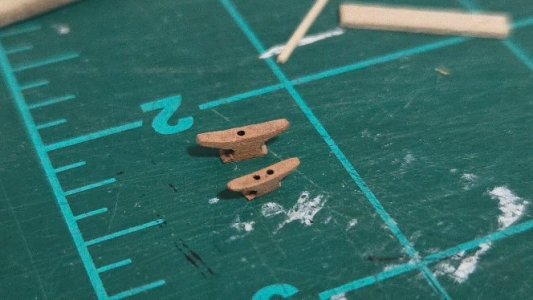
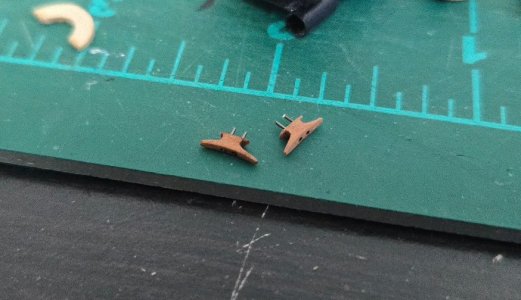
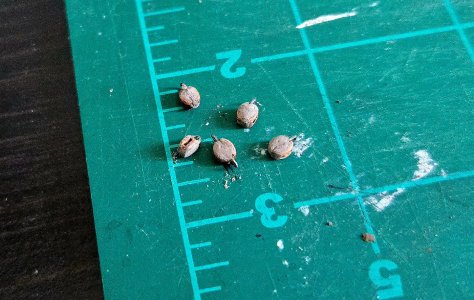
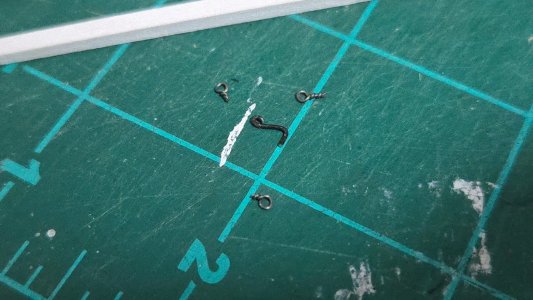
This then brings me to the question of cleat sizes. In the past, I have made my own cleats. However, a long while ago during the Crafty Sailor going-out-of-business sale, I picked up some Falconet cleats in 5, 7.5, and 9mm sizes. They look pretty nice, although there's a lot of laser char to remove.
20260515_213021.jpg
20260515_215727.jpg

My initial thoughts were that the 7.5mm cleats were too tiny, and I would use the 9mm, but in some locations the 9mm look a bit bulky. I looked in Chapelle's Boatbuilding and American Fishing Schooners, but didn't find much beyond an admonition to not use excessively small cleats. Then I thought about how, in many build logs of kit builds, the kit cleats didn't look out of scale to me (if they were, I don't think it was by much). The kit cleats are 10mm long, which, scaling down to 1:32, corresponds to the 7.5mm. So I think I'll be mainly using those.
20260515_215814.jpg

The one spot I may go with the larger cleat is for the mainsheet. I think the larger cleat looks a bit better there, and the mainsheet would have greater forces acting upon it and would need to be adjusted a fair bit (more than the halyards), so maybe a larger cleat there would make sense?
20260515_215858.jpg
 
After some discussion, looking more closely at photos, it seems like the mainsheet cleats were often fairly small. So, all the same size it is.

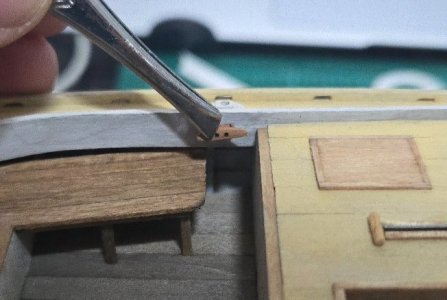
For the cleats, I pinned them with short lengths of wire. It was tricky marking where to drill, as each cleat had two pins.
20260516_122627.jpg
20260516_143018.jpg
I also drilled holes in the coaming to run the jib sheets through. This was a bit nerve-wracking, one coaming split although I was able to glue it back together. I added the eyebolts for the jib sheets, as well.
20260516_122638.jpg
20260517_104419.jpg
20260517_104701.jpg
At this point, I finally felt like I could add the tiller. I propped it up to hold in the proper location until the glue cured.
20260517_153126.jpg
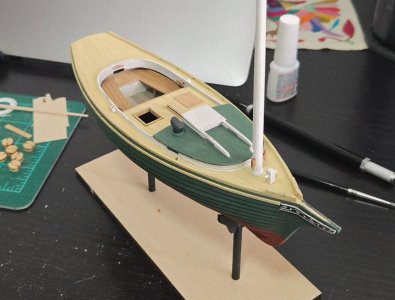
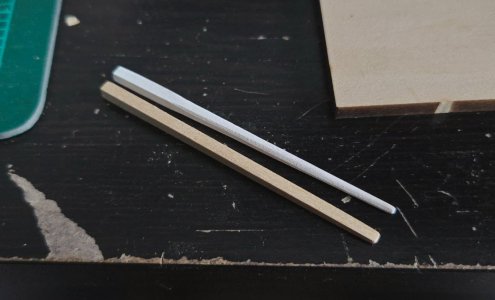
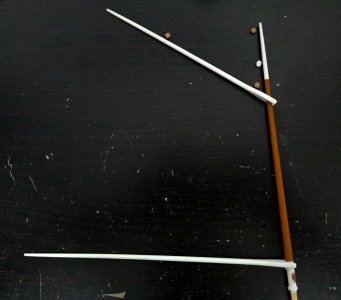
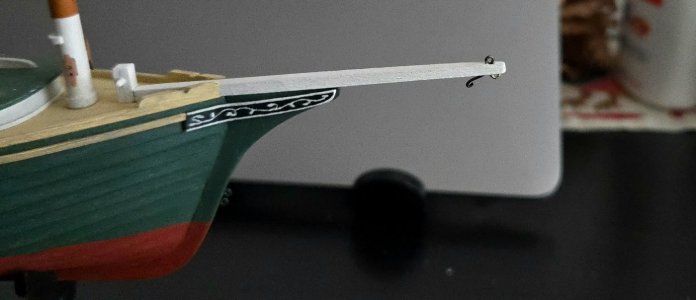
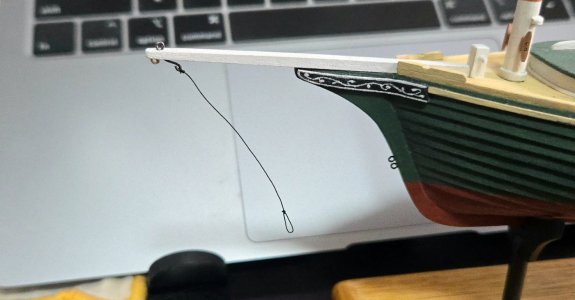
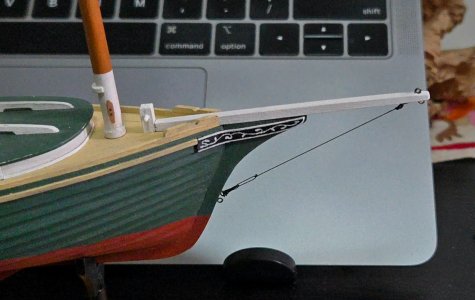
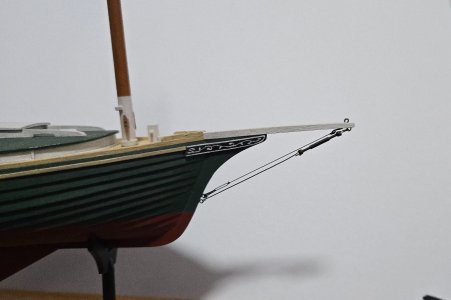
I also worked on painting the mast and yards. While doing this, I realized that my bowsprit was curved. I decided to take the opportunity to make a new one. I decided to make this one rather flat and wide. I seem to remember that another modeler did the same on his, as it would better resist lateral pressure, and I noticed that bowsprits like that appeared in several photos.
20260517_155003.jpg
For the mast, I saw that most seemed to be a brownish color, sometimes with white at the top and bottom. The brownish color is presumable oiled or varnished wood, but I wasn't going to leave this mast natural, so I just painted it brown. Here's everything dry-fit together, with the gaff and boom just loosely fit in place.
20260518_074852.jpg
I also painted the pillars on the display base black.
 
Looking at photos, I realized that the blocks used seem to have mostly been internally-stropped, such as those below.
Screenshot2026-05-20at6_39_25AM.png.20606e5a572b5a34cef43d851f6d823a.png
Source

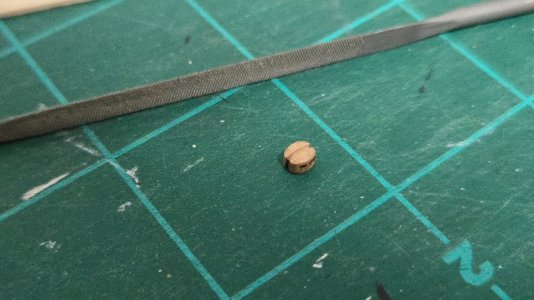
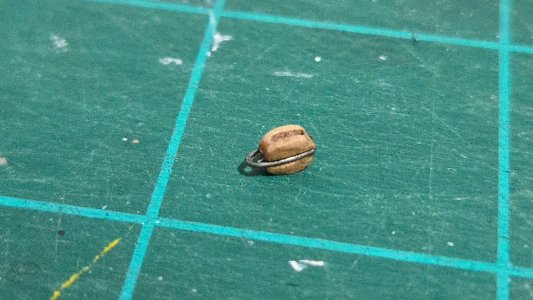
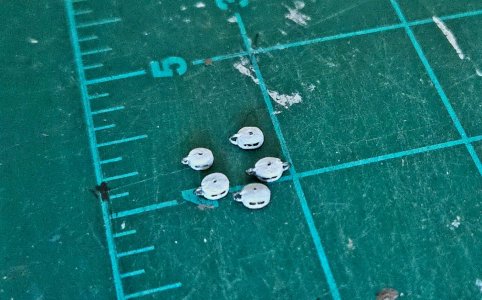
I've never done internally stropped blocks before, so I decided to give it a try. I was inspired by MSW member PaulLeWol's Sharpie build, where I think I remember him more or less doing the following, although with much greater precision than I've managed. First, I took a 4mm block (purchased from Model Expo) and sanded off the laser char. This was tricky, as the thing is tiny. I then filed a gouge in both sides.
20260519_224313.jpg
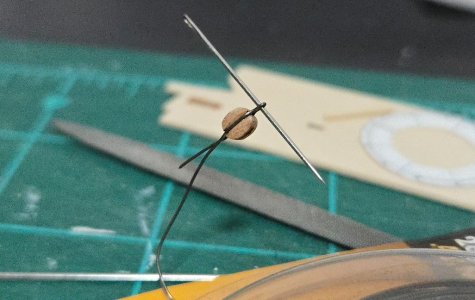
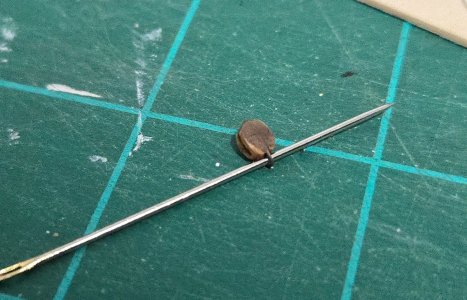
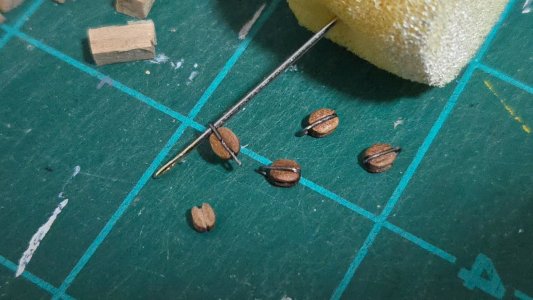
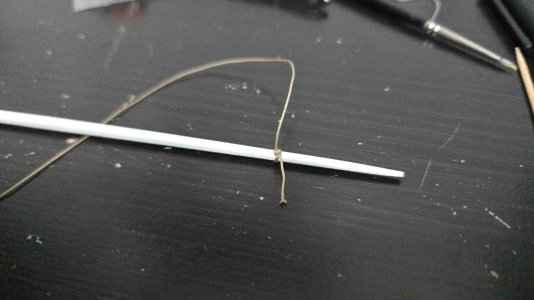
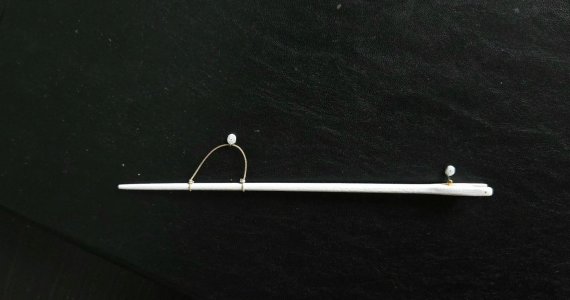
I then tried to use wire to make the internal strops. First, I used 24 gauge, but I found it a little too thick, so I switched to 28 gauge. I tried the arrangement below, using a needle to keep a rounded eye open, but I changed tack soon because I realized that the eye was too big.
20260519_225242.jpg
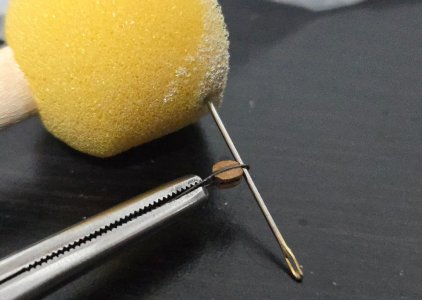
It was better to place the needle right against the block and bend it right over. I also found that it helped to stick the needle in something so it was less inclined to slide everywhere.
20260519_230119.jpg
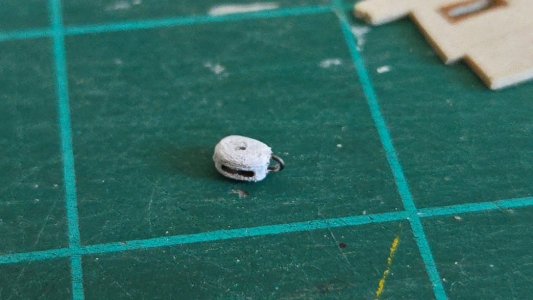
I then dabbed superglue on the sides. Once it dried, I trimmed off the excess and bent the nubs over. At this point, close-up photography revealed a lumpy, misshapen little thing.
20260519_231108.jpg
Of course, the strops are supposed to be internal. To hide them, I applied a bit of wood filler.
20260519_231341.jpg
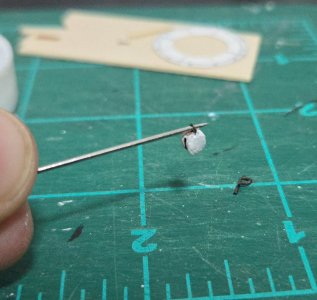
After sanding that to smooth it, I painted the block white, following the example of some photos. As it turns out, the white paint really highlighted how uneven the block was.
20260519_232404.jpg
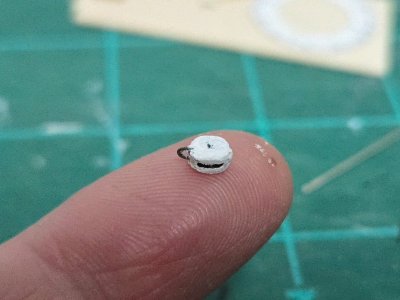
So, I sanded it lightly with 600-grit sandpaper and added another coat of paint. Once dry, I used a pencil to draw in the axle. Close-up photos really draw out every imperfection, but my sense was that it looks all right from normal viewing distances.
20260519_234010.jpg
Finally, looking at it with fresh eyes the next morning, I remembered that blocks should be a bit more rounded. So, I sanded down the edges even more and repainted. With that, I’m happy with the results.
20260520_102431.jpg
Overall, I think this method worked fairly well, although there are some improvements I could make. First, I should sand and shape the block at a fine grit before stropping, to minimize the lumpy unevenness I've noticed and to improve its shape. Second, I should also file a notch on the bottom so that the ends of the wire can lie flush with the block. Third, if I'm painting these, I don't know if I need to fully remove the char, beyond just rounding the edges and the like.

If the method worked, though, I'm not sure about the size of the block. The 4mm blocks are the smallest I currently have. Seen against the mast, they don't look horrible.
20260520_063512.jpg
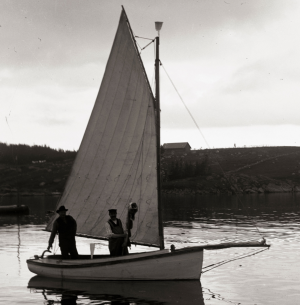
But, looking at photos, I notice that many of the blocks used look extremely small, especially once I start looking for smaller vessels and not Friendship Sloops (which were often around 10 feet or so longer than the boat I'm modeling).
Screenshot2026-05-10at10_07_23PM.png.40b488a619312a5a63d52b73df7939ee.png
Source

Screenshot2026-03-20at9_06_32AM.png.221b8e9ca5b397023dfa836cb4989db5.png
Source

ScreenShot2025-04-16at9_05_42PM.png.72af1fa10e8275e4b87b35c98150fd2d.png
Source

In that last photo, I estimate the blocks to be around 4, maybe 4.5 inches long, corresponding to about 3-3.5mm model blocks. The 4mm block corresponds to about 5 inches in real life. As it turns out, I have some 3mm and 3.5mm blocks that I will be able to pick up when visiting family in the US in about a month, so I'm wondering if it would make sense to wait until I pick those up to make the rest of the blocks.

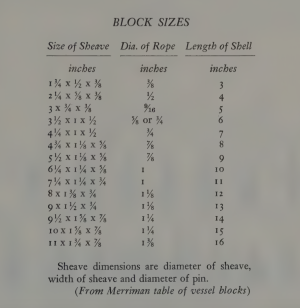
This led me to do some research on the topic. Frustratingly, much of the rigging information out there is for larger ships (Steel, Biddlecomb, etc.), so it's not very relevant to these sorts of small working boats. John Leather's The Gaff Rig Handbook has a lot of interesting details, but nothing on sizes. Looking through my sources, I found that Chapelle's The American Fishing Schooners is focused on far larger vessels, but includes a table relating block size to rigging diameter, seen below. This is useful information, but I'm also not sure what size rigging would be used.
Screenshot2026-05-20at8_16_43AM.png.1267476b2b73eccea819a0bb0198d7ff.png
Source: Chapelle, The American Fishing Schooners, p. 347.

So I began looking for rigging sizes, as well. Chapelle's plan for the Muscongus Bay Sloop in American Small Sailing Craft doesn't say anything about rigging, and the only detail included for the small Friendship Sloop Pemaquid in the same book is to mention that the standing rigging was 1/4-inch wire (p. 275). This is at least useful for my forestay, but doesn't say anything about the blocks or running rigging.

Chapelle's Boatbuilding was more helpful, but with some caveats. In general, he notes that, where the mainsheet is concerned, strength is less of a concern than ease of handling: a 1/2-inch diameter rope is strong enough for a 400-450-square foot mainsail, but a 3/4-inch or larger rope is easier to handle (p. 580). He also mentions that "the size and material of the blocks should suit the ship," and mentions that "fisherman-quality commercial blocks" look rather large compared to "small bronze yacht blocks" (p. 579).

Boatbuilding also contains a number of sail plans for vessels close to the size of the 22.5-foot long sloop I'm modeling. These come with the caveat that 1) they're generally of yachts, not workboats, and 2) only one of them has a gaff rig, with most sporting a leg-of-mutton, bermuda, or spritsail rig, and all are set for smaller sails than on the Muscongus Bay Sloop. Although Chapelle's plan in American Small Sailing Craft doesn't give a sail area for the latter, I estimate from the dimensions provided that the main sail was roughly 250-280 square feet and the jib about 50-60 square feet.

The only gaff-rigged vessel detailed in Boatbuilding is a 22-foot Scow Sloop described as a "utility boat of the Dutch type" (p. 229). It has a proportionally much taller and narrower gaff sail with an area of 130 square feet, with a 56 square foot jib. Block sizes are not stated, but the mainsheet and gaff halyard are 3/4-in, and the jib sheet and halyard 1/2-in diameter, corresponding by the American Fishing Schooners with a 6-7 inch block on the former and a 4-inch block on the latter.

However, these are by far the largest block and rope sizes given. The 23-foot long Bermuda-rigged Tabloid Cruising Sloop (p. 378), with a 175-square-foot mainsail, uses a 5/8-in mainsheet and a 1/2-in jib sheet. The 30-foot Sharpie Cruiser (p. 237), with a two-masted leg-of-mutton rig and sails 203 and 144 square feet in size, uses 3/8-in line for both halyards and sheets. The 24-foot Sharpie (p. 66), also a two-masted leg-of-mutton rig but with 120 and 110 square foot sails, uses 4-inch blocks with 1/2-inch line on the sheets. Finally, the 24-foot Hampton Boat (p. 69) has a two-masted spritsail rig with 180 and 94 square foot sails (puls a 46 square foot jib). The sheets use 3- and 4-inch blocks and 1/2- and 3/8-inch line (the larger on the main and the smaller on the mizzen), with 1/2-inch line used for the spritsail halyards and 3/8-inch line on the jib halyard.

Looking at the photographic evidence, it seems to me like I should use smaller 3.5mm blocks (corresponding to about 4 inches) for most or all of the blocks, possibly even replacing the 4mm block I already made. Looking at Chapelle's Boatbuilding, it does seem like a 1/2-inch jib sheet and halyard (corresponding to about a 0.4mm rope) with a 4-inch block (technically closer to 3mm at scale, although 3.5mm may be acceptable to make it slightly easier to work). For the mainsheet and gaff halyard, the Scow Sloop, the only gaff-rigged workboat discussed, suggests that thicker line and bigger blocks may be acceptable, as does Chapelle's note that a thicker mainsheet is desirable for ease of handling. A 6-inch block would be about 4.7mm at scale, and 3/4-inch line would correspond to 0.6mm rope.

So, I think there are some contradictions here. Chapelle suggests that larger may be appropriate, at least for the mainsheet and possibly main halyard, but photos generally show rather smaller sizes, and in any case it looks like I need to go smaller than 4mm blocks for the jib. Triangulating between sources to compromise, and thinking about relative weights of line, not just dimensions, I feel like it may work to do 4mm blocks and .06mm rope for the mainsheet (corresponding to 5 inch blocks and 3/4-inch rope), 3.5mm blocks and 0.5mm rope for the gaff halyard (4.5 inch blocks and 5/8-inch rope), and a 3mm block and 0.4mm rope (4 inch block and 1/2-inch rope) for the jib. But if anyone has any suggestions, I'm all ears. Are there other useful sources out there on comparable workboat rigging dimensions that I'm unaware of?
 
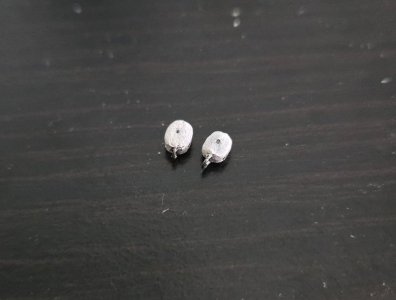
I haven't had much time for modeling lately, but a very minor update. First, I made the other 4mm internally-stropped block. This is the last block I'll be making until picking up my order of 3.5mm and 3mm blocks later this month.
20260603_082206.jpg

I also noticed that the centerboard pull handle had split.
20260603_092012.jpg

This bothered me, so I replaced it with a new one.
20260603_095151.jpg

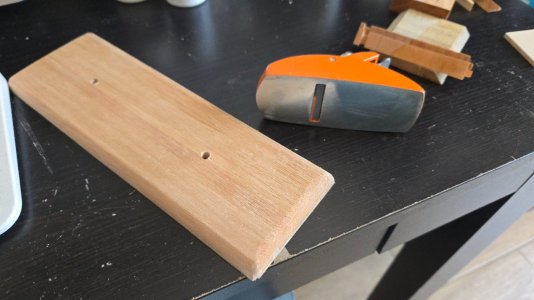
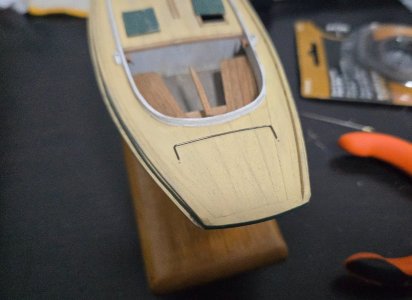
Finally and most importantly, I finished the base. I had been using the laser-cut base, but didn't love how it looked (not to mention that a lasering error marred it a bit). By chance, I was gifted a nice plank of Spanish Cedar with a rounded profile. I decided that it would make the perfect base for the Sloop. First things first, I cut it to size and drilled the holes. In order to round off the ends to match the sides, I used a small block plane I recently purchased (it's not great, but it was cheap and works pretty well after I flattened the sole a bit and sharpened the blade) to rough in the shape, and later sanded it smooth.
20260528_110916.jpg

I finished it with lemon shellac to deepen the color a bit. I also slightly shortened the posts, as I felt the model was a bit high.
20260603_091923.jpg

As I'm trying to finish some gifts I'm making before my trip to visit family, I probably won't be able to do much more modeling this month.
 
Back
Top