SHOPPING
Have been progressing slowly forward on the sanding as I have a lot of trouble with sore wrists and fingers.
To rest my hands, I go off and look at ways to lessen the pressure on my hands and wrist. Of course, they do cost money, and inevitably, I would have had to eventually buy one. Dave Stevens mentioned a right-angle tool for a Dremel, but I did not have a Dremel, but a Ryobi high-speed rotary tool. They are just about as good as, if not the same as, a Dremel, but the right-angle tool did not fit it, unfortunately. Therefore, I had to go shopping.
Before I rushed out and bought a Dremel, I did a bit of Internet search and found out that not all Dremels can handle the right-angle tool effortlessly.
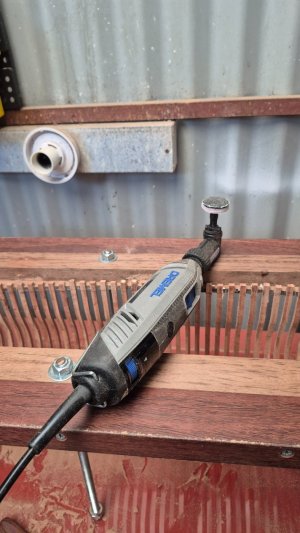
The Dremel 4250 175-watt motor is the one to use for the right-angle tool because of the drag on the motor due to the extra forces created by the extra gearing, etc. Coupled with an emery disk on the end takes a lot of power for the Dremel, and not losing power is a main concern. I have made the right choice and am happy with the choice of Dremel to drive the tooling.
BTW, the disk on the end is my homemade sanding disk bit and works a treat
I must add, if it wasn't for the SOS site, and many other clubs or forums we may belong to, how would we find out if this tooling is available? It could take years searching on the net, and maybe looking at something different, as experience tells us that the item may not be good enough to do the job, and yet, like I have found out, there is a tool that I frowned on that actually is very capable of doing what I want it to do as the make has responded and made a stronger, more powerful rotary tool, capable to handle what I wanted to do.

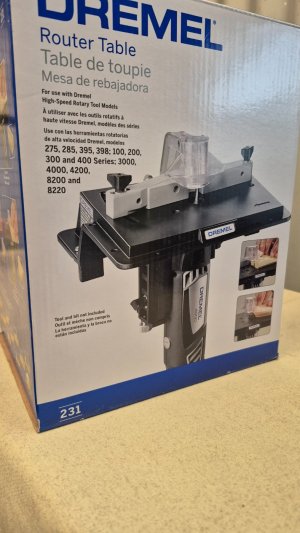
While I was in the mood for spending money, I saw a Dremel router bench and had had in my mind how I could make decorative wooden pieces, and the way I could go about it has been sitting in my mind for quite a long time. Well, on the board in front of me, at the tool shop, was a set of Router bits, which would be mainly the ones I may use in doing little rounded edges, coves, and so on.
Router bits that fit the Dremel:
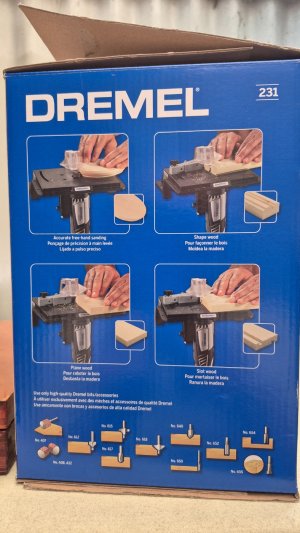
The Router bits are on the bottom of the box, with the numbers corresponding to the bit you may want.
The only criticism I have so far with this package is that it shows what router bits can do, but not on small bits of wood. The pieces they are gnawing at would be routed on a big router. It is what it is, I guess. Also, the shield is a problem as we know the dust will block the viewing, as well as sawdust sticking to the perspex. Always wear safety glasses/ goggles when routing.
How much do you need to sand back to make the smooth transition from frame to frame? Do you need to go right to the bottom?
That depends on what you are doing; a fully enclosed model does not need to be done, but where there are decks, etc., going to be, yes, they must have a smooth transition. So how do I mark out where I go, dangle a rule over the edge into the hull, and scratch a line with a pencil where I need to sand the transition, or make a measuring tool and make it look like a craftsman put the transition in with some accuracy?
Well, I took the second option and made a tool and then another tool so I could measure on the outside and inside of the ship.
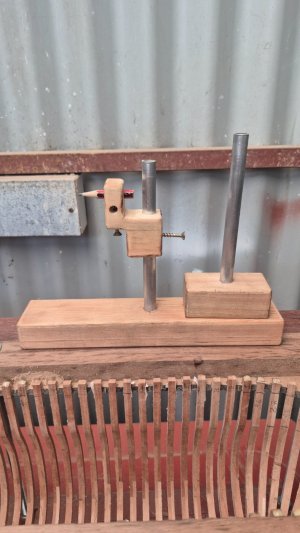
Looks like a bit of Junk Art, but truly, they are very handy measuring devices.
The long block is used for measuring inside the hull. It is easy to set up. Place the pencil at a height from a flat surface, minus the width of the block, to get very close measurements each time. Of course, a supply of sharp, short pencils is always needed, as the pencil goes dull.
Then place it inside the hull of the boat after the extra calcs have been done, and scribe the lines:
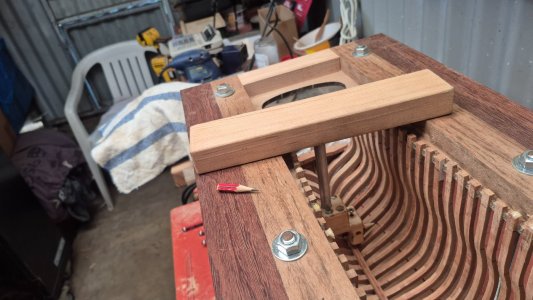
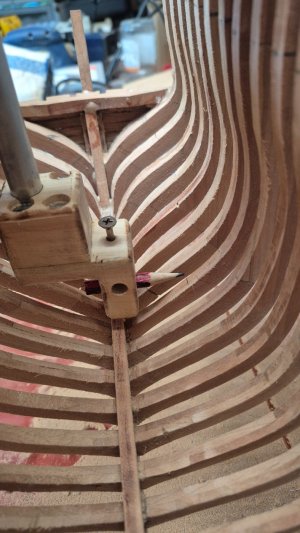
The smaller measuring block stand is used for the hull's outside measurements. The step-down is useful here as I have to make some very low measurements. The scribing head is universal, as it is used on each measuring block:
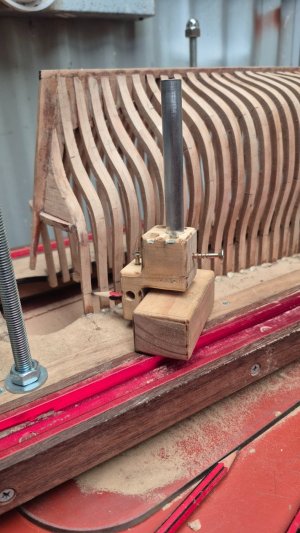
The rod is a bit of a hollow aluminium shaft I had saved for a rainy day.