
-
SUBSCRIBE TO SHIPS IN SCALE TODAY!
The beloved Ships in Scale Magazine is back and charting a new course for 2026!
Discover new skills, new techniques, and new inspirations in every issue.
NOTE THAT OUR NEXT ISSUE WILL BE July/August 2026 -

Win a Free Custom Engraved Brass Coin!!!
As a way to introduce our brass coins to the community, we will raffle off a free coin during the month of August. Follow link ABOVE for instructions for entering.
You are using an out of date browser. It may not display this or other websites correctly.
You should upgrade or use an alternative browser.
You should upgrade or use an alternative browser.
My Log (GaryA): The Bounty Build from Plans and Partial Kit from the Lumber yard for Model Shipwrights

- Joined
- Mar 28, 2024
- Messages
- 297
- Points
- 138

Hi all, I have not done much on the model, although I am making steady progress with the frames.
I have to work between the Extension of the Caravan Port, the model of the Bounty, the Garden, and the golf, so to say I am making steady progress is a fair comment.
However, as I go into the build and break down the monotony of the frames, I have taken a short break to make a sliding table for the Proxxon saw.
What has interested me is how to create the grating on the model accurately. So I had a crack at it after following the methods used by Kevin Kenny, as familiar with the best concepts he uses, as I have applied this method when making up interlocking corners on boxes, etc.
I have cut the first groove using a 1.21mm Proxxon off-the-shelf Carbide blade with 20 teeth on a 50 mm diameter. Then I moved to a new saw blade by Proxxon and of less thickness - .50mm, to slice the thickness of the grating pieces off.
I had, of course, no idea what would happen, as I knew it would not be smooth sailing, as I am dealing with very fine cut grooves, roughened up with a saw blade, and expecting something to happen, and it did! The wood I used was Pinus Pinaster, pine grown in the Southern Hemisphere, but originally from the Northern Hemisphere. It has a common name, Maritime Pine.
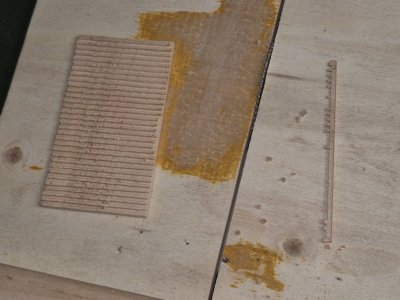
Here are the results of my labour, and I need some help to determine what type of wood would be a better wood to use, or what I can do to prevent this from happening.
I have to work between the Extension of the Caravan Port, the model of the Bounty, the Garden, and the golf, so to say I am making steady progress is a fair comment.
However, as I go into the build and break down the monotony of the frames, I have taken a short break to make a sliding table for the Proxxon saw.
What has interested me is how to create the grating on the model accurately. So I had a crack at it after following the methods used by Kevin Kenny, as familiar with the best concepts he uses, as I have applied this method when making up interlocking corners on boxes, etc.
I have cut the first groove using a 1.21mm Proxxon off-the-shelf Carbide blade with 20 teeth on a 50 mm diameter. Then I moved to a new saw blade by Proxxon and of less thickness - .50mm, to slice the thickness of the grating pieces off.
I had, of course, no idea what would happen, as I knew it would not be smooth sailing, as I am dealing with very fine cut grooves, roughened up with a saw blade, and expecting something to happen, and it did! The wood I used was Pinus Pinaster, pine grown in the Southern Hemisphere, but originally from the Northern Hemisphere. It has a common name, Maritime Pine.
Here are the results of my labour, and I need some help to determine what type of wood would be a better wood to use, or what I can do to prevent this from happening.

If it works, go for it. Thanks for posting. FWIW I found breakage was a problem doing it this way years ago so went with the old tried and true method I first saw in Bernard Frolich's book, The Art of Ship Modeling. There is no breakage and is accurate in forming the ledges and battens even at the smallest scales we normally see. I'll try to make a sample and photograph the steps along the way and post in the Tricks of the Trade topic here at SoS.
Allan
Allan
Last edited:
- Joined
- Mar 28, 2024
- Messages
- 297
- Points
- 138
Thanks, Allan, that would be great.If it works, go for it. Thanks for posting. FWIW I found breakage was a problem doing it this way years ago so went with the old tried and true method I first saw in Bernard Frolich's book, The Art of Ship Modeling. There is no breakage and it accurate in forming the ledges and battens even at the smallest scales we normally see. I'll try to make a sample and photograph the steps along the way and post in the Tricks of the Trade topic here at SoS.
Allan
- Joined
- Mar 28, 2024
- Messages
- 297
- Points
- 138
So, fellow Shipwrights, I have come up with an explanation that I hope you can all follow. Please be free to comment. BTW, I did the same for AllanKP69's " Tricks of the trade" site. I want to keep a detailed record of the method I use to make the grating on my log as well.
Also, the first 2 pics show the extrusions face up, but I think you are well aware they are lying flat on the saw surface for the saw to cut the grooves mentioned with the explanation.
This grating is at a 1:48 scale. The saw blade cuts the grooves a little wider than the width of the blade, which brings it into cooey of the right size.
Here is the material with the grooves cut....
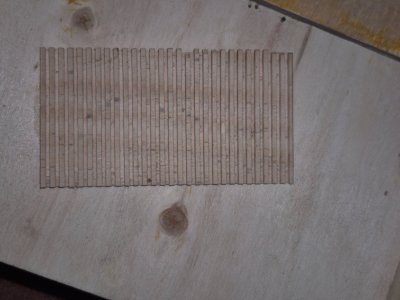
Then I turn the material to 90 degrees to do this cut again, at half the depth and on the grooved side....
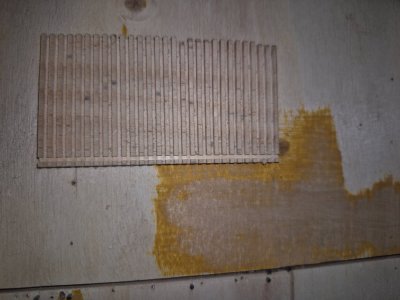
Note: This again only cut halfway through.
THEN..
I turn the piece over and perform the last cut to produce the Strip.
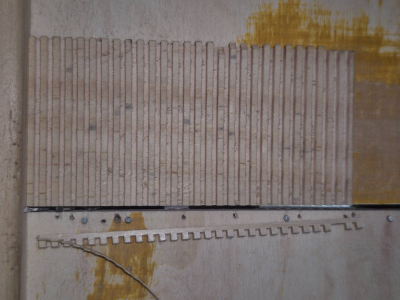
I will add that this is Pinus Pinaster, or commonly known as Maritime Pine in Europe.
I am finding it a challenge, but the more strips I produce, the fewer extrusion problems. BTW, with the right tools, it is quite easy to replace missing extrusion pieces from the strips, but I wait until the whole grating has been made to show you what I do and the tools I have to carry out the repairs.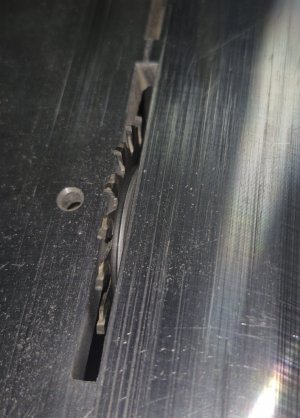
Here is the Saw blade I am using on the Proxxon.
You can see the teeth have no angle on them, ideal for making grooves in wood, square at the bottom. This saw blade had to be bought separately, as the new saw only comes with a slitting-type blade.
Also, the first 2 pics show the extrusions face up, but I think you are well aware they are lying flat on the saw surface for the saw to cut the grooves mentioned with the explanation.
This grating is at a 1:48 scale. The saw blade cuts the grooves a little wider than the width of the blade, which brings it into cooey of the right size.
Here is the material with the grooves cut....
Then I turn the material to 90 degrees to do this cut again, at half the depth and on the grooved side....
Note: This again only cut halfway through.
THEN..
I turn the piece over and perform the last cut to produce the Strip.
I will add that this is Pinus Pinaster, or commonly known as Maritime Pine in Europe.
I am finding it a challenge, but the more strips I produce, the fewer extrusion problems. BTW, with the right tools, it is quite easy to replace missing extrusion pieces from the strips, but I wait until the whole grating has been made to show you what I do and the tools I have to carry out the repairs.
Here is the Saw blade I am using on the Proxxon.
You can see the teeth have no angle on them, ideal for making grooves in wood, square at the bottom. This saw blade had to be bought separately, as the new saw only comes with a slitting-type blade.
Last edited:
- Joined
- Mar 28, 2024
- Messages
- 297
- Points
- 138
Back onto the Framing jig again.
After some consideration of how I was going to line up the frames and glue them to the mounting jig, I came to the conclusion that the string line is not the way to go about it. So, having in mind using a "strong back" seemed like a better way to carry out the fixings of the frames, so that all the frames would run on a true and straight centre line. This would involve using no pressure, especially when drilling holes and ensuring good alignment of holes, when joining aluminium strips together. To make this strong back, I needed it to be straight in two directions. Not only straight but also rigid.
The strong back is made out of 25 x 3mm thick flatbar and 25 x 25 x 3mm thick 90-degree angle.
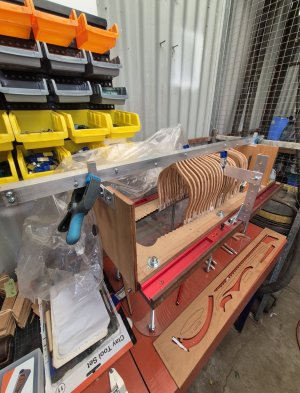
The next frame shows that the Strong Back is not sitting down correctly on the plate. The strong back must be sitting flat on the adjustment plate at either end, and the frames must be positioned against the strong back. See the Pic and look for the arrow depicting the gap.
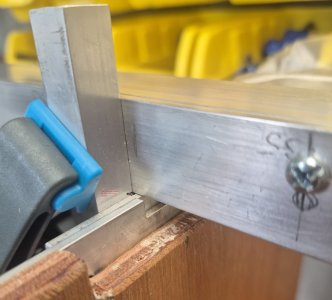
I am using clamps at each end to hold the strongback in position.
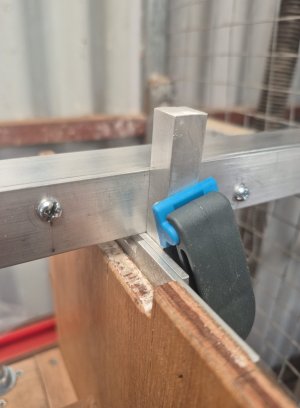
Once the strongback is in position, the gantry comes into use. The frame is set at 90 degrees to the frame and locked into the frame's slot position.
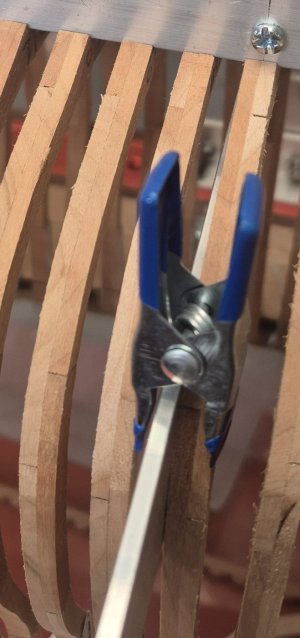
In my thought process before I made this Strongback, I felt I would not be able to actually fit the frames, as I feel the item specifications call for accuracy, and this would be the only way I could do the frame fitting.
All I have to do now is fit and glue all Frames into position.
Any questions, feel free to ask
After some consideration of how I was going to line up the frames and glue them to the mounting jig, I came to the conclusion that the string line is not the way to go about it. So, having in mind using a "strong back" seemed like a better way to carry out the fixings of the frames, so that all the frames would run on a true and straight centre line. This would involve using no pressure, especially when drilling holes and ensuring good alignment of holes, when joining aluminium strips together. To make this strong back, I needed it to be straight in two directions. Not only straight but also rigid.
The strong back is made out of 25 x 3mm thick flatbar and 25 x 25 x 3mm thick 90-degree angle.
The next frame shows that the Strong Back is not sitting down correctly on the plate. The strong back must be sitting flat on the adjustment plate at either end, and the frames must be positioned against the strong back. See the Pic and look for the arrow depicting the gap.
I am using clamps at each end to hold the strongback in position.
Once the strongback is in position, the gantry comes into use. The frame is set at 90 degrees to the frame and locked into the frame's slot position.
In my thought process before I made this Strongback, I felt I would not be able to actually fit the frames, as I feel the item specifications call for accuracy, and this would be the only way I could do the frame fitting.
All I have to do now is fit and glue all Frames into position.
Any questions, feel free to ask
- Joined
- Mar 28, 2024
- Messages
- 297
- Points
- 138
Here is how good the alignment turned out using this method.
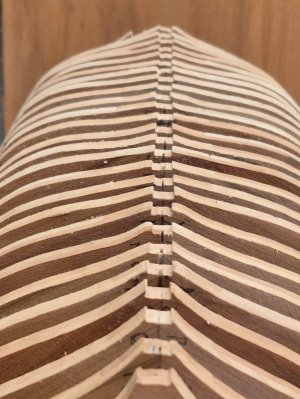
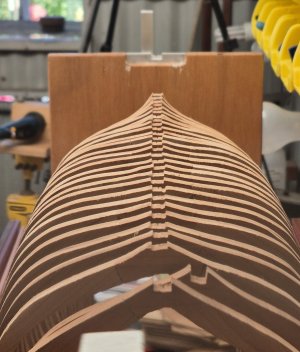
There is one or 2 may be a little out as the wood will flex in the heat, but I'm very happy how the setup worked.
On the second Photo, I have shown two frames out of alignment, which will be fitted when I have fitted the keel
Any comments?
There is one or 2 may be a little out as the wood will flex in the heat, but I'm very happy how the setup worked.
On the second Photo, I have shown two frames out of alignment, which will be fitted when I have fitted the keel
Any comments?
- Joined
- Mar 28, 2024
- Messages
- 297
- Points
- 138
A PROBLEM WITH THE STERN TIMBERS
So now I have fitted the keel. That was very easy and no ten-thumbing. Now I moved on to fitting the Stern Timbers and lost the handle. I think I found it again, but only due to a slightly incorrect interpretation of the drawing, maybe on my part. I will explain by video, and also by description, including photos.
Maybe Dave Stevens can help to solve the interpretation of the drawing.
Here is how it appears the Stern timbers are located: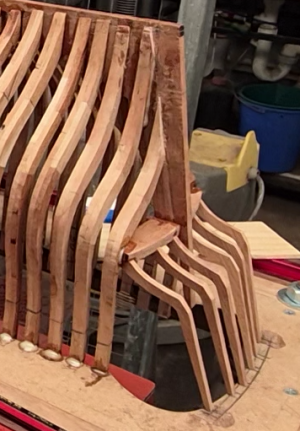
However, according to the drawing, it appears that it is not how they are located, or I have got it wrong somehow.
So, as for the drawing, I am showing where I sort of lost it...
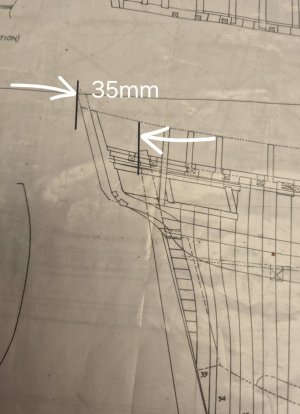
So, as the arrows depict above, the distance from the Keel post to the End of the most distant Stern Timber Frame is 35 mm, but when I project the radius as shown in the pic above, the lines are further away. Probably with a bit of scrambling with the four inner posts, I, maybe, could get away with it, but the external two are so far away from the matching scribed radius lines that there is no chance they will line up.
So I went and looked at SOS, and I see a scratch build being done by Lester Palifca, and he was having a little trouble with the Stern Timbers, and Dave Stevens gave him a hand to sort it out, and I am sure how Dave explains it is how I have finally set the timbers correctly, I hope. All the model ships and how they were built can be found on different forums, and it is very handy to know.
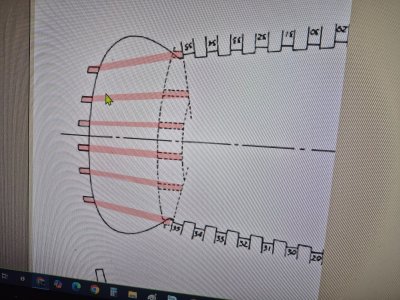
So if I followed the set pattern of the Stern Timber position to the new arc, I made with my homemade Scribing arm, as the next pic shows
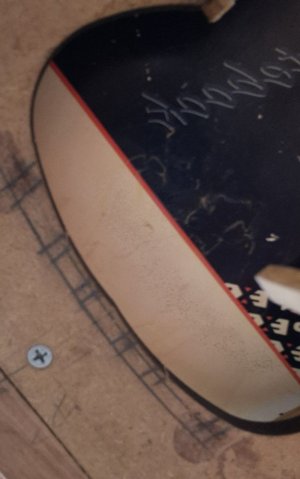
You can see that the positions where the Stern Timbers are located on this new radius (visualized by the two arcs drawn), are not correct to the length of the Stern Timbers supplied, so I went back to the drawing board, and followed how they appear to fit, which was as the cut out appears on the base board supplied. This is as it appears on the setup, with what seems to be information on the drawings supplied, as previously shown:
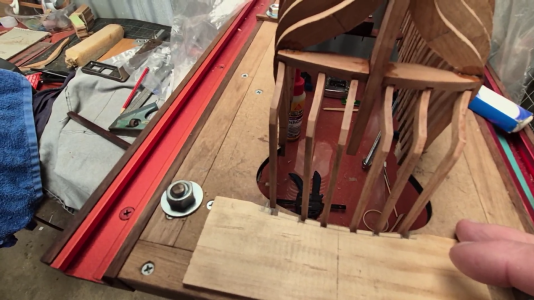
Viewing the timbers, you will see they seem to be a bit short, especially those on the outer edges. Obviously wrong on my part, or a misunderstanding of drawing.
So, I went back to how they are supposed to fit, and maybe Dave can help me out here and point out what is meant in the drawing.
Here is the final setup showing the Stern timbers following perimeter of the cutout, base board supplied, and hopefully correct:
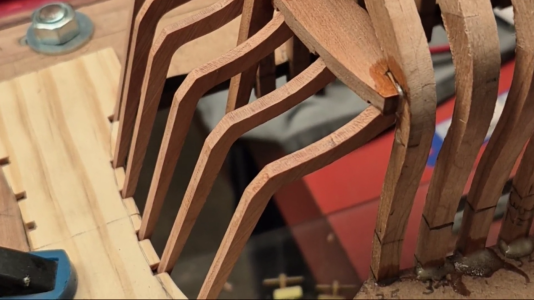
Here is the layout from the rear view showing timbers resting on the base plate:
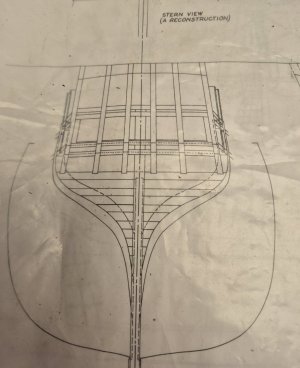
All comments welcomed
So now I have fitted the keel. That was very easy and no ten-thumbing. Now I moved on to fitting the Stern Timbers and lost the handle. I think I found it again, but only due to a slightly incorrect interpretation of the drawing, maybe on my part. I will explain by video, and also by description, including photos.
Maybe Dave Stevens can help to solve the interpretation of the drawing.
Here is how it appears the Stern timbers are located:
However, according to the drawing, it appears that it is not how they are located, or I have got it wrong somehow.
So, as for the drawing, I am showing where I sort of lost it...
So, as the arrows depict above, the distance from the Keel post to the End of the most distant Stern Timber Frame is 35 mm, but when I project the radius as shown in the pic above, the lines are further away. Probably with a bit of scrambling with the four inner posts, I, maybe, could get away with it, but the external two are so far away from the matching scribed radius lines that there is no chance they will line up.
So I went and looked at SOS, and I see a scratch build being done by Lester Palifca, and he was having a little trouble with the Stern Timbers, and Dave Stevens gave him a hand to sort it out, and I am sure how Dave explains it is how I have finally set the timbers correctly, I hope. All the model ships and how they were built can be found on different forums, and it is very handy to know.
So if I followed the set pattern of the Stern Timber position to the new arc, I made with my homemade Scribing arm, as the next pic shows
You can see that the positions where the Stern Timbers are located on this new radius (visualized by the two arcs drawn), are not correct to the length of the Stern Timbers supplied, so I went back to the drawing board, and followed how they appear to fit, which was as the cut out appears on the base board supplied. This is as it appears on the setup, with what seems to be information on the drawings supplied, as previously shown:
Viewing the timbers, you will see they seem to be a bit short, especially those on the outer edges. Obviously wrong
on my part, or a misunderstanding of drawing.So, I went back to how they are supposed to fit, and maybe Dave can help me out here and point out what is meant in the drawing.
Here is the final setup showing the Stern timbers following perimeter of the cutout, base board supplied, and hopefully correct:
Here is the layout from the rear view showing timbers resting on the base plate:
All comments welcomed
Last edited:
Looking at the stern timbers resting on the wing transom (base plate) do your plans show any other views? The side stern timbers appear to the be the same height as the others, that does not match the contemporary drawing which shows the outer timbers about 37 inches shorter than those in the center. Also, I am pretty sure she was built similar to other ships of her time even as a merchant vessel, so the outer counter timbers would not be straight, but rather would be rounded so the planking is a smooth transition from the side of the hull all the way to the end as the stern. https://www.rmg.co.uk/collections/objects/rmgc-object-86456
Allan
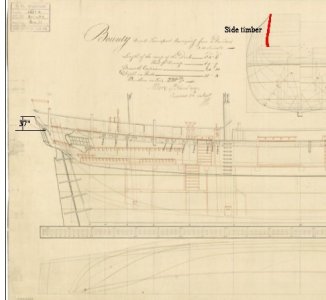
Allan
Last edited:
- Joined
- Mar 28, 2024
- Messages
- 297
- Points
- 138
Looking at the stern timbers resting on the wing transom (base plate) do your plans show any other views? The side stern timbers appear to the be the same height as the others, that does not match the contemporary drawing which shows the outer timbers about 37 inches shorter than those in the center. Also, I am pretty sure she was built similar to other ships of her time even as a merchant vessel, so the outer counter timbers would not be straight, but rather would be rounded to the planking is a smooth transition from the side of the hull all the way to the end as the stern. https://www.rmg.co.uk/collections/objects/rmgc-object-86456
Allan
View attachment 575081
Hi Allan yes as shown on this drawing>
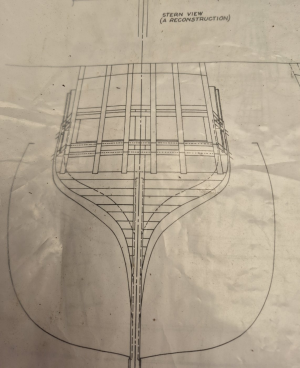
As shown here, there is a difference when calculated out, which would be about 30 odd Inches also, but I am referring to where the highest point of the Wing Transom Arms or timbers is resting away from the Baseline, 35 mms from the keel post to get the radius dimension. I had to work out the distance to scribe an arc. Maybe none of the radii matched up how these stern Timbers lined up as they do. I think I am digging myself a hole here, but I am sure Dave Stevens can tell what the drawing shows is correct, and the base plate was made, and what dimensions Dave used to make the base plate dimensions.
Thanks for the interaction Allan. Most appreciative.
Last edited:
- Joined
- Mar 28, 2024
- Messages
- 297
- Points
- 138
When it came to fitting the Keelson to the frame of the build, I all of a sudden came to a halt. The reason was I did not have enough of the clamps shown to hold the keelson in place. Then, I came to a solution by tightening string around the keelson, but that did not work either, as I could not pull it tight enough (drying time was approaching, too). Then a great idea came to me.
If I backed off the string a bit, then I could use a lever to twist the string tight. By Jove, it worked and just in time too.
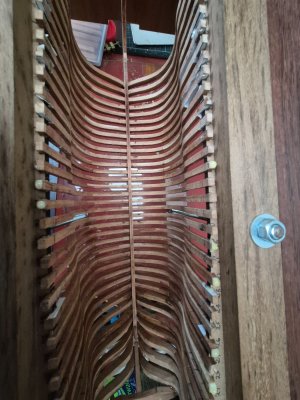
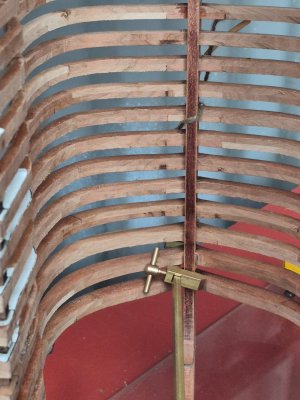
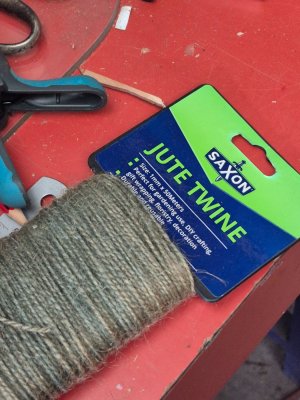
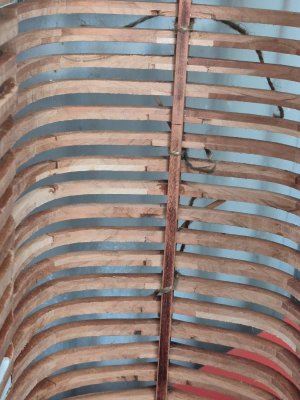
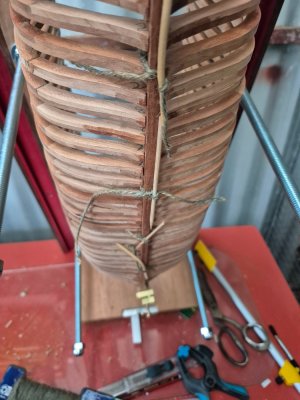
There is more than way to skin a carcass and also more than one way to clamp two objects together. Back to the caveman style and it works still.
*Footnote: while browsing on Dave Stevens pages on a short note running short of clamps I see he also will use string to tighten wood together in hard to clamp spots. Sorry about stealing your thunder Dave, as was not intended.
Does goes to show on S.O.S., many ideas are covered.
If I backed off the string a bit, then I could use a lever to twist the string tight. By Jove, it worked and just in time too.
There is more than way to skin a carcass and also more than one way to clamp two objects together. Back to the caveman style and it works still.
*Footnote: while browsing on Dave Stevens pages on a short note running short of clamps I see he also will use string to tighten wood together in hard to clamp spots. Sorry about stealing your thunder Dave, as was not intended.
Does goes to show on S.O.S., many ideas are covered.
Last edited:
Aut inveniam viam faciam (I shall either find a way or make one) is a good mind set for ship modelers at times. You have provided another solution that will hopefully help another member down the road.By Jove, it worked and just in time too.
Allan
- Joined
- Mar 28, 2024
- Messages
- 297
- Points
- 138
Hi Allan, Absolutely, and I agree whole heartedly. Also, I managed the tightness of the string to leave no marks on the wood. I found out if I only passed the string over itself 3 times was enough to stop the string loosening.Aut inveniam viam faciam (I shall either find a way or make one) is a good mind set for ship modelers at times. You have provided another solution that will hopefully help another member down the road.
Allan
- Joined
- Mar 28, 2024
- Messages
- 297
- Points
- 138
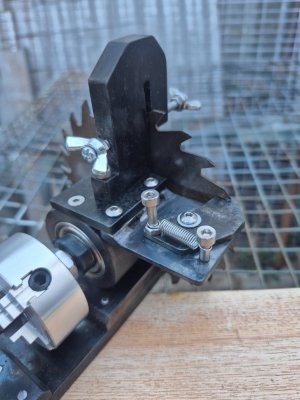
Building a special dividing head to make the windlass and steering wheel.
Have taken time off from the framing and looked at the workings of the Steering wheel, the Windlass and I was thinking do I spend $6000 on a small milling machine, and a dividing head and tooling for this gear, to create a couple of items and after that not hardly used or do I attempt to make up a piece of tooling to be useful to create accurate milling on a circumference along with using my lathe as Milling Machine.
Well, I took the second consideration and set to work making all the parts as this pic shows.
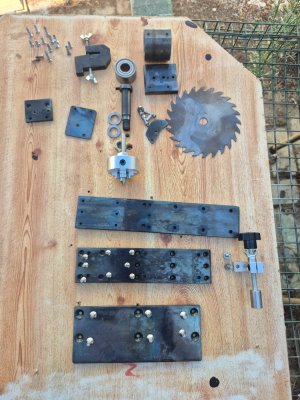
Put it all together and trialed it with a piece of dowel, which went on to be the completed windlass on my first attempt
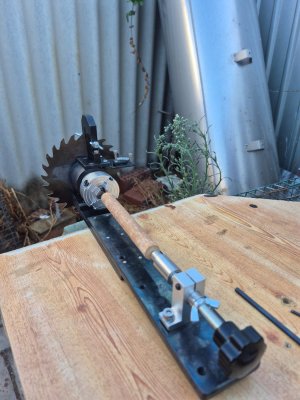
Here is a view of the locking mechanism I made to hold the saw blade in the exact position each time I revolved it to its new position, and then tightened the wing nut on either side of the saw blade to lock it firmly.
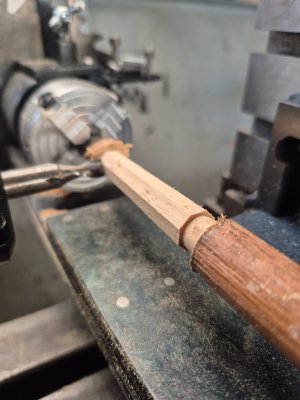
Then started practicing on the piece of dowelling after fitting the dividing head to my vertical clamping vice, and it was turning out quite well as everything was going according to a miraculous plan >
The wood is called Tasmanian Oak and may be related to the oak trees from the western side of the USA, as Tasmania broke away from there and floated down to where it is now, just below Australia.
The dowelling was used in the Aviary for my birds when I was breeding them. I did not expect the wood to go the whole machining journey, but it certainly did without splitting or chipping - it appeared to be able to handle a milling cutter running at 1450 rpm extremely well.
Here is the finished Windlass at 1/48 scale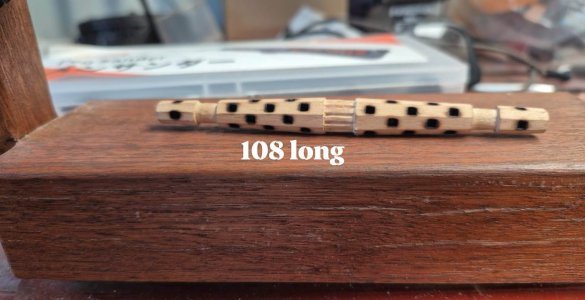
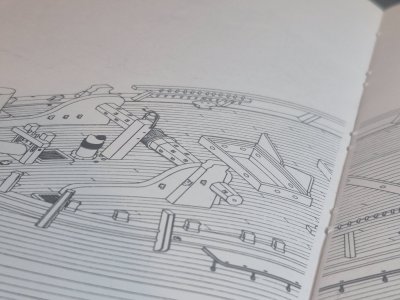
Here is what the windlass is going to look like when installed on the ship:
Have taken time off from the framing and looked at the workings of the Steering wheel, the Windlass and I was thinking do I spend $6000 on a small milling machine, and a dividing head and tooling for this gear, to create a couple of items and after that not hardly used or do I attempt to make up a piece of tooling to be useful to create accurate milling on a circumference along with using my lathe as Milling Machine.
Well, I took the second consideration and set to work making all the parts as this pic shows.
Put it all together and trialed it with a piece of dowel, which went on to be the completed windlass on my first attempt
Here is a view of the locking mechanism I made to hold the saw blade in the exact position each time I revolved it to its new position, and then tightened the wing nut on either side of the saw blade to lock it firmly.
Then started practicing on the piece of dowelling after fitting the dividing head to my vertical clamping vice, and it was turning out quite well as everything was going according to a miraculous plan >
The wood is called Tasmanian Oak and may be related to the oak trees from the western side of the USA, as Tasmania broke away from there and floated down to where it is now, just below Australia.
The dowelling was used in the Aviary for my birds when I was breeding them. I did not expect the wood to go the whole machining journey, but it certainly did without splitting or chipping - it appeared to be able to handle a milling cutter running at 1450 rpm extremely well.
Here is the finished Windlass at 1/48 scale
Here is what the windlass is going to look like when installed on the ship:
Last edited:
- Joined
- Mar 28, 2024
- Messages
- 297
- Points
- 138
Making Bushes for the Forward Windlass.
After spending a considerable time on the windlass, making it and turning out so well, I was wondering if I had it in me to make the next part for the windlass pedestal stands, Pawl Bitts.
How I came about this is that, when looking at the material sent over to me in cutout form, I noticed the windlass pedestal stands, or Pawl Bitt, had a half-section Octagon cut out, then a half-hole section for the Windlass shaft bearing placements to be fitted to the windlass pedestal mounts.
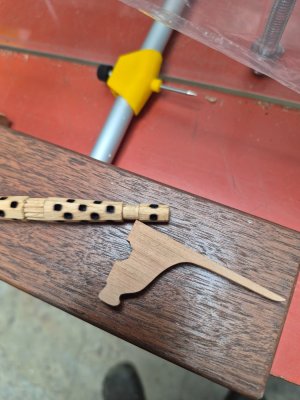
This half-octagon hole would be ok for a static windlass, but I wanted to have one that worked so people could see how it did work.
So, having a Dividing Head on hand, I decided to have a go at making the bushes up. They were very tiny, but I wanted to try to make them
So I got my favourite wood (Tasmanian Oak, again) and set about making them...
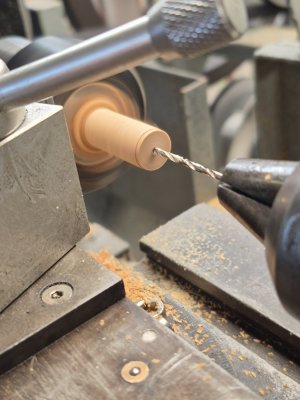 Drilled a hole that would centralize on the centres of the Dividing head
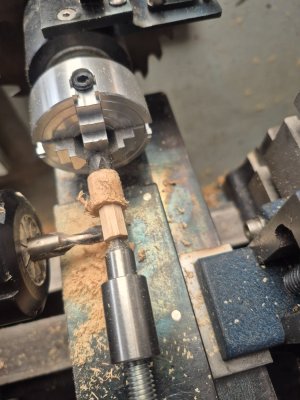 Machined an octagon to the correct size of the Pawl Pitt Octagon....
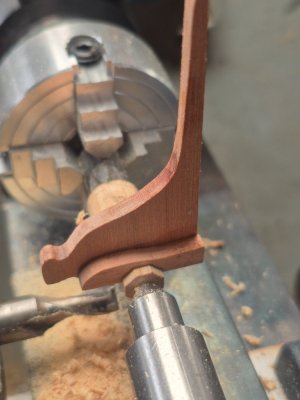 Then parted them, nearly, but leaving enough to use my jeweler's saw to cut through the remaining piece of wood, as that's when most mishaps happen, as the parting tool breaks through the wood.
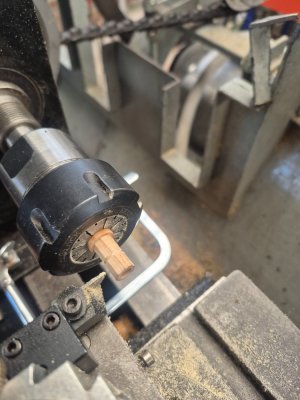 Fit and glued the bushes into the Pawl Bitts
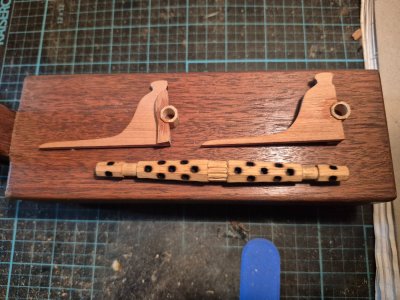
Sanded the excess off the bush, then cut the excess bushing off and checked the fit again.
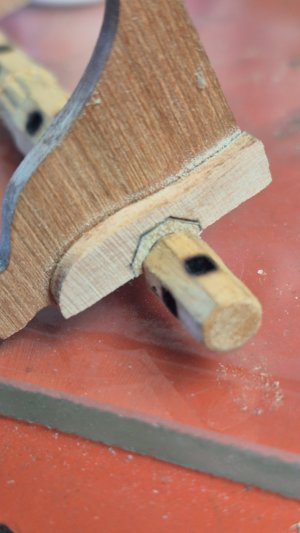
It's amazing what you can do with the right gear!
Fun Facts: the lathe is over a 100 years old and runs on true love. I have done lots of milling with it, like Flycutting, Keyways, and also made gears for the feed mechanisms.
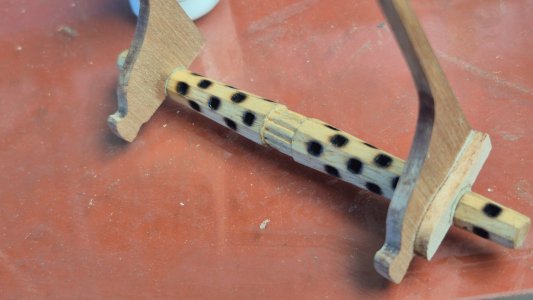
After spending a considerable time on the windlass, making it and turning out so well, I was wondering if I had it in me to make the next part for the windlass pedestal stands, Pawl Bitts.
How I came about this is that, when looking at the material sent over to me in cutout form, I noticed the windlass pedestal stands, or Pawl Bitt, had a half-section Octagon cut out, then a half-hole section for the Windlass shaft bearing placements to be fitted to the windlass pedestal mounts.
This half-octagon hole would be ok for a static windlass, but I wanted to have one that worked so people could see how it did work.
So, having a Dividing Head on hand, I decided to have a go at making the bushes up. They were very tiny, but I wanted to try to make them
So I got my favourite wood (Tasmanian Oak, again) and set about making them...
Drilled a hole that would centralize on the centres of the Dividing head Machined an octagon to the correct size of the Pawl Pitt Octagon.... Then parted them, nearly, but leaving enough to use my jeweler's saw to cut through the remaining piece of wood, as that's when most mishaps happen, as the parting tool breaks through the wood. Fit and glued the bushes into the Pawl Bitts Sanded the excess off the bush, then cut the excess bushing off and checked the fit again.
It's amazing what you can do with the right gear!
Fun Facts: the lathe is over a 100 years old and runs on true love. I have done lots of milling with it, like Flycutting, Keyways, and also made gears for the feed mechanisms.
Last edited:


Your build is looking very nice !
- Joined
- Mar 28, 2024
- Messages
- 297
- Points
- 138
Thanks Mate, enjoying doing it too.Your build is looking very nice !