
• Win a Free Custom Engraved Brass Coin!!!
    As a way to introduce our brass coins to the community, we will raffle off a free coin during the month of August. Follow link ABOVE for instructions for entering.
  • SUBSCRIBE TO SHIPS IN SCALE TODAY!

    The beloved Ships in Scale Magazine is back and charting a new course for 2026!
    Discover new skills, new techniques, and new inspirations in every issue.

    NOTE THAT OUR NEXT ISSUE WILL BE MARCH/APRIL 2026

Planking using small nails

Joined
Mar 28, 2024
Messages
277
Points
138

Hi Everyone, I am quite curious to see how many model shipwrights use nails to scale when doing planking, etc.
I have acquired these nails from the internet, and, being very hard to see with these tiny naked eyes, is that why most shipwrights use a pencil? Or is the drilling of the holes a problem?

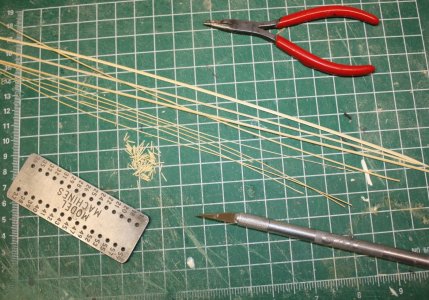
20260421_171922.jpg20260421_171323.jpg
They are 0.3 mm by 4mm in length and have a 0.5 mm head.
So, I have worked out that the nails the old long-time-ago shipwrights would have used in the 17/18Th century would have been copper, wood, or iron nails, or though the latter would have begun use in the 18th century. Their sizes would have varied for the application they were going to be used for. Today I am talking about the planking on the decks, and either copper or iron was used, and a large dab of tar was added to the hole to stop the rot of the nail. So saying this is why people use a pencil to show the staining of the tar, or just a easy way to create the belief of a nail being put in the wood to hold the plank to the timbers underneath.
I would also like to know why not pre-drill the holes slightly oversized so the nails would easily fit into the holes.
Drills and what to be careful of when buying them: I have a few of those packets of modellers drills, and I decided to buy another set of them as a few of the smaller drills have gone missing or broken. I bought another pack off the net and thought, no worries, have some replacements for those missing, that was a year ago. Well, today, I pulled out this new set of drills and looked at a .3mm drill, and it appeared to be too big by my eyesight. I measured and found it was 0.6mm, not 0.30mm. So I went to the next slot and took out the next size drill and measured that, 0.6 again, and the next one was the same. In total, 4 drill bits were all the same. So I could not check out if the fit was too small at the .30 mm hole or .35 was the way to go

 
and a large dab of tar was added to the hole to stop the rot of the nail.
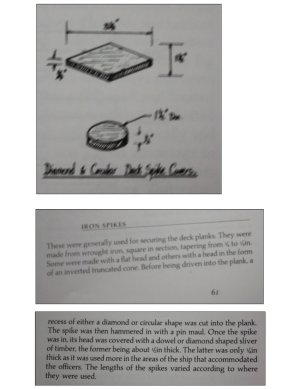
For English ships, when securing deck planking in the 17th and 16th centuries, they used metal spikes, usually iron, but according to Peter Goodwin, once they were driven home they were covered with wooden plugs, not tar or other sealants. I would not be surprised if they were covered with other media on some ship but I have not found an information based on contemporary sources about anything other than wooden plugs. I do not like to use the words never, always, only, etc for ships in the age of sail due to the many exceptions/variations tried but you will not be wrong to use wooden treenails as the exposed part will look like a round 1.5" diameter (0.8mm for 1:48, 0.6mm for 1:64, or 0.4mm for 1:96)wooden cover over the would be spikes. Tar or similar would not look like any contemporary model of English warships in the 17th and 18th centuries that I have seen, but maybe some member has photos of an exception
Allan.

Deck spikes and covers.JPG
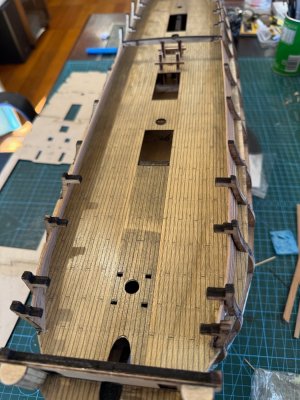
While Victory is a modern ship now with fiber glass cannon and such, if they were true to reconstruction, you can see the wooden plugs rather than tar or other sealants. Tar and feet would be a mess on hot days.

1776871427821.jpeg
 
I have seen some just use brass wire, no heads to represent nails, but you have to research the specific ship or era and country to see what the real ship builders used.

One problem with nails, is they make it hard to sand a smooth surface, as they eat up sandpaper designed for softer wood.
 
how many model shipwrights use nails to scale when doing planking, etc.
The term used up to now is "pins". At least for me, nail means something Ferrous. Iron fasteners and ship models have given proof to the rule that "rust never sleeps". As for the pins that you have - do not let the heads get anywhere close to the surface of the planking. Never in it.

Brass pins have been a modelers convention for a while. I have photos of contemporary models in French museums supplied in AAMM monographs that have brass hull planking fasteners. They kinda dominate.

There are contemporary models in the NMM that have wooden dowels as hull planking fasteners. Actually securing planking to framing - not for show. The diameter of the dowels is out of scale and also kinda dominates.

I believe that you will find any historical evidence of visible dowels and spikes being visible at scale viewing distance is a rare exception.

Using pins and or dowels on model planking is best considered a modelers convention.
To me, doing a myriad of shallow just for show doweling is a silly waste of time.
Using brass pins and hitch chocks is the effective way to clamp planking until the PVA bonding agent cures. The choice is then to either pull the pin and fill the hole with a dowel dipped in 90% PVA and pushed home or
the pin nipped at the plank surface and filed flush.

For a while now - the practical - long enough to actually secure - dowels are Bamboo. Endcap Bamboo skewers -
requires a draw plate - and a single edge Gem blade froe
Byrnes' is excellent -
Jewelers wire draw plates - used from the opposite from the intended face - probably needs scrubbing with sharpening stones to get a cutting edge - the hole progression does not usually match our #61 -#80 intervals - probably really expensive now.
General Tools SS 1-60 and SS 61-80 drill bit gauges work for me. Price shop but quality steel and accurate holes are really important. Again stone the surface to get an edge.

Bamboo skewers- there are many species of Bamboo used for this - some split and shave-off nicely - most fight you all the way - some are not worth the effort - lots of choices - from different Asian sources - get a variety - they do not cost all that much.

The holes - you want a push fit that is just loose enough to allow for extraction without much effort. But not a stirring rod in a test tube loose.
Slightly watery PVA between the dowel and pin. The bond between wood and brass is not close to wood to wood with PVA. But it is strong enough that serious torque is needed to break it. Probably more force than normal atmospheric humidity changes will produce.

If you do not have one - a Rogers #61-80 dome stand drill bit set. Quality HSS for the bits - a series of replacement bits from a trustworthy vendor may be necessary for quality. Backup for breakage is needed anyway.

I have a strong attraction to using Bamboo and brass and maybe copper wire mostly for the clamping and belt and suspenders factor.
However:
The final way too busy look -
The extra attention and time to get each hole drilled at the proper distance from the plank edge and from the frame edge -
The huge number of holes -
The thousands of dowels to draw and pins to buy-
These all over balance the equation to the "It just ain't worth it." side.
 
So, I have worked out that the nails the old long-time-ago shipwrights would have used in the 17/18Th century would have been copper, wood, or iron nails, or though the latter would have begun use in the 18th century. Their sizes would have varied for the application they were going to be used for. Today I am talking about the planking on the decks, and either copper or iron was used, and a large dab of tar was added to the hole to stop the rot of the nail. So saying this is why people use a pencil to show the staining of the tar, or just a easy way to create the belief of a nail being put in the wood to hold the plank to the timbers underneath.
I would also like to know why not pre-drill the holes slightly oversized so the nails would easily fit into the holes.

That you have taken the care to do some research in pursuit of ensuring historical accuracy in your model is most commendable. A sampling of the present crop of models betrays the sad fact that far too few exhibit the attention to detail which is the hallmark of quality scale ship models. All too often, today's "post-internet" modelers look no further than popular ship modeling forums and social media pages as research resources without recognizing that much, if not most, of what's posted "on the world's largest refrigerator door" isn't necessarily accurate.
Although widely embraced as an "essential detail," the out-of-scale depiction of deck planks, fastenings, and fasteners on scale ship models is one of the most common, and obvious, errors to be seen in ship models being built today. In part, this fad is perpetuated by ship model kit manufacturers whose instructions direct the unwitting consumer to include such "essential details." In other instances, models sporting grossly unrealistic black "freckles," completely misplaced relative to underlying framing timbers, over-scale stripes of seam compound depicting out-of-scale plank lengths and widths and incorrect butt spacing, and "real copper plates" peppered with a "pox" of over-scale "rivets" are routinely pictured online to invite the admiring "ooh's" and "aah's" of the blind teaching the blind in "monkey see, monkey do" fashion that this is the way it's supposed to be done.

Some modelers will for a variety of reasons profess not to care, others will obstinately maintain that "it's my model and I can build it as I like," and still others will challenge anyone's right to judge their work. The former two positions are entirely valid, as far as the modeler's prerogatives go. In those cases, the modeler's stipulation renders consideration of their model's quality irrelevant. The latter position, however, fails to recognize that every model "speaks for itself" when seen by others. Every model stands on its own merits. Its level of quality is demonstrated by the model itself separate and apart from anything else. When knowledgeable eyes view a model exhibiting historical inaccuracies and errors of scale, such faux pas detract from the quality of the models exhibiting them. Unfortunately for the fine art of scale ship modeling, it seems the established norms of academic constructive criticism have been stifled by the champions of mediocrity marching under the banner of social correctness. They would have the fine art of scale ship modeling reduced to the level of the Special Olympics where "just showing up" is sufficient to establish credibility because "everybody gets a prize for trying." None of the Old Guard who learned the craft in an age when the hallmark of high-quality scale ship modeling was the dedicated pursuit of perfection in scale and historical accuracy want to hurt the feelings of a novice bursting with pride over their first effort by calling it a dog's breakfast, but here we are. Without constructive criticism in the public fora, nothing is taught and nothing is learned, which is a pretty deadly situation for a fine art form dependent upon the pursuit of excellence.

Consequently, the novice, flushed with a counterfeit "Thrill of Victory" absent risking the "Agony of Defeat," (as ABC TV's Wild World of Sports' used to put it before there were "participation trophies") never improves their skills. They just keep buying one mediocre ship model kit after another selected from a limited fleet of uninteresting subjects that have by now been modeled poorly thousands of times.

So, without pointing fingers at any particular model, and God forbid for sure, any particular modeler, allow me to answer the question generally in the hope at least some of the "internet generation," will "get the memo" and thereby built scale ship models that speak better for themselves than most.


The generally accepted definition of a high-quality scale ship model:

"A high-quality scale ship model provides a compelling impression of an actual vessel within the constraints of historical accuracy."

"Historical accuracy" encompasses all the objective, or measurable, standards of technical exactness that might apply to a ship model. These embrace the obvious hull shape and fairness; precision in fittings, rigging, and colors; lack of anachronisms; and so forth. But it also encompasses all aspects of craftsmanship because the lack of craftsmanship creates unrealistic and, therefore, historically inaccurate blemishes on a model. ... The phrase "historically accurate" alone effectively replaces the intention of the now-vapid "museum quality."

"... (A "compelling impression") allows and encourages aesthetic interpretation of a vessel that will help propel the viewers to make the leap of faith that allows a model to work or to willingly suspend the disbelief that keeps a model from working. Both processes help viewers accept the invitation to visit a ship instead of a model. Compelling impression is the result of applying artistic and interpretive decision-making processes... to amplify a model beyond being a mere assemblage of parts.


Rob Napier, Caring for Ship Models - A Narrative of Thought and Application, (2022) Seawatch Books.

See: https://seawatchbooks.com/products/...tive-of-thought-and-application-by-rob-napier


Always envision your model in terms of "scale viewing distance." Creating a compelling scale ship model takes much more than simply reproducing the subject at a smaller scale. Scale is about viewing distance. As viewing distance increases, appearances change and as appearances change, our brains adjust to compensate for the changes in what are eyes are seeing. Based on our previous experience, our brains often know things "are there" even when our eyes can't see them, but our brains also know and strongly note when our eyes see things our brains know our eyes "shouldn't" be seeing. When you look at a scale model and see things you shouldn't be seeing at the scale viewing distance, it ruins the illusion that you are really looking at the real, full-scale subject from a given distance and emphasizes that you are, rather, looking at something else entirely, to wit: at best "just a model," and at worst, "a toy."

"Realistic" as used in ship modeling is a relative term. It only has meaning in the context of the applicable scale which determines the "scale viewing distance" of the model. There is a difference between what the brain may know is there and what the eyes actually see. In order to portray a scale miniature "realistically," which is to say to confirm what brain accepts of what the eye sees, the miniature must depict the color and detail the brain expects the eyes to see at the "scale viewing distance," rather than the actual viewing distance. Any difference between what the eye sees when examining a model and what the modeler expects the viewer to believe, i.e. the models "realism," defeats the "trick" the miniaturist must perform upon the viewer's brain and thus destroys the compelling effect of "realism" in miniature.

A correct appraisal of scale viewing distance must be taken into account if the model is to create the effect of realism required of a high-quality scale model. Scale viewing distance is simply "what does a thing look like when viewed from a given distance." If a miniature is to appear realistic, it must be made to appear as the full-size subject would appear if being viewed from its full-scale distance. At most all scales below 1:48, plank seams, wooden plugs and trunnels, copper sheathing "rivets" (they are tacks,) and the like, are invisible at customary scale viewing distances. Many modelers mistakenly show out-of-scale plank seams, plugs, trunnels, and other fasteners thinking they are "adding detail." Out-of-scale detail is a distraction that destroys the compelling impression of reality that defines a high-quality ship model.


Scale viewing distance is easy to calculate by calculating the distance from the model viewer's eyes multiplied by the denominator of the model's scale. For example, if the model will be viewed by three feet away and the model's scale is 1:48, the scale viewing distance is 144 feet (3 x 48 = 144). The detail on the model should be what one sees on the full-size ship when viewed from 148 feet away. If you're a modeler who expects your 1:48 model to be scrutinized from a foot away (which is probably closer than it should be properly viewed) then its scale viewing distance is 48 feet.

Scale viewing distance applies not only to details, but also to color and finish. As the viewing distance increases, glossy reflections decrease. Glossy finishes on models are out of scale. Also, colors tend to darken, or take on a greyish cast, as viewing distance increases. No competent landscape painter will ever paint the hills in the distance the same color green as the meadow in the foreground. Modelers need to learn and apply these principles to the finishes of their models to avoid their looking like "toys." Studying landscape painting manuals will be helpful to learn this.

Modelers who haven't acquired the ability to intuitively recognize the scale viewing distance of ship models from their own experience of full-size vessels, should experiment with other subjects. Create a full-size mock-up of the detail in question and view it from a measured distance. If you must, drive a nail into a board fence and walk 150 feew away from it. If you can see the nail, portray on your model exactly what you can see on your experimental subject, not what you know the nail looks like when viewed up close! If you can't see it at full-scale, don't model it at small-scale! Out of scale details just scream at the viewer, "It's a not a real ship!" which by any definition is the antithesis of what scale ship modeling is all about.


If you can't see it at scale viewing distance, it really matters that it's not on the model! It's always better to omit a detail than to include one that is over-scale. The object of modeling a detail that is not visible at scale is, if necessary, to very subtly "suggest" detail which invites the viewer's brain, rather than their eyes, to form an impression of the vision the artist intends to convey. Sometimes all it takes is a bit of color or shade mottling to do the trick. The mistake many kit modelers make is letting their brain get ahead of their eyes: "I know these things are separate plates covered with a bunch of nails so I've got to show them."

Another way to calculate scale viewing distance is to use the general rule of thumb formula that all items on the prototype twelve inches or larger for 1:96 scale, six inches or larger for 1:48 scale, and so on for any scale in the same proportion, should be reproduced on the model. If less than the minimum on the prototype, they generally should not be reproduced. This is the detail standard required for models built to U.S. Navy government contract standards. (See: https://www.navsea.navy.mil/Home/Wa...ications-for-Building-Exhibition-Ship-Models/) Keeping it in mind will keep all of your detail at a consistent level that will not distract the viewer. Inconsistencies in the level of detail portrayed tend to distract the viewer by saying, "There's too much" or "There's too little." and "It doesn't look real." It's easier for the eye to not notice a missing detail than to overlook one that's there and shouldn't be.


No shipwright ever stopped a deck fastener hole with tar or putty. That's just a fact. Deck fasteners are subject to tensile (withdrawal) force. They are countersunk and plugged as this provides the most secure watertight seal. A plug may be set in tar, but tar alone is not sufficient to provide the necessary water-proof seal. Note that deck seams are only paid with tar stopping, which serves to protect the fiber caulking material from the elements. It is the tightness of the driven caulking material that seals the swelled deck planks which seal the deck seams, just as with the hull planking.

Nail heads were never left exposed on decks. The depiction of a bunch of "black dots," pieces of black nylon fishing line, or even metal pins has no place on a quality ship model. No ship ever looked like that. With wooden countersink plugs or trunnels in place, at most any scale viewing distance it would be near impossible to visually discern the difference between the wood deck and the wood plug. The plugs are virtually invisible.

Note also that, particularly in small craft construction, countersunk metal hull plank fasteners, which are subject to shear force, may be plugged with putty. Where nails are used to secure hull planking, the practice was to wrap tarred oakum around the shank of the nail beneath the head before driving it. When the nail was driven, the underside of the nail head would compress the oakum and create a tight seal around the shank of the nail. The directional forces on a fastener determine the methods employed to ensure a watertight seal of the fastening.
There's no need for you to put nails in your deck planking at all. Assuming you are working in a scale smaller than 1:48, I can't imagine why you would have any occasion whatsoever to show "nails" in your deck.


Drills and what to be careful of when buying them: I have a few of those packets of modellers drills, and I decided to buy another set of them as a few of the smaller drills have gone missing or broken. I bought another pack off the net and thought, no worries, have some replacements for those missing, that was a year ago. Well, today, I pulled out this new set of drills and looked at a .3mm drill, and it appeared to be too big by my eyesight. I measured and found it was 0.6mm, not 0.30mm. So I went to the next slot and took out the next size drill and measured that, 0.6 again, and the next one was the same. In total, 4 drill bits were all the same. So I could not check out if the fit was too small at the .30 mm hole or .35 was the way to go

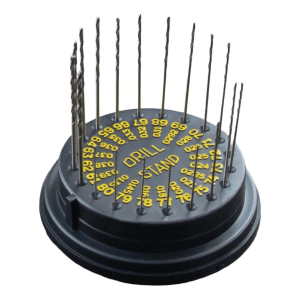
Yes, if you buy cheap drill bits, you are liable to get stuck with poor sizing. The best practice for buying small "number size" bits is to buy a Rogers drill bit index and bit set and a decent pin vise. (See picture and link below.) Be sure to buy a Rogers drill bit index and bits, which will cost you around $30.00. (MicroMark, linked below, IMHO is very overpriced, but they often have sales.) The Rogers sets seem harder to find. Do not buy what appears to be an identical set by "Gyros." The bits in the Gyros index set are apparently of a lower quality. The Gyros index and bits are apparently a Chinese knock-off. The Rogers sets, still made in the U.S., have been around forever. Once you have your index and bits, buy bits in tubes of ten of each size as you break them. You will break bits until you master using your pin vise(s) and learn to "choke up" on the bit shaft so as to present the shorted unsupported length of bit to the work as is possible. By buying ten of one size when you break one, you will quickly acquire a "stock" of only those bit sizes that you use (and break) a lot. There is an important difference in quality with drill bits, and you do get what you pay for. I have found supply houses like McMaster-Carr have good quality numbered bits available at relatively reasonable prices. Don't waste your money on the carbide bits made for use in CNC machines. Carbide is far too brittle for hand drilling. They break with frustrating frequency if used in a pin vise or in a rotary tool. Don't bother with them. Use high-speed steel numbered drill bits only.


1776905664280.png
 
Last edited:
For English ships, when securing deck planking in the 17th and 16th centuries, they used metal spikes, usually iron, but according to Peter Goodwin, once they were driven home they were covered with wooden plugs, not tar or other sealants. I would not be surprised if they were covered with other media on some ship but I have not found an information based on contemporary sources about anything other than wooden plugs. I do not like to use the words never, always, only, etc for ships in the age of sail due to the many exceptions/variations tried but you will not be wrong to use wooden treenails as the exposed part will look like a round 1.5" diameter (0.8mm for 1:48, 0.6mm for 1:64, or 0.4mm for 1:96)wooden cover over the would be spikes. Tar or similar would not look like any contemporary model of English warships in the 17th and 18th centuries that I have seen, but maybe some member has photos of an exception
Allan.

View attachment 593868
While Victory is a modern ship now with fiber glass cannon and such, if they were true to reconstruction, you can see the wooden plugs rather than tar or other sealants. Tar and feet would be a mess on hot days.

View attachment 593869
Hi Allan, thank you for reaching out and giving out more good information. What I was trying to say about the tar is that the tar was added to the hole before the nail, and then I forgot to add, as you informed us, a wooden cap was then added to seal the nail from exposure.
Can see the nails have been covered with a wooden plug in this photo. The same would have been done for the planking on the hull as well.
So, now, after reading what Allan has included, the nails really are a waste of time, though maybe the model nails could be used and set distances to secure the planking a little better to the framing of the ship. Don't know. Redface
Cheers for that Thumbs-Up
 
That you have taken the care to do some research in pursuit of ensuring historical accuracy in your model is most commendable. A sampling of the present crop of models betrays the sad fact that far too few exhibit the attention to detail which is the hallmark of quality scale ship models. All too often, today's "post-internet" modelers look no further than popular ship modeling forums and social media pages as research resources without recognizing that much, if not most, of what's posted "on the world's largest refrigerator door" isn't necessarily accurate.
Although widely embraced as an "essential detail," the out-of-scale depiction of deck planks, fastenings, and fasteners on scale ship models is one of the most common, and obvious, errors to be seen in ship models being built today. In part, this fad is perpetuated by ship model kit manufacturers whose instructions direct the unwitting consumer to include such "essential details." In other instances, models sporting grossly unrealistic black "freckles," completely misplaced relative to underlying framing timbers, over-scale stripes of seam compound depicting out-of-scale plank lengths and widths and incorrect butt spacing, and "real copper plates" peppered with a "pox" of over-scale "rivets" are routinely pictured online to invite the admiring "ooh's" and "aah's" of the blind teaching the blind in "monkey see, monkey do" fashion that this is the way it's supposed to be done.

Some modelers will for a variety of reasons profess not to care, others will obstinately maintain that "it's my model and I can build it as I like," and still others will challenge anyone's right to judge their work. The former two positions are entirely valid, as far as the modeler's prerogatives go. In those cases, the modeler's stipulation renders consideration of their model's quality irrelevant. The latter position, however, fails to recognize that every model "speaks for itself" when seen by others. Every model stands on its own merits. Its level of quality is demonstrated by the model itself separate and apart from anything else. When knowledgeable eyes view a model exhibiting historical inaccuracies and errors of scale, such faux pas detract from the quality of the models exhibiting them. Unfortunately for the fine art of scale ship modeling, it seems the established norms of academic constructive criticism have been stifled by the champions of mediocrity marching under the banner of social correctness. They would have the fine art of scale ship modeling reduced to the level of the Special Olympics where "just showing up" is sufficient to establish credibility because "everybody gets a prize for trying." None of the Old Guard who learned the craft in an age when the hallmark of high-quality scale ship modeling was the dedicated pursuit of perfection in scale and historical accuracy want to hurt the feelings of a novice bursting with pride over their first effort by calling it a dog's breakfast, but here we are. Without constructive criticism in the public fora, nothing is taught and nothing is learned, which is a pretty deadly situation for a fine art form dependent upon the pursuit of excellence.

Consequently, the novice, flushed with a counterfeit "Thrill of Victory" absent risking the "Agony of Defeat," (as ABC TV's Wild World of Sports' used to put it before there were "participation trophies") never improves their skills. They just keep buying one mediocre ship model kit after another selected from a limited fleet of uninteresting subjects that have by now been modeled poorly thousands of times.

So, without pointing fingers at any particular model, and God forbid for sure, any particular modeler, allow me to answer the question generally in the hope at least some of the "internet generation," will "get the memo" and thereby built scale ship models that speak better for themselves than most.


The generally accepted definition of a high-quality scale ship model:

"A high-quality scale ship model provides a compelling impression of an actual vessel within the constraints of historical accuracy."

"Historical accuracy" encompasses all the objective, or measurable, standards of technical exactness that might apply to a ship model. These embrace the obvious hull shape and fairness; precision in fittings, rigging, and colors; lack of anachronisms; and so forth. But it also encompasses all aspects of craftsmanship because the lack of craftsmanship creates unrealistic and, therefore, historically inaccurate blemishes on a model. ... The phrase "historically accurate" alone effectively replaces the intention of the now-vapid "museum quality."

"... (A "compelling impression") allows and encourages aesthetic interpretation of a vessel that will help propel the viewers to make the leap of faith that allows a model to work or to willingly suspend the disbelief that keeps a model from working. Both processes help viewers accept the invitation to visit a ship instead of a model. Compelling impression is the result of applying artistic and interpretive decision-making processes... to amplify a model beyond being a mere assemblage of parts.


Rob Napier, Caring for Ship Models - A Narrative of Thought and Application, (2022) Seawatch Books.

See: https://seawatchbooks.com/products/...tive-of-thought-and-application-by-rob-napier


Always envision your model in terms of "scale viewing distance." Creating a compelling scale ship model takes much more than simply reproducing the subject at a smaller scale. Scale is about viewing distance. As viewing distance increases, appearances change and as appearances change, our brains adjust to compensate for the changes in what are eyes are seeing. Based on our previous experience, our brains often know things "are there" even when our eyes can't see them, but our brains also know and strongly note when our eyes see things our brains know our eyes "shouldn't" be seeing. When you look at a scale model and see things you shouldn't be seeing at the scale viewing distance, it ruins the illusion that you are really looking at the real, full-scale subject from a given distance and emphasizes that you are, rather, looking at something else entirely, to wit: at best "just a model," and at worst, "a toy."

"Realistic" as used in ship modeling is a relative term. It only has meaning in the context of the applicable scale which determines the "scale viewing distance" of the model. There is a difference between what the brain may know is there and what the eyes actually see. In order to portray a scale miniature "realistically," which is to say to confirm what brain accepts of what the eye sees, the miniature must depict the color and detail the brain expects the eyes to see at the "scale viewing distance," rather than the actual viewing distance. Any difference between what the eye sees when examining a model and what the modeler expects the viewer to believe, i.e. the models "realism," defeats the "trick" the miniaturist must perform upon the viewer's brain and thus destroys the compelling effect of "realism" in miniature.

A correct appraisal of scale viewing distance must be taken into account if the model is to create the effect of realism required of a high-quality scale model. Scale viewing distance is simply "what does a thing look like when viewed from a given distance." If a miniature is to appear realistic, it must be made to appear as the full-size subject would appear if being viewed from its full-scale distance. At most all scales below 1:48, plank seams, wooden plugs and trunnels, copper sheathing "rivets" (they are tacks,) and the like, are invisible at customary scale viewing distances. Many modelers mistakenly show out-of-scale plank seams, plugs, trunnels, and other fasteners thinking they are "adding detail." Out-of-scale detail is a distraction that destroys the compelling impression of reality that defines a high-quality ship model.


Scale viewing distance is easy to calculate by calculating the distance from the model viewer's eyes multiplied by the denominator of the model's scale. For example, if the model will be viewed by three feet away and the model's scale is 1:48, the scale viewing distance is 144 feet (3 x 48 = 144). The detail on the model should be what one sees on the full-size ship when viewed from 148 feet away. If you're a modeler who expects your 1:48 model to be scrutinized from a foot away (which is probably closer than it should be properly viewed) then its scale viewing distance is 48 feet.

Scale viewing distance applies not only to details, but also to color and finish. As the viewing distance increases, glossy reflections decrease. Glossy finishes on models are out of scale. Also, colors tend to darken, or take on a greyish cast, as viewing distance increases. No competent landscape painter will ever paint the hills in the distance the same color green as the meadow in the foreground. Modelers need to learn and apply these principles to the finishes of their models to avoid their looking like "toys." Studying landscape painting manuals will be helpful to learn this.

Modelers who haven't acquired the ability to intuitively recognize the scale viewing distance of ship models from their own experience of full-size vessels, should experiment with other subjects. Create a full-size mock-up of the detail in question and view it from a measured distance. If you must, drive a nail into a board fence and walk 150 feew away from it. If you can see the nail, portray on your model exactly what you can see on your experimental subject, not what you know the nail looks like when viewed up close! If you can't see it at full-scale, don't model it at small-scale! Out of scale details just scream at the viewer, "It's a not a real ship!" which by any definition is the antithesis of what scale ship modeling is all about.


If you can't see it at scale viewing distance, it really matters that it's not on the model! It's always better to omit a detail than to include one that is over-scale. The object of modeling a detail that is not visible at scale is, if necessary, to very subtly "suggest" detail which invites the viewer's brain, rather than their eyes, to form an impression of the vision the artist intends to convey. Sometimes all it takes is a bit of color or shade mottling to do the trick. The mistake many kit modelers make is letting their brain get ahead of their eyes: "I know these things are separate plates covered with a bunch of nails so I've got to show them."

Another way to calculate scale viewing distance is to use the general rule of thumb formula that all items on the prototype twelve inches or larger for 1:96 scale, six inches or larger for 1:48 scale, and so on for any scale in the same proportion, should be reproduced on the model. If less than the minimum on the prototype, they generally should not be reproduced. This is the detail standard required for models built to U.S. Navy government contract standards. (See: https://www.navsea.navy.mil/Home/Wa...ications-for-Building-Exhibition-Ship-Models/) Keeping it in mind will keep all of your detail at a consistent level that will not distract the viewer. Inconsistencies in the level of detail portrayed tend to distract the viewer by saying, "There's too much" or "There's too little." and "It doesn't look real." It's easier for the eye to not notice a missing detail than to overlook one that's there and shouldn't be.


No shipwright ever stopped a deck fastener hole with tar or putty. That's just a fact. Deck fasteners are subject to tensile (withdrawal) force. They are countersunk and plugged as this provides the most secure watertight seal. A plug may be set in tar, but tar alone is not sufficient to provide the necessary water-proof seal. Note that deck seams are only paid with tar stopping, which serves to protect the fiber caulking material from the elements. It is the tightness of the driven caulking material that seals the swelled deck planks which seal the deck seams, just as with the hull planking.

Nail heads were never left exposed on decks. The depiction of a bunch of "black dots," pieces of black nylon fishing line, or even metal pins has no place on a quality ship model. No ship ever looked like that. With wooden countersink plugs or trunnels in place, at most any scale viewing distance it would be near impossible to visually discern the difference between the wood deck and the wood plug. The plugs are virtually invisible.

Note also that, particularly in small craft construction, countersunk metal hull plank fasteners, which are subject to shear force, may be plugged with putty. Where nails are used to secure hull planking, the practice was to wrap tarred oakum around the shank of the nail beneath the head before driving it. When the nail was driven, the underside of the nail head would compress the oakum and create a tight seal around the shank of the nail. The directional forces on a fastener determine the methods employed to ensure a watertight seal of the fastening.
There's no need for you to put nails in your deck planking at all. Assuming you are working in a scale smaller than 1:48, I can't imagine why you would have any occasion whatsoever to show "nails" in your deck.


Yes, if you buy cheap drill bits, you are liable to get stuck with poor sizing. The best practice for buying small "number size" bits is to buy a Rogers drill bit index and bit set and a decent pin vise. (See picture and link below.) Be sure to buy a Rogers drill bit index and bits, which will cost you around $30.00. (MicroMark, linked below, IMHO is very overpriced, but they often have sales.) The Rogers sets seem harder to find. Do not buy what appears to be an identical set by "Gyros." The bits in the Gyros index set are apparently of a lower quality. The Gyros index and bits are apparently a Chinese knock-off. The Rogers sets, still made in the U.S., have been around forever. Once you have your index and bits, buy bits in tubes of ten of each size as you break them. You will break bits until you master using your pin vise(s) and learn to "choke up" on the bit shaft so as to present the shorted unsupported length of bit to the work as is possible. By buying ten of one size when you break one, you will quickly acquire a "stock" of only those bit sizes that you use (and break) a lot. There is an important difference in quality with drill bits, and you do get what you pay for. I have found supply houses like McMaster-Carr have good quality numbered bits available at relatively reasonable prices. Don't waste your money on the carbide bits made for use in CNC machines. Carbide is far too brittle for hand drilling. They break with frustrating frequency if used in a pin vise or in a rotary tool. Don't bother with them. Use high-speed steel numbered drill bits only.


View attachment 593996
Thanks, Bob. You made some very good points in your post that make a hell of a lot of sense. I will value these comments from all of you. Thanks, and regards
 
maybe the model nails could be used and set distances to secure the planking a little better to the framing of the ship. Don't know. Redface

That depends upon the framing material and its grain orientation, if any. It appears many kit manufacturers are now using a lot of MDF, a "manufactured wood product," instead of natural "grown" wood, for laser-cut frames. MDF may crumble if a pin is driven into it, if the pin will stand being driven at all, or if a hole which is too tight is drilled for the pin. In similar fashion, the grain orientation of grown wood will determine the ease with which a pin can be driven. Either way, a hole is going to have to be drilled, in which case, a wooden peg (bamboo or wood, e.g. a round birch toothpick) is stronger than the pin and can be cut flush and sanded when fairing and preparing the hull for finishing without the hassle of counter-setting the pin ends and filing the countersunk holes beforehand. It's relatively impossible to sand a hull with a bunch of metal pin ends at the surface.

Properly spiled (shaped) and heat-bent planks should lay fair to their faying surfaces (i.e. frames, keel, stem, and deadwood) without any need to be forced into shape on the frames, such that adhesive alone is more than sufficient to secure them, clamping being required only to hold them into position until the adhesive sets. In such case, there's no need to pin them to the framing structure.
 
Somewhere I read that the wooden plugs that covered the ends of nails securing deck planking were set in white lead, not tar.

For those not familiar, white lead used to be the pigment for white paint. It could also be purchased in cans and had the consistency of putty.

Roger
 
Somewhere I read that the wooden plugs that covered the ends of nails securing deck planking were set in white lead, not tar.

For those not familiar, white lead used to be the pigment for white paint. It could also be purchased in cans and had the consistency of putty.

Roger

In the yard, if it were being done correctly, wooden plugs would only be set in thickened shellac or varnish. The "dregs"from varnish buckets would be saved and allowed to thicken for that purpose. The plugs would always be cut with matching sets of tapered screw hole drilling bits with adjustable countersinks and plug cutters made by Fuller Company. They're the only ones that work like they should, making straight sided, tight-fitting plugs. (There are brands that have tapered plugs, but these are only suitable for furniture trim, not real plugging on a wooden boat.) If a plug can't be driven deep and tight enough to stay put by friction alone, it's not likely to stay put for long whatever you try to glue it in their with. The reason shellac or varnish was used was to provide a water seal which permits the relatively easy removal of plugs in the event a fastening needed to be pulled without damaging the surrounding edges of the countersunk hole as was frequently required when working on trim and the like. Of course, this was "yacht work." For the rough and tumble workboats and larger vessels, I'm sure they'd just use whatever goop that would seal which had handy to dip the plugs into, including thickened old white lead paint.

We used a lot of white lead putty of which you speak for filling counter-sunk screw holes on workboats and small craft where the planks were too thin to permit a counterbore deep enough to hold a plug properly. I've seen it used to fill deep set deck planking nail holes on canvas-covered decks, too. Although while white lead glazier's putty used to be sold in hardware stores everywhere years ago, in the boatyard we'd use a product called white lead paste that came on special order from George Kirby Jr. paint company in New Bedford, Mass. This marine paint company, near the waterfront in New Bedford, has been continuously operated by the Kirby family since its founding in 1846. White lead paste looks a lot like runny yoghurt. It's a thick mixture of pure white lead pigment and raw linseed oil (without any driers.) This would then be thickened in the yard with "whiting," which was basically talcum chalk to the consistency desired. It could be used in "peanut butter consistency" as bedding compound or thickened to a putty consistency for stopping seams in laid and caulked decks that would be varnished, such as on fancy runabout foredecks and engine covers where white seams were desired. This was before the eco-regulators came to town. I doubt Kirby's could supply it anymore, although I know they've been able to come up with some amazingly authentic colors and coatings for restoration work all over the country. They used to be, and probably still are, Mystic Seaport's go-to coatings supplier.

If we wanted this white lead putty to remain somewhat flexible, such as when it was used as bedding compound or seam stopping, it was important to seal the wood faying surfaces well with shellac, varnish, or paint before applying the white lead bedding compound or putty to prevent the wood from leaching out the raw linseed oil from the putty. Otherwise, the putty would dry out, get hard, and crumble.

White lead putty was made by making a "volcano" shaped pile of whiting on a scrap of waste plywood or whatever and pouring some white lead paste into the "volcano's crater." You'd then take a wide putty knife and start slowly folding the "sides of the volcano" into the crater to mix the past and whiting until it was the desired consistency. Sometimes, if it was putty to be used below the waterline or as bedding compound, we'd mix in some of the "sludge" that settled to the bottom of the big "first rinse" drum that the bottom painting brushes were cleaned in. This sludge was a concentrate of solids from bottom paint. In those days, good bottom paint contained not only cuprous oxide by a wonderfully effective biocide called tributyl tin oxide or "TBTO." It marked the apex of anti-fouling technology. Unfortunately, the eco-regulators outlawed its use all over the world because... wait for it... it killed marine organisms.
:rolleyes:
 
Last edited:
Back
Top