- Joined
- Oct 13, 2021
- Messages
- 32
- Points
- 48

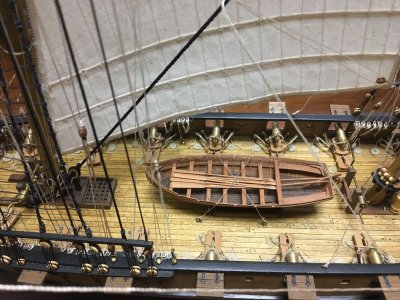
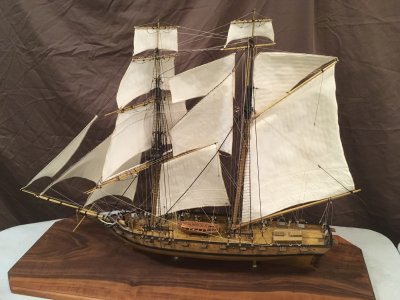
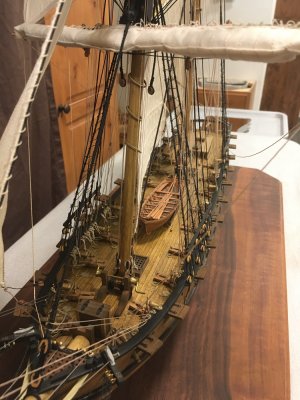
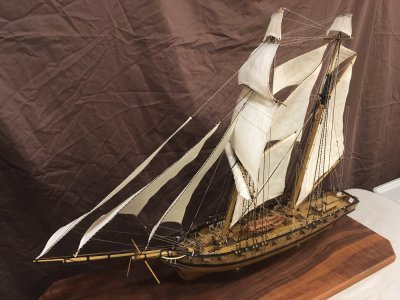
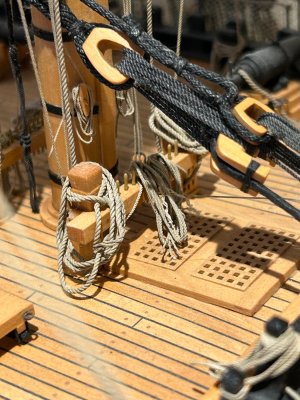
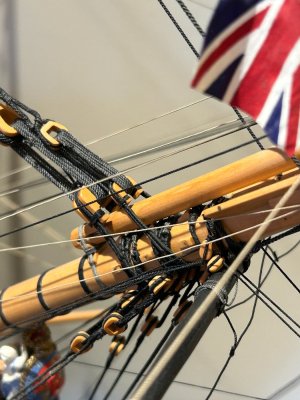
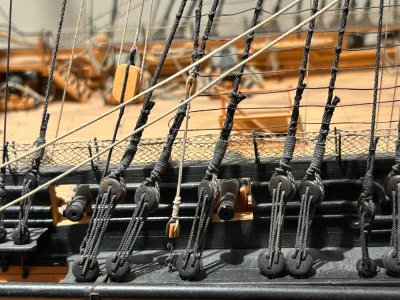
Here are some pictures of the Prince de Neufchatel, which I rigged with the nylon thread you are considering.

 |
The beloved Ships in Scale Magazine is back and charting a new course for 2026! Discover new skills, new techniques, and new inspirations in every issue. NOTE THAT OUR NEXT ISSUE WILL BE MARCH/APRIL 2026 |
|
 |
As a way to introduce our brass coins to the community, we will raffle off a free coin during the month of August. Follow link ABOVE for instructions for entering. |
|

Hi JohnI use the thread you posted and make my own left hand rigging thread with it. It works very well.
I use the rope walk machine from Model Shipways with great success to make left hand rope of any diameter I want.
I also use the Syren Serve-o-matic machine to serve lines and to tie lines onto blocks.
View attachment 596195
View attachment 596196
What can I tell you? If your experience was a mystery, mine was a mysterious disaster. With these types of machines, you often have to work on them for months maybe years just to figure out the proper exit point; the output mechanism involves three rotational maneuvers that you have to synchronize perfectly together. If even one of them is off, the rope simply won't feed out. Furthermore and this is the final issue when the machine finishes its cycle, it keeps rotating; this leaves the strands loose, causing the rope to lose at least 20-25 cm (or 10-15 inches) of tension at the end of the rope. Even if you secure the ends with CA glue, the twists still come undone. You also need to have plenty of time to tinker with all the various parameters that influence the quality of the rope and right now, time is exactly what I don't have. I'm still a long way from retirement; I only get to work on my model in the afternoons about two or three hours at a time and not every day at that.I guess mine was one of the mysteries of life! It did not work????????
I'm afraid my opninium of this vertical is the same as David Webber's of his. On my first attempt to load threads, they all twisted themselves together, I found it needed 3 hands for success! I gave up the vertical setup & made up a replica of my large ropewalk in my workshop. I used a length of 'plastic' sill, as used by conservative builders, mounted the Domanoff on it, & then made a tail stock. First off, the threads all twisted together then broke up - attempt 2; a cone was added, but still the threads would not form into a satisfactory looking rope, only in places, then they broke up as before. Verdict; In the trash! Utter waste of my time & effort. I stick to my trusted Mk (phase) 4 ropewalk!
Interesting. I own small cheap Domanoff rope maker machine for many years and can’t say nothing but that it’s very good. My machine winds rope in vertical position.
You shouldn't have bought a planetary hoist. You need to know how to use it. A vertical hoist is much easier to use. For spooling, use a Guttermann e121 or a Gutterman Tera, but the Tera is more difficult to work with.
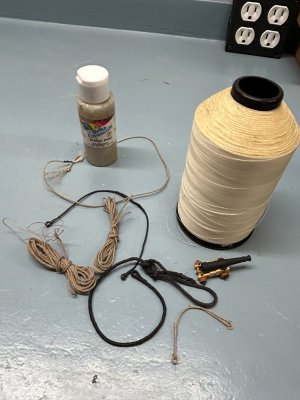
I haven’t had any problem with tension or stretching. For finishing the rope, I simply draw it through a diluted solution of acrylic paint.Hi David, that sounds good, but someone mentioned something about nylon, specifically that it can lose its tension due to heat or temperature fluctuations. And here in Florida, one thing we have plenty of is heat! Haha. What is your experience with this? Is that true? Another question: I know it looks very similar to the real thing, but how do you go about dulling the shine on the thread? Or do you just leave it with its factory finish? Thanks in advance for your prompt reply.
Cheers
Maybe I'm just lucky, but I haven't experienced any problems with the nylon changing tension. After I spin a new rope I give it a good tug to tighten the fibers. Perhaps that helps.Hi David, that sounds good, but someone mentioned something about nylon, specifically that it can lose its tension due to heat or temperature fluctuations. And here in Florida, one thing we have plenty of is heat! Haha. What is your experience with this? Is that true? Another question: I know it looks very similar to the real thing, but how do you go about dulling the shine on the thread? Or do you just leave it with its factory finish? Thanks in advance for your prompt reply.
Cheers
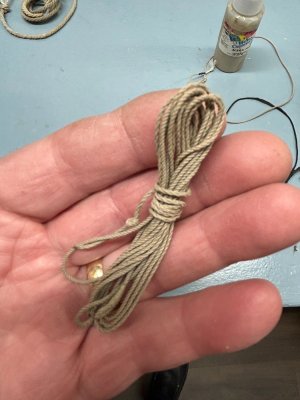
Let me know your honest opinion about that mi friend!! You can see part of what got ruined behind the machine, to the left! And that is just a small percentage of everything I had to throw in the trash. Furthermore, I'm talking about a wind machine not the vertical one. That is my opinion regarding the PL4-3 that I bought, on which I lost over $300.
View attachment 595986
View attachment 595987
View attachment 595988
View attachment 595993
View attachment 595994
 )
)
I didn't have the desire to make a rope-weaving machine myself, but making it myself is the best choice. My machine is completely printed on a 3D printer, including the gears. If I were to make it myself, I would prefer metal gears and bearings. Suitable gears and bearings can be easily found in online stores.Obviously, if I had known that machine wouldn't solve my problem, I wouldn't have bought it, or do we come out of the womb already knowing how to run? There is plenty of time in this life to learn. I learned that I made a mistake and perhaps should have considered the cheaper machine instead. I’m generally of the opinion that buying cheap ends up costing you more in the long run; that’s precisely why I decided to buy that specific machine rather than a different one. Besides, there isn't much variety available on the market, and I’ve already had a bad experience with Chinese-made products. Perhaps in your case, the cheap machine actually worked out for you! I congratulate you on that, and thank you for your comment and for the photos; I’m seriously going to consider building that vertical machine myself.


I’ve been looking at parts and have located everything; the only thing I’m not sure how to handle is the electrical connections. But you’re right—here in the USA, you can find all those parts cheaply on Alibaba, as well as on Amazon. In the end, I think I’m going to build the machine myself.I didn't have the desire to make a rope-weaving machine myself, but making it myself is the best choice. My machine is completely printed on a 3D printer, including the gears. If I were to make it myself, I would prefer metal gears and bearings. Suitable gears and bearings can be easily found in online stores.
View attachment 596231
View attachment 596232

looks amazing!! thank you for sharing your experience!!!!I haven’t had any problem with tension or stretching. For finishing the rope, I simply draw it through a diluted solution of acrylic paint.
Maybe I'm just lucky, but I haven't experienced any problems with the nylon changing tension. After I spin a new rope I give it a good tug to tighten the fibers. Perhaps that helps.
Once a rope is made, I color it with a watered down mix of acrylic paint of the colour I choose. You should be able to find this paint in most art or craft stores.
All the ropes shown here were made by spinning up multiples of 0.016" nylon thread.
View attachment 596222
View attachment 596223
View attachment 596224
View attachment 596225
View attachment 596226
I'll probably do the same—I'm already looking into the necessary supplies to make my own! because I ended up losing my money.I didn't like the Domanoff machine either, ended up making my own. I use Amann Serafil, beautiful polyester. Good luck.

Hi Bob.I feel your pain! As noted early on in this thread, operating a planetary rope making machine does have a learning curve. There's nothing wrong with the Domanoff PL4. It is the most capable rope making machine on the market, particularly with respect to its ability to lay up four-strand rope with the essential fifth central core strand and its small space requirements. That said, perhaps for reasons of international language differences or the manufacturer's over estimating their customers' sophistication with the mechanics of rope making, I have to say that their instructional materials are perhaps less than adequate for the unsophisticated operators of these machines. With knowledge of the mechanics of rope making, anybody should be able to recognize and diagnose the problems most initially experience with the planetary machines. (Don't ask me how I know this!
I won't attempt to write a compreshensive instruction manual here, but I will pass on some observations that I hope will be of assistance to you and others. Your experiences aren't unique, by any stretch of the imagination. (Been there. Done that. Got the tee shirt!) Some of my suggestions may be already well-known to you, but I'm stating them now because I have no idea of the extent of your experience at the moment.
Study the mechanics of how rope "works" and understand it before doing anything else.
Understand the importance of the direction of the lays in making up a rope. Understand "left hand" and "right hand" laid rope, also sometimes referred to as "S-laid" and "Z-laid" rope respectively. Understand how the tension created by the twist in the strands made in the rope making process works to form the rope and hold it together. Google is your friend. Read everything you can find online about rope making. There is a lot of material in this forum. Model Ship World also has extensive discussions of rope making, including a lot on the Domanoff machines, some of it directly posted by Alexi himself. (There is a section in their "rigging" sub-forum that covers it all. At the moment the MSW server is down, but expected to be up soon, or so they say.)
Pay particular attention to the brands and types of thread that others use with good results and don't deviate from those.
Some report good results with nylon thread. I have no direct experience with nylon thread, but I can say that, generally, synthetic thread does not take dye well, so a scale rope maker will be better off working with thread that is colored the color they want to use on their model in the first place. Natural fiber thread is easier to dye. Synthetic rope is made of various "plastics" and plastic, being non-absorbent, must be colored either in its initial manufacture or by coating it with some sort of color. Natural fibers are absorbent and take dye readily. All threads have their limitations for use in making scale rope. The major issues are stability and stretch due to environmental conditions such as heat and humidity, and other susceptibility to age-related deterioration. Some thread material will hold together and not unlay as readily as others because its fibers are less smooth and benefit from the increased friction as the twisted fibers bear on each other to hold the rope together. Other synthetic fibers are "smooth" and will "slip" and so not yield as acceptable a rope when twisted up.
Learn from others' mistakes! Use what works. The cost of thread should not be a consideration. When purchased in large spools rather than small amounts packaged on the usual small spools for home sewing machine use, the price-per-foot is much, much cheaper. Not all threads are the same. Not only are there many sizes and colors, but also different "finishes" resulting from the fiber material, the tightness of the thread twist (the thread's "hardness") and its reflective qualities (glossy or matte.) For all these reasons, I recommend you only use the Gutterman "Mara," "Scala," or "e121" 100% polyester threads so many have found excellent for scale rope making. Gutterman has a wide spectrum of available colors and you can similarly "go to school" on what others are using for various purposes. The Gutterman "Mara" line has been approved by some European museum curators and restorationists as suitably archival (100+ years "lifespan.") At one time, natural linen thread was the "industry standard," but this thread is no longer readily commercially available in sizes and finishes suitable for scale rope making, being replaced by synthetics and synthetic blends in the general thread making industry. Not all colors, types, and package amounts of scale rope making threat are available in fabric stores! Don't even bother looking for them there. The best place I know to obtain Gutterman thread for scale rope making in the colors ship modelers require in the large "industrial" quantity spools is WAWAK Sewing Supplies in New Jersey. (See: https://www.wawak.com/search-results/?Brand=Gutermann&q=Gutterman+Mara&r=true)
The direction of the thread's twist dictates the direction of the rope's twist.
If your thread is right-hand twist, the rope will be left-hand twist. If you then make rope with the resulting left-hand twist rope as its strands, the resulting rope will be right-hand twist. If you try to lay right-hand twist rope with right-hand twist thread strands, it's not going to work. Most thread is right-hand twist. Most rope on period sailing vessels was right-hand twist. This creates a problem for those who wish to have their scale rope twisting in the historically accurate direction. Most don't bother because it's so small a detail that it isn't a major flaw. However, if one wants absolutely accurate period scale rope, they will have to use left-hand strands to yield right-hand rope.
A novice rope maker is well-advised to master laying up rope of three single strands before progressing to multiple part strands.
Your first picture above appears to show six threads presumably twisted in three pairs. There's more than enough things to go wrong laying up single thread strands without doubling the risk! Planetary rope making machines don't handle multiple part strands very well at all in my experience. It's too difficult to get the tension equal in all the threads at the same time. (More about this later, but equal tension is critical to successful planetary rope making.) There are various ways to control the diameter of the rope to be made. Multiple thread strands is one way, but better suited to rope making machines which do not draw thread suppled from bobbins. Other ways to determine diameter are to vary the diameter of the threads that serve as the strands and to lay up thin rope and then use that rope as strands to make a thicker rope. Keep in mind as well that bobbin-fed planetary rope making machines have upper limits to the size of the strands that they can spin into rope. The PL-4 works fine for the scale rope normally required for commonly used scales, but when one reaches the upper limits of the machine, it will let the operator know! Also, the thicker the strands loaded on the bobbins, the shorter the maximum length of rope made becomes.
The thread strands must be wound on the bobbins with equal tension on each bobbin.
The resistance on the thread strands on the bobbins as the thread is pulled by the take-up spool must be equal on each bobbin.
The result you are getting in the rope in your second picture posted appear to be the result of uneven tension on both one of the threads in a strand wound on the bobbin and uneven tension on the strands coming off a bobbin.
To get a bobbin wound with even tension, it really must be wound on a bobbin winder. All sewing machines have bobbin winders on them. If you don't have a sewing machine, the easiest thing to do is buy a stand-alone bobbin winder. These start at around twenty-five dollars. Amazon has lots of different models. You don't need anything fancy. These all have an adjustable tension device which ensures constant tension to the thread as it is wound evenly on the bobbin and an automatic shut-off feature when the bobbin is full of thread. Wind your bobbins full to start so you don't have uneven waste when the shortest one runs out! Another advantage of these machines is that they load a bobbin in seconds.
The tension on the thread strands coming off the bobbins as the machine runs is also very important. This ensures an equal twist and lay-up to all the strands in the rope. On the PL-4, the bobbin tension is adjusted by the knob on each bobbin axle. There is a felt spacer on each bobbin axle and adjusting knob pushes the side of the bobbin against this felt pad to create friction which adjusts the tension of the thread as it is pulled from the bobbin by the tension of the rope pulled by the take-up spool on the machine. This adjustment must be made by "feel." pull a bit on each strand when setting up the machine to be sure the tension on each is equal before tying off to the take-up spool to make sure they are good to go.
Once the strands are set up through the machine to the take-up spool, you will need to test at slow speed to adjust the relative rates of the planetary wheel and the take-up spool. The take-up spool must turn at a slow enough rate to permit the bobbins on the planetary wheel to spin the strands sufficiently to create the tension which causes them to lay-up tightly enough against each other. The cuntline (the "seam" between the strands of the laid-up rope) should be at an angle of about forty-five degrees from the centerline of the rope and this is how you know your lay is tight enough, which is to say that your strands have been twisted tightly enough before the rope begins to form when it comes through the guide on its way to the take-up spool. The bobbins must spin quite fast to do this. The point at which the three strands "kink" to press against each other forming the rope can be adjusted by adjusting the speed of the planetary wheel and/or the speed of the take-up spool. Admittedly, this will take a bit of practice and experimentation. It's sort of like patting your head with one hand and your stomach with the other while walking and chewing gum, but a little bit of practice and you'll have it down without much trouble. The important thing is that the strands are twisted tightly enough to have the rope forming together at the point where it comes out of the planetary wheel guide on the machine. (Dominoff's instructional videos show this but unfortunately don't tell you what it is you are looking at!) Read Dominoff's posts on the MSW rope making section for more detailed information about adjusting the "rope forming point" and the adjustment of the rope making exit guide on the planetary wheel for more on this subject. The twist of the strands is key to successful rope making. Most all of the issues folks encounter result from a lack of equal and sufficient tension on the strands from unequal tension in winding the thread on the bobbins, unequal tension on the bobbins as the thread comes off the bobbin, and/or insufficient twist imparted to the strands.
Once you have the PL-4 properly adjusted to make good rope at slow speed, you can incrementally increase the speeds of the planetary wheel and the take-up spool, taking care to maintain the relative rates of speed of each. You will seen that adjusting the speed of the take-up spool with cause the point at which the strands "kink" into rope to move and that adjusting the speed of the planetary wheel will cause the tightness of the lay-up to vary.
Rope made with synthetic thread generally needs to be "heat cured" after lay-up to prevent unraveling.
Synthetic (plastic) thread tends to have a "memory" and want to unravel when rope made of it is cut. This unraveling can be eliminated by heating the line after lay-up. This "cooking" very slightly "softens" the "plastic" so it "forgets" its original form and when it cools is "set" such that it stays put and doesn't unravel. You will find the exact recipe for this cooking in the MSW rope making posts. The rope should be secured from unlaying by tying a seizing of thread around one end before taking it off the planetary wheel and then carefully unwinding it from the take-up wheel and seizing it at the other end so it can be handled before being "cooked" without risking unravelling. I don't at the moment remember the temperature and time in the over for this sufficiently to feel secure in stating it with absolute certainty at the moment, but it's something like 120 degrees Fahrenheit for five minutes or something like that. Oven temperatures can vary, so one has to be careful. It's in the nature of the material that if the critical temperature or time is exceeded, you'll end up with a puddle of melted polyester which is not good. Some recommend applying heat with a hair dryer instead of baking in the oven. I haven't tried that, but plan to do so in the future. When treating the rope, it should be wound around some sort of mandrel so that it does not stick to itself or end up with kinks "cooked" into it. I've wrapped it around an empty can to good effect. The advantage promised by the hair dryer alternative is not having to deal with the oven and the can and the ability to better monitor the effect of the heat applied as you go. Heat treated scale rope should not unravel at all thereafter, although some slight tendency to unravel due to rough handling in use may remain, so a drop of shellac or other cement is probably advisable when rigging with it, although some report no need to do that at all.
Keep records of your rope making successes.
When you've set up the PL-4 to make acceptable rope of any given size, write down the type and size of the thread and the type and size of the rope [e.g. "1:48 scale 1" diameter, right hand lay, Gutterman Mara (size and color)] plus the settings of the control dials on the PL-4 on an index card and tape a short length of the rope made to the index card. Keep the index card and the rope made loosely coiled in a Ziploc plastic bag. If you need to make more in the future, you won't have to do as much for the set up over again.
I hope this will be helpful to you or anybody else. This is stuff I learned the hard way. Rope making is a somewhat arcane art. Now you know some of its "secret handshakes." Try to set your frustration aside and give the PL-4 another chance. It's a complex tool, but not at all an inherently bad one.

Hi Bob.
Honestly, this is the best explanation I’ve found on the web out of all the research I’ve done. Obviously, while running tests, I took many of the points you mentioned into account; but, my friend, the frustration truly got the better of me. It is simply impossible to wind the thread onto the bobbins with perfectly uniform tension.
I know that sewing machines have a built-in bobbin-winding system, and I also know that there are simpler machines designed solely for winding bobbins, that much is clear. The problem is that you spend all that money with the intention of making ropes, only to discover that you have to buy additional auxiliary machines. Some of the videos about all those PLs from Domanov on YouTube are over seven years old, and some of the machines shown don't even look anything like the ones available today, not to mention that none of the videos have any audio! Whether you’re Russian, Ukrainian, Polish, Czech, German, or American, no matter what language you speak or use to explain the operation, it’s always possible to add subtitles to the videos so that viewers can at least get a basic understanding of how the machine works and what factors need to be considered to ensure it runs properly. Furthermore, I tried to contact Aleksei Domanov directly, and I must say that his attitude left a great deal to be desired. I clearly gathered that his intention is to sell a lot and offer very little assistance, judging by the way he responds to messages. I wrote to him in Polish, and he replied, "Sorry, I don't speak Polish." I then wrote to him in English, and in a very high-handed manner he proceeded to correct me, insisting that his machines are not "braiding machines." Sorry, but perhaps I was mistaken, as in another language I speak, that is a valid term for them. In any case, I was not at all pleased with the way he treated me as a customer. Furthermore, as you rightly explain, there are 3-4 factors whose simultaneous operation you must coordinate, just to produce something that even vaguely resembles a rope, or else you simply have to tinker with the machine for two, three, or five years before you finally manage to produce a decent rope. I truly appreciate the amount of time you invested in writing this up and providing such a thorough explanation. However, for my part, I want nothing more to do with "planetary rope-making machines." I’m going to try my luck with a vertical machine instead; unfortunately, I don’t have the necessary space or facilities to accommodate a horizontal one. After reading the comments and advice from other forum members, I think I’m going to try building one myself that way, if something goes wrong, I’ll have no one to blame but myself! Hahaha. Once again, thank you for your extensive explanation; I truly appreciate it. I always learn something new from comments like this, but I believe I’ve finally made my decision.
By the way!!!! how you know all this!
Thank you again my friend!! Cheers



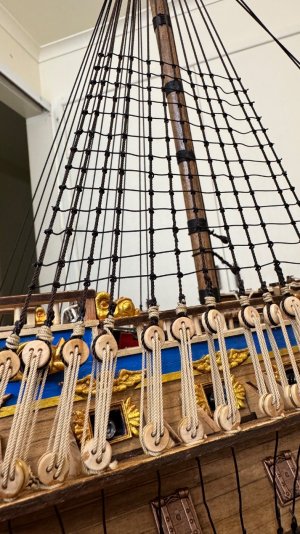
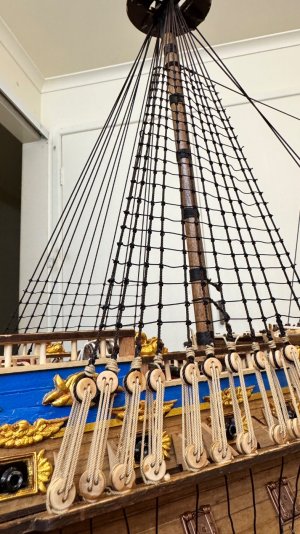
My dear friend Philip!!!As you know I also own a PL-4 and I don’t like it.
Mine sits on a shelf never to be touched again. I will be selling mine soon.
I’m using a more traditional rope walk machine. And getting excellent results of it and it’s easier to use. Heaps easier and critical the rope walk rope making machine. Including the vertical one you mentioned can wind in more than 1 yarn into a thread which the PL-4 lacks the ability to do as a conventional rope walk machine does.
After all the traditional rope walker has been used to make ropes for some 400 years from what I can find in my research. There is a reason for that. And if you ever get the chance to try one you will see for yourself why.
View attachment 596646
View attachment 596647
View attachment 596649
By the way, why do you go down to the base of the dead eye to finish tying off the rope? Does that particular model have a different system? Or is that your own idea? Thanks in advance for the clarification!! Cheers.As you know I also own a PL-4 and I don’t like it.
Mine sits on a shelf never to be touched again. I will be selling mine soon.
I’m using a more traditional rope walk machine. And getting excellent results of it and it’s easier to use. Heaps easier and critical the rope walk rope making machine. Including the vertical one you mentioned can wind in more than 1 yarn into a thread which the PL-4 lacks the ability to do as a conventional rope walk machine does.
After all the traditional rope walker has been used to make ropes for some 400 years from what I can find in my research. There is a reason for that. And if you ever get the chance to try one you will see for yourself why.
View attachment 596646
View attachment 596647
View attachment 596649
That’s where I start.By the way, why do you go down to the base of the dead eye to finish tying off the rope? Does that particular model have a different system? Or is that your own idea? Thanks in advance for the clarification!! Cheers.


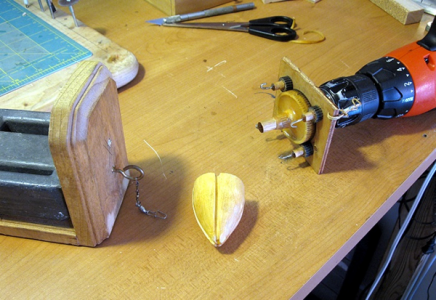
Hi Thegatzby,When I built my first wood kit ( Mamoli Rattlesnake ) in1994 I had visions of producing something like those amazing contemporary models in the Rogers’s collection. With no internet to speak of, I relied on books and Ships in Scale magazine.
It quickly became clear that the ‘thread’ provided in the kit would not satisfy my vision. I found out what I could about rope making, and the adventure began.
View attachment 598667
These were the parts of my first rope maker .
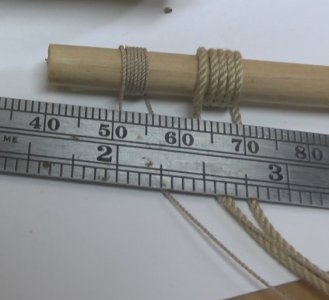
View attachment 598668
Here are some typical results.
Here is a video I made of my current machine. I try to explain how the parts work and how the rope comes together.
I have been making this with the idea of putting together a little machine that I can sell for a reasonable price, but I welcome anyone to duplicate or improve on my design, and have a simple set up that makes rope comparable to anything available in the market.
The benefits of having your own machine include an infinite choice of color, size and no worries about running out of something you bought, and now have to worry about getting a color and size match, or waiting for a particular size to be back in stock.